
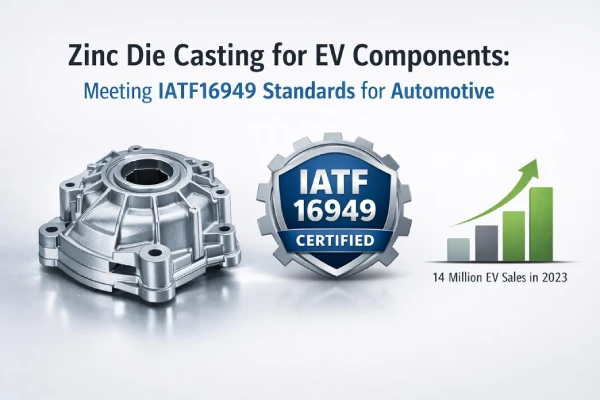
Zinc die casting has gradually become a preferred process for manufacturing electric vehicle components. The motor housings and electronic enclosures produced through this process are subject to extremely strict dimensional tolerances, with absolutely no tolerance for even the slightest deviation. In the automotive industry, the real challenge lies not in the ability to perform the casting itself, but in the ability to deliver zinc die-cast parts at scale while maintaining traceable and verifiable quality.
As global EV sales topped 14 million units in 2023, according to the International Energy Agency, automakers aren’t just shopping for parts—they’re hunting for precision, repeatability, and IATF16949 discipline baked into every mold cycle.
This article focuses on the field of zinc die casting for electric vehicles, providing an in-depth analysis of IATF 16949 compliance standards, core production factors, and tolerance control solutions. It comprehensively covers the key aspects of the entire zinc die casting process, from quality management systems and material certification to mold manufacturing and mass production. Drawing on practical examples of core components such as motor housings, it offers the industry professional solutions that balance compliance, precision, and stability, helping companies meet the stringent demands of the automotive industry.
IATF 16949 Compliance Requirements for Zinc Die Casting
In the field of zinc die casting for electric vehicles and automotive platforms, compliance with the IATF 16949 standard meets automotive buyers’ demands for strict quality control, standardized documentation, and seamless operations. This standard regulates the entire workflow of zinc die casting services, covering every stage from the injection of molten zinc to the final inspection report.
Quality management system essentials for zinc die casting
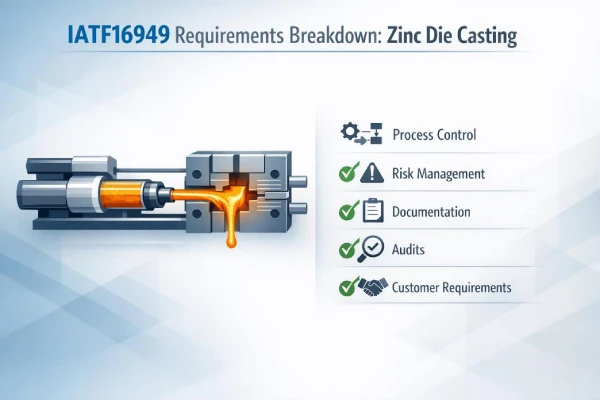
In zinc die casting production, an effective quality management system compliant with the IATF 16949 standard ensures stable and predictable production. The core system includes:
- Process control that tracks mold temperature, verifies injection speed, and monitors cavity pressure.
- Dynamic updates to risk and mold wear reviews based on PFMEA.
- Version control of control plans and work instructions.
- Conducting internal system and tiered audits.
- Meeting customer requirements for special feature marking and PPAP submission.
For high-volume zinc die casting, stability trumps guesswork. Supro MFG integrates mold design, mold manufacturing, and casting process validation into a controlled workflow, ensuring that zinc die cast parts remain within theoretical tolerances with every pour.
Traceability and inspection protocols for EV components
Strict Traceability Management for Electric Vehicle Motor Housings:
- Batch codes on the die-casting machines are linked to barcodes for the zinc alloy batches.
- Zinc die castings undergo rigorous dimensional inspections during the process and are verified using a CMM at the end of the production line.
- Control measures for identifying zinc die-cast parts include laser marking and mold cavity number traceability.
Under strict statistical process control, zinc die-casting trends are reviewed daily. Any non-conformities trigger control measures, including root cause analysis, and customers are notified when necessary.
“Automotive electrification is intensifying supplier quality expectations, with traceability now considered a baseline requirement,” notes a 2025 McKinsey automotive supply chain update.
When it comes to zinc die casting for electric vehicle components, data recording is far more than just a formality. It ensures the smooth progress of projects. As a professional zinc die casting manufacturer, every zinc casting produced by Supro MFG for electric vehicle platforms is traceable back to its melting data and inspection records.
Material certification and testing procedures in zinc alloy castings
Material control for zinc die casting begins at the source: we select only approved zinc alloy suppliers and conduct annual re-evaluations. Upon receipt of materials, we require certification reviews and verify the chemical composition of the zinc die casting material using a spectrometer. Tensile tests and hardness tests are conducted to confirm mechanical properties. All test results are verified by an external accredited laboratory.
Every batch of zinc alloy used for zinc die casting is cross-checked against the specifications in the drawings. If there is any deviation in chemical composition, production is halted immediately. The rule is simple: zinc castings made from unverified alloy data are nothing short of a hidden risk.
Continuous improvement and defect analysis under IATF16949
Material certification and inspection procedures for zinc die casting must be integrated into daily quality improvement efforts. Map porosity distribution and analyze the root causes of flash, conducting structured root cause analysis using 5-Why sessions and fishbone diagrams. Implement corrective and preventive actions for zinc die casting projects and track customer feedback through performance dashboards.
On a zinc die casting production line, even the slightest deviation can quickly lead to scrap. For this reason, SPC early warning systems, mold maintenance, and process adjustments are constantly in place. Continuous improvement is an integral part of how Supro MFG manages its zinc die casting projects—ensuring tight tolerances, reduced defects, and stable output.
3 Key Factors In Zinc Die Casting
Zinc die casting sounds simple—melt, pour, cool, and you’re done. In reality, every detail of the zinc material, the mold, and the casting affects cost, assembly precision, and durability. From alloy selection to mold manufacturing and mass production, scientific and systematic control ensures that zinc die-cast parts are highly precise, have a smooth surface finish, and meet mass production requirements.
Material selection: zinc alloy grades and tolerances
In zinc die casting, the choice of alloy directly determines strength, wear resistance, and dimensional accuracy. Selecting the wrong zinc alloy can quickly compromise strict dimensional tolerances.
To ensure the performance of zinc die-cast products, material selection must be precise:
1) Automotive brackets use ZA-8 alloy to meet high tensile strength requirements.
2) Zamak 3 alloy is used for electric vehicle components to ensure ductility.
3) Outdoor enclosures require a stable grade of zinc die casting material.
4) Salt spray test specifications are typically related to IATF 16949 certification requirements.
Ensure that tolerances in zinc die casting match the CAD model. Rigorously review 2D drawings, account for die casting shrinkage, and confirm target tolerances of ±0.02–0.05 mm before finalizing the mold. Supro MFG’s engineers match alloy data with actual zinc die casting flow behavior—rather than relying solely on catalog numbers—to maintain consistent quality across batches of zinc die castings.
The following table lists the performance characteristics and application parameters of zinc die casting alloys:
Alloy Grade | Tensile Strength (MPa) | Typical Tolerance (mm) | Common Use |
Zamak 3 | 280–300 | ±0.05 | Interior automotive parts |
ZA-8 | 370–400 | ±0.03 | Structural EV components |
Zamak 5 | 310–330 | ±0.04 | Hardware, enclosures |
Mold fabrication and tooling design for precision
In the manufacture of precision molds for zinc die casting, the use of short runners in the gating system reduces turbulence, and balanced runners facilitate precision casting of complex geometries. A uniform cooling layout minimizes warpage and controls shrinkage in thin-walled zinc alloy automotive components.
To enhance the durability of zinc die casting molds, hardened inserts are used in high-wear areas, and replaceable cores are employed for threaded features.
In zinc die casting, the quality of the mold steel directly affects surface finish and flash control. Supro MFG treats molds as long-term assets; the molds we manufacture can withstand high cycle counts while maintaining dimensional stability.
High-volume production with secondary machining capabilities
The key to expanding zinc die casting operations lies in control, not speed:
1) Integrate automated die casting cells with in-line trimming, and use SPC to drive quality control.
2) Employ CNC drilling in secondary processing to achieve precision threading. Tapping, reaming, and surface finishing ensure that electric vehicle components are ready for direct assembly.
3) Perform coordinate measurement on critical holes and inspect surface roughness prior to shipment.
High-volume production achieves optimal results when die casting and machining are closely integrated. It is the seamless combination of zinc die casting, precision CNC machining, and intelligent inspection that produces reliable zinc alloy die-cast components.
Supro MFG’s zinc die casting services go beyond mere metal forming; we are committed to the large-scale, trouble-free delivery of high-quality automotive components that are clean and ready for direct assembly.
Looking for a reliable China metal foundry?
- We can help you optimize product design and save costs.
- We can help you with high quality high volume cast parts.
- We can deliver on time and get more sales market opportunities.
- You will benefit from Supro MFG metal casting service.
Solving Tolerance Instability via Zinc Die Casting Process Management
Tolerances must be strictly controlled during the zinc die casting process. Even the slightest deviation in the variables related to zinc material, molds, and casting processes can cause parts to quickly fall outside the specified tolerances. The following section explains how to ensure that every zinc alloy die-cast part meets specifications precisely through smarter monitoring, machining, and data integration.
Real-time process monitoring in die casting
In modern zinc die casting, stable production output depends on strict control of the die casting process and its key process parameters.
A three-tier core monitoring framework is deployed in the zinc die casting production process:
- Sensor technology is used to monitor cavity temperature, injection pressure, and injection speed. A real-time data acquisition system captures fluctuations in each cycle.
- A statistical process control dashboard provides early warnings of deviations before scrap accumulates, and an automatic alarm system triggers adjustments to plunger speed or cooling time.
- Integrated quality control logic correlates parameter changes with dimensional trends.
Supro MFG applies this structured approach throughout the production of zinc die-cast parts, ensuring consistency in every zinc die-casting run, even during high-volume production.
The following are the benchmarks for parameter stability in zinc alloy die casting:
Parameter | Target Range | Alert Threshold | Impact on Casting Quality |
Melt Temperature (°C) | 410–430 | ±5°C | Porosity, shrinkage |
Injection Pressure (MPa) | 35–55 | ±3 MPa | Fill completeness |
Cycle Time (sec) | 18–25 | ±2 sec | Dimensional variation |
Die Temperature (°C) | 150–200 | ±8°C | Surface finish stability |
Secondary machining: achieving exact tolerances
Even a well-controlled zinc die casting production line may require precision finishing. In such cases, secondary machining can enhance the precision of all components. CNC milling improves the dimensional accuracy of sealing surfaces, while reaming and tapping optimize thread features. In-process inspection verifies tolerance control before the batch is completed. Toolpath adjustments prevent excessive cutting and improve surface finish.
The precision machining process consists of casting inspection, fixture alignment, controlled cutting, and final verification.
This balance between casting and precision machining ensures that zinc die castings used in telecommunications enclosures or automotive brackets meet strict specifications without incurring additional costs. Supro MFG coordinates the die casting and machining processes to achieve both precision and production efficiency.
CAD models integration with quality control systems
The integration of CAD models with the quality control system enables closed-loop quality management for zinc die casting. We embed geometric dimensions and tolerance data into the CAD models to create a digital master. The CMM system performs automated inspection procedures. The inspection results are synchronized with the quality control system, creating a traceable record of the zinc die casting process.
The data integration workflow for zinc die casting includes: uploading models to inspection software, aligning them with the part coordinate system, automatically comparing them against nominal geometry, and generating deviation maps and corrective feedback.
The digital twin links real-time casting data with inspection metrics, using trend analysis to guide mold maintenance and parameter adjustments.
By integrating CAD, inspection, and casting data, Supro MFG ensures that every zinc die casting project is quantifiable, repeatable, and under control.
EV Motor Housing: Precision Zinc Castings
Electric vehicle platforms impose stringent tolerance requirements, flawless surface standards, and exceptionally high durability specifications on components—and this is precisely where zinc die casting excels. From CAD-driven geometric design to global shipping, every step is critical to producing high-quality zinc die castings. This article will provide a detailed analysis of how raw zinc alloy is transformed into high-performance electric motor housings through intelligent design, stable die-casting processes, and rigorous logistics management.
Technical drawings and CAD specifications for motor housings
Accurate CAD models are at the heart of every zinc die-cast motor housing project. Using detailed technical drawings and certified 3D data, the design team finalizes the geometry of the zinc die-cast parts before mold manufacturing begins.
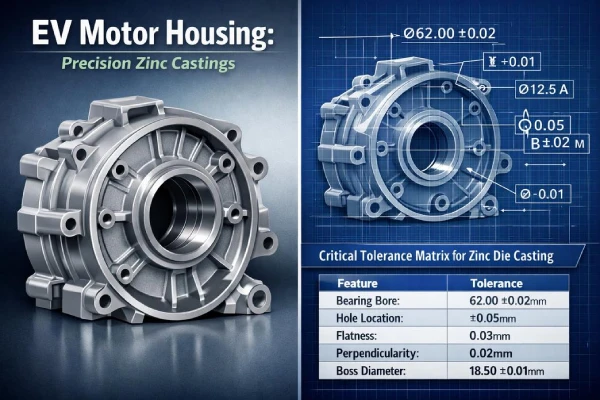
The digital design and control phase of zinc die casting involves using Geometric Dimensioning and Tolerancing (GD&T) to precisely define the flatness, concentricity, and runout of the bearing bore. The zinc die casting material grade is verified to ensure thermal stability. Wall thickness is specified to reduce the risk of porosity.
During the release phase of zinc die casting production, we perform final 3D verification and review the mold flow analysis, and hand over all data to the die casting team. Supro MFG engineers cross-check every zinc die casting file before tool steel is cut. Only with precise data and strict control over zinc castings can we ensure that the die casting process parameters align with the design intent.
The following is the critical tolerance matrix for zinc die casting:
Feature | Nominal (mm) | Tolerance (±mm) | Surface Finish (Ra μm) | Inspection Method |
Bearing Bore | 62.00 | 0.02 | 0.8 | CMM |
Mounting Face Flatness | — | 0.03 | 1.6 | Surface Plate |
Stator Pocket Diameter | 145.00 | 0.05 | 3.2 | CMM |
Seal Groove Width | 4.00 | 0.01 | 0.8 | Optical Gauge |
Mold fabrication and high-volume zinc alloy casting
High-volume zinc die casting production relies on intelligent mold design and precision tooling. Die casting molds must be able to withstand thermal cycling without experiencing dimensional drift.
Key considerations include:
- Ensuring a balanced internal runner layout in the zinc die casting mold.
- Stable control of the injection process during casting.
- Selecting the appropriate alloy to ensure consistent flow of the zinc alloy.
- Minimizing deformation of the cooling channels.
- Optimizing venting design to limit gas entrapment.
- Strategically positioning ejector pins to protect the surface finish.
“The global automotive die casting market continues to grow, driven by EV demand and lightweight material strategies,” notes the 2025 outlook from the International Energy Agency (IEA) transport report, highlighting steady expansion in light metal casting for e-mobility platforms.
Mass production of zinc die-cast parts is not just about speed; it’s also about rhythm. When the cycle time for zinc die casting remains consistent, dimensional accuracy becomes predictable. This is the solution Supro MFG offers to help OEM projects achieve annual production volumes in the six-figure range.
Surface finish requirements and secondary machining steps
Surface integrity determines sealing performance and bearing life. For zinc die-cast motor housings, surface treatment is not merely decorative but serves a functional purpose. Achieving excellent surface finish requires a coordinated multi-step process:
- During the casting control phase, injection parameters are adjusted, and mold cavity polishing is performed to achieve a smoother surface finish.
- The secondary machining stage includes CNC machining of bearing seats, drilling and tapping, and post-processing inspection using a CMM.
- During the surface treatment stage, chemical surface treatments are applied to enhance the corrosion resistance of zinc die-cast parts, and deburring is performed to protect the seals.
Die-cast zinc parts are typically transferred directly from the casting process to the machining station. The castings are well-suited for machining, ensuring tight cycle times. This balance allows zinc die casting to remain competitive with aluminum die casting in the field of small- and medium-sized motor frames.
Packaging requirements and global distribution logistics
Once zinc die castings pass inspection, packaging and logistics become critical to maintaining quality. We use custom foam trays and VCI anti-corrosion bags to prevent motor housings from shifting and rusting during transport. Our warehouse operates on a first-in, first-out (FIFO) basis and maintains batch traceability. Bulk shipments of zinc die cast parts are sent by sea, while urgent orders are shipped by air.
The supply chain process for zinc die casting is just as critical as mold design. Global distribution plans must align with OEM production windows, and a professional logistics team can manage delivery schedules down to the week.
Supro MFG’s zinc die casting projects go far beyond the die casting machines themselves. Inventory buffers, export documentation, and regional hubs ensure the smooth operation of electric vehicle assembly lines. Zinc die casting is not just about molten metal; it’s about timing, attention to detail, and being fully prepared for every shipment.
Contact Supro-Mfg
With its three core strengths—an IATF 16949-compliant management system, precise material selection, and sophisticated mold design and mass production control—zinc die casting perfectly meets the stringent requirements of the electric vehicle industry. As a professional zinc die casting manufacturer, Supro MFG provides reliable zinc die casting solutions for the automotive industry through end-to-end management and continuous improvement.
 English
 Français
 Deutsch
 Italiano
 日本語
日本語 한국어
한국어 Polski
 Português de Angola
 Русский
 Español de Argentina