

Aluminum castings have a dense and robust structure, yet they are highly prone to leakage and failure during pressure testing due to internal micro-bubbles and hidden shrinkage cavities. In mass production, such defects directly drive up scrap rates and production costs, resulting in significant losses. Vacuum impregnation technology can precisely penetrate hidden micro-pores in aluminum castings and seal them effectively. This transforms high-risk components into high-quality products with exceptional pressure resistance, reliably ensuring the sealing performance and operational stability of aluminum castings.
Grand View Research reports the global aluminum casting market surpassed \$80 billion in 2023, driven by automotive and aerospace demand—industries where “close enough” doesn’t cut it.
This article provides a detailed analysis of the causes of porosity in aluminum castings, offers a comprehensive overview of the vacuum impregnation process, and highlights the advantages of this technology in enhancing sealing performance, stabilizing mechanical testing results, reducing scrap rates, and meeting industry certification requirements, thereby providing a reliable solution for the production of high-quality aluminum die cast parts.
How do bubbles form in aluminum castings?
When aluminum castings fail X-ray inspection, gas porosity is often the culprit. Whether in small aluminum casting parts or large structural castings, trapped gases can compromise both strength and surface finish. Specific causes include pouring techniques, variations in hydrogen solubility, errors in pattern making and core production, and insufficient feeding in gravity casting. These defects reduce the density and strength of aluminum casting parts; they are often hidden and can easily lead to testing failures.
Gas Entrapment in Sand Casting of A356 Aluminum Alloy
In the sand casting of A356 aluminum alloy, the formation of porosity is typically related to pouring behavior and mold setup. When a damp sand mold comes into contact with high-temperature molten metal, hydrogen gas produced by the decomposition of water vapor is easily dissolved into the melt. If the pouring system is improperly designed, eddy currents may form, causing air to be entrained in the molten metal and further exacerbating pinhole defects. In addition, poor permeability of the sand mold also increases the risk of porosity.
The resulting defects in aluminum castings appear as circular porosity on X-ray scans and as visible pinholes on the surface of the castings. Supro MFG reviews the gating ratios and venting paths prior to production to reduce scrap rates in high-volume aluminum casting production.
Hydrogen Solubility Issues in Alloy 356-T6
In the 356-T6 heat treatment process, the root cause of porosity lies in chemical properties, not merely in gas flow. Hydrogen has a high solubility in molten aluminum alloys, and its sharp decline during solidification is the primary cause of secondary porosity in aluminum castings. If effective degassing is not achieved through rotary degassing during the melting stage, supersaturated hydrogen will precipitate, thereby compromising the density and strength of aluminum casting parts.
The following are key data points for molten aluminum castings:
Temperature (°C) | Hydrogen Solubility (ml/100g) | Porosity Risk Level |
700 | 0.65 | Low |
720 | 0.75 | Moderate |
740 | 0.85 | High |
760 | 0.95 | Very High |
780 | 1.05 | Severe |
Mold Flow Simulation Flaws and Core Making Errors
When Moldflow simulations are skipped, aluminum castings are highly susceptible to porosity due to inaccuracies in turbulence modeling and misjudgments regarding vent blockages. More seriously, if excessive binder is used or curing is insufficient during the core-making process, gas can become trapped within the core, directly leading to uneven density in the aluminum casting parts. Such defects are particularly difficult to detect after T6 heat treatment.
This is precisely where Supro MFG stands out. For molds used in aluminum casting and custom die-casting projects, we conduct enhanced DFM inspections prior to release.
Shrinkage Porosity during Gravity Casting of Lightweight Alloys
In gravity casting of lightweight alloys, shrinkage defects in aluminum castings are a filling issue related to solidification behavior. When the riser is designed too small or positioned improperly, the molten metal cannot compensate for the volume reduction during solidification, resulting in the formation of irregular voids within the aluminum castings. This directly leads to reduced tensile strength and failure in pressure testing.
For aluminum castings used in automotive brackets or housings, precise riser sizing and thermal analysis ensure the integrity of the final metal casting. This is key to ensuring that reliable aluminum components maintain their strength under actual loads.
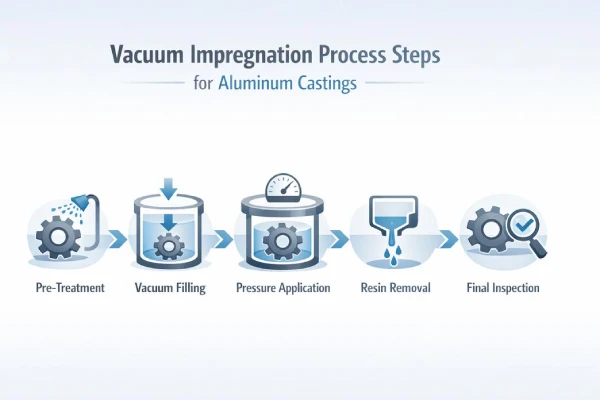
Steps in the vacuum impregnation process for aluminum castings
Although high-performance aluminum castings are strong and durable, tiny pores can still lead to leaks and pressure loss. This is where vacuum impregnation technology comes into play. For aluminum parts, cast aluminum housings, and other aluminum components, sealing these micro-pores ensures that aluminum casting parts remain reliable in actual use.
Pre-Treatment: Deburring, Cleaning & Ultrasonic Testing
Prior to sealing aluminum castings, the preliminary preparation work includes:
Removing burrs, such as sharp edges and loose particles, from the aluminum casting parts.
Cleaning off oil stains and machining residues.
Conducting ultrasonic testing to inspect for internal defects.
At this stage, it is essential to implement defect control for aluminum castings, conduct external surface inspections and internal defect detection, and complete cleanliness verification to ensure that aluminum parts are free of residues, and that the cavities are dry and contamination-free. If the pretreatment process is rushed, the impregnating agent will fail to adhere. The higher the cleanliness of the metal surface, the better the sealing performance of the aluminum die cast parts.
Vacuum Filling with Low-Viscosity Epoxy Resin
By evacuating the air from the interior of porous aluminum castings in a sealed vacuum chamber and using low-viscosity epoxy resin, the resin is injected under negative pressure and deeply impregnated to ensure smooth penetration into the micro-pores, completely filling the voids. This achieves reliable sealing of the castings, effectively resolving issues such as bubbles and leaks in aluminum die cast parts, and improving density and yield rates.
The vacuum impregnation process is most beneficial for aluminum components with interconnected pores. The resin displaces trapped air and blocks leakage pathways without altering the base metal.
Pressure Application and Polymer Curing
Once the filling process is complete, the critical stage of pressure curing begins. Utilizing industrial autoclaves and pressure vessels, the aluminum castings undergo pressurization under precisely controlled conditions, forcing the resin deeper into the micro-pores. This is followed by a controlled polymerization process and the stabilization of the resin curing. Thermal equilibrium technology ensures no deformation occurs during heat treatment, and dimensional stability is strictly maintained. This permanently cures the properties of the aluminum casting parts designed for hydraulic systems, thereby establishing a robust sealing barrier.
Excess Resin Removal and Surface Finishing
After curing is complete, excess resin must be thoroughly removed. Surface preparation is achieved through water rinsing and spot cleaning, followed by precision machining and light polishing to refine the surface. This process produces a smooth, residue-free, high-quality surface on aluminum castings and accurately restores the tolerances of tight-fitting components. Aluminum die cast parts can be coated or assembled directly without additional processing, effectively enhancing both the appearance of the parts and their assembly fit.
Final Inspection: Dimensional Inspection & X-Ray Inspection
During the final inspection phase, rigorous quality control procedures are applied to aluminum castings, with precision ensured through comprehensive dimensional inspections and verification of critical tolerances. Internal validation is performed using X-ray and advanced non-destructive testing, supplemented by pressure leak tests to confirm sealing performance. Formal quality assurance is established through comprehensive documentation, and final part verification and approval of aluminum die-cast products are completed to ensure that product quality meets all standards.
For a leading aluminum die casting manufacturer like Supro MFG, this rigorous process ensures that castings meet ISO and ASTM standards. When customers require pressure-resistant aluminum die casting solutions, Supro MFG ensures that its products are leak-proof, stable, and capable of withstanding the demanding conditions of real-world applications.
Looking for a reliable China metal foundry?
- We can help you optimize product design and save costs.
- We can help you with high quality high volume cast parts.
- We can deliver on time and get more sales market opportunities.
- You will benefit from Supro MFG metal casting service.
4 Advantages of Vacuum Impregnation for Aluminum Castings
Aluminum castings are widely used in products such as engines, pumps, and housings. However, even high-quality die cast parts may contain microscopic pores that can compromise performance. For manufacturers of aluminum die cast parts in large-scale production, the vacuum impregnation process is key to sealing these micro-pores, ensuring that the aluminum components maintain their strength, meet specifications, and can withstand the pressures of real-world operating conditions.
Enhanced Pressure-Tightness for Corrosion-Resistant Aluminum
Pressure leaks are often a major headache in aluminum die casting. Vacuum impregnation directly improves airtightness by sealing the micro-pores inside aluminum castings and other aluminum components, effectively preventing leaks.
The vacuum impregnation process significantly improves the airtightness of aluminum castings, effectively sealing microchannels within the castings to meet the stringent sealing requirements of hydraulic and fuel systems. It also enhances corrosion resistance, reduces fluid ingress, and helps maintain the long-term integrity of aluminum die cast parts.
It is primarily used for automotive pump housings, aluminum castings for aerospace structures, and industrial valve bodies. For high-precision aluminum die-cast parts, this process enhances component integrity without the need for redesign.
Improved Mechanical Property Testing Reliability
Internal porosity in aluminum casting samples can skew the results of mechanical property tests. Once the samples are sealed, the reliability of the following tests will be improved:
Tensile strength verification
Yield strength confirmation
Fatigue life cycle testing
Vacuum impregnation stabilizes the material properties of aluminum castings, eliminates the risk of hidden leaks, and protects material integrity. It maintains dimensional accuracy, reduces variability between tests, and effectively improves the consistency and reliability of mechanical property testing for aluminum die cast parts.
A 2024 Deloitte manufacturing outlook noted that “quality consistency in advanced materials processing remains a defining competitive factor for global suppliers.”
For aluminum castings used in regulated industries, data reliability is of the utmost importance. Supro MFG employs a vacuum impregnation process to ensure that aluminum die-cast parts can withstand repeated testing without unexpected failure.
Reduced Scrap Rate in Large Part Casting
Vacuum impregnation technology helps reduce the scrap rate of aluminum castings through stricter porosity control and the complete elimination of air bubbles, thereby mitigating the issue of scrap castings eroding profits.
It effectively reduces the scrap rate of large aluminum castings, improves production efficiency, strictly controls production costs, and minimizes rework, resulting in direct cost savings. In high-volume aluminum die-casting production lines, even a slight reduction in the defect rate of castings can have a significant impact on profits and substantially improve production efficiency.
Compliance with ASTM Standards and RoHS Requirements
Modern aluminum castings must strictly comply with ASTM standards, the RoHS Directive, and various regulatory requirements. Supro MFG has established a comprehensive certification framework that includes validated material certifications and documented quality assurance procedures. This framework supports AS9100 workflows and IATF 16949 controls, adapts to updates in environmental regulations and industry standards, and provides compliant and reliable quality assurance for aluminum die-cast products.
For aluminum die casting part manufacturers supplying the global market, compliance is not merely a matter of paperwork—it is the key to market access. Supro MFG integrates the impregnation process into its aluminum die casting parts production workflow, ensuring that parts easily meet inspection, certification, and export requirements.
Contact Supro-Mfg
In summary, the causes of porosity in aluminum castings involve various factors, including process, materials, and simulation, and can significantly impact product performance. Vacuum impregnation technology, through a comprehensive process involving pretreatment, vacuum infusion, and pressure curing, can effectively seal micro-pores. It offers the advantages of enhancing sealing performance, stabilizing mechanical test results, reducing scrap rates, and meeting industry compliance requirements, thereby providing an efficient solution for the high-quality production of aluminum die cast parts.
 English
 Français
 Deutsch
 Italiano
 日本語
日本語 한국어
한국어 Polski
 Português de Angola
 Русский
 Español de Argentina