
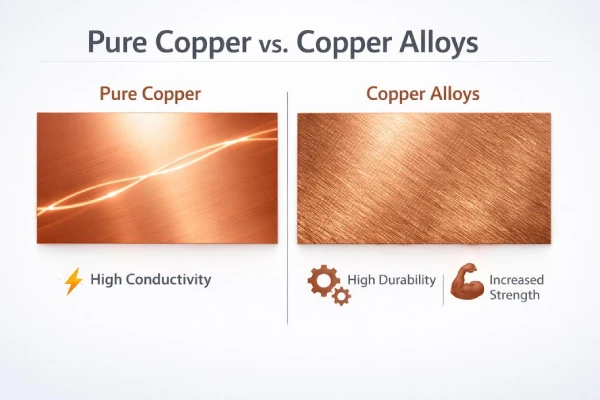
Copper casting offers a diverse range of options—from pure copper to high-performance alloys—for electrical, thermal management, and structural applications. The entire casting process requires a careful balance between material purity, solidification behavior, and process parameters. Pure copper is chosen for its exceptional electrical and thermal conductivity, while copper alloys incorporate elements such as beryllium, tellurium, and phosphorus to achieve higher strength or wear resistance.
The selection of copper castings directly impacts the performance and lifecycle costs of end products. Pure copper offers five inherent advantages in heat dissipation, electrical conductivity, corrosion resistance, and recyclability; however, when applications require high-strength contacts, easily machinable precision components, or fatigue resistance in springs, beryllium copper, tellurium copper, and phosphor bronze become the optimal solutions for casting projects.
This guide provides a detailed analysis of the core definitions, key equipment, primary processes, and five major advantages of copper casting, as well as alloy selection for electrical components, offering a technical reference for material selection decisions.
What Is Copper Casting? Key Basics
Copper is heated until it melts, then poured into a mold, where it cools to form a solid, durable shape. From raw materials to precision components, this process seamlessly combines practical skills with advanced metallurgy in modern copper casting foundries.
Defining Copper Casting: From Molten Metal to Solid Form
Copper casting is, at its core, a process that closely integrates heat transfer, flow, and solidification. Unlike conventional casting, the copper casting process requires a precise balance between thermal conductivity, flow distance, and cooling rate—the solidification behavior of pure copper and copper alloys differs significantly at this stage, directly affecting the final mechanical properties.
In copper casting, the choice of base copper or alloy depends on requirements for thermal conductivity or strength. The material is then placed in a furnace and melted under controlled conditions. Careful monitoring of melt temperature and chemical composition ensures that the copper castings meet metallurgical specifications.
In high-precision mass production scenarios, the copper die casting process utilizes the high thermal conductivity of the metal mold cavity to rapidly dissipate heat, promoting grain refinement and reducing porosity defects. From the molten to the solid state, temperature gradients determine the grain structure, mold design dictates dimensional accuracy, and controlled solidification parameters effectively reduce the risk of porosity and segregation in copper castings.
By the time the solid copper castings leave the foundry, they have already acquired the desired electrical conductivity, thermal conductivity, and corrosion resistance—this is the actual process by which copper transition from a liquid to a solid state.
Core Foundry Equipment: Melting Furnaces to Molding Machines
For any professional copper casting foundry, core capabilities hinge on a complete equipment chain—from the melting furnace to the molding machine. Reliable copper casting equipment is first and foremost reflected in the melting system: the melting furnace heats pure copper or copper alloy raw materials to a fully fluid state, the crucible protects the molten metal from contamination, and the pouring ladle ensures safe pouring.
During the molding stage, the molding machine compacts the sand or uses a metal mold to form a precise cavity, with the core defining the complex geometry. This comprehensive copper casting process directly affects the density and dimensional accuracy of the copper castings.
The finishing system determines the final quality of the copper casting. The shaking process efficiently removes sand particles, separating the casting from the mold. The grinding process trims the sprue and flash, eliminating stress concentration points. Surface treatment, through polishing or coating, enhances the durability and corrosion resistance of the copper cast parts.
According to the International Copper Study Group’s 2024 outlook, refined copper demand remains strongly tied to electrical and industrial growth, reinforcing steady investment in casting capacity worldwide.
Supro MFG integrates these systems into its high-efficiency copper casting production line, ensuring strict quality control and keeping scrap rates low.
Essential Processes: Sand Casting, Investment Casting, and Beyond
Each copper casting process strikes a balance between cost, precision, and surface quality. Supro MFG selects the appropriate copper alloy casting method based on specific requirements to ensure customers receive parts with a high degree of fit and consistent performance. Different casting processes are suitable for different production tasks, as detailed below:
- Copper sand casting uses disposable sand molds, offering broad applicability and low cost. It is particularly suitable for large parts and small-batch production, though surface finish and dimensional accuracy are limited.
- Copper investment casting uses ceramic molds to achieve dimensional accuracy of CT4–CT6 grade and surface quality of Ra 1.6–6.3 μm, with a minimum wall thickness of 0.5 mm. It is suitable for high-value-added, complex castings in the aerospace and precision machinery sectors.
- Copper die casting: This process involves high-pressure, high-speed filling of the metal mold cavity, achieving dimensional accuracy of CT4–CT6 grades. It offers high production efficiency and is suitable for mass production of small, thin-walled copper castings.
- Copper centrifugal casting utilizes centrifugal force generated by high-speed rotation to fill the mold cavity with molten copper. This process produces a dense microstructure free of shrinkage defects, making it the preferred method for cylindrical parts such as copper sleeves and bearing shells.
- Copper continuous casting employs water-cooled molds to achieve continuous pouring and solidification, making it suitable for the efficient production of long products such as copper rods and billets.
Copper Casting: Pure vs. Alloy Strength Comparison
When it comes to copper castings, strength is always the primary concern. Pure copper offers a classic, pristine appearance, while copper alloys provide greater toughness. In selecting copper castings, understanding the trade-off between the high electrical conductivity of pure copper and the high strength of copper alloys is key to engineers making the right decision.
Pure Copper
In copper casting applications, high-purity metals stand out due to their emphasis on electrical conductivity rather than sheer strength. However, in the casting of copper for electrical enclosures or bus ducts, the factors given priority differ.
Pure copper has lower mechanical strength than other alloy grades, but it exhibits excellent ductility under stress and high plasticity during the copper casting forming process. It also possesses exceptional electrical conductivity (typically exceeding 100% IACS), and its high thermal conductivity aids in heat dissipation.
Molten pure copper exhibits excellent casting fluidity in controlled molds, and due to its high purity, alloy segregation is minimal. It is suitable for manufacturing copper castings that require flexibility, such as power connectors.
The International Copper Study Group noted in its 2025 outlook that global demand for high-conductivity copper castings continues rising, driven by electrification and grid upgrades.
For a professional Chinese copper casting foundry like Supro MFG, pure copper casting remains the preferred solution when electrical conductivity is non-negotiable.
The following are the properties and typical applications of pure copper C110:
Property | Pure Copper (C110) | Unit | Typical Application |
Tensile Strength | 210–250 | MPa | Electrical bus bars |
Hardness | 40–60 | HB | Terminals |
Electrical Conductivity | 100–101 | % IACS | Power systems |
Thermal Conductivity | 385–400 | W/m·K | Heat sinks |
Copper Alloys
Copper alloys, on the other hand, are quite different; their properties change rapidly when alloying elements are added. By leveraging a proven copper casting process, the following can be achieved:
- Increased strength in structural components
- Higher hardness under load
- Enhanced wear resistance in moving parts
In bronze and brass casting, slight adjustments to the composition directly affect mechanical properties. Bronze casting typically enhances corrosion resistance, while brass casting improves machinability. Beryllium-based alloys can achieve extremely high strength after heat treatment.
Copper alloy casting typically follows these steps:
1) Select an alloy formulation based on load requirements.
2) Control the chemical composition of the melt to achieve balanced mechanical properties.
3) Perform heat treatment to unlock enhanced strength.
4) Perform finishing operations to meet strict tolerance requirements.
In summary, copper alloy castings are tougher and harder, making them suitable for products that must withstand pressure.
Supro MFG is dedicated to supporting copper and copper alloy casting projects with extremely high durability requirements—such as gears, valve bodies, and pump components. When engineers need to prioritize toughness over mere electrical conductivity, alloyed copper castings are the preferred choice.
Looking for a reliable China metal foundry?
- We can help you optimize product design and save costs.
- We can help you with high quality high volume cast parts.
- We can deliver on time and get more sales market opportunities.
- You will benefit from Supro MFG metal casting service.
5 Advantages Of Pure Copper Casting
When performance is critical, pure copper casting stands out. From thermal management to electrical conductivity, this casting process is both simple and efficient. Furthermore, its comprehensive performance in terms of corrosion resistance, machinability, and recyclability makes pure copper the material of choice for demanding applications.
Superior Thermal Conductivity for Heat-Sensitive Parts
In terms of thermal management, the high thermal conductivity of pure copper makes it a reliable choice for industrial cooling and power systems, particularly those operating under harsh conditions. Because of the thermal conductivity of pure copper castings, dynamic cooling systems can respond quickly and maintain stable thermal management performance during repeated thermal cycles. As a result, copper castings with complex geometries can provide exceptional heat dissipation performance.
Thanks to copper’s excellent thermal conductivity, copper castings feature a uniform grain structure, which helps reduce the risk of equipment overheating and extends service life. For example, in heat sinks, this eliminates localized hot spots. During the production of mold inserts, it helps balance temperatures. It also ensures that power modules remain within safe operating limits.
Compared to aluminum alloys, copper cast parts conduct heat more efficiently, which means that smaller structures can withstand the same load. This is a significant advantage for both compact electronic devices and heavy-duty tools.
Unmatched Electrical Performance in Conductive Components
Electrical engineering requires low resistance and stable current flow. For this reason, pure copper castings demonstrate unique advantages in high-load electrical applications and conductive components. The high electrical conductivity of copper cast parts ensures that they maintain stable electrical performance under load. The benefits of efficient power transmission help reduce energy loss in power distribution units. For busbars and switchgear, copper castings reduce both resistance losses and heat buildup. This balance is hard to beat.
The following is a performance comparison based on industry standard values:
Material Type | Electrical Conductivity (% IACS) | Thermal Conductivity (W/m·K) | Typical Application | Relative Resistance |
Pure Copper Casting | 100% | 390–401 | Busbars, connectors | Very Low |
Aluminum Alloy | 61% | 205–237 | Lightweight conductors | Medium |
Brass Casting | 28% | 120 | Fittings, terminals | High |
Bronze Casting | 15% | 60 | Bearings, bushings | Very High |
High Corrosion Resistance Without Alloying Elements
An often-overlooked advantage of non-alloyed copper is its inherent corrosion resistance. During the pure copper casting process, an oxide layer forms on the surface of the casting, effectively preventing further degradation of the material. Copper castings exhibit strong chemical stability in air and remain reliable even with moderate exposure to the environment.
In water supply systems and outdoor installations, copper castings maintain excellent performance without the need for coatings. This simplifies maintenance and reduces long-term costs. For infrastructure projects utilizing copper castings, the reduced use of additives also means fewer material variables to manage.
Ease of Machining and Post-Casting Finishing
Pure copper offers excellent machinability and produces smooth cast surfaces. It is a favored material among manufacturers for its ease of machining. The copper casting process involves the following steps:
1) Precision turning or milling.
2) Deburring and polishing.
3) Final post-processing is performed to optimize surface quality.
During the manufacturing process, copper casting enhances surface quality, ensures dimensional stability, and is compatible with CNC systems, thereby meeting customized manufacturing requirements. This flexibility ensures that casting projects can meet strict tolerance requirements, whether for power connectors or custom enclosures. Teams that partner with experienced copper casting service providers like Supro MFG frequently note that the machining process is highly predictable, which allows production to proceed smoothly and helps avoid unexpected issues.
Recyclability and Environmental Benefits
Sustainability is more important than ever, and copper casting aligns perfectly with this trend. Pure copper is 100% recyclable, with minimal loss of properties upon remelting, supporting full recyclability while maintaining performance.
Furthermore, scrap from copper cast parts can be directly reintroduced into the casting process. Quality remains uncompromised, and standards are upheld. This circular model not only makes copper casting practical but also a wise choice for forward-thinking companies.
Copper Casting: Selection of Casting Alloys for Electrical Components
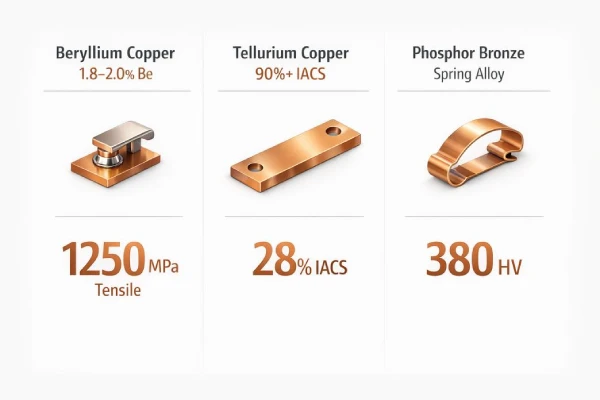
Electrical performance begins at the smelting stage. A prudent selection of copper raw materials determines the conductivity, strength, and service life of critical electrical components. In copper casting, three alloy options offer the advantages of ultra-high strength, a balance of conductivity and machinability, and fatigue resistance, respectively. Engineers can select the appropriate alloy based on specific electrical and mechanical load requirements.
Beryllium Copper Casting for High-Strength Contacts
When high loads and strict tolerance requirements coexist, beryllium-containing copper castings are an excellent choice. Copper alloys containing 1.8–2.0% beryllium achieve tensile strengths exceeding 1,200 MPa after heat treatment, effectively increasing the hardness of the castings and enhancing wear resistance in sliding contacts.
This alloy formulation ensures high strength while maintaining the machinability of electrical contact geometries. A conductivity of 20–30% IACS provides a balance between electrical and mechanical properties. Typical applications include heavy-duty relay contacts, aerospace connectors, and industrial switchgear.
At Supro MFG, our copper casting and post-casting aging processes are fully optimized, ensuring that the cast copper components consistently meet specifications without any issues.
The following is a comparison of the properties of cast copper alloys before and after heat treatment:
Property | As-Cast | Heat Treated | Unit | Application Impact |
Tensile Strength | 600 | 1250 | MPa | Long-term load |
Conductivity | 18 | 28 | % IACS | Signal flow |
Hardness | 180 | 380 | HV | Contact wear |
Elongation | 8 | 3 | % | Form stability |
Density | 8.3 | 8.3 | g/cm³ | Weight control |
Tellurium Copper: Balancing Conductivity and Machinability
In the field of copper casting, tellurium-copper achieves a unique balance between electrical conductivity and machinability. By adding trace amounts of tellurium, castings maintain an IACS conductivity of over 90% while producing smooth chip cross-sections and significantly reducing tool wear. This advantage extends throughout the entire copper casting process, ensuring reliable and smooth machined surfaces for precision electronic components.
In copper casting projects requiring precision threads or fine features, the use of tellurium-containing copper alloys can reduce secondary machining time. It minimizes vibration, resulting in smoother tapping. Supro MFG typically recommends this process for busbar and terminal manufacturing where both a polished finish and high performance are required.
Phosphor Bronze Solutions for Spring Contacts
In the field of copper casting, phosphor bronze has become the material of choice for spring contact applications due to its unique shape memory properties. The addition of tin and trace amounts of phosphorus to the copper matrix refines the grain structure and enhances corrosion resistance. Through an optimized copper casting process, the castings maintain stable spring force even after millions of cycles, while also offering excellent electrical conductivity and resistance to oxidation.
For designers who need to balance cost and durability, phosphor bronze castings ensure that components are both compact and robust. From battery clips to terminal springs, the cast copper alloys manufactured by Supro MFG ensure smooth current flow while effectively reducing the rate of post-sales repairs.
Contact Supro-Mfg
Copper casting offers a clear selection path between pure copper and copper alloys: Pure copper excels in high electrical and thermal conductivity, corrosion resistance, machinability, and recyclability, making it suitable for thermosensitive and electrical applications; beryllium copper, tellurium copper, and phosphor bronze, on the other hand, meet the requirements for high-strength contacts, precision machining, and spring fatigue resistance, respectively. Leveraging a well-established copper casting process, engineers can strike a precise balance between performance and cost, ensuring the reliable service life of copper castings.