
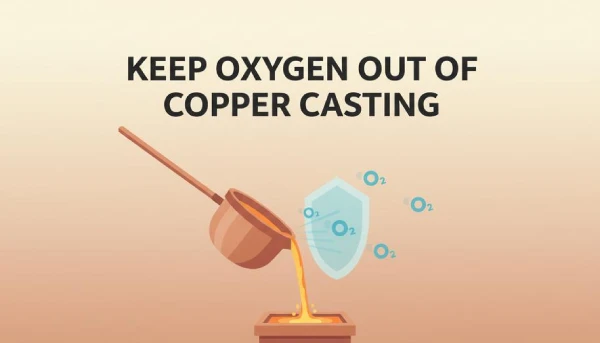
Oxidation defects in copper casting turn sound metal into scrap, disrupt production schedules, and undermine trust with buyers. However, oxidation occurs rapidly when the molten metal is too hot and the atmosphere is oxygen-rich. For this reason, modern foundries combat oxidation defects in the casting process through strict controls, rigorous discipline, and critical process knowledge.
Even slight fluctuations in furnace temperature, alloy composition, or exposure to air can trigger a chain reaction, leading to defects in copper castings such as discoloration, embrittlement, or porosity. The root cause lies in deficiencies in process control. Oxidation not only compromises surface finish and strength but also permeates the entire process, from melting and transfer to pouring. Only by addressing the root causes—such as high-temperature exposure, oxygen dissolution, and mold design—can stable and controllable copper casting production be achieved.
This article will systematically explain how to establish an oxidation protection system throughout the entire copper casting process, focusing on three key principles—inert gas protection, vacuum degassing, and flux addition—and integrating practical workshop applications such as furnace operation, sand regeneration, core-making precision, and real-time monitoring. It aims to provide foundries with actionable technical guidance.
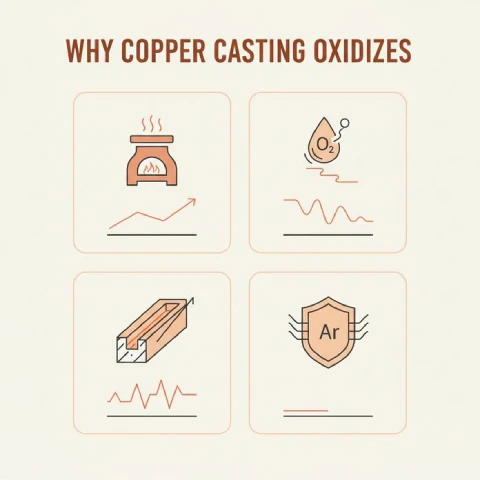
Why Does Copper Casting Oxidize?
In the copper casting process, oxidation continues to occur, systematically affecting the surface finish, strength, and porosity of the castings. Even slight variations in furnace temperature, alloy composition, or exposure to air can trigger a chain reaction. If issues such as darkening, embrittlement, or porosity arise, the root cause is typically found in deficiencies in process control.
High-Temperature Exposure in Melting Furnaces
Oxidation of copper castings typically begins inside the melting furnace. When castings are heated to excessively high temperatures for too long, their surfaces cannot remain clean. The high-temperature environment inside the furnace exceeds the alloy’s limits, thereby accelerating surface oxidation and thickening the oxide layer on the surface of the molten metal. High temperatures and prolonged exposure to heat accelerate the reaction between the molten metal and the furnace atmosphere.
At the same time, unstable control of the copper casting process is a common cause of oxidation, including fluctuations in the air-fuel ratio of the burner and excessive air intake. Additionally, the materials themselves exhibit significant sensitivity: phosphor bronze used in open furnaces and silicon bronze exposed to an oxygen-rich furnace atmosphere are both prone to quality defects.
Oxygen Dissolution in Molten Copper Alloys
In copper casting and other copper casting processes, oxygen is a hidden factor, and controlling dissolved oxygen is critical to the quality of the final casting.
The solubility of oxygen in molten copper alloys increases with rising temperature, and the liquid metal actively absorbs oxygen from the air, forming copper(I) oxide. This characteristic persists throughout the entire casting process; the high affinity of molten copper for oxygen leads to gas entrapment during solidification, which in turn causes oxidation defects and porosity.
Compared to pure copper, copper alloys have a higher oxygen solubility in the liquid state, which increases the risk of gas absorption and ultimately reduces the tensile strength of the finished copper castings.
Impact of Wall Thickness and Draft Angles
In copper casting, poor geometry can lead to more casting defects, and design choices can also affect the risk of oxidation in the castings. Thin-walled designs cool more quickly, making them prone to strong turbulence during filling; meanwhile, inadequate draft angles can disrupt the flow and cause surface entrapment of air.
Considering factors related to casting design and mold geometry, in die casting, high-speed filling causes oxidation peaks to rise, while in centrifugal casting, radial forces exacerbate air entrapment. Professional copper casting services must control airflow at the source—through mold geometry—to reduce the risk of oxidation defects.
Insufficient Inert Atmosphere Control
Insufficient Inert Atmosphere ControlThe key to preventing oxidation in copper casting lies in strict atmosphere control. Without an appropriate inert atmosphere, air leaks can easily occur during transfer, causing the molten metal to come into contact with oxygen during pouring.
Protection methods include argon shielding, nitrogen blanketing, and vacuum casting systems.
Copper casting foundries committed to high-quality production typically employ comprehensive protective gas systems. For this reason, the team collaborating with Supro MFG places particular emphasis on implementing controlled anti-oxidation methods during the casting process. Stability of the copper castings is ensured by strictly controlling furnace sealing, gas flow rates, and vacuum duration.
The occurrence of oxidation during copper casting is governed by the physical laws of the process. As long as air and heat are properly controlled, the castings will perform as expected.
Looking for a reliable China metal foundry?
- We can help you optimize product design and save costs.
- We can help you with high quality high volume cast parts.
- We can deliver on time and get more sales market opportunities.
- You will benefit from Supro MFG metal casting service.
3 Core Principles To Prevent Copper Casting Oxidation
In the copper casting process, even minimal exposure to oxygen can compromise surface finish and strength. In actual production settings, the quality of copper materials and castings depends on how well oxidation is controlled. To address this issue, Supro MFG has established three core principles that address atmospheric isolation, melt purification, and chemical modification, thereby creating a comprehensive oxidation protection system.
Principle 1 - Inert Gas Shielding via Argon Atmospheres
When molten copper comes into contact with air, oxidation occurs immediately. For foundries committed to producing high-quality bronze or brass castings, stable furnace atmosphere management is critical to ensuring the quality of copper castings.
Inert gas protection is the primary method for suppressing oxidation in copper castings. During the furnace atmosphere control phase, high-purity argon—the primary protective gas—is applied directly above the molten pool to create a stable protective atmosphere. During metal transfer, ensuring a continuous flow of argon along the ladle reduces turbulence and covers the exposed molten copper surface to limit oxygen absorption. During the pouring stage, controlling the height of the flow column and preventing spatter ensures continuous protection against oxidation. Implementing this series of measures throughout the copper casting process results in high-quality copper cast products.
Principle 2 - Vacuum Degassing for Dissolved Oxygen Removal
For high-precision copper castings, dissolved oxygen can remain trapped within the molten metal even if the surface appears clean. In such cases, Supro MFG employs a controlled vacuum degassing process to ensure tight and consistent internal quality.
Vacuum degassing effectively removes dissolved oxygen through the following process:
1) Place the molten copper in a vacuum chamber and rapidly reduce the pressure to initiate the degassing process and extract gases.
2) Directly remove oxygen from the molten copper and reduce hydrogen content, ultimately minimizing porosity defects in the castings.
3) The optimized copper alloy castings exhibit higher density, improved tensile strength, and consistent performance.
Principle 3 - Protective Fluxes and Alloying Additives
In actual copper and casting production, surface oxidation can be kept within acceptable limits through the use of sophisticated chemical methods. Supro MFG combines flux control with alloy formulation to ensure that copper castings remain clean throughout the entire process, from melting to pouring into the mold.
A protective flux is applied to the surface of the melt to form a stable flux layer. This protects the melt by blocking contact with air, thereby reducing the formation of inclusions. At the same time, adding deoxidizers such as phosphorus and introducing silicon-based alloy additives during the copper casting process not only directly removes dissolved oxygen from the molten copper alloy but also precisely controls surface oxidation reactions. To further enhance the quality of copper castings, fine-graining agents can be added before pouring to achieve a denser, more oxidation-resistant microstructure, effectively reducing oxide inclusions and resulting in a smoother casting surface.
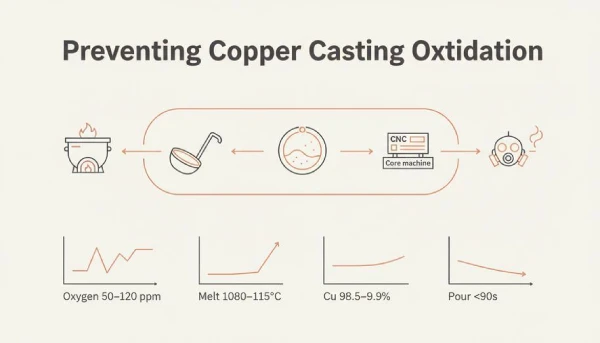
Foundry Setup: Preventing Copper Casting Oxidation
Maintaining the cleanliness of copper castings requires both scientific knowledge and the practical intuition gained from workshop experience. This series will provide a detailed explanation of furnace-side operating procedures, sand handling, core precision, and real-time molten metal inspection. All content is tailored to the daily operations of a foundry and the realities of extended pouring sessions, ensuring consistent copper casting quality throughout the entire production process.
Optimizing Melting Furnaces and Pouring Ladles
High-quality copper casting begins during the smelting preparation stage, not after pouring. To produce castings with high density and low oxidation levels, foundries must implement systematic controls at the furnace and ladle stages. Supro MFG combines the following solutions with process audits to ensure that melt quality is secured before pouring begins.
To achieve high-quality copper casting, the type of furnace selected should be compatible with the charge size of the copper alloy. Induction furnaces are widely used due to their rapid melting rates and reduced oxygen ingress. Additionally, the refractory lining should be inspected regularly for areas where copper has reacted with the lining to prevent the introduction of impurities.
Ladle operating procedures are equally critical in the copper casting process: preheating the ladle prevents gas absorption caused by thermal shock, selecting the appropriate crucible material limits impurity adsorption, and temperature control must be maintained within the recommended temperature range for the alloy to prevent overheating from exacerbating oxidation.
During the transfer phase, the surface of the molten pool is covered with an inert gas; the steady gas flow significantly reduces oxygen entrainment caused by turbulence, thereby producing uniform copper cast parts.
Integrating Sand Reclamation Systems to Reduce Inclusions
The cleanliness of molding sand directly affects the quality of copper castings. Residual oxides in contaminated sand can re-enter the molten copper, leading to inclusion defects. An integrated sand regeneration system effectively addresses this issue: mechanical regeneration removes scale, while thermal regeneration burns off the binder. Combined with screening to control particle size and a sand cooler to stabilize the mold cavity temperature, this system enhances mold cavity integrity. A cleaner sand-binder mixture allows the molten copper to flow more smoothly during pouring.
Deploying CNC Machining Centers with Core Making Equipment
Core misalignment can cause metal spatter and exacerbate oxidation reactions in copper casting. To address this issue, Supro MFG employs the following integrated approach to consistently maintain uniform wall thickness and minimize turbulence during repeated casting production.
1) Standardizing the geometry of the core box;
2) Setting the core pusher pressure to ensure uniform filling;
3) Thoroughly drying the cores after cleaning, without cutting corners;
4) Automating core handling to minimize damage;
5) CNC machining precision at the sprue ensures a stable melt flow.
Using Spectrometers for Real-Time Atmosphere Monitoring
Modern gas analysis tools can monitor oxygen levels before defects become apparent, and the real-time data displayed allows for the timely salvage of non-conforming furnace batches.
“Real-time melt monitoring is becoming a baseline expectation for copper alloy quality,” noted the International Copper Association’s 2024 manufacturing outlook.
The monitoring system primarily consists of an oxygen sensor positioned above the melt pool that works in conjunction with emission spectroscopy to continuously monitor oxygen levels and shifts in alloy composition, while maintaining an inert atmosphere through an argon shield or nitrogen purge.
The control loop refers to the mechanism that allows for rapid parameter adjustments after abnormal data alarm signals are fed into the process control system. The following are the key control parameters:
Parameter | Target Range | Alert Point | Action |
Oxygen (ppm) | 50–120 | >150 | Increase inert cover |
Melt Temp (°C) | 1080–1150 | >1180 | Reduce power |
Cu % | 98.5–99.9 | <98.3 | Alloy correction |
Pour Delay (s) | <90 | >120 | Reheat ladle |
Contact Supro-Mfg
Oxidation control in copper casting must be implemented throughout the entire process, from melting and transfer to pouring. By identifying high-temperature exposure, oxygen dissolution, and design flaws at the source; implementing the three key principles of inert gas protection, vacuum degassing, and fluxing; and optimizing shop-floor practices such as furnace and ladle design, sand regeneration, core-making precision, and real-time monitoring, systematic measures can significantly improve the density and mechanical properties of copper cast parts while reducing scrap rates.