
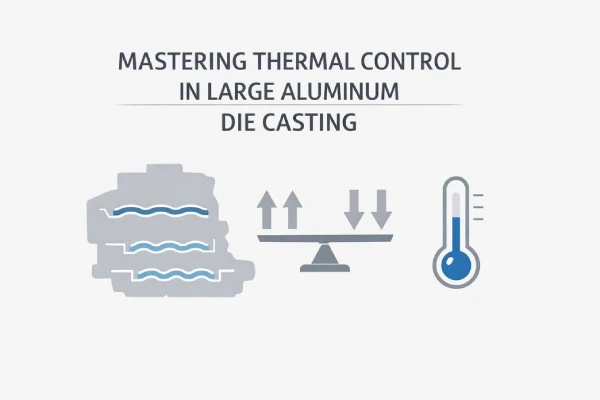
Thermal deformation in aluminum die casting has always been a key challenge that limits the precision and yield rate of large components. Even minor dimensional warping and structural distortion not only affect the fit during subsequent assembly but also significantly increase production costs, making it a pressing technical issue in die casting production.
The thermal deformation of aluminum die cast parts is influenced by a combination of factors. Improper control of process parameters such as mold temperature and injection pressure, unreasonable wall thickness design and cooling layout, as well as non-standard heat treatment procedures, can all lead to residual stress imbalances and dimensional deviations, thereby causing deformation and increasing the scrap rate.
This article focuses on the control of thermal deformation in large-scale aluminum die casting. It begins by analyzing the key control points for critical process parameters, followed by an examination of the primary causes of thermal deformation. The paper then outlines optimization strategies for T6 heat treatment and zoned water cooling, integrating these with the PPAP validation system to form a comprehensive closed-loop quality control system. This provides die casting manufacturers with practical technical guidance for improving the dimensional accuracy of large components.
Key Process Parameters in Aluminum Die Casting
High-precision aluminum die casting requires strict adherence to process specifications. For large automotive and industrial housings, even minor deviations in thermal cycling and pressure parameters can directly affect the integrity of the final part. Focusing on mainstream die-cast aluminum materials such as ADC12 and A380, this article breaks down precise control strategies from key dimensions—including mold temperature and injection pressure—to provide practical technical guidance for those seeking a die casting manufacturer.
Die Temperature Settings for ADC12 Precision
When using ADC12 aluminum die casting, die temperature and temperature uniformity determine casting accuracy. The control process is carried out in stages as follows:
First, the die casting mold heating settings are configured, with a preheating range typically set between 180–220°C (to prevent premature solidification below 570°C), and temperature fluctuations maintained within ±10°C. Next, sensors positioned near the thin-walled ribs continuously monitor thermal stability during the aluminum die casting process, perform real-time surface scanning and mapping of the die-cast parts, and provide feedback to the heating module.
Key inspection points in aluminum die casting production include: preventing cold shuts in thin-walled areas, minimizing weld lines at core pins, and maintaining dimensional tolerance within NADCA standards. As a leading Chinese aluminum die casting manufacturer, Supro MFG’s rigorous mold temperature control ensures that ADC12 material fills fine features smoothly, thereby guaranteeing repeatability during long-term continuous production.
Injection Pressure Optimization in Cold-Chamber Tooling
In cold-chamber die casting, calibrated injection pressure determines the integrity and density of aluminum die castings. The control logic typically follows this sequence:
During the slow shot phase, air is purged from the mold cavity. This eliminates residual gases and prevents them from affecting the structural quality of the aluminum die casting parts
During the fast shot phase, molten die cast aluminum rapidly fills the mold cavity at a gate velocity of 1.5–2.5 m/s. Balanced pressure control stabilizes the flow pattern of the aluminum, eliminating issues with uneven filling.
During the pressurization phase, compensatory contraction (typical target range: 60–80 MPa) is applied to prevent deformation of the mold structure and ensure the dimensional accuracy of the aluminum core casting.
Key points in practice:
Maintain a smooth pressure curve
Prevent flash caused by sudden increases in hydraulic pressure
Adjust the gate thickness according to the pressure rise requirements
During the aluminum die casting process, excessive pressure can damage the mold, while insufficient pressure can cause porosity. Through careful adjustment, it is possible to ensure that die cast aluminum components are dense and free of defects.
Molten Metal Superheat Control with A380 Alloy
For A380 alloy, control of melt temperature and superheat determines the metal’s fluidity and the soundness of its microstructure.
During the furnace treatment stage, maintain the target temperature between 660 and 690°C to prevent the formation of iron dross in the die cast aluminum material, and perform regular dross removal and quality inspections.
During the transportation of molten metal, minimize heat loss and maintain stable die casting process parameters.
During the pouring and solidification stage, ensure a balanced solidification rate to maintain the structural integrity of aluminum die cast parts.
It is important to note that excessive superheat can lead to defects in aluminum castings, such as coarse grain structure and porosity. Conversely, a pouring temperature that is too low can easily cause defects in the gate and the casting as a whole, directly reducing the yield rate of finished products.
In high-volume aluminum die casting production, consistent heat treatment of A380 material ensures predictable shrinkage rates and facilitates subsequent machining. This is not a complex technical process, but rather a matter of rigorous heat treatment control.
Cooling Time Adjustments via Zoned Water Channels
During the aluminum die casting process, large parts are prone to thermal deformation due to uneven cooling. An advanced zoned cooling channel design enables precise local temperature control of die-cast parts: the main channels regulate the overall cooling rate, while secondary zones provide enhanced cooling for thick-walled areas to prevent shrinkage voids. This strategy not only shortens the aluminum die casting cycle time (by up to 20%) but also significantly reduces warpage and extends the service life of H13 tool steel molds. Faster cycle times are not always better; balanced cooling helps reduce stress.
By following these precise temperature control procedures, aluminum die casting can produce straight parts, dimensionally stable products, and achieve high production yields.
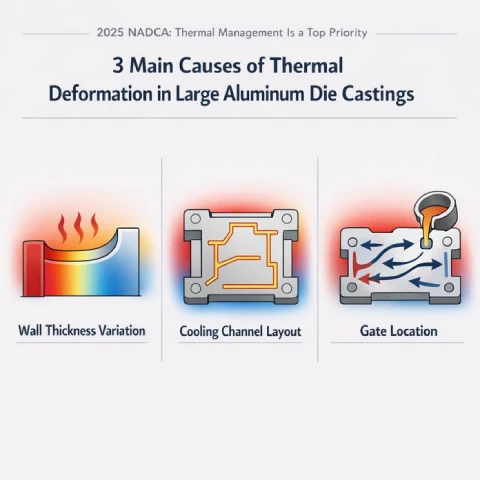
The 3 Main Causes of Thermal Deformation in Large Aluminum Die Cast Parts
Large aluminum die cast components do not deform without cause. Heat, metal flow, and design choices all play a role. During the die-casting process, minor design flaws can accumulate and eventually lead to serious deformation issues.
Excessive Wall-Thickness Variations
In aluminum die casting, uneven part thickness can severely disrupt cooling balance, leading to thermal deformation in large parts. From a design perspective, sharp transitions disrupt the flow of molten aluminum, thick bosses delay solidification and create “hot spots,” and poorly balanced ribs exacerbate stress concentration.
From a process analysis perspective, heat tends to accumulate in thick-walled areas and dissipate slowly, while thin-walled areas cool rapidly. This temperature difference causes residual stresses to build up, and the resulting internal contraction forces eventually cause the aluminum die cast parts to deform, leading to severe warping that directly affects assembly tolerances.
Insufficient Cooling-Channel Distribution
In aluminum die casting, an inadequate distribution of cooling channels can directly disrupt the cooling balance. Sparse cooling channels hinder heat dissipation, while improper spacing exacerbates temperature gradients, leading to uneven mold temperature distribution and slowed solidification rates. Ultimately, this results in extended cycle times for aluminum die casting projects and increases the risk of significant deformation in rigid housings. Optimizing the layout of the cooling system to ensure uniform heat exchange is key to improving the yield of aluminum die cast parts.
The 2025 NADCA industry outlook notes that thermal management remains “a top operational priority for North American die casting aluminum suppliers,” especially for large structural parts requiring ±0.002 in/in tolerances.
Supro MFG eliminates the impact of temperature fluctuations by using simulation to verify the compliance of the catheter path prior to mass production.
Improper Gating Location
An incorrect gate location in a die casting mold can directly cause thermal deformation of the parts. An improper angle of attack disrupts laminar metal flow, while excessive injection pressure causes localized overheating in the cavity, creating hot spots. Uneven filling patterns compromise the integrity of aluminum die cast parts; hot spots result in uneven shrinkage, ultimately leading to widespread deterioration in dimensional accuracy.
Optimizing gate design to ensure smooth filling of molten metal is key to controlling thermal deformation in large aluminum castings. Supro MFG uses predictive gate simulation to mitigate localized overheating, thereby ensuring long-term dimensional stability in aluminum die cast parts.
Looking for a reliable China metal foundry?
- We can help you optimize product design and save costs.
- We can help you with high quality high volume cast parts.
- We can deliver on time and get more sales market opportunities.
- You will benefit from Supro MFG metal casting service.
Heat Treatment Reduces Distortion Rate by 22% for Large Aluminum Die Casting Components
Large automotive body panels manufactured using the aluminum die casting process often appear sturdy on the outside, but they harbor internal stresses. In high-volume die casting production, these stresses can cause large aluminum parts to warp after machining. Here’s how heat treatment can change that.
Solution: T6 Heat Treatment on LM24 Components
For large aluminum die cast parts made from LM24 alloy, deformation is primarily caused by uneven cooling. To address this issue, T6 heat treatment of LM24 alloy components is a proven core solution: solution treatment ensures uniform distribution of alloying elements and eliminates casting segregation; controlled quenching minimizes thermal deformation; and subsequent artificial aging treatment increases yield strength by approximately 30%, significantly enhancing the deformation control capabilities of aluminum die castings.
In terms of the manufacturing process, we recommend mapping stress distributions after die casting, recording reference dimensions prior to CNC Machining Services, and verifying flatness and hole alignment after T6 heat treatment. This systematic approach is particularly well-suited for the production of aluminum die cast parts that require high dimensional stability. At Supro MFG, customized thermal cycling treatments prevent warping during secondary machining of aluminum die cast parts, ensuring easy compliance with strict GD&T requirements.
Impact of Tempering Temperature on Distortion
In the heat treatment of aluminum die castings, the tempering temperature directly determines the effectiveness of residual stress relief. If the temperature is too high, it will soften the die cast aluminum material; if it is too low, stress relief will be insufficient. A closed-loop control system is established through real-time furnace temperature calibration and batch traceability:
- Record post-casting deformation
- Adjust the tempering temperature window
- Re-run the pilot production batch
- Compare CMM data
- Lock in the parameters for mass production.
Through post-machining deformation analysis and long-term dimensional stability testing, we ensure that aluminum die cast parts meet tolerance requirements. Precise tempering is the core process for balancing material properties and deformation control.
PPAP-Driven Validation of Deformation Reduction
In aluminum die casting, a standardized PPAP verification system is employed to ensure strict quality control and thermal deformation management of die cast parts.
Submit PPAP documentation in accordance with the IATF 16949 standard, linking the control plan to process control checkpoints. Conduct deformation measurements using a CMM, validate the reliability of measuring tools through GR&R (Gauge Repeatability and Reproducibility), and then assess capability using Cp/Cpk (≥1.33). Complete the quality assurance cycle through trial runs, dimensional sampling, corrective action trigger conditions, and customer signature confirmation. This system ensures that aluminum die cast parts consistently meet tolerances, allowing statistical analysis to drive real improvements. Through a robust quality assurance system, Supro MFG ensures mathematically verified reductions in distortion.
Uneven cooling during the aluminum die casting process? A zoned cooling channel design can solve this problem.
Uneven heat distribution is a major quality risk in aluminum die casting production, as it can easily lead to a cascade of defects in castings—such as warping, localized sink marks, and surface roughness—significantly reducing the product yield rate. Experienced aluminum die casting manufacturers fine-tune their cooling systems, and the use of zoned cooling channels is the key technical solution to this problem.
Optimizing Multi-Zone Cooling in High-Pressure Die Casting
In aluminum alloy high-pressure die casting, multi-zone cooling effectively controls thermal deformation and ensures part quality. By adjusting process parameters such as injection speed, holding pressure, and holding time, and combining these with simulation analysis to identify hot spots, predict shrinkage zones, and optimize coolant flow, stable cooling efficiency in aluminum die casting can be achieved.
In terms of partition configuration, fixed partitions are suitable for thick-walled ribs and large land areas in aluminum die castings, while variable partitions are used for thin-walled surfaces with high aesthetic requirements. This approach effectively reduces internal stress, ensures part quality and dimensional accuracy, and helps die casting manufacturers consistently produce aluminum die castings with high uniformity.
The casting process for aluminum die castings runs more smoothly when heat is dissipated at an appropriate rate across all zones. In the production of automotive body aluminum die castings, this balance ensures high surface flatness and reduces scrap rates. Supro MFG leverages advanced thermodynamic simulation technology to precisely configure the zone layout before mold manufacturing begins, thereby saving time and reducing rework.
Mold Fabrication Tips for Water Channel Zoning
In aluminum die casting mold manufacturing, water flow partition design is a key technique for controlling thermal deformation:
During the layout phase, high-temperature cavities must be isolated, and return flow paths must be shortened.
During the machining stage, precision machining processes must be employed to ensure accurate drilling paths and proper sealing of the plug surfaces.
During the validation stage, flow balance tests and endurance trials are conducted in conjunction with pressure-based leak tests.
Selecting appropriate aluminum die casting mold materials (such as high-quality H13 steel) can extend mold life.
Mastering these techniques helps aluminum die casting manufacturers consistently produce high-precision parts.
In aluminum die casting molds, poor sealing can quickly lead to failure in flow control. Supro MFG prioritizes long-term durability over initial performance, ensuring that aluminum die casting parts remain stable even after thousands of castings.
Balancing Cooling Rate for A360 Alloy Parts
Since the A360 alloy contains 9%–10% silicon, excessively rapid quenching rates can cause a sharp increase in thermal stress. In the metallurgical control of aluminum die casting, balancing the cooling rate of A360 alloy parts can effectively control thermal deformation. Rapid quenching of thin-walled sections should be avoided to ensure uniform distribution of eutectic silicon and improve microstructural control.
At the same time, the solidification time is optimized to strictly synchronize with the freezing of the gate. This strategy effectively ensures the dimensional stability of aluminum die cast parts, helps prevent warping, and lays a solid foundation for subsequent surface treatment. Achieving a balanced cooling rate is key to improving the quality of A360 parts.
The aluminum die casting process for A360 parts requires smooth, even cooling—the process should be steady and never rushed. When performed correctly, the aluminum castings will feature clean edges and tight dimensional tolerances, thereby reducing complications in subsequent machining operations.
Contact Supro-Mfg
To address the issue of thermal deformation in large aluminum die cast components, it is essential to precisely control key process parameters such as mold temperature and injection pressure. By optimizing the root causes of defects—including wall thickness design, gate layout, and cooling channels—and combining these efforts with T6 heat treatment and the PPAP quality control system, it is possible to effectively reduce the deformation rate while consistently improving the dimensional accuracy and production yield of aluminum die castings.
 English
 Français
 Deutsch
 Italiano
 日本語
日本語 한국어
한국어 Polski
 Português de Angola
 Русский
 Español de Argentina