
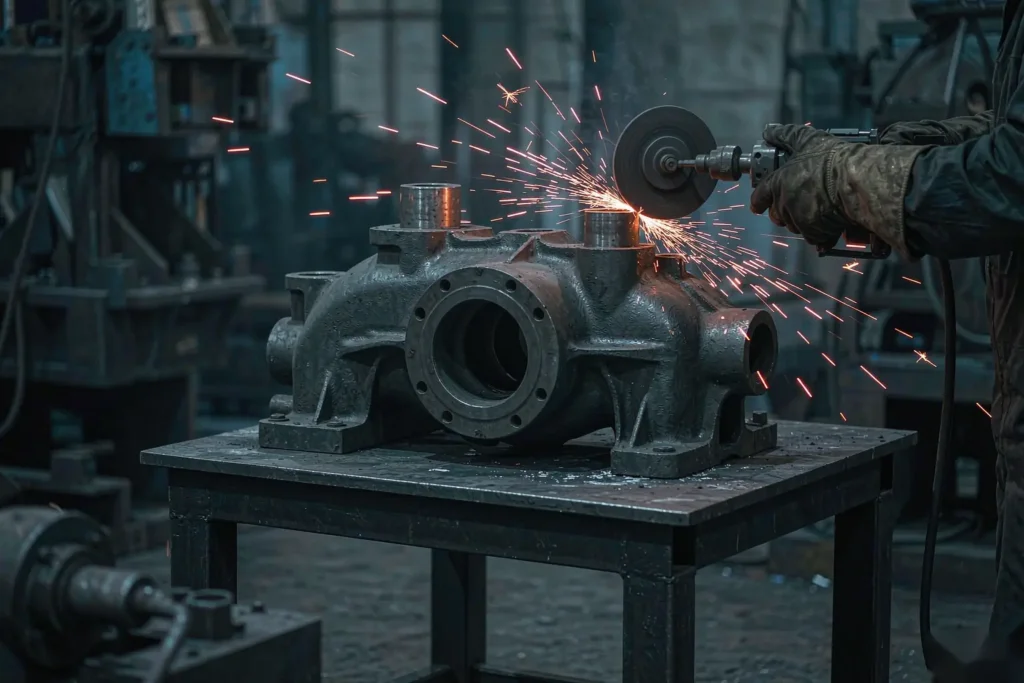
Casting degating is the single most underestimated hour block in a foundry cleaning room. The metal is poured, the mold is broken, and then a worker spends minutes per part separating runners and risers with a wheel, saw, or hammer. Those minutes rarely appear in a quote, yet they decide how much a casting really costs to deliver.
This guide gives B2B buyers and engineers the practical side of casting degating: which removal method fits each alloy and section, how riser-neck geometry sets the cut time, what a 12,000-part cost model actually shows, and where automation does and does not pay back. Numbers are shop-floor models, not marketing claims. Measurement vocabulary follows NIST metrology guidance, and the cleaning-room sequence sits inside the wider secondary operations route.
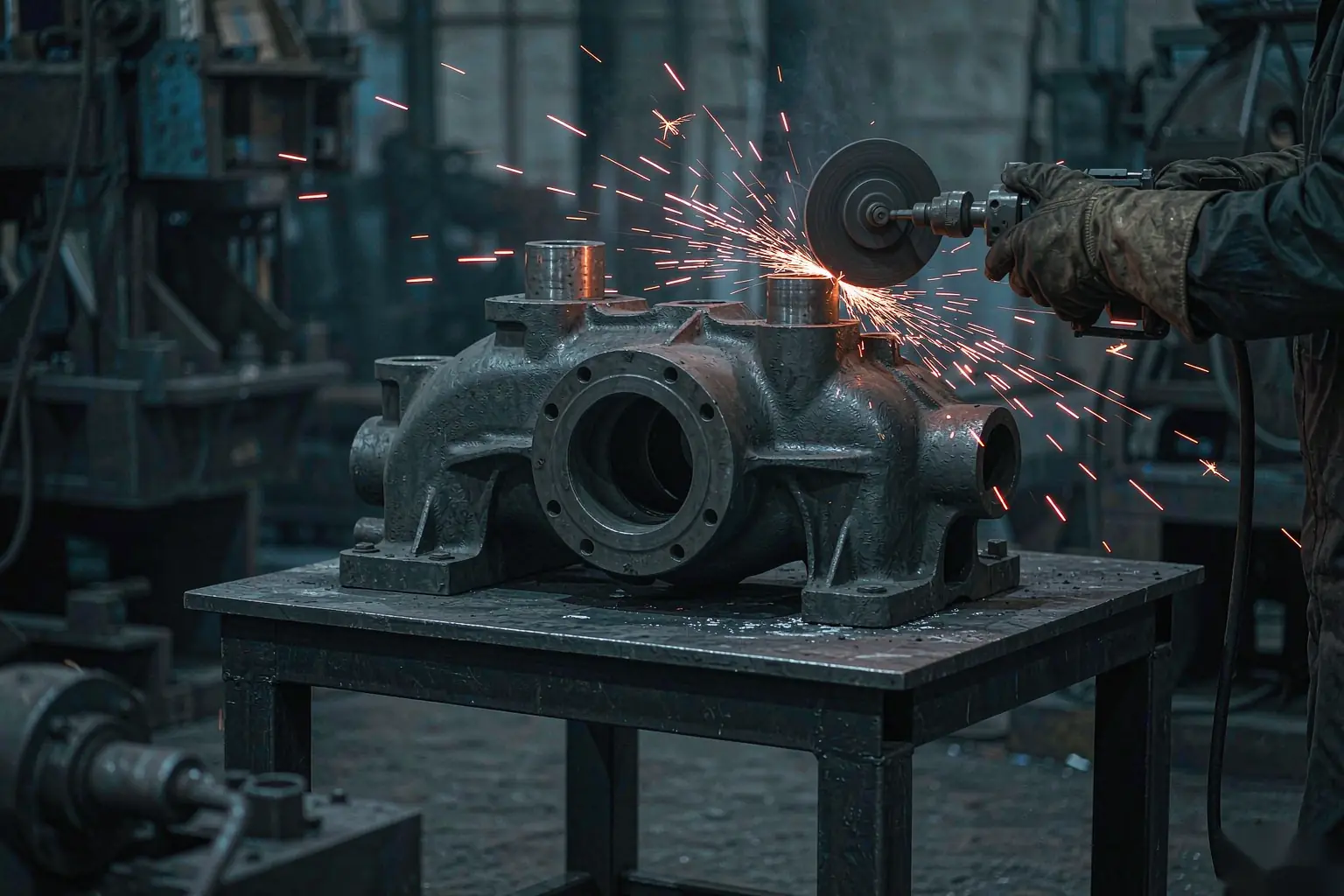
What Casting Degating Actually Covers
Casting degating is the separation of the gating and feeding system from the casting: sprue, runners, ingates, and risers. It ends when the casting is detached. It does not include the subsequent blend-out, grinding, or blending of the remaining stub — that work is surface finishing, often called fettling. Keeping the two cost buckets separate matters because they respond to different levers: degating cost is driven by section area and access, while fettling cost is driven by residual stub height and surface requirement.
A typical sand-cast pump housing carries two Ø50 mm riser necks and one Ø30 mm ingate. In ductile iron that means roughly 4.7 minutes of manual cutting per part before any grinding starts. Multiply by 12,000 parts and the cleaning room spends about 946 hours per year on three cuts. Buyers rarely see that number in a casting cost breakdown, which is why supplier quotes can differ by more than the metal weight suggests.
- Primary degating: knocking, sawing, or cutting the runner and riser away from the casting body.
- Secondary degating: removing the remaining collar or pad flush to the design surface.
- Fettling / fettling-out: blending the stub, parting-line flash, and core prints to the agreed surface texture.
- Inspection: checking the cut face for tears, hot shorts, and inclusions before the part moves to machining.
The distinction is also contractual. A drawing that specifies “gate and riser removed, stub max 1.5 mm on machined faces” is unambiguous. A purchase order that says “clean casting” is not, and it is the source of most nonconformance disputes in the cleaning room. For aluminum programs, aluminum die casting commonly uses a trim press instead of a wheel, which changes the entire cost equation.
Casting Degating Methods Compared by Alloy and Section
No single casting degating method wins across all alloys. Selection depends on the section area being cut, the alloy ductility, the brittleness of the junction, and the volume. The table below is the practical shop-floor window used for sand and permanent-mold work.
| Method | Best alloy / section | Typical rate | Strength | Limitation |
|---|---|---|---|---|
| Hammer knock-off | Gray iron, brittle necks up to Ø40 mm | Seconds | Zero consumable cost | High tear-out risk on ductile iron; noisy; inconsistent break face |
| Band saw | Aluminum and brass, Ø15–60 mm | 200–400 mm/min | Clean square face, low heat | Blade wear on sand inclusions; slow on ferrous sections |
| Abrasive cut-off wheel | Ductile iron and steel, Ø20–80 mm | ≈ 980 mm²/min effective | Universal, low capex | Wheel cost and dust; operator skill sets cycle time |
| Plasma / oxy-fuel | Steel risers over Ø80 mm | Fast on heavy sections | Handles large cross-sections | Heat-affected zone; not for aluminum; secondary grinding |
| Trim press | Die-cast aluminum and zinc | Seconds per part | Best unit cost at volume | Dedicated die cost; poor flexibility |
| Robotic abrasive cell | Repeat ferrous programs | ≈ 2,450 mm²/min | Consistent, traceable cycle | High capex; needs stable part presentation |
For sand-cast ductile iron the abrasive wheel remains the default because the neck contains sand traces that destroy saw blades quickly. Robust process control starts at the mold, not at the wheel: the casting mold coating and the foundry core making practice both influence how much abrasive material sits in the cut zone.
Thermal methods deserve care. Plasma and torch cutting leave a hardened heat-affected zone that may crack during later machining, and on aluminum they simply are not viable. The AWS welding and cutting guidance is the right reference for thermal-cut safety and qualification, while dust and ventilation in the cleaning room should follow local NFPA requirements.
The Neck Modulus Rule: How Riser Design Sets Casting Degating Time
The most effective casting degating improvement happens before pouring. Cut time scales with cross-sectional area, so a smaller riser neck is a direct labor and consumable saving — provided the neck still feeds the hot spot. The standard check is a modulus comparison: for a cylindrical neck, the modulus M is approximately D/4 when side cooling dominates. For a solid connection, the neck modulus should be at least half the modulus of the section it feeds.
Worked modulus and cut-time check
Take a Ø60 mm boss on a ductile iron pump housing. Its modulus M is about 15 mm. The required neck modulus is therefore 0.5 × 15 = 7.5 mm. A Ø50 mm neck gives D/4 = 12.5 mm — safe. Reducing to Ø38 mm gives 9.5 mm, still above the requirement, while Ø30 mm sits exactly on the 7.5 mm line with no margin for mold variation.
| Neck diameter | Neck modulus (D/4) | Required | Cut area | Cut time | Verdict |
|---|---|---|---|---|---|
| Ø50 mm | 12.50 mm | 7.50 mm | 1,963 mm² | 2.00 min | Safe but slowest |
| Ø38 mm | 9.50 mm | 7.50 mm | 1,134 mm² | 1.16 min | Safe, 42% less area |
| Ø30 mm | 7.50 mm | 7.50 mm | 707 mm² | 0.72 min | At limit — no margin |
At an effective abrasive rate of 980 mm²/min, moving from Ø50 to Ø38 on two necks cuts 1.70 minutes from every part. The reduction requires a pattern or core-box change, so it is a design decision, not a shop-floor tweak. The same logic is used when designing casting riser systems and when reviewing casting simulation output for feeding. Where local chilling is used instead, casting chills can reduce the required neck size further.
The counterintuitive part: buyers often negotiate the price per kilogram of poured metal and never ask about neck diameter. Yet the neck is paid for twice — once as feed metal, and again as cleaning-room minutes. The metal casting guide explains how these two costs interact in the overall process chain.
A 12,000-Part Cost Model: Where Casting Degating Money Really Goes
Below is a complete casting degating model for a 12,000-part-per-year ductile iron pump housing. Assumptions: two Ø50 mm riser necks plus one Ø30 mm ingate, loaded shop labor of 36 USD/hour, a 400 × 3.2 mm resin wheel costing 6.50 USD with a cumulative cut capacity of 49,000 mm², and an effective manual abrasive rate of 980 mm²/min.
| Cost element | Per part | Per year (12,000) | Basis |
|---|---|---|---|
| Riser neck cutting (2 cuts) | 4.01 min | 802 hours | 1,963 mm² ÷ 980 mm²/min × 2 |
| Ingate cutting (1 cut) | 0.72 min | 144 hours | 707 mm² ÷ 980 mm²/min |
| Labor at 36 USD/hr | 2.84 USD | 34,044 USD | 4.73 min × 0.60 USD/min |
| Cutting wheels | 0.61 USD | 7,371 USD | Area ÷ 49,000 mm² × 6.50 USD |
| Total casting degating | 3.45 USD | 41,408 USD | Labor plus wheels |
Labor absorbs 82% of the casting degating budget. Wheels are only 18%. This is why buying a cheaper wheel rarely moves the needle, and why the casting scrap rate and the allowance for machining allowance should be reviewed together with the cleaning-room routing.
Hot Casting Degating vs Cold: The Counterintuitive Result
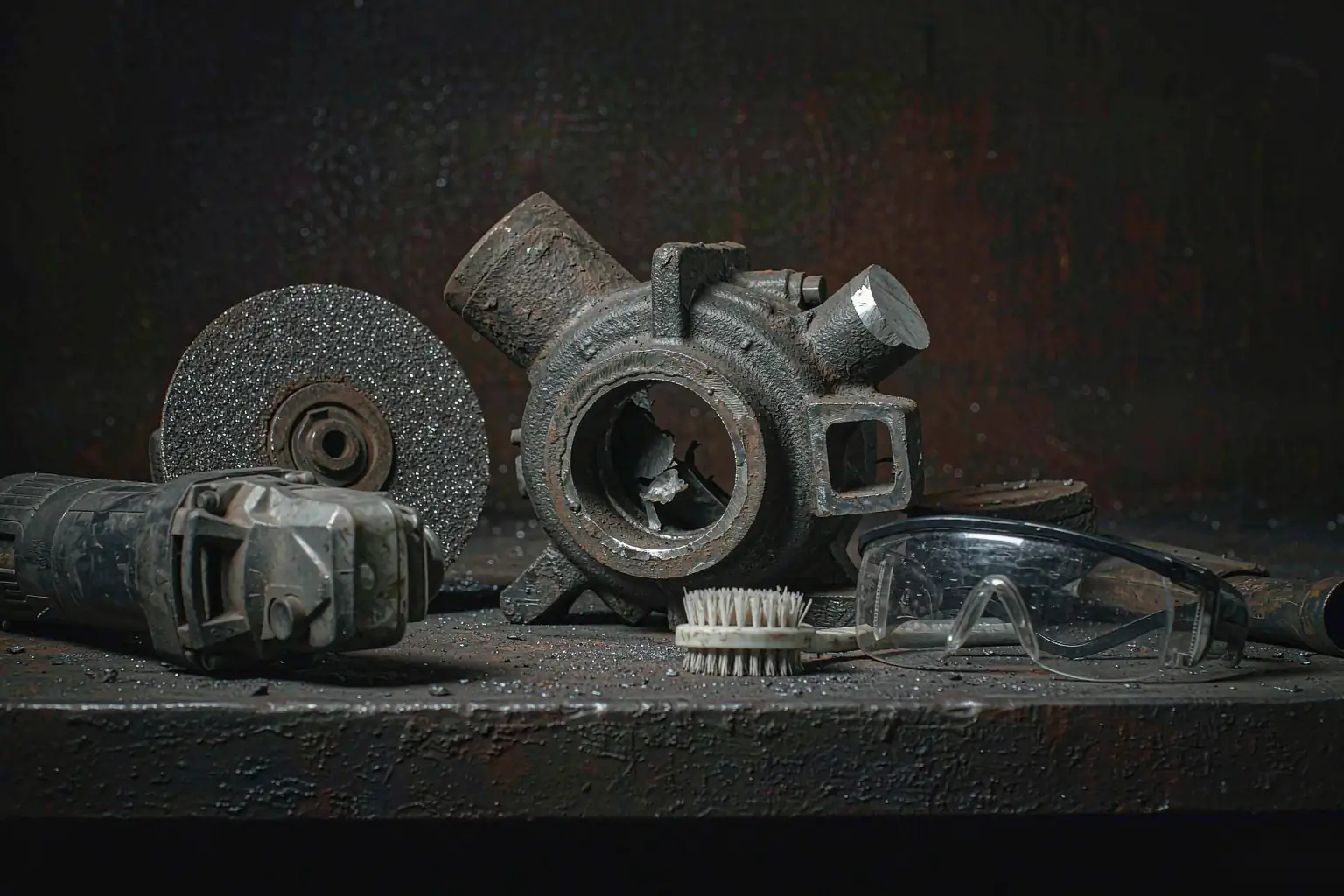
A common shop-floor instinct is to cut risers while the casting is still hot, because hot ductile iron is weaker and the wheel bites faster. At roughly 650 °C the effective cut rate rises by about 60%, to 1,568 mm²/min. The three cuts fall from 4.73 to 3.23 minutes, saving 0.90 USD of labor per part. That looks like a clear win — until the failure costs are added.
| Factor | Cold degating | Hot degating | Delta per part |
|---|---|---|---|
| Cut cycle | 4.73 min | 3.23 min | 1.50 min saved |
| Labor | 2.84 USD | 1.94 USD | 0.90 USD saved |
| Tear-out rate at junction | 0.4% | 1.8% | 1.4% extra |
| Tear-out cost at 95 USD/part | 0.38 USD | 1.71 USD | 1.33 USD added |
| Extra blend-out for oxide skin | 0.00 USD | 0.36 USD | 0.36 USD added |
| Net | Baseline | Worse | 0.79 USD lost |
The net result is that hot casting degating costs about 0.79 USD more per part, or 9,461 USD more per year at this volume. The reason is that the hot junction tears rather than cuts, and the oxide skin left by thermal cutting adds grinding work. The same trade-off appears at the casting shakeout decision point: shaking out early saves mold handling but can move the part into degating at a temperature the process cannot absorb. Heat-treatment routing in casting heat treatment should be sequenced after degating wherever the stub is a stress raiser.
Residual Stub Height and the Grinding That Follows
Casting degating does not end at separation. The remaining stub must be removed to the drawing limit. A machined face specified at 1.5 mm maximum stub requires substantially more blend-out than a 3.0 mm non-machined allowance. In this model, the extra 1.5 mm across three interfaces costs 1.57 minutes of grinding and about 18% more wheel consumption — 1.06 USD per part, or 12,665 USD per year.
A simple fixturing change that holds the part at a consistent angle can pay back in under two months, far faster than a machine replacement. This is one of the cases where a casting tolerances discussion with the buyer yields a bigger saving than a process upgrade. Surface texture requirements should be stated on the drawing rather than left to inspection, as the common casting defects reference set makes clear.
| Stub specification | Grind time | Wheel use | Cost per part |
|---|---|---|---|
| 1.5 mm on machined faces | 0.35 min/interface | Baseline | 0.00 USD delta |
| 3.0 mm on unmachined faces | 0.70 min/interface | +18% | 1.06 USD delta |
For high-volume die-cast parts the equivalent lever is trim-die design rather than stub control; see the die casting services route for how trimming is integrated. For low-volume work, a metal prototype casting program should agree the stub limit before the first sample is cut.
When a Robotic Casting Degating Cell Pays Back
The natural question after a labor-heavy cost model is whether to automate. A robotic abrasive cell with powered feed and a rigid fixture cuts at roughly 2,450 mm²/min — 2.5 times the manual rate — and needs an operator only about 25% of the time. Capex, including integration, is about 80,000 USD.
| Annual volume | Robot unit cost | Saving vs manual | Payback |
|---|---|---|---|
| 12,000 parts | 2.40 USD | 1.05 USD/part | 75.9 months |
| 20,000 parts | 2.20 USD | 1.25 USD/part | 38.3 months |
| 30,000 parts | 2.10 USD | 1.35 USD/part | 23.6 months |
| 40,000 parts | 2.05 USD | 1.40 USD/part | 17.1 months |
At 12,000 parts the cell does not pay back within a normal equipment life. Even at 40,000 parts it takes over 17 months. By contrast, the neck redesign and the stub fixture together cost 6,000 USD and save 2.29 USD per part, giving a 2.6-month payback. The practical verdict: fix the casting degating geometry and the presentation fixture before buying a robot. For programs with genuinely stable, high-volume presentation, CNC machining services can also absorb some stub removal into the machining setup, reducing the load on the cleaning room.
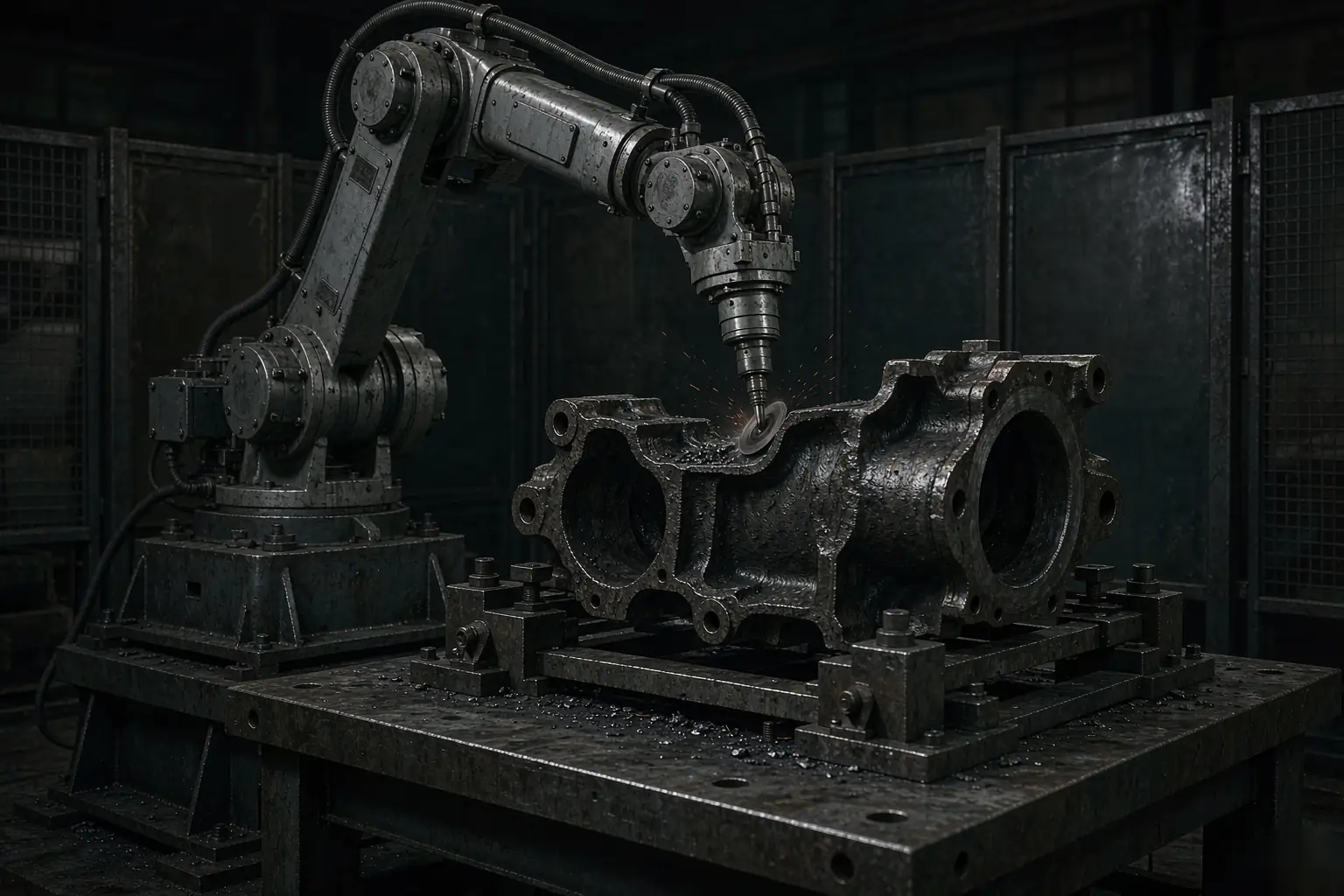
Automation also changes the supplier profile. A shop with investment casting and robotic finishing is competitive on small precision parts, while a jobbing sand casting foundry wins on flexibility. Buyers should match the process to the volume rather than assume the most automated quote is cheapest.
Safety and Process Controls in Casting Degating
Cut-off wheels operate at high surface speed and fail catastrophically when side-loaded. Guards, rated wheels, and trained operators are non-negotiable. Dust from sand-containing cut faces is a respiratory hazard, and thermal cutting adds fume control. The NFPA fire and safety guidance and AWS cutting standards are the reference points; local rules always override a generic checklist.
- Wheel inspection: check rating and damage before each shift; discard wheels that have been side-loaded.
- Part presentation: fixture the casting so the cut cannot pinch the wheel — most wheel failures here are pinch events.
- Ear and respiratory protection: mandatory in the cleaning room, including for visitors.
- Cut-face review: sample one part per hour for tears and inclusions; log the result against the heat number.
Process discipline is usually the cheapest control. The same point applies to energy use: DOE industrial efficiency guidance notes that housekeeping and sequencing changes often beat equipment purchases on payback. Cutting only what the drawing requires — rather than over-removing feed metal — also supports the aluminum association guidance on material efficiency.
An RFQ Checklist for Casting Degating
Put the cleaning room into the RFQ. A supplier who has priced degating correctly will answer these questions without hesitation, and the answers will explain why two quotes for the same drawing differ.
| Field | What to ask | Why it matters |
|---|---|---|
| Riser and gate layout | Provide the feeding layout with neck diameters | Sets cut area and labor minutes |
| Removal method | Wheel, saw, press, or torch, and why | Indicates tear-out and HAZ risk |
| Stub limit | Maximum residual on machined and unmachined faces | Drives downstream grind cost |
| Cut-face acceptance | Reference standard and sample frequency | Prevents nonconformance disputes |
| Cleaning-room labor | Loaded rate and standard minutes per part | Reveals the real cost driver |
| Consumables | Wheel or blade life assumed in the quote | Explains per-part consumable delta |
| Automation | Robot cell or manual, with annual volume assumption | Shows whether capex is being amortized |
| Change control | Who approves a neck-diameter change after PSW | Protects feeding while saving cut time |
A supplier that can discuss casting molds making and the gate layout together is usually the one that has modeled degating. For early-stage programs, 3D printing prototype can validate part presentation before a trim fixture is cut.
30-Day Plan to Reduce Casting Degating Cost
- Days 1–5: Time three cuts on the current program with a stopwatch. Record neck diameter, cut area, and wheel consumption per 100 parts.
- Days 6–10: Group parts by cut area. Identify the top three by annual minutes, not by unit weight.
- Days 11–15: Run the modulus check on each neck. Flag any neck above 0.5 × hot-spot modulus as a redesign candidate.
- Days 16–20: Review stub specification with the buyer. Move unmachined faces to a looser limit where function allows.
- Days 21–25: Trial a presentation fixture on the highest-volume part. Measure grind minutes before and after.
- Days 26–30: Recost the program with the new neck, fixture, and cut-face acceptance. Lock the change in the control plan.
This sequence turns casting degating from an invisible labor block into a measurable cost line. It also creates the evidence needed for a casting part consolidation discussion, where removing an entire joint can eliminate degating rather than optimize it. For iron programs, the iron casting solutions team can review neck layout against the pouring window described in casting pouring temperature.
FAQ: Casting Degating
What is the difference between casting degating and fettling?
Casting degating separates the runner and riser from the casting. Fettling removes the remaining stub, flash, and core-print material and blends the surface to the drawing requirement. Degating cost scales with cut area; fettling cost scales with stub height and surface finish.
Can I reduce the riser neck diameter without causing shrinkage?
Yes, if the neck modulus stays at or above half the modulus of the section it feeds. In the worked example a Ø50 mm neck could move to Ø38 mm while keeping 9.5 mm against a 7.5 mm requirement. Always confirm with solidification simulation before releasing the pattern change.
Why is hot degating not always cheaper?
Hot metal cuts faster, but the junction is weaker. In the model, a 0.90 USD labor saving was outweighed by 1.33 USD of extra tear-out risk and 0.36 USD of additional blend-out for oxide skin, for a net loss of 0.79 USD per part.
When does a robotic degating cell pay back?
In the modeled case, an 80,000 USD cell needed roughly 30,000 parts per year to reach a payback under two years. Below that volume, neck redesign and presentation fixturing delivered a faster return at a fraction of the capex.
What should an RFQ state about degating?
At minimum: the riser and gate layout with neck diameters, the removal method, the maximum residual stub on machined and unmachined faces, the cut-face acceptance standard, and the assumed annual volume. These five fields remove most ambiguity from the cleaning-room scope.
*Data referenced from NIST, AWS, NFPA, Aluminum Association and DOE industrial efficiency publications, and from Supro MFG shop-floor records.
 English
 Français
 Deutsch
 Italiano
 日本語
 한국어
 Polski
 Português de Angola
 Русский
 Español de Argentina