
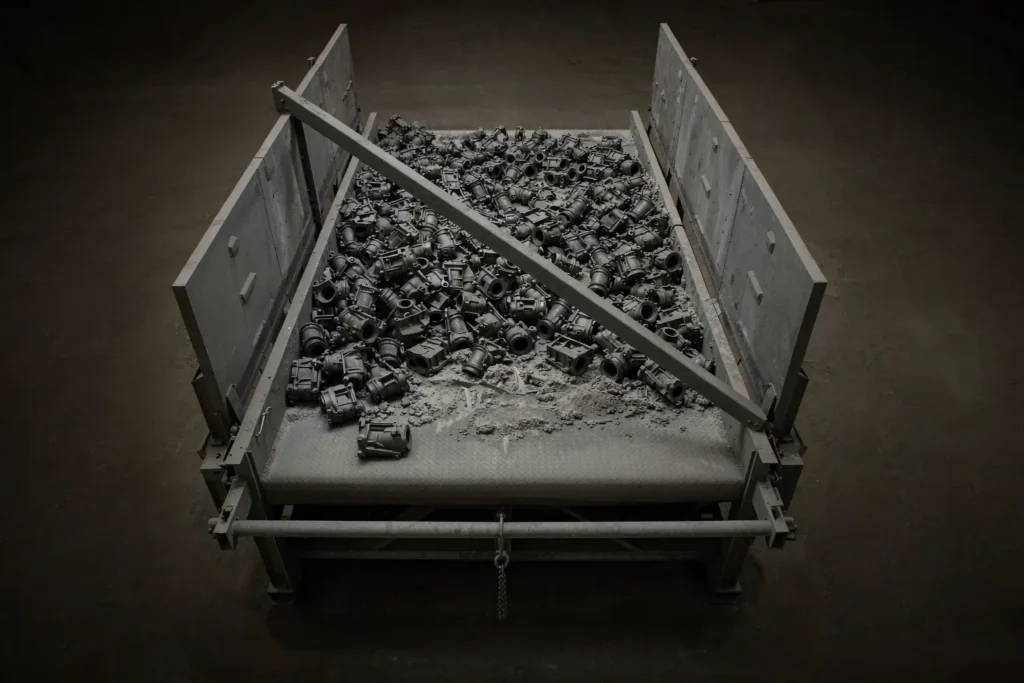
Casting shakeout is the moment a solidified casting leaves its sand mold — and the timing of that moment quietly decides your scrap rate, your flask inventory, and your energy bill. Pull too hot and you buy cracks and distortion; hold too long and you buy molds that never earn their keep. This guide gives you the temperature windows, the cooling math, and the cost model to set the window part by part.
Most buyers treat casting shakeout as a housekeeping step: the metal is solid, shake it out, move on. Foundries that run tight margins treat it as a control variable. The difference shows up in dimensional drift, heat-treatment response, and how many flasks you need to own. In this article we bring in DOE foundry efficiency guidance and ASTM A536 ductile iron requirements, then build a worked cooling model you can adapt to your own part.
What Is Casting Shakeout and Why the Clock Starts at Pour
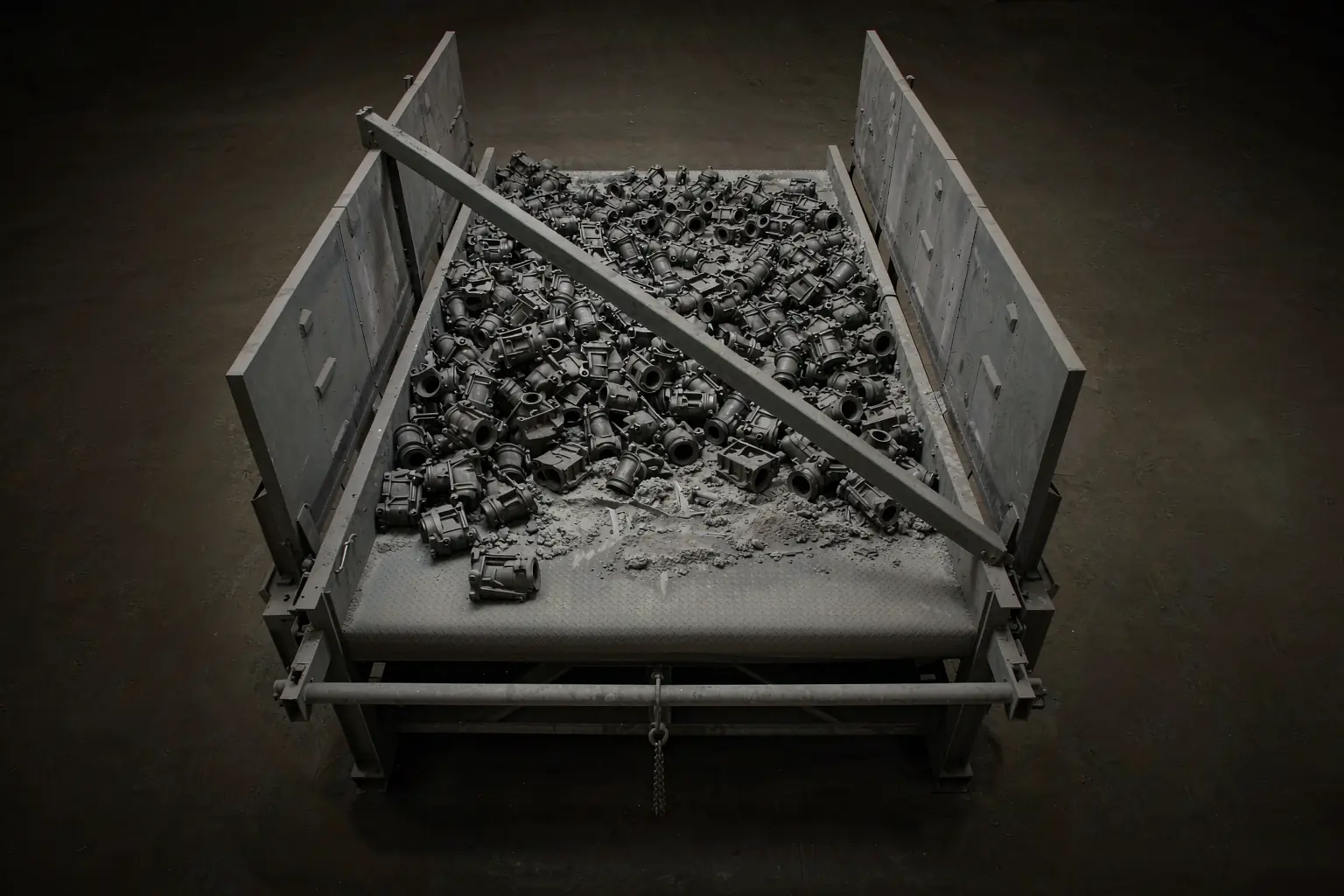
Casting shakeout is the mechanical separation of the casting, the gating system, and the sand mold after the metal has solidified enough to be handled. On a green-sand line it happens on a vibratory deck or a shakeout grid; with cold-box and shell cores it also means breaking the core binder’s hold on the cavity. The useful mental model: the pour starts two clocks. The first is solidification — when the last liquid disappears. The second is in-mold cooling — how far the casting drops in temperature while it is still surrounded by sand. Casting shakeout ends the second clock, and picking that end point is the decision.
Why does this matter to a buyer and not just the foundry? Because the temperature at casting shakeout sets the starting condition for everything after it. A casting pulled at 900 °C arrives at the fettling bench with high residual stress and low hot strength; a casting pulled at 500 °C has already passed through its plastic range while supported by mold sand. That single choice changes distortion, crack susceptibility, and even how much stock the CNC machining operation must remove. If you want the broader process map first, our metal casting guide places shakeout in the full sequence from pattern to inspection. Treat casting shakeout as a recordable process parameter — the target temperature and the hold time belong in the route card, not in an operator’s habit.
The Two Clocks: Solidification Time vs. In-Mold Cooling Time
Solidification time follows Chvorinov’s rule, t_s = B·(V/A)², where V is casting volume, A is its cooling surface area, and B is a mold–metal constant. The ratio V/A is the casting modulus M. Notice the exponent: double the modulus and solidification takes roughly four times as long. In-mold cooling then continues at a rate governed by the casting’s thermal mass versus the heat it can push through sand and into the shop air, which we approximate with a lumped-capacitance time constant τ = m·c_p/(h·A).
Here is the part that surprises people: solidification and cooling scale differently with section size. We modeled three ductile-iron parts of the same alloy. Numbers are indicative — confirm against your own mold material with casting simulation before setting a production window.
| Part (ductile iron) | Mass / Area | Modulus M = V/A | Chvorinov t_s (B = 11 min/cm²) |
|---|---|---|---|
| Thin plate | 20 kg / 4,200 cm² | 0.67 cm | ~5 min |
| Pump housing | 45 kg / 2,400 cm² | 2.64 cm | ~77 min |
| Compact hub | 105 kg / 2,600 cm² | 5.61 cm | ~346 min |
The thin plate and the compact hub differ in modulus by 8.4×, which means about 70× in solidification time — from minutes to nearly six hours. Any casting shakeout policy expressed as “X minutes after pour” is therefore wrong by construction. It has to be expressed as a Target temperature on a specific section, which is exactly what the heat-treatment team also cares about, since the as-shaken structure sets the response to T6 or annealing.
Casting Shakeout Temperature Windows by Alloy
The safe casting shakeout window is bounded below by handling strength and above by hot-shortness and distortion risk. It is alloy-specific and section-specific. These are practical starting bands for sand castings; they are not universal laws, and heavy sections need the low end while thin sections can sometimes run hotter.
Reading the window table
| Alloy family | Typical shakeout band | Why this band |
|---|---|---|
| Gray iron | 450–650 °C | Graphite flake network gives hot strength; can be shaken hotter than steel. |
| Ductile iron | 500–700 °C | Nodular structure tolerant, but heavy sections segregate — see ASTM A536. |
| Cast steel | 650–870 °C | Low hot ductility near solidus; hot-tear risk if pulled early. |
| A356 / Al–Si | 200–300 °C | Fast solidification but soft when hot; support in mold until cooler. |
| Manganese bronze | 400–550 °C | Wide freezing range — long pasty zone, sensitive to early handling. |
Notice the counter-intuitive ordering: cast steel leaves the mold hotter than aluminum. That is not an error. Steel has far greater high-temperature strength than a soft aluminum alloy just past solidification, so it tolerates an earlier shakeout in absolute temperature even though its solidification took longer. The window follows the alloy’s hot-strength curve, not a simple “hotter metal waits longer” rule. Our casting alloy selection guide explains how the same property drives material choice.
Calculating Your Casting Shakeout Time with Chvorinov and Newton Cooling
Let us make the second clock concrete with a 45 kg ductile-iron pump housing. Chvorinov gives solidification of roughly 77 minutes. For in-mold cooling we use τ = m·c_p/(h·A) with m = 45 kg, c_p ≈ 520 J/(kg·K), effective h ≈ 45 W/(m²·K) through sand, and A ≈ 0.24 m². That yields τ ≈ 2,167 s ≈ 36.1 min. Cooling follows T(t) = T_amb + (T_solidus − T_amb)·e^(−t/τ), with T_amb = 25 °C and ductile-iron solidus ≈ 1,150 °C.
Worked cooling steps
Solving t = τ·ln[(T_solidus − T_amb)/(T_target − T_amb)] gives the extra minutes in mold after solidification. The table shows how quickly the same part traverses the upper part of its window — and how expensive the last 200 °C become.
| Target shakeout temp | Extra min in mold after solidification | Total occupancy (77 + extra) |
|---|---|---|
| 900 °C | 9.1 min | ~86 min |
| 750 °C | 15.9 min | ~93 min |
| 600 °C | 24.2 min | ~101 min |
| 500 °C | 31.1 min | ~108 min |
| 300 °C | 50.9 min | ~128 min |
After 30 minutes of in-mold cooling this housing is already near 515 °C. In other words, the first half hour buys most of the metallurgical benefit, and the last 200 °C of cooling costs disproportionally more mold time. This is the quantitative reason many foundries target a mid-window temperature rather than “as cold as possible.” Instrument it with embedded thermocouples for the first article, then use a calibrated infrared pyrometer on a fixed section for routine control — NIST’s metrology guidance is a good reference for pyrometer calibration discipline.
Casting Shakeout Too Early: The Defect Ledger
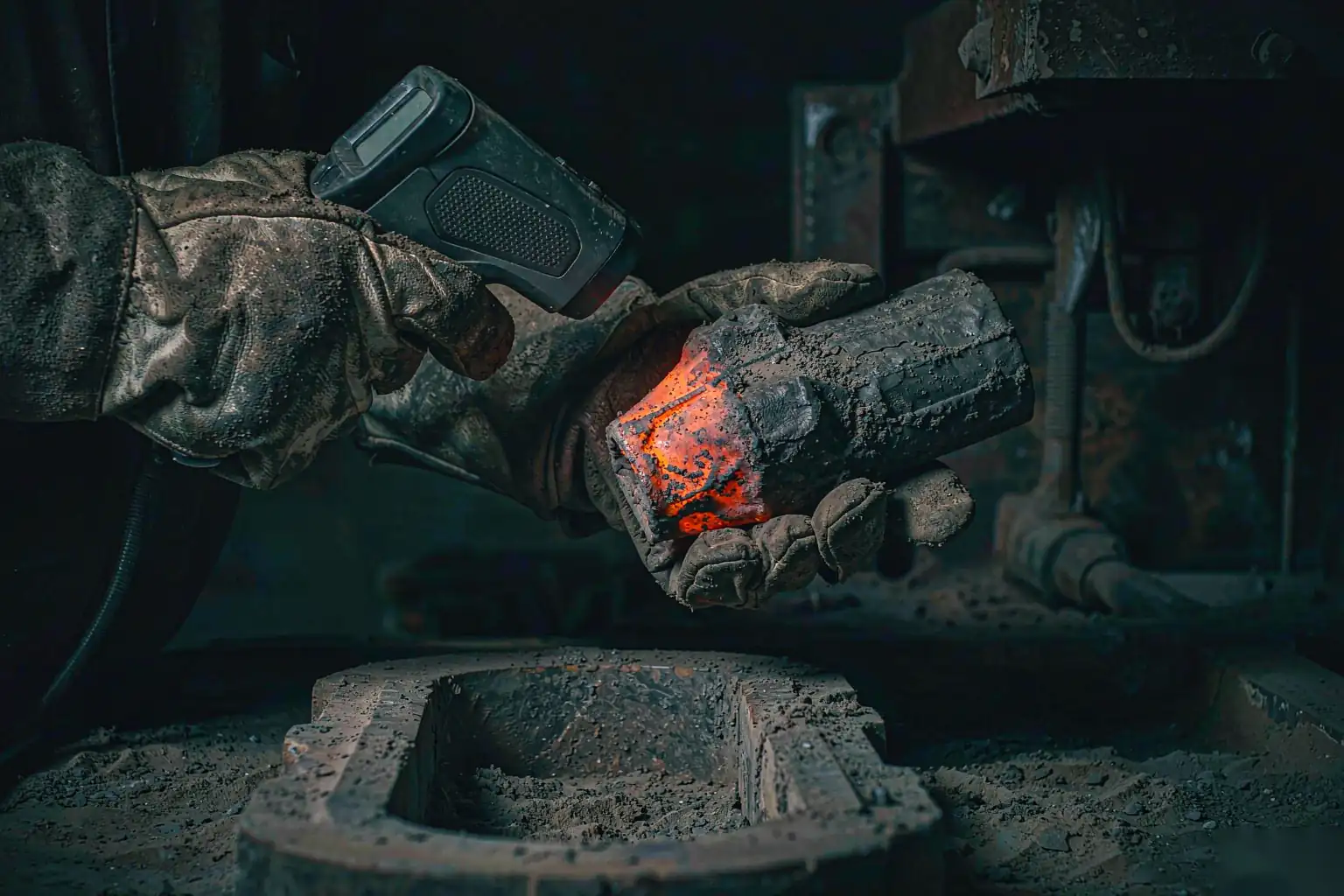
Pulling before the section reaches its target temperature does not create a single defect — it creates a family of them, each with a different signature. The most common is hot-tear cracking along thin-to-thick transitions, driven by the casting being pulled while still in its low-ductility range. Next is distortion: a thin-wall housing pulled at 800 °C can sag under its own weight once the mold support is gone. Finally, heavy sections can develop internal shrinkage or micro-porosity if shakeout interrupts the feeding and cooling regime that the riser design assumed.
| Symptom | Shakeout link | First corrective move |
|---|---|---|
| Hot tears at section joins | Pulled inside low-ductility band | Raise shakeout temp downward — hold 10–15 min longer |
| Out-of-flat thin walls | Low hot strength, mold support removed | Cool below 600 °C; add support fixtures |
| Core-related stuck sand | Binder not yet thermally broken down | Match shakeout to core collapse profile |
| Distorted after machining | Stress released when stock removed | Add stress-relief step; see heat treatment |
A useful cross-check is the foundry’s scrap log: if defects cluster on the first casting out of the mold each cycle, the casting shakeout window is usually the culprit rather than the melt. Compare against the common casting defects catalogue so the team does not mislabel a thermal crack as a sand inclusion. Radiation-based inspection per ASTM E446 can confirm whether an internal indication originated at shakeout.
Casting Shakeout Timing and the Cost of Patience
Holding a casting longer in the mold costs flask occupancy. On a line with a 4-minute takt and our 45 kg housing, a 900 °C casting shakeout needs about 21.5 flasks in circulation (86 min ÷ 4), while a 500 °C shakeout needs about 27 flasks (108 min ÷ 4). That is 5.5 extra flasks — roughly $6,600 in one-time tooling if a flask plus its mold costs around $1,200. The question is whether the later shakeout earns back that cash through lower scrap.
A breakeven you can run
Suppose early shakeout produces a 4.0% thermal-damage scrap rate and the controlled window cuts it to 1.2% — a 2.8-point swing. On 6,000 housings a year at $85 of accumulated material plus machining value per rejected part, that is 168 parts or $14,280 per year. Against the $6,600 flask investment, the controlled casting shakeout window pays back in about 5.5 months. The counter-case matters too: if your scrap rate is already below 1%, extra flasks may never pay back, and the better lever is faster cooling through mold-material choice — see green sand versus resin sand thermal behavior and the sand casting process page.
| Line item | 900 °C shakeout | 500 °C shakeout |
|---|---|---|
| Mold occupancy | ~86 min | ~108 min |
| Flasks in circulation | 21.5 | 27.0 |
| Flask investment | baseline | +$6,600 once |
| Thermal-damage scrap | 4.0% = $20,400/yr | 1.2% = $6,120/yr |
| Net year one | reference | +$7,680 ahead |
There is a second hidden cost on the other side. Sand that leaves with a hotter casting carries more heat into the sand reclamation loop, raising cooler load and binder breakdown. And when shakeout runs late, the mold-coating layer has more time to interact with the metal surface — a factor covered in our mold coating guide. Both effects are small per casting but scale with volume.

A Step-by-Step Casting Shakeout Window Study
For a new part, the cheapest way to set the casting shakeout window is a structured first-article study rather than a guess. This is also the study a buyer can ask a supplier to show during qualification — it is more revealing than a certificate.
- 1. Identify the controlling section. Mark the thickest modulus region and the thinnest hot-spot. Casting shakeout temperature is set by the section that either cools last or cracks first.
- 2. Instrument the first three molds. Embed thermocouples at the controlling section and at a surface point; record temperature versus time after pour.
- 3. Compute M and t_s. Use Chvorinov with a B value calibrated to your mold media, then compare predicted solidification to the thermocouple plateau.
- 4. Choose a target temperature band. Start mid-window from the alloy table, not at the edge.
- 5. Shake out a trial matrix. Pull one mold at each of three temperatures (e.g., 750, 600, 500 °C) and record distortion, hot tears, and core removal.
- 6. Lock the window into the work instruction. Specify a temperature and a tolerance band, plus a maximum hold time so an aborted cycle does not sit indefinitely.
- 7. Audit quarterly. Re-shake a sample when mold material, binder, or section design changes — all three shift the cooling constant.
This study dovetails with the first article inspection package and should reference the drawing’s datum scheme, because distortion is measured against datums. For investment castings the same logic applies with shell cooling instead of green sand; see our investment casting page, and for high-volume aluminum the die casting route moves the same question into die-temperature control.
How to Specify Shakeout in Your RFQ
Buyers rarely write shakeout requirements, which is why they inherit whatever the foundry defaults to. Add these eight fields to your next casting RFQ and you will get a much more comparable set of quotes.
| RFQ field | What to write |
|---|---|
| Alloy & spec | Exact grade, e.g., ASTM A536 65-45-12 |
| Controlling section | Location of max modulus on drawing |
| Target shakeout temp | Band at that section, e.g., 550–650 °C |
| Measurement method | Thermocouple or calibrated pyrometer + section |
| Max in-mold hold | Ceiling if the line stops mid-cycle |
| Post-shakeout handling | Fixtures or stacking limits for thin walls |
| Distortion limit | Flatness against drawing datums |
| Evidence | First-article cooling curve and scrap log |
Do not stop there. Float the same question up the supply chain: a supplier that controls casting shakeout with temperature rather than a stopwatch is usually the one that also controls pouring temperature and melting energy with data. If you need help turning a drawing into a controlled process, our mold-making and prototype casting teams can run the first-article study with you before you commit to production tooling.
FAQ
Is a hotter casting shakeout always faster and cheaper?
It is faster in mold occupancy but not necessarily cheaper. Early casting shakeout reduces flask count and shortens the cycle, yet it raises thermal-damage scrap. Our worked example shows the scrap saving outweighing the flask cost once the scrap swing exceeds roughly two percentage points. Run your own breakeven with your scrap rate and part value.
Can I use one shakeout time for all my castings?
No. Modulus drives solidification to the second power, so parts of the same alloy can differ by tens of times in required time. Set the casting shakeout point by a target temperature at the controlling section, then convert to time for each part number.
How accurate does temperature measurement need to be?
A repeatable ±25 °C at a defined section is enough for process control. The gain from chasing ±5 °C is usually smaller than the variation between sections. Calibrate the pyrometer to a traceable reference and always measure the same spot — emissivity changes on oxidized versus clean surfaces can swamp the instrument’s accuracy.
Does shakeout affect machining allowance?
Indirectly, yes. A casting shaken hot and then distorted may need extra cleanup stock to clean up on the machine, while a controlled casting shakeout holds geometry closer to nominal. See casting machining allowance for how allowance is set section by section.
What if the line stops with a mold still in the flask?
Define a maximum in-mold hold in the work instruction. A long hold usually does no metallurgical harm but blocks flask availability, and in some alloys extended slow cooling coarsens structure. If the stop exceeds the limit, quarantine those castings for inspection rather than mixing them into the normal stream.
*Data referenced from AFS / NADCA industry publications, ASTM A536 and E446, NIST metrology guidance, and Supro MFG shop-floor records. Cooling figures are worked estimates; validate against first-article thermocouple data for your part.
 English
 Français
 Deutsch
 Italiano
 日本語
 한국어
 Polski
 Português de Angola
 Русский
 Español de Argentina