
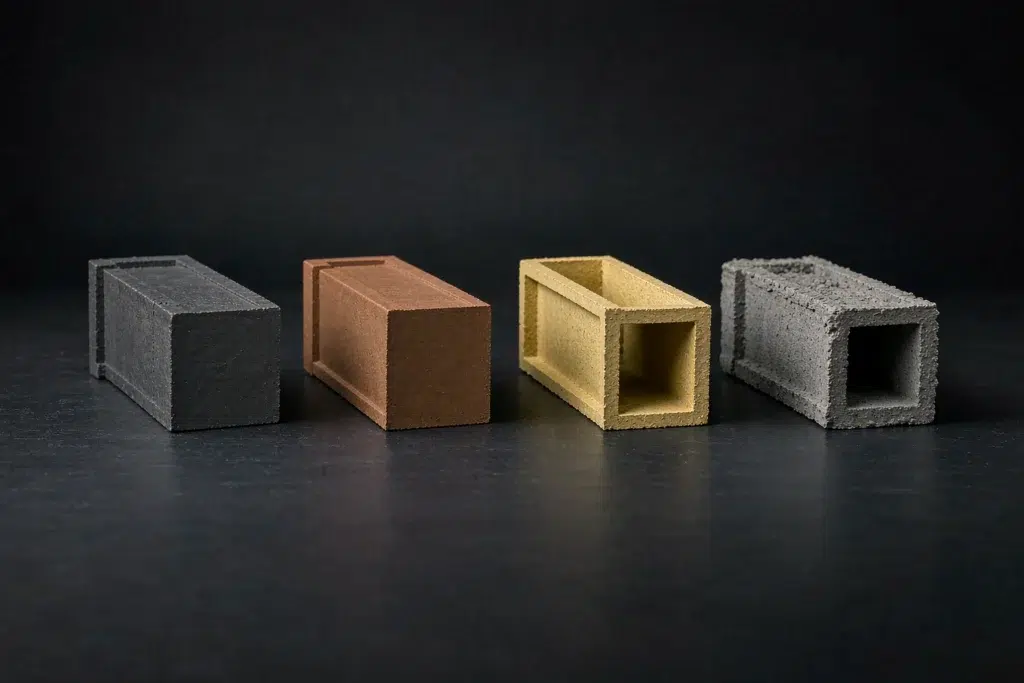
Foundry core making is the quiet variable that decides whether an internal passage ends up on the drawing or on the scrap pile. Buyers compare alloy grades, pouring temperature and machining allowances for weeks, then discover too late that the water jacket, oil gallery or hydraulic bore was never a machining problem at all — it was a core problem, set months earlier by a binder choice nobody put in the RFQ.
This guide treats foundry core making as an engineering and commercial decision, not a workshop detail. We compare four production routes on one part number, show the arithmetic behind binder level, gas evolution, cycle time, dimensional drift and cost per good casting, and give you the eight questions to ask on a supplier walk-through. Numbers below are an explicit shop-floor model with stated assumptions so you can re-run them on your own volumes; acceptance language is anchored to ASTM A536, ASTM E446 e ASTM A802, with process-control expectations drawn from AIAG core-tool practices. If you are new to the wider process, start with our guia de fundição de metais before working through this article.
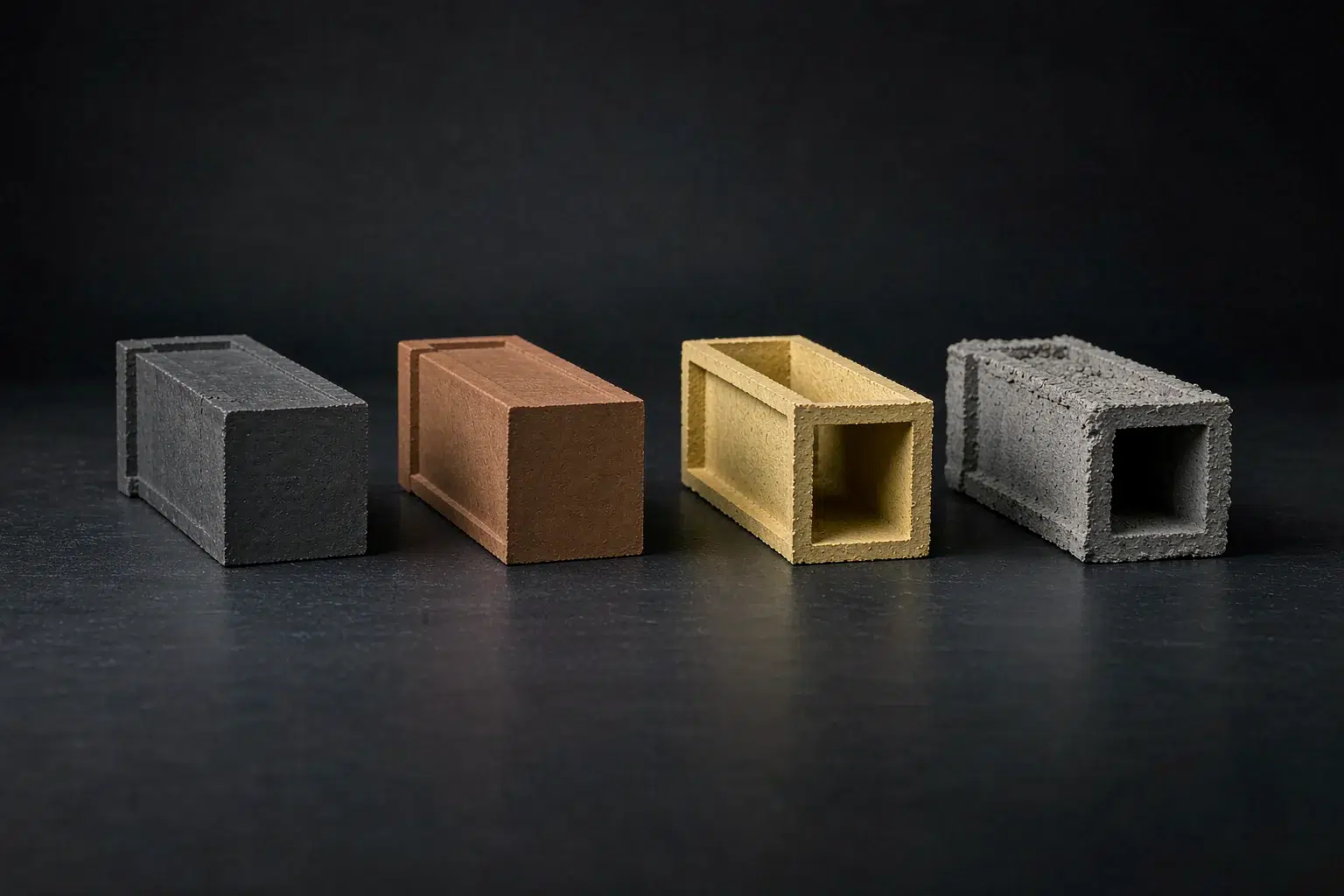
What Foundry Core Making Actually Controls
A core is the negative of an internal feature. Foundry core making is therefore a dimensional capability, not a consumables purchase. Where the mould defines the outside of a casting, foundry core making defines everything the customer cannot see until the part is sectioned or pressure-tested: wall thickness behind a boss, the radius of an oil gallery, the continuity of a cooling jacket, the straightness of a long hydraulic bore. Three consequences follow. First, error in a core is locked inside the part and cannot be corrected by a downstream operation without expensive Maquinação CNC or scrapping the casting. Second, the core is the largest single source of gas in the mould, so binder chemistry directly sets porosity risk — see our analysis of sand casting porosity and shrinkage. Third, the core must collapse after pouring, so its strength during filling and its weakness during shakeout are the same specification, not two.
Design geometry and production route are different decisions. In foundry core making, the drawing fixes the shape while the route fixes the repeatability. Our article on concepção de núcleos para fundição em areia covers core prints, chaplets, venting and core-box parting; this article covers how the core is actually made, because two cores drawn identically can behave completely differently in the mould. Foundry core making sits between tooling (casting moulds making) and melt practice (casting pouring temperature), and the interfaces are where most cost leaks occur.
Four Outputs A Buyer Is Really Buying
Translate a core quotation into four measurable outputs. Each has a test method and a clause you can write into a acordo de qualidade de fundição.
| Output | How It Is Measured | Failure Mode | Contract Hook |
|---|---|---|---|
| Internal geometry | CMM on sectioned first article; CT on pilot lot | Thin wall, blocked passage, core shift | Wall thickness min and Cpk target |
| Gas budget | LOI and gas evolution at 850 °C, ml/g | Blowholes, pinholes, subsurface pores | Max binder % and venting scheme |
| Hot strength | Tensile / transverse test on cured core | Core float, breakage, metal penetration | Min core strength at pour time |
| Collapsibility | Shakeout time; retained sand mass | Hot tearing, burnt-on sand, cleaning hours | Cleaning time per part, max shakeout residue |
The Four Foundry Core Making Routes Compared
Four routes cover almost every sand-cast internal feature. They differ in where the curing energy comes from, how much organic binder enters the mould, and how much tooling you must buy before the first core exists. The table below uses a single representative DN200 ductile-iron pump housing water-jacket core as the reference part, with a 40 × 60 mm nominal core cross-section, 200 mm length and 2,400 cm³ solid volume.
| Parâmetro | Cold Box (PU / Amine) | Hot Box (Furan / Phenolic) | Shell Core (Resin-Coated Sand) | No-Bake / CO2 Silicate |
|---|---|---|---|---|
| Binder on sand, % | 1.0–1.6 | 1.5–2.5 | 3.0–5.0 | 2.5–4.0 / 3–5 silicate |
| Core-box temperature | 20–30 °C (ambient) | 200–260 °C | 250–300 °C | Ambient |
| Cure / cycle time | 15–30 s | 30–90 s | 20–60 s skin formation | 20–60 min / 10–30 s gassing |
| Tooling and equipment | Steel box + amine generator + scrubber | Heated box + temperature control | Heated box + dump/invest machine | Wood / resin box, mixer, no heater |
| Dimensional capability, mm per 100 mm | ±0.30 | ±0.45 | ±0.25 | ±1.00 |
| Core mass, kg (reference part) | 3.60 (solid) | 3.60 (solid) | 1.10 (hollow, 4 mm skin) | 3.60 (solid) |
| Economical annual volume | > 5,000 | 1,000–10,000 | > 2,000, thin complex passages | < 500, prototypes, very large cores |
Route selection is not a beauty contest. Foundry core making should be selected backwards from the acceptance standard. It follows the geometry, the volume and the acceptance standard in that order. For a broader view of where each sits in the process family, see green sand casting, resin sand casting e shell mold casting. Note that shell moulding (making the outer cavity shell) and shell coremaking (making a hollow internal core) share a material but not a purpose; our investment casting mold article explains the separate ceramic-core route used when a passage is too fine for sand at all. For parts that cannot tolerate a sand core, serviços de fundição sob pressão e fundição à cera perdida are the usual alternatives.
Cold Box: Seconds, But A Chemistry Budget
Cold box mixes washed silica sand with a phenolic resin and a polymeric isocyanate, blows it into an unheated box at 0.4–0.7 MPa, then passes a tertiary-amine vapour through the packed sand. Cure is effectively instantaneous at room temperature: 15–30 s from blow to strip. That is why high-volume fundição em areia lines run cold box for water jackets and port cores. The price is a chemistry budget: the amine must be metered, the exhaust scrubbed, the sand temperature held in a narrow band, and the mixed sand used within its bench life. Sand temperature and humidity are the two variables that quietly move core strength, and they belong in the same control plan as your optimizing sand casting parameters work.
Hot Box And Shell: Heat As A Tooling Cost
Hot box cures a furan or phenolic binder against a 200–260 °C core box, typically with an acid catalyst latent in the mix. Shell core uses resin-coated sand dumped or blown into a 250–300 °C box; the skin forms for 20–60 s, then the uncured centre is drained back, leaving a hollow 3–8 mm shell. Both put heat into the tool, so box thermal expansion, heater zoning and release-agent build-up become dimensional variables, not maintenance trivia. That is a tooling-design question covered in casting mold design patterns e mastering sand casting mold materials. The energy is not free either; the DOE Industrial Efficiency and Decarbonization Office treats process heating as a measurable load, and a heated core box belongs in your plant energy model alongside the furnace.
No-Bake And CO2: Cheap Tooling, Slow Clock
Self-setting furan or phenolic binders, and sodium-silicate sand gassed with CO2, cure at ambient temperature with nothing more than a mixer and a simple box. Tooling can be wood or resin, which is why foundry core making for prototypes and very large one-off cores starts here. The trade is time: 20–60 min of cure before the core can be handled, plus manual finishing. For a metal prototype casting service or a 3D printing prototype that needs a real cast internal passage, this is the correct route — provided you accept the wider tolerance band. The NFPA guidance on combustible liquids and ventilation is relevant wherever solvent-bearing binders and amine are stored or mixed.
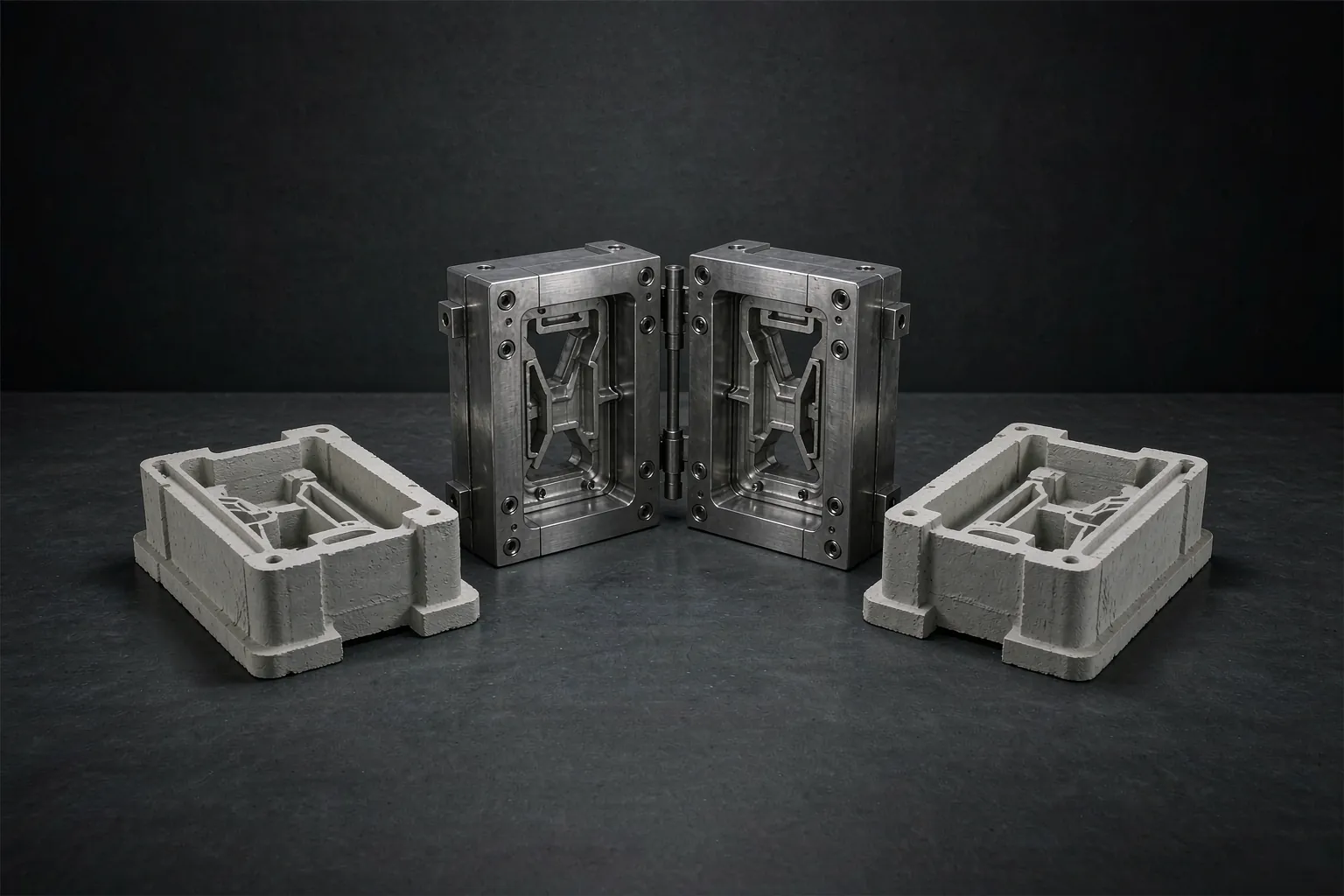
Binder Chemistry And The Gas Budget In Foundry Core Making
Organic binder is the gas source. Foundry core making therefore starts with a mass balance rather than a price list. At pouring temperature the resin decomposes and releases a volume of gas roughly proportional to how much binder went into the sand. A usable first-order shop model is gas evolution (ml/g) ≈ 11.5 × binder% + 3.0, measured on cured core samples at 850 °C, with the intercept standing for moisture and residual organics in the sand itself. Combine that with core mass and you get the number that actually matters: litres of gas per core, not ml/g of sand.
| Percurso | Binder % (model) | Gas, ml/g | Core mass, kg | Gas per core, L |
|---|---|---|---|---|
| Cold box | 1.3 | 18.0 | 3.60 | 64.8 |
| Hot box | 2.0 | 26.0 | 3.60 | 93.6 |
| Shell core | 4.0 | 49.0 | 1.10 | 53.9 |
| No-bake | 3.0 | 37.5 | 3.60 | 135.0 |
Here is the counter-intuitive result that trips up a lot of RFQ comparisons. Resin-coated sand has by far the highest binder level and the highest gas per gram — 49.0 ml/g, nearly 2.7 times the cold-box figure — yet the hollow shell core releases the lowest gas per part at 53.9 L, 16.8% less than the solid cold-box core and 60.1% less than the no-bake core. A 4 mm skin on a 40 × 60 mm section leaves a shell area fraction of 736 / 2,400 = 30.7%, so core mass drops from 3.60 kg to 1.10 kg. Judging cores by binder percentage alone will lead you to reject the cleanest option.
Gas still has to leave the mould. Venting, core-print clearance and coating permeability decide whether 53.9 L escapes through the vents or into the metal. That is why foundry core making cannot be specified in isolation from casting mold coating, sand casting tools and gating system design and controlo da turbulência do fluxo na fundição em areia. If porosity does appear, the diagnostic sequence in crushing sand casting porosity and the defect map in defeitos comuns na fundição e como evitá-los will tell you whether the signature is gas, shrinkage or penetration. Radiographic acceptance for steel castings is normally referenced to ASTM E446 reference radiographs; visual surface acceptance to ASTM A802; and ductile-iron grade and properties to ASTM A536. Where a pore is found in a cored passage, AWS welding-repair guidance is the usual starting point for deciding if salvage is even permissible.
Cycle Time: Foundry Core Making Sets The Line Rate
A moulding line can only close as fast as its cores arrive. Foundry core making is the upstream bottleneck most capacity plans forget. Take a two-cavity machine for cold and hot box, a single-cavity shell machine, and six parallel no-bake boxes with a 30-minute cure. Effective output and the hours needed for a 60,000-core annual programme are below.
| Percurso | Cycle / cavities | Cores per hour | Hours for 60,000 | Practical implication |
|---|---|---|---|---|
| Cold box | 25 s / 2 | 288 | 208 | One machine, spare capacity for a second part number |
| Hot box | 60 s / 2 | 120 | 500 | One machine, plus heater maintenance windows |
| Shell core | 45 s / 1 | 80 | 750 | One machine on single-shift plus overtime buffer |
| No-bake / CO2 | 30 min / 6 boxes | 12 | 5,000 | 2.5 labour-years, large floor area, six tool sets |
At 4,000 effective machine-hours per year on two shifts, the cold-box route uses 5.2% of one machine’s capacity while the no-bake route needs 1.25 machine-equivalents and a small army of hands. That gap is not a labour-rate problem; it is a fixed-capacity problem that shows up as missed deliveries and premium freight. It also explains why a cheap no-bake core becomes expensive exactly when a programme succeeds. Feed these hours into your discriminação dos custos de fundição e casting scrap rate model rather than treating cores as an overhead line; our casting total cost of ownership article shows how this kind of capacity assumption changes a supplier ranking.
Dimensional Accuracy And Core Movement
Core dimensions drift for three reasons: in foundry core making, all three are measurable before any metal is poured. the box itself (machining and thermal growth), the cure (shrinkage or expansion of the bond), and handling (sag, breakage, float under buoyancy). Capability figures below are per 100 mm of core length; on a 200 mm core they double. Assume a nominal 6.0 mm wall over the core and a design minimum of 5.0 mm.
| Percurso | Capability, mm / 100 mm | Deviation on 200 mm, mm | Worst wall, mm | Margin vs 5.0 mm min |
|---|---|---|---|---|
| Shell core | ±0.25 | ±0.50 | 5.50 | +0.50 pass |
| Cold box | ±0.30 | ±0.60 | 5.40 | +0.40 pass |
| Hot box | ±0.45 | ±0.90 | 5.10 | +0.10 marginal |
| No-bake | ±1.00 | ±2.00 | 4.00 | −1.00 fail |
The no-bake route fails the wall minimum outright, and the usual “fix” is to add 1.5 mm of process stock to the nominal wall. That is not free. With a wetted passage area of 0.084 m², an extra 1.5 mm adds 126 cm³ of iron ≈ 0.91 kg per casting, or 54.4 t per year at 60,000 pieces; at 0.62 USD/kg of metal that is roughly 33,700 USD of extra metal per year to compensate for a tooling shortcut. Cheaper core boxes, heavier castings. Capability data belongs in the guia de tolerâncias de fundição conversation and in your casting machining allowance budget, with verification planned through métodos de inspeção de peças fundidas and a documented casting first article inspection.
Core prints, chaplets and vent channels are the mechanical countermeasures; their layout is a design question we cover separately in concepção de núcleos para fundição em areia. Feeding and pressure interactions sit with casting riser design. Where an internal passage ends up out of tolerance, disposition logic follows casting nonconformance rather than an informal “use as is” note. Measurement traceability should follow the NIST metrology framework so a Cpk argument survives a customer audit.
Foundry Core Making Economics: Cost Per Core Vs Cost Per Good Casting
Now put the four routes on one P&L. Foundry core making has to be compared on the same denominator as scrap. Assumptions: 60,000 castings per year, one core per casting, finished casting value 42 USD, sand 0.09 USD/kg, cold-box binder 3.20 USD/kg, hot-box binder 2.60 USD/kg, no-bake binder 2.40 USD/kg, resin-coated sand 0.42 USD/kg, iron 7.2 g/cm³, metal 0.62 USD/kg. Core-related scrap rates are taken from the same model programme: 1.9% cold box, 2.4% hot box, 0.7% shell, 3.5% no-bake. Every scrapped casting loses its full value.
| Percurso | Sand + binder, USD/core | Energy + labour + amort., USD/core | Total, USD/core | Scrap rate |
|---|---|---|---|---|
| Cold box | 0.324 + 0.150 | 0.030 + 0.012 + 0.120 | 0.64 | 1.9% |
| Hot box | 0.324 + 0.187 | 0.085 + 0.140 | 0.74 | 2.4% |
| Shell core | 0.462 (coated sand) | 0.065 + 0.150 | 0.68 | 0.7% |
| No-bake | 0.324 + 0.259 | 0.000 + 0.850 | 1.43 | 3.5% |
| Percurso | Cores, USD/year | Scrapped castings | Scrap loss, USD/year | Total, USD/year |
|---|---|---|---|---|
| Cold box | 38,400 | 1,140 | 47,880 | 86,280 |
| Hot box | 44,400 | 1,440 | 60,480 | 104,880 |
| Shell core | 40,800 | 420 | 17,640 | 58,440 |
| No-bake | 85,800 | 2,100 | 88,200 | 174,000 |
The comparison that matters is cold box versus shell core. Shell cores cost 0.04 USD more each — 2,400 USD/year more in core spend — but they cut scrap loss by 30,240 USD/year, so the route that looks more expensive on a per-core quote is 27,840 USD/year cheaper in total. Against an incremental 58,000 USD for a shell machine, coated-sand supply and a converted core box, payback is 58,000 / 27,840 × 12 = 25.0 months. A buyer who ranks suppliers by core price alone will select the second-best route. This is the same denominator trap we describe in casting price per kg e casting total cost of ownership; it is also why a pedido de cotação para fundição should ask for both core cost and core-related scrap history.
Where The Savings Actually Come From
Break the 27,840 USD into its parts: 30,240 USD of avoided scrap, minus 2,400 USD of extra cores. Roughly 92% of the benefit is quality, not purchasing. Add the 33,700 USD of metal that a no-bake process-stock fix would have cost, and the case for specifying the core route at RFQ stage becomes obvious. Cleaning and shakeout time also improve with a hollow shell core, which flows into surface treatment services cost; downstream heat treatment services cannot repair a core-generated pore, so prevention is the only economic lever. For ductile-iron pump and valve work, see also our iron casting solutions e how to choose a casting alloy.
Sand Temperature And Humidity: Hidden Capex In Foundry Core Making
Cold-box chemistry is temperature-sensitive enough to be a seasonal risk. Foundry core making in an unconditioned core room is a summer-quality risk. Using a Q10 ≈ 2 rule on bench life with a 3.0 h reference at 20 °C, and an inverted-U strength curve peaking near 25 °C, a summer sand-temperature excursion changes the process window as follows.
| Sand temperature | Mixed-sand bench life, h | Immediate tensile strength, MPa | Practical consequence |
|---|---|---|---|
| 15 °C | 4.24 | 1.72 | Slow amine cure, longer blow-to-strip |
| 20 °C | 3.00 | 1.95 | Nominal window |
| 25 °C | 2.12 | 2.05 | Peak strength, shorter batch life |
| 30 °C | 1.50 | 1.62 | Smaller mix batches, more waste |
| 35 °C | 1.06 | 1.18 | −42% strength, breakage and core shift |
At 35 °C the mixed sand must be consumed in about an hour, and core strength has fallen 42% from peak. If that adds 0.8 percentage points of core-related scrap, it costs 480 castings × 42 USD = 20,160 USD/year on our 60,000-piece programme, while the wasted sand itself is only about 2,300 USD/year. A 28,000 USD sand-temperature conditioning unit pays back in roughly 16.7 months on the scrap avoidance alone. The lesson generalises: in foundry core making, the cheapest thing in the box (sand) is often the most expensive thing to leave uncontrolled. Sand condition also drives the reclamation loop discussed in foundry sand reclamation, and the same instrumentation discipline applies to casting incoming inspection plans. Aluminium foundries face a parallel moisture sensitivity in A356 work, which the Aluminum Association addresses in its industry guidance.
Emissions, Waste And Compliance
Amine vapour, solvent-bearing binders and spent core sand are regulated materials, not housekeeping. Foundry core making carries a compliance footprint that buyers increasingly audit. A cold-box cell needs a sealed gas circuit, an acid scrubber and monitoring of the amine supply; a shell or hot-box cell adds thermal-oxidation or ventilation for cure fumes. Ask the supplier for the solvent and binder mass balance per 1,000 cores, not just a “we comply” statement. The EPA Sustainable Materials Management programme and the EU waste and recycling framework are the reference points for spent foundry sand classification; GHG Protocol Scope 3 accounting is where binder-derived process emissions usually enter a customer’s inventory. Binder level therefore has a second cost: a shell core with 4% resin produces more organic decomposition products per kilogram of sand even though its hollow geometry reduces the total per part. Both numbers belong in the same disclosure.
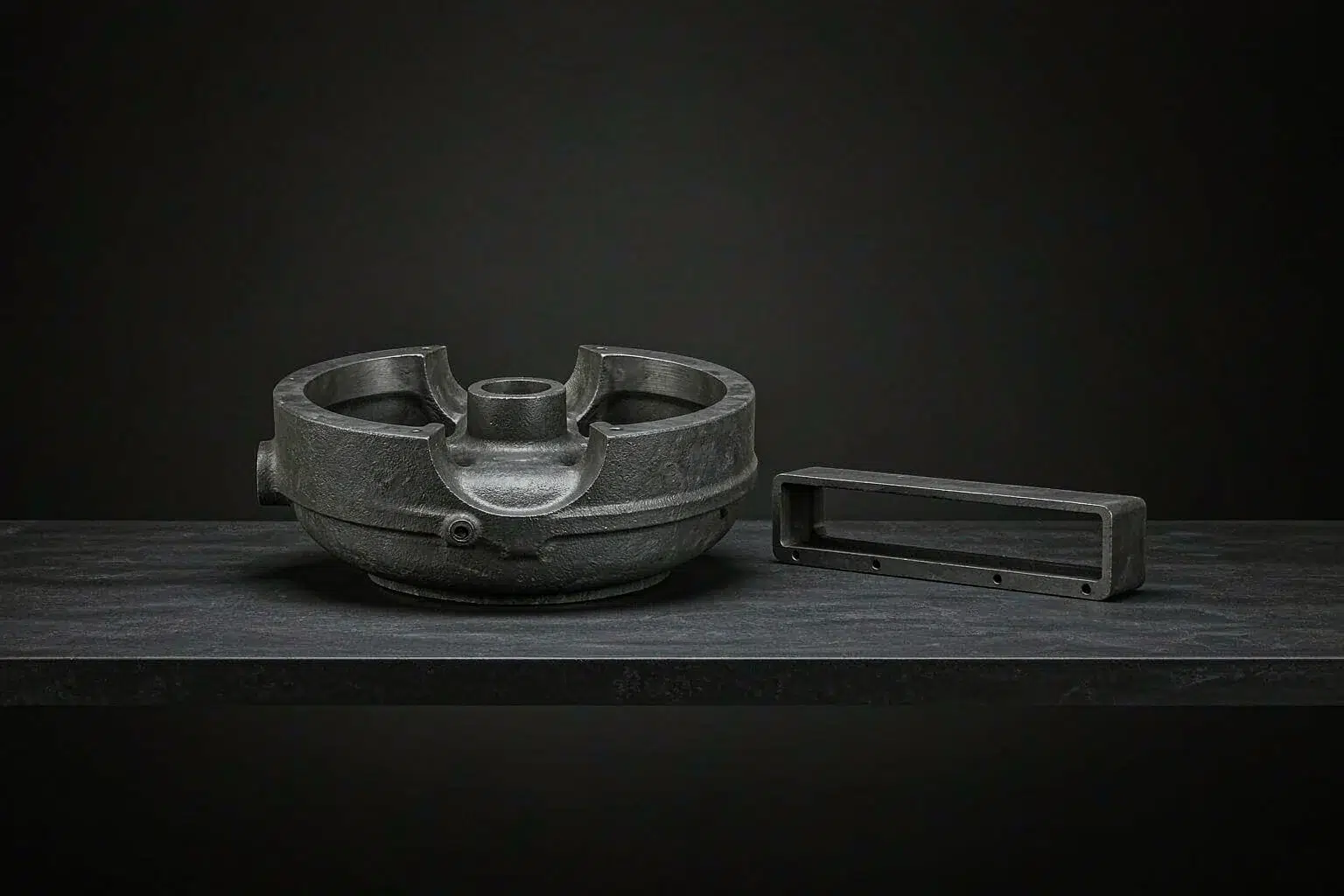
Buyer Due Diligence: Foundry Core Making On The Shop Floor
A core route is easy to claim and hard to fake. Foundry core making evidence is the fastest test of a supplier’s process discipline. Eight questions, asked in the core room with the shift supervisor rather than in a meeting room, will separate a controlled process from a hopeful one. Our foundry audit checklist e auditoria a fornecedores de peças fundidas give the full scoring frame; this is the core-specific slice.
| # | Ask For | Pass Evidence | Red Flag |
|---|---|---|---|
| 1 | Route and binder spec per part number | Written route sheet, binder % with tolerance | “Same for all our jobs” |
| 2 | 30 days of sand temperature / humidity logs | Continuous trace, defined action limits | No data, or weekend gaps |
| 3 | Core strength test records with time stamps | Per-shift samples tied to mix batch | Single “typical” value |
| 4 | LOI / gas evolution trend | Control chart, upper spec line | No LOI measurement at all |
| 5 | Core-box maintenance and vent cleaning | Shot-count-based cleaning interval | “We clean when it looks dirty” |
| 6 | Core-related scrap Pareto, last 12 months | Separate gas / shift / breakage categories | All scrap lumped as “quality” |
| 7 | Wall-thickness CMM data on cored sections | Cpk with the min-wall limit shown | Only pass/fail on a go-no-go gauge |
| 8 | Amine / fume abatement and waste manifests | Scrubber service log, disposal records | No documentation available |
Items 2, 3 and 7 are the ones most often missing, and they are precisely the ones that predict the 27,840 USD gap above. AIAG-style process-control expectations make a per-shift strength record a reasonable request, not an unusual one. Where a supplier cannot separate core-related scrap, the casting nonconformance e casting defect claim routes become slow and expensive; a written casting incoming inspection plan is the fallback.
RFQ Checklist For Foundry Core Making
Put these eight fields in the RFQ so quotations are comparable. Foundry core making belongs in the RFQ, not in a post-award clarification. Without them, a supplier can quote a no-bake core against a cold-box core and appear 20% cheaper while delivering a part that fails wall thickness.
| Field | What To Require | Why It Matters |
|---|---|---|
| Core route and binder system | Named route, binder %, supplier | Sets gas, dimensional and cost baselines |
| Core mass and shell thickness | kg per core; hollow/solid declared | Converts ml/g into litres per part |
| Dimensional capability | mm per 100 mm, plus Cpk on min wall | Prevents hidden process-stock mass |
| Venting and coating scheme | Vent path, wash type, dry film thickness | Closes the gas escape path |
| Core-box ownership and life | Owner, shot count, refurb interval, storage | Avoids a tooling hostage situation |
| Cycle time and capacity | Cores/hour, cavities, effective hours/year | Confirms the delivery promise |
| Core-related scrap history | 12-month rate by failure category | Separates quote price from landed cost |
| Controlo de alterações | Written notice + re-PPAP on route/binder change | Stops silent route swaps after approval |
The change-control line is the one buyers omit most often and regret most. A foundry under cost pressure can switch from cold box to a cheaper self-set binder without changing a single drawing dimension; the drawing stays compliant while gas-derived porosity doubles. Tie any route change to a new casting first article inspection and a acordo de qualidade de fundição amendment. Commercial clauses on price adjustment belong with casting price adjustment e pedido de cotação para fundição practice.
A 30-Day Validation Plan
Week 1: freeze the route sheet, collect 30 days of sand-temperature and strength logs, and section three production castings to measure the cored wall at its thinnest point. Week 2: run a designed comparison on 200 cores — two binder levels or two cure times — and record gas evolution, core mass and handling breakage. Week 3: cast a pilot lot with the chosen setting, radiograph or CT the internal passages, and compute Cpk against the minimum wall. Week 4: close the commercial loop with a core-cost plus scrap-cost comparison, then write the route, binder level, venting scheme and change-control clause into the purchase order. Our guides to sand casting defects elimination, métodos de inspeção de peças fundidas e casting incoming inspection plans supply the test detail; optimizing sand casting parameters covers the DOE structure. For aluminium parts where the core interacts with hydrogen solubility, add the checks in A356 vs A380 alloy selection.
Foundry core making rewards buyers who specify it early. Once tooling is cut and the route is fixed, every later correction is a process-stock addition, a machining operation or a scrap claim. Put the core in the RFQ, put the numbers in the purchase order, and the internal passage stops being a surprise.
Perguntas frequentes
Which foundry core making route is cheapest?
No-bake has the lowest tooling cost, and cold box the lowest cost per core above about 5,000 pieces a year. But in our 60,000-piece model the shell route was cheapest overall at 58,440 USD/year of core plus scrap cost, versus 86,280 USD for cold box. Specify on total cost per good casting, never on core price alone.
Does a higher binder percentage always mean more porosity?
Per kilogram of sand, yes: gas evolution rises roughly linearly with binder level. Per finished core, not necessarily. A hollow shell core with 4% resin weighs 1.10 kg against a 3.60 kg solid cold-box core, so it releases 53.9 L of gas versus 64.8 L. Geometry can outweigh chemistry.
Can I use one core route for prototypes and series production?
Technically yes, commercially rarely. Prototypes justify no-bake or 3D-printed sand cores because tooling is cheap; series volumes above a few thousand need cold box or shell to hold cycle time and wall thickness. Treat a route change as a formal engineering change with a new first-article inspection.
What should be in a core-related acceptance clause?
Minimum wall thickness with a Cpk target, maximum binder percentage, the venting and coating scheme, core strength at pour time, and a change-control requirement. Reference ASTM E446 for radiographic severity levels, ASTM A802 for visual surface acceptance and ASTM A536 for ductile-iron grade requirements where relevant.
Why does sand temperature matter so much for cold box?
Amine-cured polyurethane chemistry is temperature-sensitive. In the model above, going from 20 °C to 35 °C halves mixed-sand bench life from 3.0 h to 1.06 h and cuts immediate tensile strength from 1.95 MPa to 1.18 MPa. Sand conditioning is therefore process equipment, not comfort equipment.
How do I know a core caused a porosity problem?
Core gas pores cluster near internal passages and often appear in the same location across a batch, while shrinkage sits at hot spots and feeding discontinuities. Compare the pore map against core vents and prints, then check the LOI trend and core-baking records for the affected lots before changing the melt practice.
*Figures are an illustrative shop-floor model with the assumptions stated in the text; standards referenced from ASTM, AIAG and NIST publications and Supro MFG process records.
 English
 Français
 Deutsch
 Italiano
 日本語
 한국어
 Polski
 Português de Angola
 Русский
 Español de Argentina