
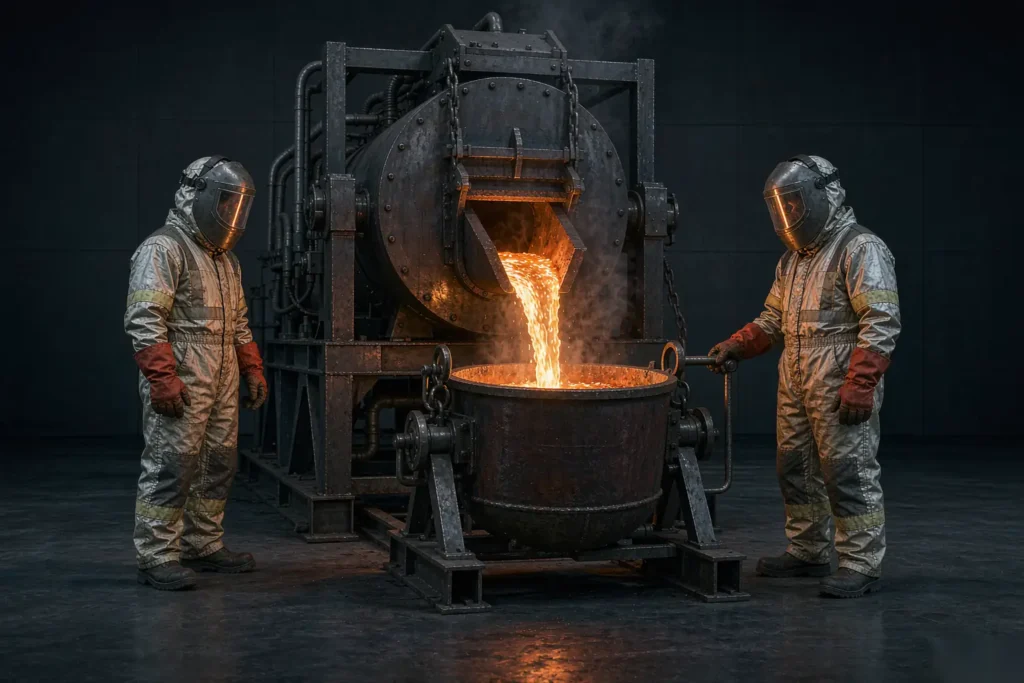
Energy is usually the second-largest conversion cost in an iron foundry, and the least specified line in a casting RFQ. Serious foundry energy efficiency work does not start with the utility contract: it starts with the enthalpy needed to turn room-temperature charge into liquid metal, the yield that decides how many tonnes must be melted per tonne shipped, and a denominator that most suppliers never write down.
This article builds a physical energy balance for ductile iron from first principles, compares four furnace routes on the same boundary, shows why four legitimate denominators produce answers that differ by 1.75×, and ranks six improvement levers by payback using one worked 6,000-tonne-per-year plant. Every figure below is computed from stated inputs, so you can substitute your own metres and rates. The aim is a foundry energy efficiency baseline you can defend in a supplier review, not a shopping list of equipment. For standards and programme context see the US DOE Industrial Efficiency and Decarbonization Office, the IEA, and the GHG Protocol on inventory boundaries. If you need the wider process map first, start with our metal casting guide.
Why Foundry Energy Efficiency Is Decided at the Furnace, Not in the Utility Contract
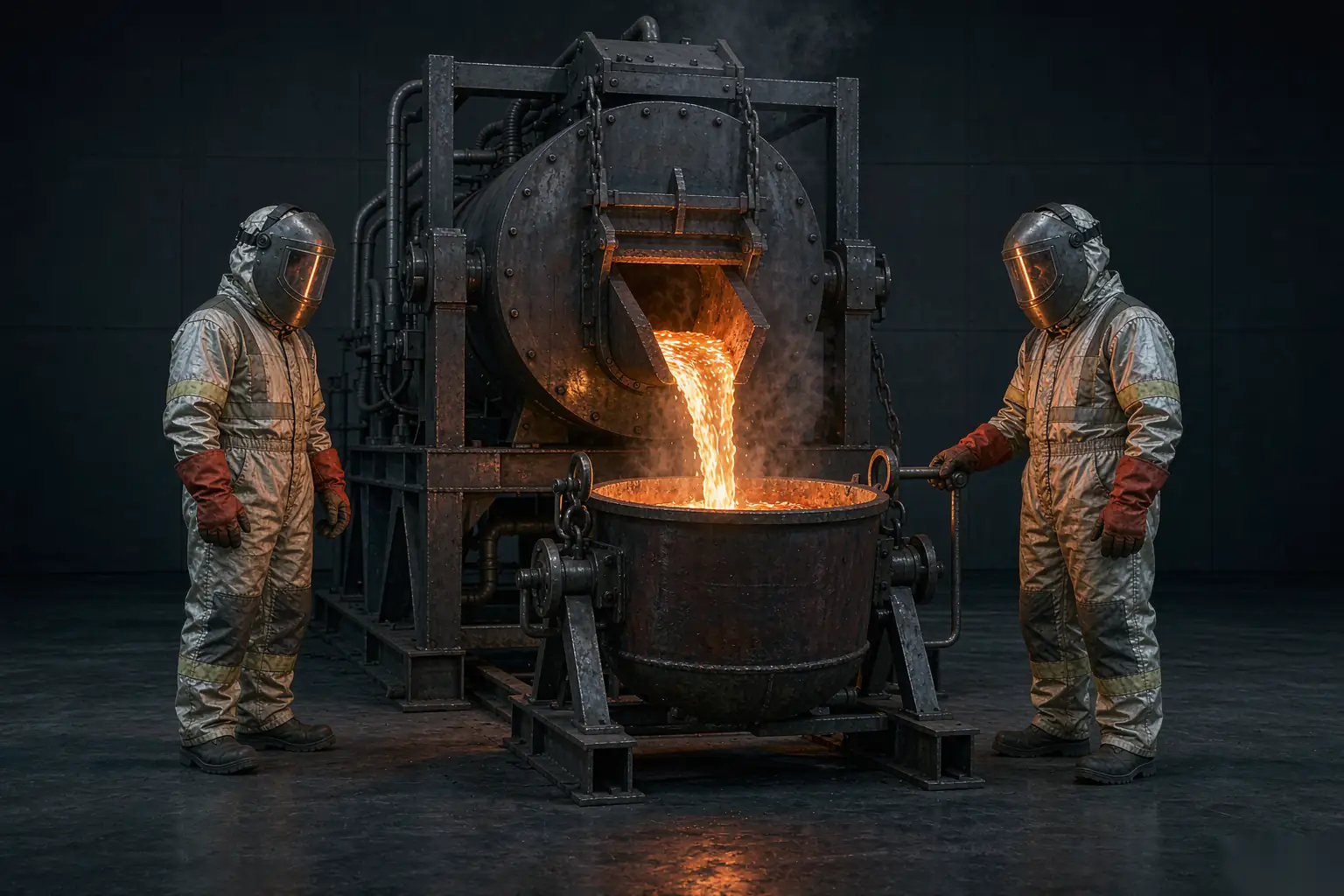
Buyers often treat energy as a price to be negotiated. It is really a quantity to be designed. A tonne of ductile iron has to be raised from 25 °C to roughly 1,500 °C before it can be poured, and physics sets a floor under that requirement that no tariff can move. Foundry energy efficiency is therefore bounded by metallurgy first and by procurement second. A good electricity price applied to a badly chosen denominator still produces an expensive casting; a mediocre price on a well-controlled melt deck frequently does not. That is why foundry energy efficiency belongs in the process specification rather than in a commercial appendix.
This distinction matters commercially because energy is rarely quoted as a separate line. It is buried in the conversion-and-margin block of a casting cost breakdown, or hidden inside a price per kg that was normalised to a different weight basis. When a supplier says their energy cost fell, the first question is not “what rate did you get” but “what did you divide by”. We return to that question in the measurement section, because it changes the reported number more than most capital projects do. A foundry energy efficiency claim without an explicit denominator is not a measurement.
- Thermodynamic floor. Heating, melting and superheating iron to tapping temperature needs about 361 kWh per tonne of liquid metal. No commercial furnace reaches that number.
- Conversion losses. Refractory heat storage, radiation from an open bath, coil cooling water and cold starts account for the gap between the floor and the meter.
- Yield multiplier. Every tonne of good castings requires more than a tonne of metal to be melted, because runners, risers and returns must also go through the furnace.
- Schedule multiplier. Metal held hot while moulds wait consumes energy without producing anything. Holding is a planning cost wearing an engineering disguise.
The Energy Balance of One Tonne: Where the kWh Go in Foundry Energy Efficiency
Take ductile iron with a liquidus near 1,150 °C, a solid heat capacity of 0.65 kJ/kg·K, a latent heat of fusion of 272 kJ/kg, and a liquid heat capacity of 0.85 kJ/kg·K. Heating the solid from 25 °C to 1,150 °C takes 0.65 × 1,125 = 731.3 kJ/kg. Melting it takes another 272 kJ/kg. Superheating the liquid from 1,150 °C to a 1,500 °C tap takes 0.85 × 350 = 297.5 kJ/kg. The sum is 1,300.8 kJ/kg, or 1,300.8 MJ/t, which converts at 3.6 MJ/kWh to 361.3 kWh/t of liquid metal. That is the invoice-free minimum.
A medium-frequency induction furnace on a well-run iron melt deck typically draws about 560 kWh per tapped tonne. The ratio 361.3 / 560 gives a thermal efficiency of 64.5%, leaving 198.7 kWh/t unaccounted for as useful heat. That remainder is not a defect, it is the cost of containment: you cannot hold 1,500 °C metal without a refractory lining, and you cannot couple an induction coil to a bath without electrical and cooling losses. Understanding foundry energy efficiency means knowing which of those losses are fixed by the equipment and which are fixed by how the equipment is run. This split is the first thing a foundry energy efficiency audit should establish.
| Balance item | Calculation | kWh per tapped tonne |
|---|---|---|
| Solid heating, 25 → 1,150 °C | 0.65 × 1,125 / 3.6 | 203.1 |
| Latent heat of fusion | 272 / 3.6 | 75.6 |
| Liquid superheat, 1,150 → 1,500 °C | 0.85 × 350 / 3.6 | 82.6 |
| Theoretical minimum | 1,300.8 / 3.6 | 361.3 |
| Actual induction input | Metered, cold-charge practice | 560.0 |
| Containment and conversion loss | 560.0 − 361.3 | 198.7 |
Three Losses That Never Appear On The Nameplate
First, refractory heat storage: every cold start re-heats the lining before it heats the charge. On a 5-tonne furnace a cold start can add roughly 180 kWh of effectively unproductive demand, which is why the number of starts per day matters as much as the tonnes melted. Second, open-bath radiation and coil cooling: an uncovered bath loses continuously, and coil losses rise as the bath level falls. Third, charge packing: loose, oxidised, light scrap traps air and slag, extends melt-down time, and drives up both kWh and dross. Charge preparation is a melt treatment issue as much as a cost one, and the metallurgical consequences of a slow, dirty melt are discussed alongside degassing and inoculation practice there.
Furnace Choice Sets the Floor for Foundry Energy Efficiency
Furnace selection is the one decision that fixes the achievable band for the life of the plant, and it is frequently evaluated on the wrong boundary. Comparing site electricity against site coke, or final energy against primary energy, produces opposite winners from the same data. The table below keeps both columns visible. A coke-fired cupola at 110 kg of coke per tonne consumes 110 × 8.1 = 891 kWh/t of chemical energy plus about 25 kWh/t of blast electricity, so roughly 916 kWh/t at the site boundary. An induction furnace draws 560 kWh/t of electricity, but at a grid primary-energy factor of 2.4 that is 1,344 kWh/t of primary energy. The induction route looks better on a site meter and worse on a primary-energy or grid-carbon basis, depending on how the grid is supplied.
| Route | Site energy, kWh/t | Primary energy, kWh/t | Practical constraint |
|---|---|---|---|
| Medium-frequency induction (iron) | 560 electric | 1,344 @ 2.4× | Charge must be dry, sized, low in rust |
| Coke cupola (iron) | 916 (891 coke + 25 blast) | ~916 + coke upstream | Sulphur pick-up, emissions control, coke quality |
| Electric arc (steel) | 450 electric + 60 gas preheat | ~1,140 | Electrode consumption, demand charges |
| Gas crucible (aluminium) | 750 gas, ~225 useful @ 30% | ~750 + gas upstream | Oxide dross, hydrogen pickup, crucible life |
This is also where energy accounting and carbon accounting part company. Our casting carbon footprint analysis works in CO2e per tonne and treats purchased metal as a constant 1.0 t per tonne shipped, so yield there mostly changes the melting burden rather than the embodied metal. Here we work in kWh and the melting burden is the whole story. Neither view is wrong; they answer different questions, and a supplier who mixes them in one spreadsheet will usually quote you the flattering one. A foundry energy efficiency comparison across two alloys is only meaningful on a common boundary. For foundries running green sand casting or our sand casting services, the iron route dominates the total, while aluminium and stainless work should reference the Aluminum Association and worldstainless data instead.
Yield Is the Biggest Multiplier in Foundry Energy Efficiency
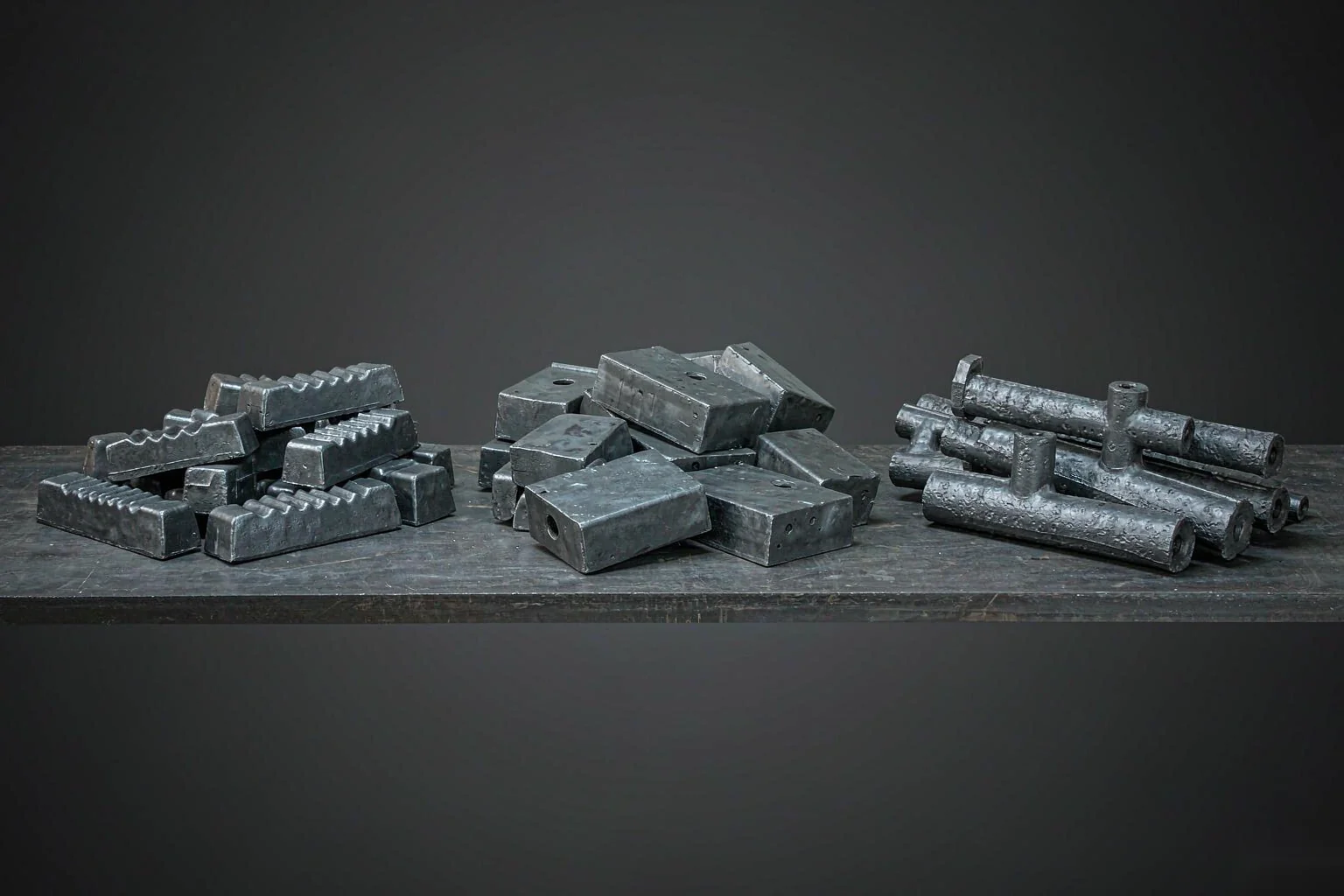
Casting yield is the mass of good castings divided by the mass of metal poured. At 62% yield, one tonne of saleable castings requires 1 / 0.62 = 1.6129 tonnes to be melted, so the melting electricity per tonne of good castings is 1.6129 × 560 = 903.2 kWh/t. Raise yield to 70% and the same arithmetic gives 1.4286 tonnes and 800.0 kWh/t. That single process change removes 103.2 kWh/t, or 11.4%, without touching the furnace, the tariff or the lining. Yield is therefore the highest-leverage foundry energy efficiency variable available to a methods engineer.
| Casting yield | Metal melted per t shipped | Melting kWh per t shipped | Index (62% = 100) |
|---|---|---|---|
| 55% | 1.8182 t | 1,018.2 | 113 |
| 62% baseline | 1.6129 t | 903.2 | 100 |
| 70% | 1.4286 t | 800.0 | 89 |
| 78% | 1.2821 t | 718.0 | 79 |
Why Running Returns Does Not Erase The Penalty
A common objection is that risers and runners are remelted in-house, so no metal is “wasted”. True for material, false for energy. In steady state the foundry still has to put 1.6129 tonnes through the furnace for every tonne that leaves the gate, and every pass through the furnace pays the full 560 kWh/t again. Returns also carry oxide and sand, so their effective melt cost is slightly worse than clean pig iron. The engineering answer is smaller and fewer risers, not more recycling: see casting riser design and mould and pattern design, or use casting simulation to prove the feeding change before cutting tooling. Yield improvements also reduce the scrap rate exposure, but the two metrics are not interchangeable and should have separate denominators in the monthly report.
Holding, Superheat and the Schedule: Three Quiet Drains on Foundry Energy Efficiency
The melt is only half the plant. A holding furnace on iron draws on the order of 40 kWh per tonne per hour. If scheduling leaves liquid metal waiting 2.5 hours on average, that is 100 kWh/t of pure standby; tightening the pouring cadence to 1.0 hour cuts it to 40 kWh/t and saves 60 kWh/t, about the same as a 5-point yield gain. Superheat is the second quiet drain: raising tap temperature by 60 °C requires 0.85 × 60 / 3.6 = 14.2 kWh/t of useful heat, which at 64.5% efficiency becomes 22.0 kWh/t of input, while adding real risk of sand burn-on, shrinkage and gas pickup. Cold starts are the third: a plant running four starts a day at roughly 180 kWh of extra lining heat each, cut to two larger heats, avoids 2 × 180 × 250 = 90,000 kWh/year.
| Non-melting load | Basis | Annual kWh (6,000 t plant) |
|---|---|---|
| Holding standby, 2.5 → 1.0 h | 40 kWh/(t·h) × 1.5 h × 6,000 | 360,000 saved |
| Cold starts, 4 → 2 per day | 180 kWh × 2 × 250 days | 90,000 saved |
| One 3 mm compressed-air leak | 0.5 m³/min → 3.6 kW × 6,000 h | 21,600 wasted |
| Unnecessary 60 °C superheat | 22.0 kWh/t × 6,000 | 132,000 wasted |
None of these appear in a furnace efficiency figure, which is why a plant can buy a new furnace and see no change in the bill. The fixes are scheduling and discipline problems: synchronise mould availability with tapping, keep ladles preheated, batch heats to the largest the furnace can hold, and walk the air lines quarterly. Foundry automation earns its keep here mainly by making the wait time visible; our notes on casting lead time explain why queueing, not melting, usually sets the real cycle. Heat treatment is a separate and often larger downstream load, covered in casting heat treatment; high-pressure die casting services have a different profile again, dominated by machine hydraulics and die temperature control rather than a batch melt. Any foundry energy efficiency programme that ignores these auxiliary loads will report a saving that never reaches the invoice.
Measuring Foundry Energy Efficiency: Four Denominators, Four Answers
Specific energy consumption (SEC) is energy divided by output. The numerator is easy; the denominator is where comparisons break. Consider one real day: 11,200 kWh metered, 20.0 t tapped, 19.2 t poured, 12.0 t of good castings, and 11.4 t shipped after machining and finishing. The same electricity produces four perfectly defensible SEC values.
| Denominator | Tonnes | SEC, kWh/t | Who tends to quote it |
|---|---|---|---|
| Per tonne tapped | 20.0 | 560.0 | Melt shop, furnace supplier |
| Per tonne poured | 19.2 | 583.3 | Pouring / methods engineering |
| Per tonne of good castings | 12.0 | 933.3 | Plant manager, cost accounting |
| Per tonne shipped | 11.4 | 982.5 | Buyer, landed-cost model |
The spread is 1.75×, larger than the gain from most equipment projects. The same denominator problem appears, with different units, in our casting scrap rate and incoming inspection plan work. For foundry energy efficiency we recommend per tonne of good castings for internal control and per tonne shipped for buyer-facing numbers, with both stated explicitly on the same report. Measurement practice should follow the NIST metrology guidance on traceable measurement, and the DOE IEDO material on industrial energy benchmarking. A foundry energy efficiency target written as a single kWh/t number is not auditable until both the denominator and the boundary are attached.
What Sub-Metering Actually Buys You
One main meter tells you the bill; four to six sub-meters tell you where to work. On a typical iron plant the split is roughly 62% melting, 11% holding, 12% compressed air, 9% dust collection and fume extraction, and 6% lighting, sand plant and services. On the 5,419,355 kWh/year baseline used below, that is about 3,360,000 kWh in melting, 596,000 in holding, 650,000 in compressed air and 488,000 in extraction. The useful output of sub-metering is not the pie chart: it is the ability to close a heat number, a kWh reading and a poured weight within ten minutes, so that an abnormal heat is investigated the same shift rather than in next month’s variance report. Our foundry audit checklist includes this traceability test as one of the on-floor evidence checks.
Six Levers Ranked by Payback: A Worked Foundry Energy Efficiency Case
Use one plant to compare levers on equal terms: 6,000 t of good castings per year, 903.2 kWh/t SEC, 5,419,355 kWh/year of melting electricity, and a flat 0.09 USD/kWh tariff giving a 487,742 USD/year melting bill. Peak and off-peak rates are 0.13 and 0.055 USD/kWh. Capital costs are indicative; substitute your own quotes. It also shows why foundry energy efficiency and energy cost are not the same objective. The ranking is deliberately by payback, not by tonnes of CO2 or by engineering elegance.
| Lever | Annual saving | Indicative capex | Payback |
|---|---|---|---|
| Shift 30% of melt to off-peak | 56,903 USD | 15,000 USD | 3.2 months |
| Holding wait 2.5 → 1.0 h | 32,400 USD | 8,000 USD | 3.0 months |
| Cold starts 4 → 2 per day | 8,100 USD | None | Immediate |
| Yield 62% → 70% | 55,742 USD | 28,000 USD | 6.0 months |
| Waste-heat recovery, 6% of SEC | 29,265 USD | 120,000 USD | 49.2 months |
| Replace the furnace | Tariff- and grid-dependent | Major, multi-year | Case-by-case |
Why The Biggest Saver Saves No Kilowatt-Hours
The off-peak shift reduces the bill by 56,903 USD/year while consuming exactly the same 5,419,355 kWh. It is a tariff and scheduling project, not an efficiency project, which is precisely why it is missed: engineering teams are measured in kWh and finance teams rarely see the melt schedule. Its only requirement is enough holding capacity and ladle discipline to move 30% of the melt into the cheap window, which is the same scheduling capability that delivers the holding-time saving above. These two levers are usually the same project and should be costed together. By contrast, 120,000 USD of heat-recovery hardware returns 29,265 USD/year and takes 4.1 years; it is a sound decarbonisation project with a poor payback, and should be justified on emissions or capacity grounds rather than sold as a cost-saving measure. The European Commission energy and emissions frameworks and the GHG Protocol are the right references for that second conversation, while the total cost of ownership model is the right frame for the first.
One material-side lever deserves a separate note. Primary aluminium via electrolysis carries roughly 14,000 kWh/t of embodied energy, while remelting recycled aluminium is around 700 kWh/t, about 5.0% of primary. Moving an A356 part to a 30% recycled charge takes embodied energy from 14,000 to 0.7 × 14,000 + 0.3 × 700 = 10,010 kWh/t, a 28.5% reduction before the foundry turns on a single furnace. That dwarfs anything on the melt deck, which is why A356 versus A380 alloy selection and recycled-content disclosure belong in the RFQ. Boundary definitions matter here too: Aluminum Association figures are cradle-to-gate and should not be added to a site SEC without saying so. Long-term contracts should also consider how tooling and energy risk interact; our casting tooling insurance and price adjustment notes cover the contractual side.
What to Put in an RFQ When You Care About Foundry Energy Efficiency
Asking a supplier for “your energy consumption” produces a number with no denominator and no boundary, and therefore no use. The eight fields below turn the question into an auditable request. They are not a lever to squeeze price: a supplier who can answer eight questions with heat-level data is demonstrating that they measure the process at all, which is a stronger predictor of consistent inspection results and dimensional tolerances than any certificate in a binder.
| Field | What to require | Why it matters |
|---|---|---|
| 1. SEC with denominator | kWh per tonne of good castings, trailing 12 months | Removes the 1.75× ambiguity |
| 2. Furnace route | Type, rated capacity, commissioning year | Fixes the achievable efficiency band |
| 3. Tariff structure | Time-of-use bands, demand charge, pass-through rule | Separates rate risk from consumption risk |
| 4. Holding practice | Average hold time, heats per day, ladle preheat | Exposes the scheduling penalty |
| 5. Weight basis | Net, gross or machined weight used for quotation | Aligns energy and price normalisation |
| 6. Yield and returns | Casting yield, in-house return ratio by part number | The largest kWh multiplier |
| 7. Index clause | Named energy index, base value, review cadence, cap | Avoids hidden across-the-board increases |
| 8. Metering evidence | Sub-meter layout, calibration record, heat-level sample | Proves the numbers are measured, not estimated |
Keep the request proportional. For a prototype or a low-volume investment casting run, fields 1, 5 and 7 are enough; a full eight-field pack belongs on an annual framework for production iron casting or die casting volumes. Where the part is still being developed, spend the effort on geometry instead: casting moulds making, metal prototype casting and 3D-printed prototypes let you prove yield before tooling is cut; CNC machining services then determine the shipped-tonne denominator. Material specifications such as ASTM A536 for ductile iron and AWS guidance for repair welding define the quality boundary that an energy project must never cross, while gray iron versus ductile iron selection changes both the tap temperature and the melt energy in ways a generic benchmark will not capture.
FAQ on Foundry Energy Efficiency
What is a realistic SEC for an induction-melted ductile iron foundry?
Around 560 kWh per tapped tonne at the furnace, or roughly 900–1,000 kWh per tonne of good castings once yield, holding and auxiliaries are included. If a supplier quotes a figure near 400 kWh/t without stating the denominator, they are almost certainly reporting tapped tonnes with no auxiliaries. Ask for both numbers on the same month.
Does a higher pouring temperature always improve casting quality?
No. Every extra 60 °C of superheat costs about 22 kWh/t of input and increases the risk of sand burn-on, gas pickup and shrinkage. Thin-wall sections may genuinely need the extra fluidity, but a blanket “just run it hotter” instruction usually trades an energy penalty for a defect that shows up later in inspection. Set tapping temperature per part number.
Is an induction furnace always greener than a cupola?
Not automatically. Induction uses about 560 kWh/t of site electricity versus roughly 916 kWh/t of coke-plus-blast energy for a cupola, but at a 2.4 primary-energy factor that electricity is 1,344 kWh/t of primary energy. The answer depends on grid mix, coke quality, and whether the comparison is site or cradle-to-gate. State the boundary before comparing.
Why does my supplier quote kWh per tapped tonne instead of per good casting?
Because it is the number the melt shop controls and it is always smaller. On the worked day above it is 560 kWh/t versus 982.5 kWh/t shipped, a 1.75× difference. Neither is dishonest on its own; the omission of the denominator is what makes the comparison useless. Require both columns in the monthly report.
Should energy cost be indexed in a long-term casting contract?
Usually yes, but with a named index, a base value, a review cadence and a symmetric cap. An open-ended “energy surcharge” clause lets a vendor pass through rate increases the plant could have scheduled away. Pair the index with a shared SEC baseline so both parties can see whether the underlying consumption is improving, not just who pays the bill. That shared baseline is the most durable foundry energy efficiency clause in a long-term agreement.
*Energy figures are worked from stated thermodynamic inputs and a representative 6,000 t/year ductile iron plant; replace them with your own metered data. Programme and standards context from the US DOE IEDO, IEA, GHG Protocol, NIST, Aluminum Association, ASTM and Supro MFG shop-floor records.
 English
 Français
 Deutsch
 Italiano
 日本語
 한국어
 Polski
 Português de Angola
 Русский
 Español de Argentina