
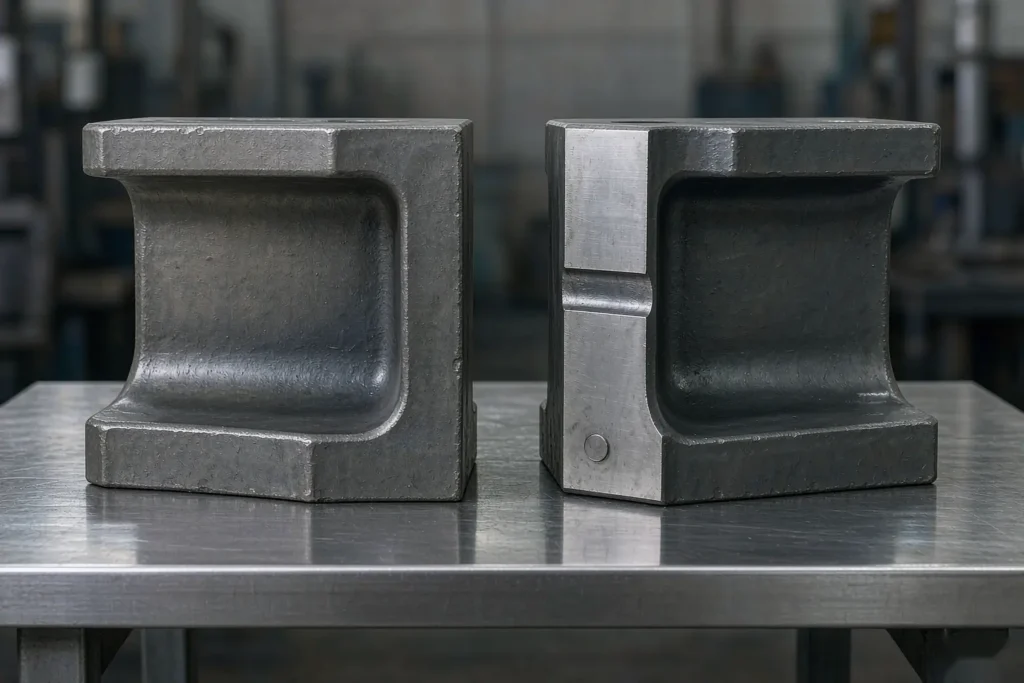
Cast steel grades decide whether a 45 kg bracket survives a −40 °C winter, whether a valve body can be welded into a pipeline without preheat cracks, and whether you pay $98 or $149 for the same pile of molten metal. Most RFQs get this wrong by naming a grade that was never the right one — usually by copying a competitor drawing.
This guide walks through the ASTM cast steel grades that actually show up in export RFQs — A27, A216, A148, A352, A217, A128 — how to read the grade designation, what the number pairs really guarantee, and where buyers lose money by over-specifying. Every number below is a minimum from the grade designation or a worked calculation you can re-run on your own part. Standards references come from ASTM International, the American Foundry Society (AFS) и ASME — always confirm against the current edition before you sign a PO. If you need the process context behind these grades, start with our руководство по литью металлов. Below we stay narrow on purpose: the cast steel grades you will actually be asked to quote, not the whole ASTM catalogue.
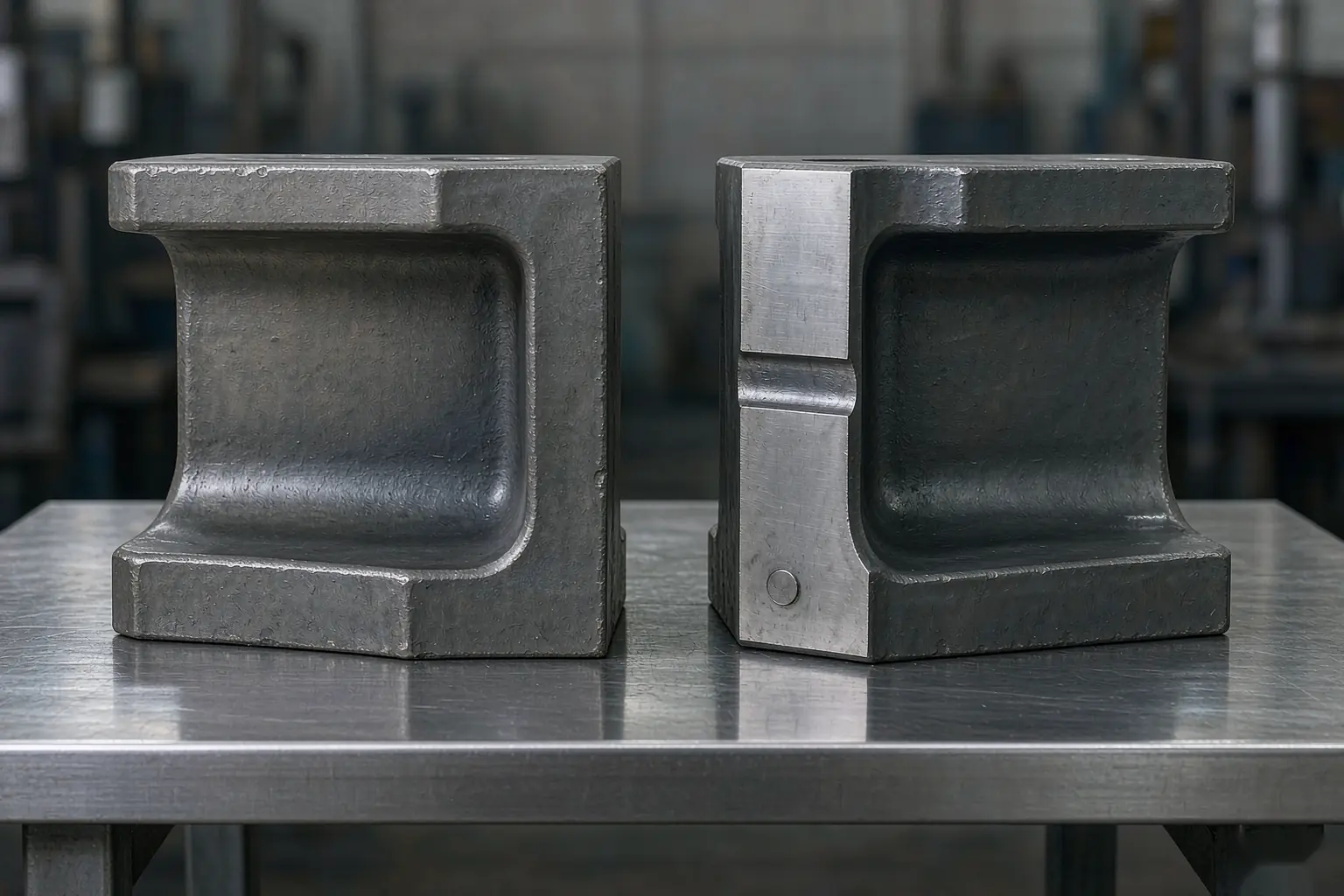
What Cast Steel Grades Actually Guarantee
A cast steel grade is not a chemistry recipe. It is a promise of mechanical properties, tested on a coupon, delivered in a defined heat treatment condition. Chemistry is usually a ceiling, not a target — the foundry dials the melt to hit strength, and the spec limits elements that hurt weldability or toughness.
Three things trip buyers up:
- The numbers are minimums, not typicals. A216 WCB at 36 ksi yield may arrive at 42 ksi. If your FEA used 42, you have no margin in the contract.
- The coupon is not your part. Properties are measured on a separately cast test block (commonly a 1 in / 25 mm keel block), which cools faster than a 100 mm section of your casting.
- The grade says nothing about soundness. Radiographic acceptance, magnetic particle coverage and repair rules live in the common-requirements spec and in supplementary requirements you have to invoke explicitly.
Put those three together and cast steel grades stop looking like a menu and start looking like a contract: minimum properties, on a defined coupon, in a declared heat treatment condition.
If you are still at the “which family” stage rather than the “which grade” stage, read cast iron vs cast steel first, then come back. And if your real question is “steel or something else entirely”, our casting alloy selection walkthrough covers the wider trade space. Both stop at the family level; this guide goes down to individual cast steel grades.
Reading the grade designation
For the carbon and low-alloy groups, the grade name is arithmetic: minimum tensile strength in ksi – minimum yield strength in ksi. A148 Grade 105-85 means 105 ksi (≈725 MPa) tensile minimum and 85 ksi (≈585 MPa) yield minimum. A27 Grade 70-36 means 70 ksi (≈485 MPa) and 36 ksi (≈250 MPa). Learn this once and you can pre-qualify any cast steel grades list in a supplier catalogue without opening a standard.
The pressure-containing families use letters instead (WCA/WCB/WCC, LCB/LCC, WC6/WC9), so those cast steel grades need a table.
| Spec & grade | Tensile min (ksi / MPa) | Yield min (ksi / MPa) | Typical delivery condition | Where it shows up |
|---|---|---|---|---|
| A27 Gr 60-30 | 60 / 415 | 30 / 205 | As-cast, annealed or normalized | General machinery, bases, housings |
| A27 Gr 70-36 | 70 / 485 | 36 / 250 | Annealed or normalized | Brackets, structural hardware |
| A216 Gr WCB | 70–95 / 485–655 | 36 / 250 | Annealed, normalized or normalized + tempered | Valve bodies, flanges, pump casings |
| A216 Gr WCC | 70–95 / 485–655 | 40 / 275 | Normalized + tempered | Higher-pressure bodies, thicker walls |
| A148 Gr 90-60 | 90 / 620 | 60 / 415 | Quenched & tempered | Construction equipment, lifting lugs |
| A148 Gr 105-85 | 105 / 725 | 85 / 585 | Quenched & tempered | High-load links, wear-critical structural parts |
| A352 Gr LCC | 70–95 / 485–655 | 40 / 275 | Normalized + tempered or Q&T | Low-temperature service to −46 °C |
Elongation moves the opposite way from strength: roughly 22% minimum elongation at the bottom of the range down to about 9% at the top. That is not a typo — you trade ductility for strength, and a casting that has to absorb impact usually wants the lower grade. Confirm exact elongation minimums against the current ASTM edition; the tensile/yield pair in the grade name is the reliable part.
Pressure, Low Temperature and Heat-Resistant Grades
Once a casting holds pressure, cast steel grades stop being about strength and start being about weldability and toughness. WCB dominates this world because it is formulated for fusion welding: carbon capped at 0.30%, manganese capped at 1.00%, and phosphorus and sulfur each held to 0.035%. That chemistry control — not the 36 ksi yield — is what you are really buying.
For our customers in valve and pump castings и marine service, three families do almost all the work:
| Family | Common grades | What it adds | Typical service |
|---|---|---|---|
| A216 carbon, weldable | WCA, WCB, WCC | Capped C/Mn/P/S for fusion welding | Ambient to ~425 °C pressure boundary |
| A352 low temperature | LCB, LCC, LC1, LC2 | Mandatory Charpy V-notch at a defined temperature | −46 °C (LCC) down to −73 °C (LC2) |
| A217 alloy, high temperature | WC6 (1.25Cr-0.5Mo), WC9 (2.25Cr-1Mo), C5 | Creep resistance and scaling resistance | Steam and petrochemical service above 425 °C |
| A128 austenitic manganese | 11–14% Mn grades | Work-hardens under impact; very tough core | Crusher jaws, excavator teeth, rail crossings |
| A351 austenitic stainless | CF8, CF8M, CF3M | Corrosion resistance instead of raw strength | Chemical, food, seawater — see our stainless grades guide |
Carbon equivalent decides your preheat, not the grade name
Take a WCB heat at the top of its chemistry window — C 0.25%, Mn 0.85%, Cr 0.15%, Mo 0.05%, Ni 0.15%, Cu 0.15% — and run the IIW carbon equivalent:
CE = C + Mn/6 + (Cr + Mo + V)/5 + (Ni + Cu)/15 = 0.25 + 0.142 + 0.040 + 0.020 = 0.45
At CE ≈ 0.45 you are in the 100–150 °C preheat band for any weld repair or fabrication weld, plus a controlled interpass temperature and usually a post-weld stress relief. Push the same design to A148 105-85 with Cr, Ni and Mo all up and CE can cross 0.60, which moves you into higher preheat, low-hydrogen consumables and a much stricter procedure qualification. It is why cast steel grades that look interchangeable on a tensile table behave very differently in a weld shop. Our casting heat treatment page covers what those cycles cost, and our heat treatment shop runs normalize, quench-and-temper and stress relief in-house.
Section Thickness: The Number Most Drawings Leave Out
Here is the part that quietly invalidates most cast steel grades selection. Standard tensile values come from a test coupon — often a 25 mm keel block. Your casting may have a 100 mm hub. Solidification time scales with the square of the modulus (V/A):
- 25 mm plate: modulus ≈ 12.5 mm
- 100 mm section: modulus ≈ 50 mm
- Ratio 4 → solidification time ratio 4² = 16× longer
Sixteen times slower cooling means coarser grain, more segregation and measurably lower yield in the heavy section than the coupon reported. Quenched-and-tempered grades are the most sensitive: the quench simply cannot pull heat out of a thick section fast enough, and A148 property minimums are realistically achievable only up to a section limit your foundry should state in writing.
Put governing section thickness and coupon location on the drawing. Then check it against feeding: heavy sections need riser volume, and our проектирование литниковых каналов и casting simulation write-ups show how the feeding requirement changes with section size. If shrinkage is already biting you, this porosity and shrinkage breakdown is the faster read. Underestimating section effect is the single most common reason cast steel grades underperform once they are bolted into service.
Moving Up the Cast Steel Grades Ladder: When the Upgrade Pays
Steel has one elastic modulus — about 200 GPa — no matter which grade you buy. That single fact decides whether stepping up the cast steel grades ladder is worth anything at all.
Work a real bracket: cantilever arm, 400 mm long, rectangular section 60 × 25 mm, load at the free end. Section properties:
- I = bh³/12 = 60 × 25³ / 12 = 78,125 mm⁴
- Z = bh²/6 = 60 × 25² / 6 = 6,250 mm³
- k = 3EI/L³ = 3 × 200,000 × 78,125 / 400³ = 732 N/mm
With a safety factor of 2 on yield, WCB (250 MPa yield → 125 MPa allowable) carries M = 125 × 6,250 = 781,250 N·mm, so F = 1,953 N, and it deflects 1,953 / 732 = 2.67 mm. Swap to A148 105-85 (585 MPa yield → 292.5 MPa allowable) and the same section now carries F = 4,570 N — but it would deflect 6.24 mm getting there. Impose a sensible 3 mm deflection limit and the high-strength bracket tops out at F = 3 × 732 = 2,196 N.
So the upgrade from WCB to A148 105-85 buys you 2,196 / 1,953 = +12% on a stiffness-governed part, at roughly 60% more casting cost. On a strength-governed part — short, stubby, no deflection constraint — it buys a genuine section reduction, and that is where the arithmetic flips. Everything above applies to every family of cast steel grades, not just the two in this example.
| Situation | Does a higher grade help? | Do this instead |
|---|---|---|
| Deflection or stiffness governs | No — E is fixed at ~200 GPa | Add ribs or depth; keep the low grade |
| Strength governs, mass is free | Rarely worth the premium | Stay on WCB or A27 70-36 |
| Strength governs, mass has a price | Yes — thinner section pays back | Move to A148 90-60 or 105-85 and thin the wall |
| Impact or low temperature | No — you need toughness, not strength | Specify A352 LCC with Charpy temperature |
| Wear and gouging | Only up to a hardness ceiling | A128 manganese, or revisit iron grades |
Cost Model: WCB vs A148 105-85 on a 45 kg Bracket
Same geometry, 48 kg cast weight before machining, 400 parts per year. Numbers are our own shop-floor quotes and will move with alloy surcharges and volume, but the ratios hold — and they hold for the whole range of cast steel grades, not just these two.
| Строка расходов | A216 WCB, 48 kg | A148 105-85, 48 kg | A148 105-85, thinned to 31.4 kg |
|---|---|---|---|
| Raw casting | 48 × $2.05 = $98.40 | 48 × $3.10 = $148.80 | 31.4 × $3.10 = $97.34 |
| Heat treatment | Normalize 48 × $0.22 = $10.56 | Q&T 48 × $0.55 = $26.40 | Q&T 31.4 × $0.55 = $17.27 |
| Machining | 1.10 h × $72 = $79.20 | 1.10 h × $80 = $88.00 | 0.95 h × $80 = $76.00 |
| NDT & certification | MT + sampling UT = $45.00 | MT + UT + hardness = $110.00 | MT + UT + hardness = $110.00 |
| Total per part | $233.16 | $373.20 | $300.61 |
Read the two decisions separately. Upgrade and keep the section: +$140.04 per part, or $56,016 a year at 400 pieces, for zero functional gain if the part is stiffness-limited. Upgrade and thin the wall from 25 mm to 16.3 mm: +$67.45 per part and 16.6 kg lighter — but deflection at the same load rises from 2.67 mm to 9.55 mm, because I drops to 21,815 mm⁴ and stiffness falls to 204 N/mm. If that bracket sits on a static base, you just paid $27,000 a year to make it bend 3.6× more.
The upgrade only clears its cost when the removed mass has a price — a moving arm, a payload-limited machine, or air freight. At roughly $6/kg of lifetime value on removed mass, 16.6 kg returns about $100 per part and the thinner A148 design wins by about $33 per part. At $0, it loses. That is the whole decision, and it is why a good supplier will ask what the part is bolted to before quoting grade. Our разбивка затрат на литье и CNC machining rates pages carry the same line-item logic.
How to Write Cast Steel Grades Into a Drawing
A cast steel grade name alone is not a specification. Nine lines close the ambiguity, and each one is a place RFQs usually leak money:
| # | Line to write | Why it matters |
|---|---|---|
| 1 | ASTM spec + year + grade (A216/A216M-xx Gr WCB) | Editions change chemistry and test requirements |
| 2 | Delivery heat treatment condition | Normalized vs Q&T changes yield by 100+ MPa |
| 3 | Governing section thickness | Coupon properties do not survive a 100 mm hub |
| 4 | Test coupon: separately cast, attached, or from the part | Defined under A781 (general) or A703 (pressure) |
| 5 | Impact test temperature and energy, if any | A216 has no mandatory Charpy; A352 does |
| 6 | NDT method, coverage and acceptance level | See our inspection methods guide |
| 7 | Weld repair: allowed or not, and to which practice | A488 for procedure and operator qualification |
| 8 | Dimensional tolerance and machining allowance | ISO 8062 — see tolerances и machining allowance |
| 9 | Documentation: EN 10204 3.1 or 3.2, heat number traceability | The MTR is the only proof you get after shipment |
Two more habits save real money. First, if the part is a static, non-pressure component, do not inherit a pressure-grade callout from an old drawing — A27 70-36 will often do the job at a lower melt cost. Second, if you need pressure service, do not assume a higher-strength grade is a free substitution: higher carbon equivalent means harder welding, more NDT and a longer qualification cycle. Every one of those nine lines costs money, which is why copying cast steel grades off an old drawing is rarely the cheapest route. Our steel casting capability page lists the grades we melt routinely, and pattern and tooling is where the lead time actually starts — see casting lead time for the full schedule.
Where Each Family Fits in the Shop
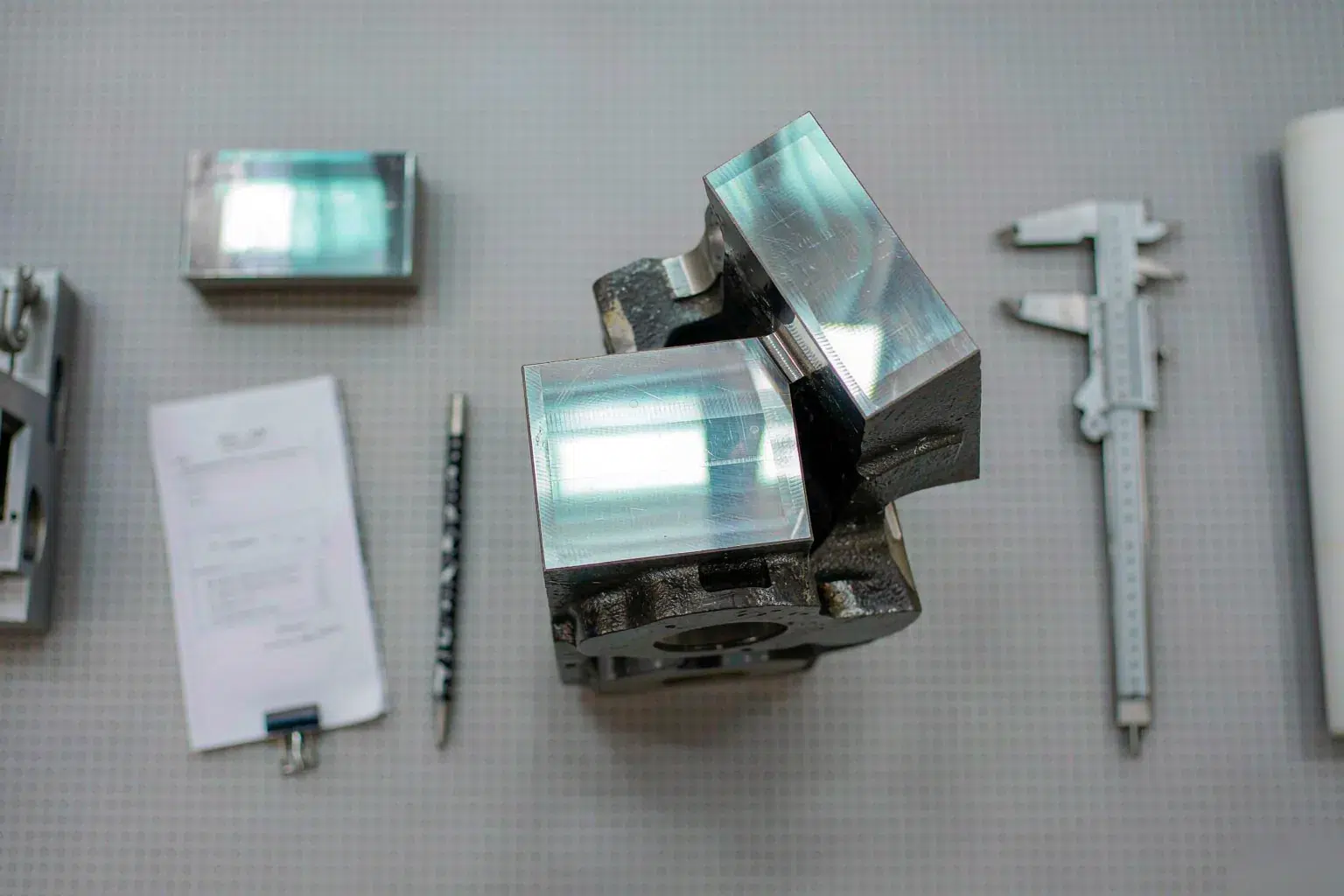
Matching cast steel grades to the process matters as much as matching them to the load. A27 and A216 grades are almost always sand cast, because the parts are large and the volumes are modest. A732 investment-cast carbon and low-alloy grades and the A351 stainless family favour литье по выплавляемым моделям when the geometry is intricate or the wall is thin. High-volume zinc and aluminium work sits on a different branch entirely — see aluminium die casting if steel is honestly overkill for your load case.
Typical homes for each family: A27 in agricultural machinery frames and bases; A148 in automotive and off-highway suspension and linkage parts; A216 and A352 in valve, pump and marine pressure boundaries. If you are early in design, our prototype casting service и Шаблоны, напечатанные на 3D-принтере let you test two grades on the same tooling before committing. And if the part will see weather or chemicals, pair the grade callout with a обработка поверхности specification at the same time — a good grade with no coating still rusts.
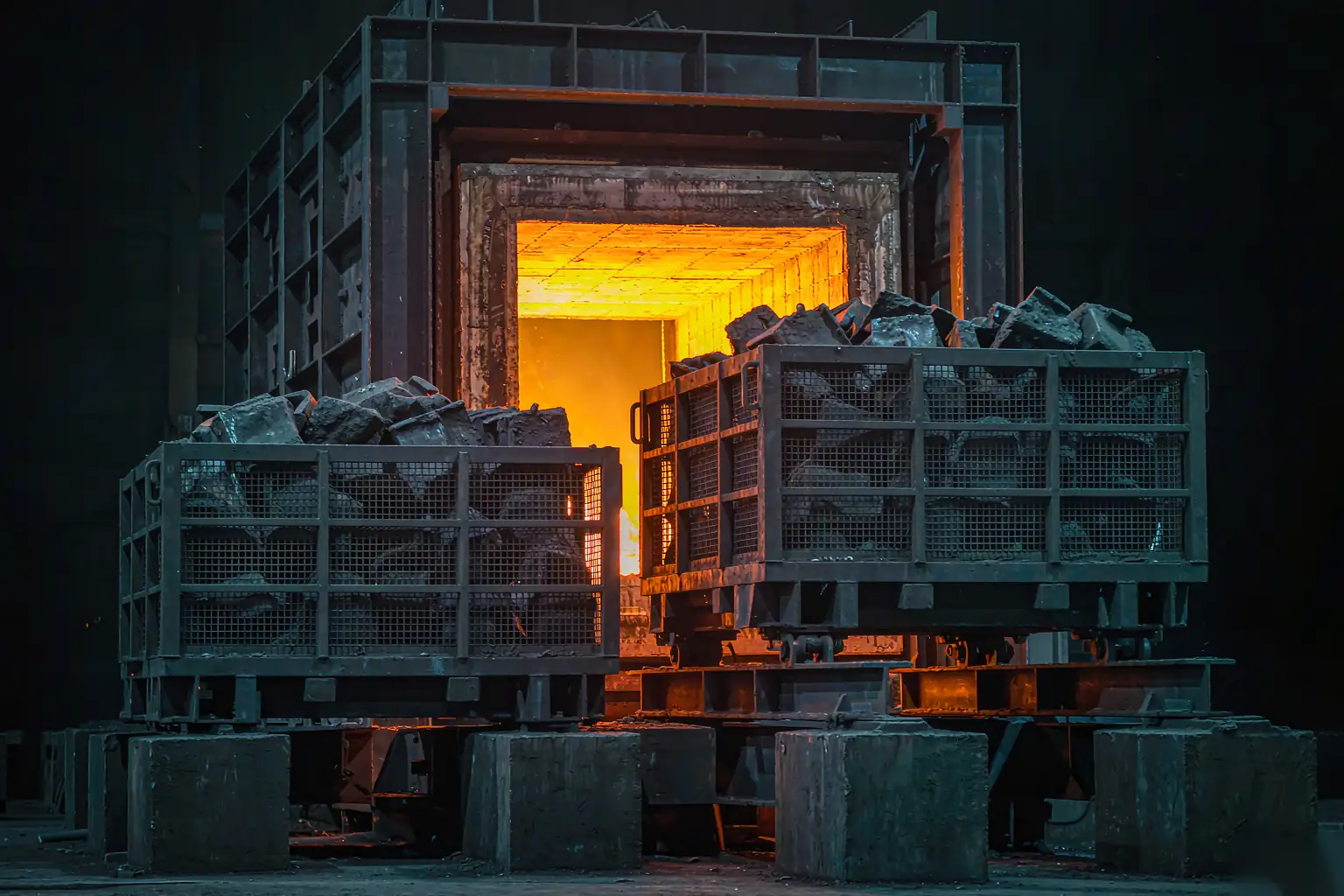
Finally, remember that defects do not care which grade you specified. Shrinkage, hot tears and inclusions follow geometry and feeding practice far more than chemistry — our defect guide и steel casting fundamentals are the right next reads, and this shop-floor walkthrough shows what the melt and pouring controls look like in practice.
Часто задаваемые вопросы
Is A216 WCB the same thing as A27 Grade 70-36?
No. The two cast steel grades sit close on strength minimums, but WCB caps carbon at 0.30% and manganese at 1.00% and holds P and S to 0.035% so the casting can be fusion welded into a pressure boundary. A27 is a general-purpose spec with looser chemistry. If the part will be welded into a pressure system, WCB is the safe call; if it is a bolted non-pressure bracket, A27 70-36 usually costs less.
Can I substitute a higher grade for a lower one?
Not automatically. A higher-strength grade usually carries a higher carbon equivalent, which raises preheat requirements and can make field welding impractical. It may also come with a hardness range your machining shop is not tooled for. Substituting upward is a design change, not a purchasing shortcut.
What should the material test report actually show?
Ask for EN 10204 3.1 at minimum: heat number, full chemistry, tensile and yield results, elongation, heat treatment record with furnace chart, and the coupon location. For pressure or critical parts step up to 3.2 with third-party witness. If impact matters, the Charpy temperature and energy values must be on the same document.
Why did my thick casting fail tensile when the coupon passed?
Section effect. A 100 mm section has four times the modulus of a 25 mm plate and solidifies about sixteen times slower, so the grain is coarser and the as-cast strength is lower than the coupon suggests. Quenched-and-tempered grades are worst affected. State the governing section on the drawing and ask the foundry to confirm the grade is achievable at that thickness.
How much does moving up a grade really cost?
On a 48 kg bracket, stepping up between these cast steel grades added about $140 per part in our model — most of it in alloy, quench-and-temper and extra NDT, not in the melting. Thinning the wall to capture the strength gain cut that gap to about $67 per part and removed 16.6 kg, but tripled deflection. Upgrade when mass has a price; stay put when stiffness governs.
*Property minimums referenced from ASTM A27, A216, A148, A352, A217 and A128; cost figures from Supro MFG shop-floor records. Always confirm against the current ASTM edition and your own design requirements.
 English
 Français
 Deutsch
 Italiano
 日本語
日本語 한국어
한국어 Polski
 Português de Angola
 Русский
 Español de Argentina