
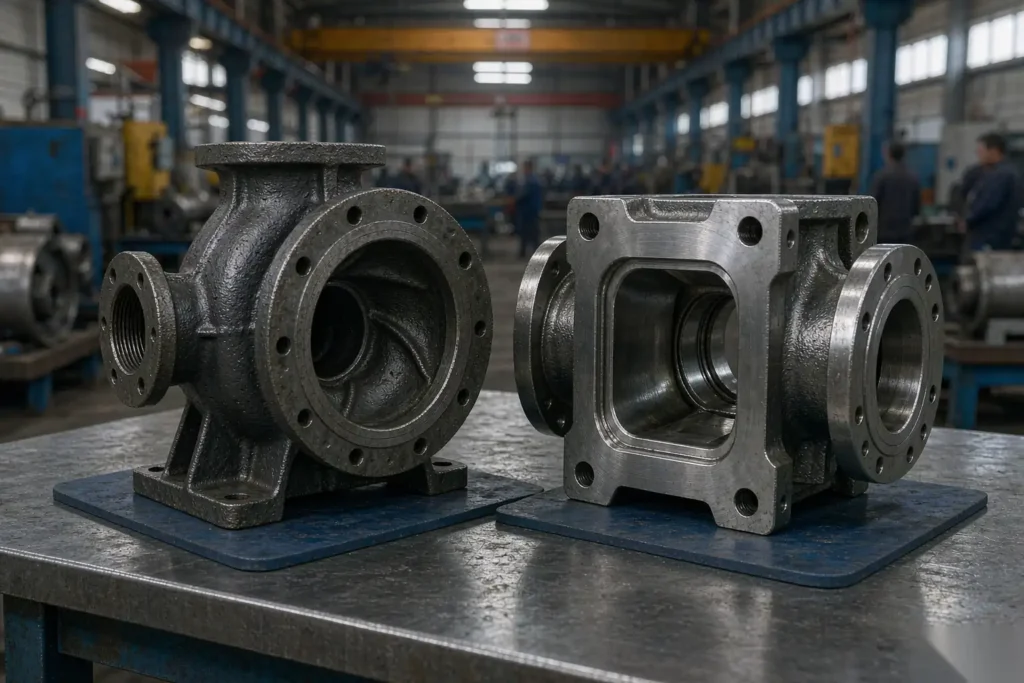
Every sourcing engineer hits the same wall sooner or later: the drawing calls for “cast steel” or “cast iron” with no grade, and the two quotes come back 40–90% apart. Choosing cast iron vs cast steel is not a matter of which one is “stronger” — it is a decision about impact load, service temperature, wall thickness, and how much the part is allowed to cost per kilogram.
This guide puts real numbers on the trade-off: tensile and Charpy data from the ASTM specifications buyers actually cite, carbon equivalents and weld preheat, melting and pouring temperatures, casting yield, machinability, and a 40 kg bracket worked out end to end. Where a rule of thumb is quoted, the underlying standard is named — including references from the Американское общество литейщиков (AFS) и ASTM International — so you can take it straight into an RFQ instead of arguing with a supplier. The short version of cast iron vs cast steel: iron buys damping, machinability and cost, while steel buys toughness, weldability and performance below zero.

What Actually Separates Cast Iron from Cast Steel
Both families start as iron plus carbon, but they sit on opposite sides of one line. Once that line is crossed, the carbon stops behaving like an alloying element and starts behaving like a defect — or like a built-in lubricant, depending on how you let it solidify. If you are still mapping the wider landscape, our руководство по литью металлов covers the full process-and-material tree before you narrow down to these two.
The 2% carbon line
Cast steel runs below roughly 2.0% carbon — most engineering castings sit between 0.15% and 0.50%. Cast iron runs above it, typically 2.5–4.0%, and that surplus carbon has nowhere to go. In grey iron it precipitates as graphite flakes; in ductile iron a magnesium treatment forces it into spheroids; in cast steel it stays chemically combined as pearlite, ferrite or cementite. This single fact drives almost every property difference that follows: damping, machinability, elongation, and weldability all trace back to whether free graphite is present.
| Фактор | Grey / ductile cast iron | Cast carbon / low-alloy steel |
|---|---|---|
| Carbon content | 2.5–4.0% C, 1.0–3.0% Si | 0.15–0.50% C, 0.30–0.80% Si |
| Carbon form | Free graphite (flakes or nodules) | Combined (pearlite / ferrite / cementite) |
| Common ASTM specs | A48 (grey), A536 (ductile), A897 (ADI) | A27 / A148 (structural), A216 WCB, A352 LCB |
| Melting range | 1150–1250 °C | 1470–1520 °C |
| Typical pouring temperature | 1350–1450 °C | 1540–1600 °C |
| Усадка при затвердевании | Grey ≈ 0 (graphite expansion offsets it); ductile 4–6% | 2.5–4.0%, always needs generous feeding |
| Minimum castable wall | 3–4 mm in sand castings | 5–6 mm, thicker on large sections |
Cast Iron vs Cast Steel: Mechanical Properties Compared
Below are the numbers you will actually find on a mill certificate. One caveat that decides a lot of disputes: ASTM A48 grey iron classes are defined on a separately cast 30 mm test bar, not on the casting itself, so a 100 mm section of Class 35 will not deliver 241 MPa through its core. Cast steel behaves far more predictably across section thickness — which is exactly why thick, highly loaded parts migrate to steel.
| Недвижимость | Grey iron A48 Class 35 | Ductile iron A536 65-45-12 | Cast steel A27 Gr 70-40 |
|---|---|---|---|
| Tensile strength, min | 241 MPa (35 ksi) | 448 MPa (65 ksi) | 485 MPa (70 ksi) |
| Yield strength, min | Not specified (breaks first) | 310 MPa (45 ksi) | 276 MPa (40 ksi) |
| Elongation, min | <1% (effectively zero) | 12% | 22% |
| Typical hardness | 180–220 HB | 156–217 HB | 150–190 HB |
| Charpy V-notch at 20 °C | Not applicable | 12–18 J | 27–60 J |
| Modulus of elasticity | 100–140 GPa | 165–170 GPa | 200–210 GPa |
| Damping capacity | 10–25× that of steel | 2–4× that of steel | Baseline |
Read that table as a whole and the pattern is obvious. In the cast iron vs cast steel decision, tensile strength is nearly a tie — 448 MPa against 485 MPa. The real gap is elongation and toughness: cast steel stretches 22% and absorbs 27 J or more, while grey iron does neither. If your part can fail by cracking, the choice is already made.
Section sensitivity, weight and corrosion
Section thickness separates the two families more quietly than any strength number. Grey iron is strongly section-sensitive: a Class 35 casting with 100 mm walls typically delivers 170–210 MPa through the core rather than the 241 MPa printed on the certificate, so a drawing that simply says “ASTM A48 Class 35” is not a specification — you have to say where the properties are required. Ductile iron is better but still fades on heavy sections. Cast steel stays close to uniform, which is the practical reason thick structural parts move to steel even when the nominal loads would suit iron. Weight runs the other way: at 7.1–7.2 g/cm³, iron is about 9% lighter than steel at 7.85 g/cm³, which matters on freight and on unsprung mass. Neither material is corrosion-proof — grey iron can form a graphitic surface layer, steel rusts uniformly, and both need paint, galvanising or an alloy upgrade. Coating options are covered in our notes on sand casting corrosion resistance, and the preparation that makes coatings stick is in the отделка поверхности отливков guide. This is the least-discussed axis of the cast iron vs cast steel decision, and the one that most often surfaces in warranty claims.

Where Cast Iron Wins
Iron is not the cheap fallback. For four out of five industrial castings it is the correct engineering answer, and here is the evidence. Before the list: cast iron vs cast steel is not a quality hierarchy, it is a load case.
- Vibration damping. Machine tool beds, compressor housings, brake rotors and engine blocks are all grey iron because flake graphite absorbs vibration instead of transmitting it. Ten to twenty-five times the damping of steel is not a marginal improvement — it is the difference between a 70 dB gearbox and an 85 dB one.
- Compressive strength and wear. Grey iron compresses at roughly 3–4× its tensile value, so Class 35 resists 700–900 MPa in compression and wears beautifully because graphite acts as a solid lubricant. Slideways, cylinder liners and pump bodies exploit exactly this.
- Machinability. Carbide tooling runs at 250–350 m/min in grey iron versus 120–180 m/min in annealed cast steel. On a part with 30 minutes of metal removal that is a direct shop-hour saving of 40–50%.
- Thin walls and near-net shape. Pouring at 1350–1450 °C with near-eutectic composition gives excellent fluidity, so 3–4 mm walls fill reliably where steel would misrun.
- Feeding yield. Grey iron expands slightly on solidification, so risers can be small or absent. Foundry yield of 75–85% against 45–60% for steel is a cost advantage that compounds at volume.
Within the cast iron vs cast steel question, iron is the default rather than the compromise. Within the iron family, the grey-versus-ductile split matters just as much as the iron-versus-steel one; our breakdown of grey iron vs ductile iron covers the ASTM A48 and A536 classes in the same level of detail. For volume housing and manifold work, see our чугунное литье capability page.
Where Cast Steel Wins
Steel earns its premium in four specific situations. If none of them appears in your service conditions, you are probably over-specifying. Each of the four conditions below overrides the cost argument in cast iron vs cast steel.
- Shock and impact loading. Excavator adapters, crusher jaws, rail couplers, lifting lugs and mining buckets see loads that no graphite-bearing structure survives. ASTM A148 Gr 105-85 delivers 724 MPa tensile with 586 MPa yield and 15% elongation — a combination ductile iron cannot reach at any price.
- Low-temperature service. Ferritic ductile iron loses toughness quickly below 0 °C. Where a Charpy value is specified at −46 °C, the spec moves to ASTM A352 LCB or LCC automatically. That requirement alone settles the cast iron vs cast steel question on any outdoor or refrigerated application.
- Weldability and field repair. Cast steel under 0.30% carbon welds with a normal preheat. Grey iron does not really weld at all — it needs 300–600 °C preheat and nickel filler, and even then the heat-affected zone cracks. If your maintenance team plans to weld a cracked part back together, specify steel.
- Pressure boundary and elevated temperature. ASTM A216 WCB is the default for valve bodies and flanges to roughly 425 °C, with 485–655 MPa tensile and 22% elongation. Our литой клапан и автомобильные отливки programmes both run carbon and stainless grades for this reason.
Stainless is a separate branch of the steel family with its own grade map — worth reading our марки нержавеющей стали для литья по выплавляемым моделям guide before you assume “cast steel” means carbon steel. When cast iron vs cast steel comes down to a Charpy figure, this is the grade set to quote from. For structural and mining components, the стальное литье line covers A27, A148 and A352 production.
Machining, Welding and Heat Treatment
Machining and dimensional work
Cast steel is not just slower to cut — it work-hardens, pushes harder on the tool, and needs more rigid fixturing, which usually means more setups. Budget 1.5–2× the machining time of the equivalent iron part, and check the stock allowance: steel castings commonly carry 3–6 mm of machining allowance on critical faces because surface quality and dimensional scatter are worse than iron. Our comparison of Обработка на станках с ЧПУ и литье explains how that allowance is set, and the ISO 8062 casting tolerances reference gives the tolerance grades to write on your drawing. Production machining runs through our CNC machining services. Build that 1.5–2× factor into any cast iron vs cast steel comparison before you commit to a material.
Weldability, in one calculation
Run the carbon equivalent before you promise anyone a weld repair: CE = C + Mn/6 + (Cr+Mo+V)/5 + (Ni+Cu)/15. A cast steel at 0.25% C and 1.00% Mn gives CE = 0.25 + 0.167 = 0.42, which calls for a preheat of roughly 100–150 °C and a standard low-hydrogen electrode. Grey iron at 3.40% C and 2.20% Si sits at a CE of about 4.1 by the cast-iron formula C + (Si+P)/3 — an order of magnitude beyond anything weldable by normal procedure. That is why repairable-in-service designs are almost always steel. On weldability, cast iron vs cast steel is not a close call.
Heat treatment response
Cast steel responds to the full toolkit — normalise and temper, quench and temper, or carburise — so one chemistry can be tuned to several strength levels. Ductile iron gets there too, via austempering: ASTM A897 grade 1400-1100-02 reaches 1400 MPa tensile with 1100 MPa yield and 2% elongation, which overlaps low-alloy steel at a lower material cost. Grey iron gets stress relief at 550–600 °C and little else. The full process map is in our термообработка отливок guide, and the furnaces behind it are described on the услуги по термической обработке page. Heat treatment is the one axis where cast iron vs cast steel can be narrowed deliberately: austempering pulls ductile iron into low-alloy steel territory at a lower material cost.
What Cast Iron vs Cast Steel Really Costs
Material price per kilogram is the number everyone quotes and the one that explains the least. Melting energy, feeding yield, machining hours, mandatory NDT and weld repair are where the money actually goes. Read those as a system and cast iron vs cast steel stops being a price-per-kilogram argument.
| Cost driver | Cast iron | Cast steel |
|---|---|---|
| Ex-works casting price, indicative | $1.0–1.5 / kg grey, $1.4–2.0 / kg ductile | $2.2–3.2 / kg carbon, higher for low-alloy |
| Foundry yield | 75–85% | 45–60% |
| Relative machining time | 1.0× | 1.5–2.0× |
| Mandatory NDT on structural parts | Visual + PT, UT on request | MT or UT commonly required, plus weld repair allowance |
| Typical tooling and sample lead time | 3–5 weeks | 5–8 weeks |
Worked example: a 40 kg mounting bracket with two machined faces. Grey iron at $1.1/kg is $44 of metal plus 22 minutes of machining at a $1.2/min shop rate, so about $70 machined. Cast steel at $2.4/kg is $96 of metal, 38 minutes of machining, and UT plus MT on a 10% sample — roughly $146 machined. The steel part costs 2.1× as much for a strength gain this bracket will never use. Reverse the loads — say a shock-loaded bucket tooth with 27 J Charpy at −20 °C — and the same 2.1× becomes cheap insurance. That is cast iron vs cast steel in one line: the premium only pays for itself when the service conditions demand it. Context for how those drivers are built up is in our разбивка затрат на литье; feeding-related yield is explained in the проектирование литниковых каналов статья.

A Decision Matrix You Can Use on Your Next RFQ
Six questions settle nearly every case. Answer them in the order a foundry engineer would read cast iron vs cast steel, and the material choice follows.
- Is a Charpy value specified? If yes, cast steel. Ductile iron can be qualified down to about −20 °C on thin sections; below that, go to A352.
- Will anyone weld it in service? If yes, cast steel under 0.30% C. Grey iron repair welding is a last resort, not a plan.
- Is noise or vibration part of the performance spec? If yes, grey iron, and say so on the drawing so nobody “upgrades” you.
- Are walls under 5 mm? If yes, iron — or switch to литье алюминия and revisit the strength budget entirely.
- Is it a pressure boundary above ambient? ASTM A216 WCB for steel, or ductile iron where the class and section are qualified — never grey iron.
- Annual volume above 500 pieces with no shock load? Grey or ductile iron, and invest the saving in better tooling through our casting mould making line.
Two follow-ups worth reading before you release the drawing: how the choice shows up as распространённые дефекты литья (steel is far more prone to hot tearing and shrinkage cavities), and what your контроль литья plan must cover so the acceptance criteria match the material you actually specified.
Часто задаваемые вопросы
Is cast steel always stronger than cast iron?
No. Ductile iron A536 65-45-12 at 448 MPa comes within 8% of A27 Gr 70-40 cast steel, and austempered ductile iron reaches 1400 MPa. What steel always wins is elongation and impact energy, not tensile strength. Answering cast iron vs cast steel from a single tensile figure is the most common sourcing mistake we see.
Can grey cast iron be welded?
Technically yes, practically no. With a carbon equivalent near 4, grey iron needs 300–600 °C preheat, nickel-based filler and slow cooling, and the heat-affected zone still cracks. Design steel into the joint if repair welding is part of the maintenance plan.
Which handles higher temperatures?
Cast steel. ASTM A216 WCB is routinely specified to about 425 °C and low-alloy grades go further, while grey iron loses strength and starts to grow through graphitisation above roughly 400 °C.
How much cheaper is cast iron?
Roughly 40–55% less per machined kilogram on a like-for-like part, from a combination of lower metal price, better foundry yield and 40–50% less machining time. On a 40 kg bracket that worked out to $70 against $146. Roughly half of that cast iron vs cast steel gap comes from machining time and feeding yield, not from the metal price itself.
How do I tell them apart in the workshop?
Wipe a machined surface with a finger: graphite leaves a grey-black smudge on iron, steel stays clean. On a grinder, cast steel throws long bright sparks; grey iron throws short, dull, red ones. For anything load-bearing, confirm with a spectrometer and the mill certificate instead — no cast iron vs cast steel decision should rest on a spark test.
Does the casting process change the answer?
It narrows it. Cast steel is almost always sand cast because of the pouring temperature, while iron also runs in permanent mould and centrifugal processes. Thin, precise steel parts point to литье по выплавляемым моделям, which is the comparison we draw in our литье в песчаные формы и литье по выплавляемым моделям guide.
*Mechanical and cost data referenced from ASTM A48 / A536 / A897 / A27 / A148 / A216 / A352 specifications, AFS publications, and Supro MFG production records. Price bands are indicative ex-works China and vary with order quantity, alloy surcharge and machining scope.
 English
 Français
 Deutsch
 Italiano
 日本語
日本語 한국어
한국어 Polski
 Português de Angola
 Русский
 Español de Argentina