
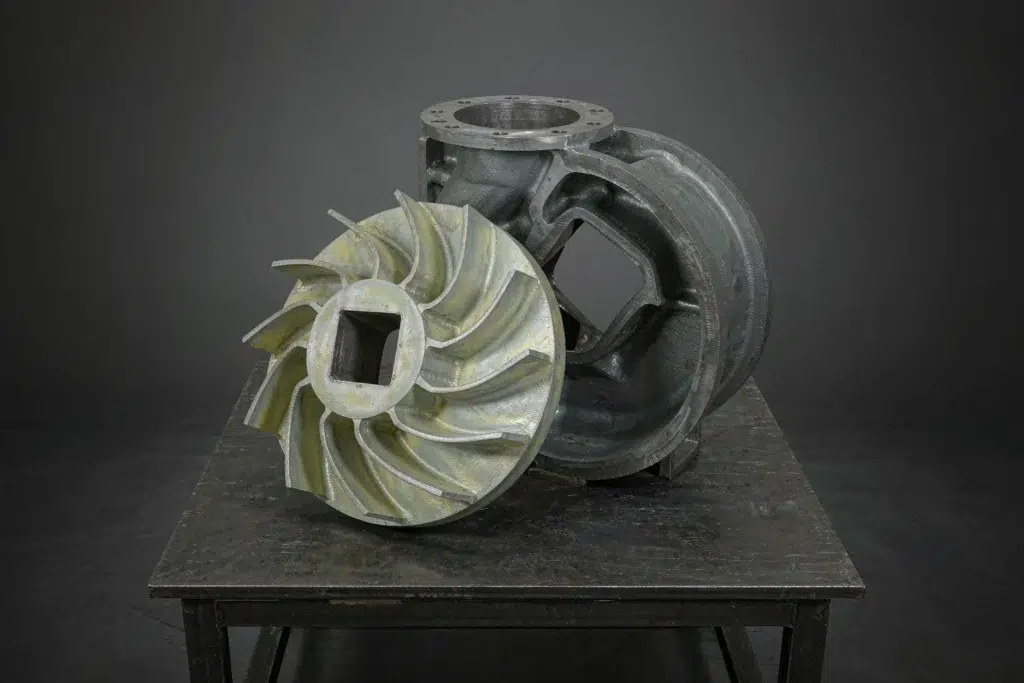
High chrome white iron castings are bought for one reason: the part has to survive abrasive wear that eats mild steel in a matter of weeks. Every other number in the quotation — price per kilogram, lead time, surface finish — is secondary to whether the carbide structure inside the metal matches the way the part actually wears. This guide is about that decision, in numbers.
What follows is the working view from a foundry floor: what an abrasion-resistant iron is under ASTM A532/A532M, how carbon and chromium set the carbide volume fraction, where the four wear modes break these parts, and two cost-per-operating-hour models that show when the premium alloy pays for itself and when it does not. Hardness conditions and chemistry limits are quoted from the standard rather than from a marketing sheet. Suppliers of the finished parts, and buyers checking them, can cross-reference the material data with NADCA on casting quality and the руководство по литью металлов on the base process.
What High Chrome White Iron Castings Are — and What They Are Not
A white cast iron is an iron that solidifies without graphite. All the carbon is tied up in carbides, which is exactly what makes the material wear-resistant and exactly what makes it brittle. ASTM A532 covers the alloyed branch of that family: irons alloyed to secure high resistance to abrasive wear for mining, milling, earth-handling and general manufacturing duty. The standard explicitly excludes plain and low-alloy white irons that consist of iron carbides in a pearlite matrix — those are hard but not tough enough to be sold as wear parts. The casting route itself is ordinary iron foundry work, литье в песчаные формы or shell moulding, with gating, pouring temperature and shakeout time doing the metallurgy rather than the moulding method.
Inside an A532 casting the microstructure is carbides in a matrix of martensite, bainite or austenite. That combination is the whole design: the carbides resist the abrasive particle, the matrix holds them in place and absorbs the load that would otherwise crack the part. Get the matrix too soft and the carbides spall out of it; get the matrix too hard and the whole casting behaves like glass. This is a different mechanism from the graphitic irons, where flake or nodular graphite controls strength and damping rather than wear, as set out in our comparison of gray iron versus ductile iron and our breakdown of cast iron versus cast steel.
The practical consequence for a buyer is that high chrome white iron castings cannot be judged on a tensile test. A 26% Cr iron will show a transverse rupture strength in the region of 900–950 MPa and a compressive strength near 2,900 MPa, but essentially no elongation. The material is being asked to resist indentation and scratching, not to stretch. That is why the acceptance test that matters is hardness, measured in a defined place, on a defined test block.
| Family | Typical hardness | Carbon form | Impact tolerance | Weld repair | Typical duty |
|---|---|---|---|---|---|
| Gray iron (ASTM A48) | 170–250 HB | Flake graphite | Low, but predictable | Difficult | Housings, bases, damped structures |
| Ductile iron (ASTM A536) | 150–300 HB | Nodular graphite | Good, 6–18% elongation | Possible with procedure | Brackets, pump bodies, gears |
| High chrome white iron (A532 Cl. III) | 450–700 HB | M7C3 carbides | Very low | Not permitted | Slurry pumps, chute liners, mill internals |
| Hadfield manganese steel (A128) | 200 HB as cast, work-hardens to 450–500 HB | Austenitic, no carbide network | Very high | Possible with procedure | Jaw plates, gyratory concaves, hammer mills |
The Carbide Structure That Makes White Iron Wear Resistant
Two carbides matter. Cementite, M3C, carries roughly 6.7% carbon by weight and sits at about 900–1,100 HV. The chromium carbide M7C3 carries 8.44% carbon and sits at roughly 1,200–1,800 HV, and it grows as isolated rods and blades rather than as a continuous network. That shape difference is why high chrome white iron castings survive a silica particle that a low-alloy white iron cannot: the abrasive has to cut through discrete hard islands instead of following a connected brittle skeleton that cracks through the casting.
For high chrome white iron castings the variable a foundry controls to choose between them is not chromium percentage alone, it is the chromium-to-carbon ratio. Once that ratio passes about 5, M7C3 dominates; below about 4.5, a substantial share of the carbon reports as cementite and the wear resistance drops even though the hardness figure can look respectable.
- 26.5% Cr with 2.50% C — ratio 10.6, fully M7C3. The standard 25–27% Cr pump and liner grade.
- 26.5% Cr with 3.40% C — ratio 7.8, hypereutectic. Primary carbide blades form in the melt, wear resistance peaks, toughness falls.
- 15% Cr with 3.00% C — ratio 5.0, borderline. Cheaper, adequate for moderate abrasion, noticeably more brittle in thin sections.
- 12% Cr with 3.00% C — ratio 4.0, mixed carbide. Sold as a wear iron, behaves like a hardened alloy steel with carbide reinforcement.
Carbon also sets how much carbide there is, and this is arithmetic a buyer can check. Taking the matrix as retaining about 0.6% C in solution and M7C3 as 8.44% C, a 2.50% C iron puts 1.90% C into carbide, which is 22.5% carbide by mass. Correcting for the density difference between carbide (about 6.9 g/cm³) and matrix (about 7.7 g/cm³) gives roughly 24.5% carbide by volume. Raise carbon to 3.40% and the same arithmetic gives 33.2% by mass and about 36% by volume.
| Carbon | Cr:C at 26.5% Cr | Carbide by volume | Wear resistance | What it costs you |
|---|---|---|---|---|
| 2.50% | 10.6 | ≈24.5% | Reference | Baseline toughness, easiest to cast and harden |
| 2.90% | 9.1 | ≈29% | +15–25% in low-stress sliding | Higher pouring temperature needed, more shrinkage |
| 3.40% | 7.8 | ≈36% | +35–50%, best in fine-particle slurry | Hypereutectic carbides settle, thin sections crack |
| 3.60%+ | 7.4 | ≈40% | Maximum abrasion resistance | Machining almost impossible, impact tolerance near zero |
The number that decides whether you get the carbide you paid for is the cooling rate. Slow cooling in a heavy sand section lets chromium partition and lets the carbide network coarsen; fast cooling in a thin section chills the iron and can crack it before it reaches the shakeout. That is why the same certified chemistry can deliver 640 HB on a 40 mm wear block and 520 HB in the 180 mm hub of a pump casing, and why the hardness clause on a purchase order has to name the location of the test.
Reading the ASTM A532 Grade Table for High Chrome White Iron Castings
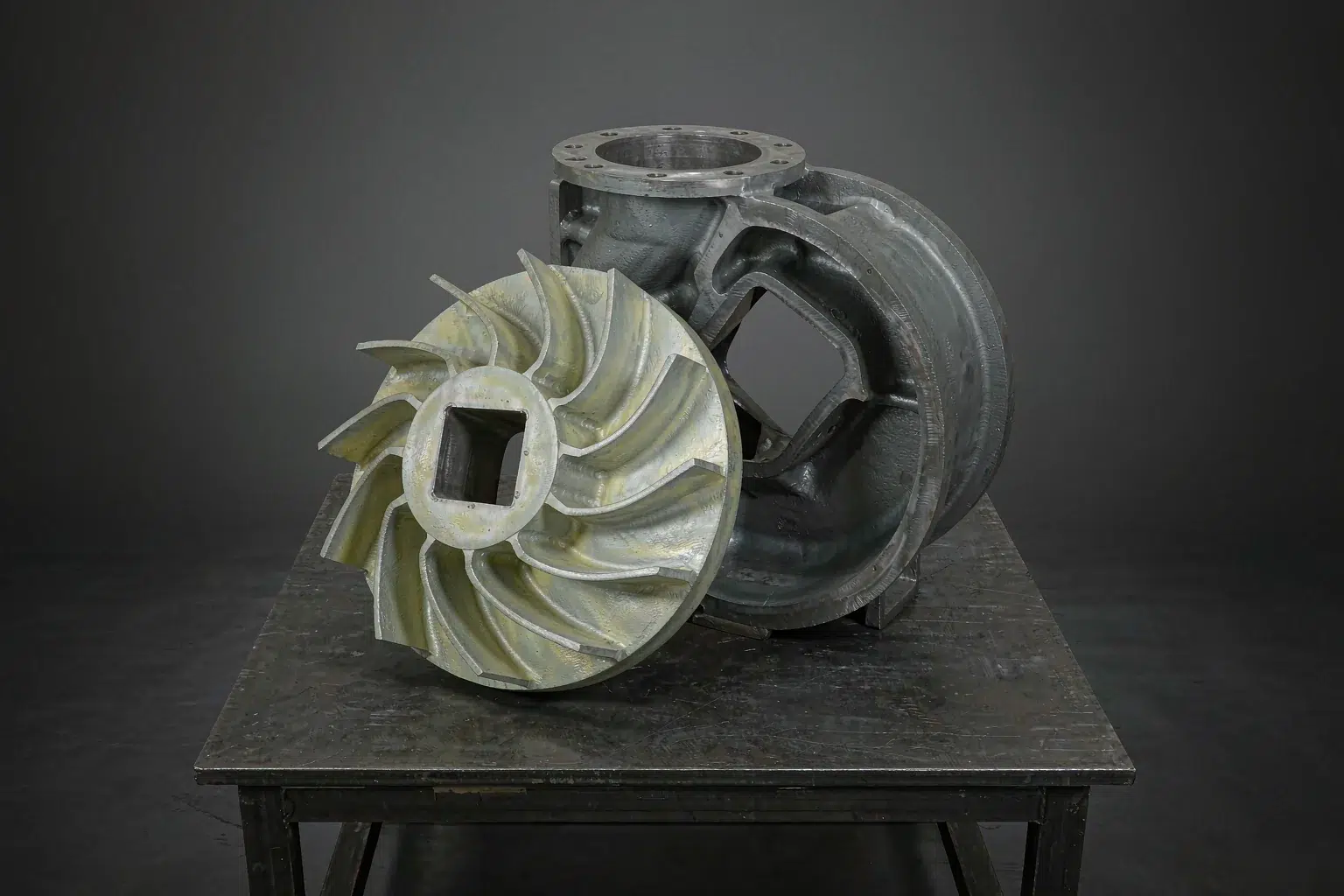
ASTM A532 organises high chrome white iron castings into three classes. Class I is the nickel-chromium family usually traded as Ni-Hard, with around 4% Ni and 2% Cr: cheap, well understood, decent in cement slurry, but well behind the high-chrome grades on both hardness and corrosion resistance. Class II is the low-carbon nickel-chromium variant, tougher and used where a casting has to take some shock. Class III is the high-chromium family, and Class III Type A is the grade that most high chrome white iron castings in the market actually are.
The chemistry window for Class III Type A, as published in the standard and reproduced by pump OEMs in their own purchase specifications, is broad: carbon 2.0–3.3%, chromium 23–30%, manganese up to 2.0%, silicon up to 1.5%, molybdenum up to 3.0%, nickel up to 2.5%, copper up to 1.2%, phosphorus 0.10% max, sulphur 0.06% max. That width is deliberate — it lets a foundry tune carbon for the wear mode and add molybdenum and copper for section thickness. It also means two suppliers can both ship “A532 Class III Type A” and deliver parts with meaningfully different wear life.
Hardness is specified by condition rather than as a single number, and this is where most quotation disputes start:
| Condition supplied | Hardness requirement | What it is for |
|---|---|---|
| As cast | ≥450 HB (≥46 HRC, ≥485 HV) | Cheap wear plate, low impact, no machining after casting |
| As cast and stress relieved | ≥450 HB | Large castings that would otherwise crack in service from residual stress |
| Hardened | ≥600 HB (≥56 HRC, ≥660 HV) | Pump internals, mill liners, anything with a real wear rate to beat |
| Hardened and stress relieved | ≥600 HB | Hardened parts with a heavy section change or a machined fit |
| Softened for machining | ≤400 HB (≤41 HRC, ≤430 HV) | The route that lets you drill, tap and bore before final hardening |
The last row is the one engineers most often miss. Above roughly 500 HB you can grind and face a high-chrome part, but you cannot drill or tap it: the same carbides that resist the abrasive destroy carbide drills and work-hardened taps within a few holes. The workable sequence is cast, soften, machine the fits and threads, then harden. It costs an extra heat cycle and it introduces distortion after machining, so the drawing has to carry enough stock on the machined faces to absorb it — the same logic we set out in the casting machining allowance guide, applied to a material that moves more than most. Fits that have to hold a tolerance are normally finished after hardening in a CNC machining services cell set up for hard turning and grinding.
Where White Iron Wear Parts Fail: Four Modes That Decide the Grade
Wear is not one phenomenon, and the grade that wins one test loses another. For high chrome white iron castings four modes decide the specification.
- Low-stress scratching. Fine particles sliding at speed: slurry lines, chute liners, fan blades, dredge pipe. The abrasive does not fracture the carbide, it scratches the matrix between carbides and eventually undermines them. 25–27% Cr at 600–650 HB is the standard answer, and carbide volume fraction is what buys life.
- High-stress grinding. The particle is crushed between two metal surfaces: roller press rolls, ball mill liners, jaw and cone wear plates. Now the carbide is loaded directly and can crack, so the matrix has to support it. 15–20% Cr with molybdenum, or 26% Cr at lower carbon, survives better than the hardest grade available.
- Impact. Any blow that stores enough energy to propagate a crack through the carbide network. Above a certain energy level, no white iron is the right answer and the specification should move to Hadfield manganese steel or a martensitic steel.
- Erosion-corrosion. Slurry that is also acidic or chloride-bearing, as in flue-gas desulfurisation and some phosphate duty. Chromium in solution protects the matrix, so the answer is 28–30% Cr even though abrasion resistance is slightly lower than at 26%.
| Wear mode | Governing property | Grade that usually wins | Common wrong choice |
|---|---|---|---|
| Low-stress scratching | Carbide volume fraction | 26% Cr, 2.8–3.2% C, hardened ≥600 HB | 12% Cr sold as equivalent |
| High-stress grinding | Carbide support by matrix | 20% Cr – 1% Mo, or 26% Cr at 2.5% C | Maximum-carbon hypereutectic |
| Impact | Fracture toughness | Hadfield Mn steel, or quenched and tempered martensitic steel | Any white iron |
| Erosion-corrosion | Cr in solid solution | 28–30% Cr | Ni-Hard, 12% Cr |
Design Rules for High Chrome White Iron Castings
High chrome white iron castings punish geometry that a ductile iron part would tolerate. Four rules cover most of the failures we see at the drawing review stage.
Minimum section and section uniformity
Below about 15–20 mm, a high chrome white iron casting chills against the mould, develops a continuous carbide skin and cracks either at shakeout or in the first thermal cycle of service. Junctions where a 60 mm boss meets a 15 mm wall are worse: the heavy section arrives late, the light section is already rigid, and the shrinkage stress has nowhere to go. Generous fillets — 12 mm radius minimum, more at internal corners — and gradual transitions do more for service life than another two points of hardness.
Contraction allowance
White iron contracts about 2.0–2.4% linearly on solidification and cooling. Gray iron, because graphite precipitation offsets part of the contraction, needs only about 1.0%. Reuse a gray iron pattern for a high-chrome part and the arithmetic is unforgiving: a pattern cut for a 600 mm nominal dimension with a 1.0% allowance is 606.0 mm long, and a metal that actually contracts 2.2% produces a casting of 592.9 mm — 7 mm undersize, which no as-cast tolerance grade for a 600 mm dimension can absorb. The pattern has to be cut, or re-cut, for the alloy, which is one of the reasons mould and pattern making for a new wear part is not a trivial line item.
Feeding and yield
High chrome white iron castings feed badly. The freezing range is narrow, the feeding distance is short, and the part cannot be patched afterwards. Take a 300 × 200 × 40 mm wear block: 2,400 cm³ of volume against 1,600 cm² of cooling surface gives a modulus of 1.50 cm. A riser sized at 1.2 times that modulus needs M = 1.80 cm, which for a cylindrical riser with height equal to diameter means 108 mm diameter and about 989 cm³ of metal that ships as scrap. Yield lands near 71%, so every finished kilogram was poured as 1.41 kg. That single ratio explains most of the price gap against a steel plate, and it is worth understanding before arguing about the rate per kilogram.
No weld repair, so the process gate does the work
A532 high-chrome castings are not weld-repaired. Pump OEM purchase specifications state it explicitly — no weld repairs allowed — and the metallurgical reason is sound: welding a 600 HB carbide-bearing iron produces a brittle heat-affected zone that fails in service, and even a cosmetically acceptable repair leaves a stress raiser in a part whose whole job is to resist cracking. That is the opposite of the situation for casting weld repair in carbon and low-alloy steel, where a qualified procedure under ASTM A488 is normal practice. The consequence for a buyer is that the quality gate has to sit upstream: pattern, gating, pouring temperature, shakeout time, and a hardness map that shows the part was actually through-hardened.
Heat Treatment: Getting a White Iron Part to 600 HB
An as-cast 26% Cr high chrome white iron casting usually lands between 450 and 550 HB. That is enough for a chute liner and not enough for a slurry pump impeller. The step up comes from destabilisation: hold the casting at roughly 980–1,020 °C for a time scaled to section — commonly two hours plus one hour per 25 mm — then air cool. That cycle precipitates secondary carbide from the austenite and leaves a martensitic matrix on cooling. A temper at 200–250 °C follows, mainly to relieve the stress the quench put in, not to soften.
The failure mode to watch in high chrome white iron castings is retained austenite in heavy sections. Cool a 150 mm hub in still air and the core may not transform; the part then reads soft on the bench, hardens further under load in service, grows a few thousandths of a millimetre, and spalls. Molybdenum, copper and nickel additions in the A532 window exist partly to buy hardenability for that reason, which is why the same class can be specified with different alloy additions for a 25 mm liner and a 150 mm casing. The heat-treatment basics are shared with other alloys — our термообработка отливок article covers the cycles — but the acceptance criterion here is a hardness figure in a specific place.
Because hardness is a through-section property that changes with position, and because high chrome white iron castings have no repair route, the acceptance test should specify: the method (Brinell, typically 10 mm ball, 3,000 kgf), the location (on the casting surface or up to 3 mm below it, as the standard allows), the number of readings, and whether the reading is taken on the part or on a test block cast from the same ladle. A single reading on a polished pad in the thinnest section is not evidence of a through-hardened casting, and it is the most common way a cheap supplier passes a hardness clause that a good one would also pass honestly.
Cost per Operating Hour, Not Cost per Kilogram
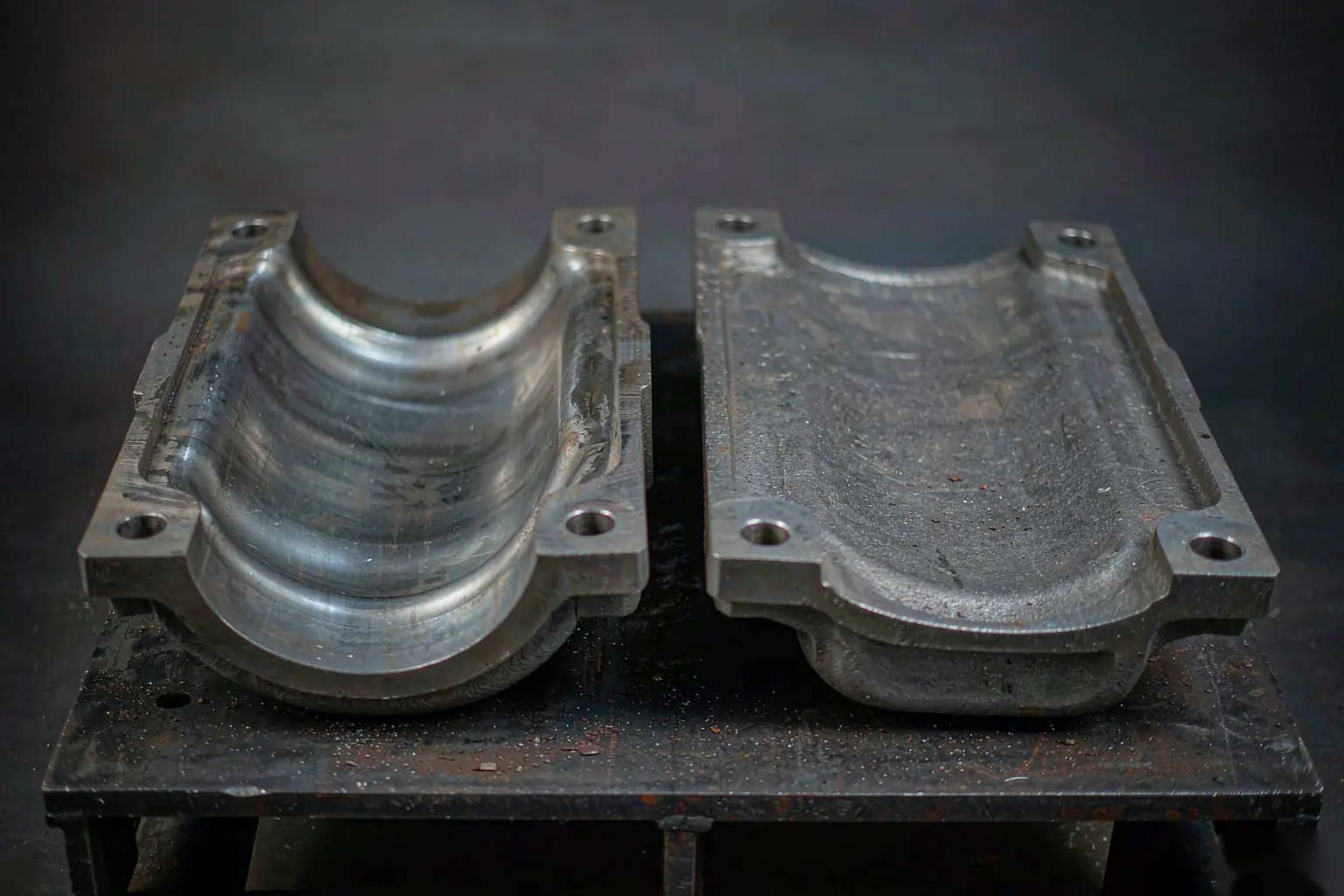
The quotation that matters compares two alloys on the same duty over the same period. Price per kilogram is the least useful number in the file, because it ignores how long the part lasts and what it costs to change it. For high chrome white iron castings the only comparable metric is cost per operating hour.
Case A: chute liner plate, 800 × 600 × 20 mm
Volume is 9,600 cm³, which at 7.6 g/cm³ is 73.0 kg. At $4.35/kg finished in the hardened condition, the high chrome white iron casting costs $317.38. A quenched and tempered 450 HB wear steel plate of the same size costs $141.09 — 2.2 times less. On a straight price comparison the steel wins and the conversation ends there, which is the mistake.
Assume the duty data from a typical aggregate chute: the high-chrome plate runs 5,600 hours, the 450 HB steel plate 950 hours. Changing a liner takes two fitters about five hours plus five hours of production stoppage, which we cost at $1,980 per change. Over 10,000 operating hours the high-chrome plate is changed 1.79 times and the steel plate 10.5 times.
| Per 10,000 operating hours | 26% Cr white iron | 450 HB wear steel |
|---|---|---|
| Part price | $317.38 | $141.09 |
| Wear life | 5,600 h | 950 h |
| Changes required | 1.79 | 10.5 |
| Parts spend | $566.74 | $1,485.14 |
| Change-out labour and downtime | $3,535.72 | $20,842.10 |
| Итого | $4,102.46 | $22,327.24 |
The high-chrome plate costs 2.2 times more to buy and 5.4 times less to run. Note where the money goes: even on parts alone the white iron is cheaper per hour, because the life ratio of 5.9 beats the price ratio of 2.2. The downtime line then widens the gap to the point where the alloy choice is no longer a procurement decision, it is an availability decision.
Case B: slurry pump impeller, 38 kg, 26% Cr against 12% Cr
Here both options are white iron, so the comparison is inside the family. At $4.90/kg plus $118 of machining, the 26% Cr high chrome white iron casting comes to $304.20 and runs 4,200 hours. A 12% Cr impeller at $4.10/kg comes to $273.80 and runs 2,600 hours. The premium is $30.40, or 11% on the part.
Cost per 1,000 operating hours is $72.43 for the 26% Cr part against $105.31 for the 12% Cr part, a 31% reduction. The $30.40 premium is recovered after 925 operating hours — less than a quarter of the 26% Cr part’s own life. Any pump that runs more than about five weeks a year should be on the higher-chrome grade, and the only situation where the cheaper impeller makes sense is a pump that is idle most of the year or is about to be replaced.
This is the same structure as any other total-cost argument on the site: the casting total cost of ownership logic applies directly, and the разбивка затрат на литье article shows how the per-kilogram figure is actually built, riser yield included.
When a White Iron Part Is the Wrong Choice
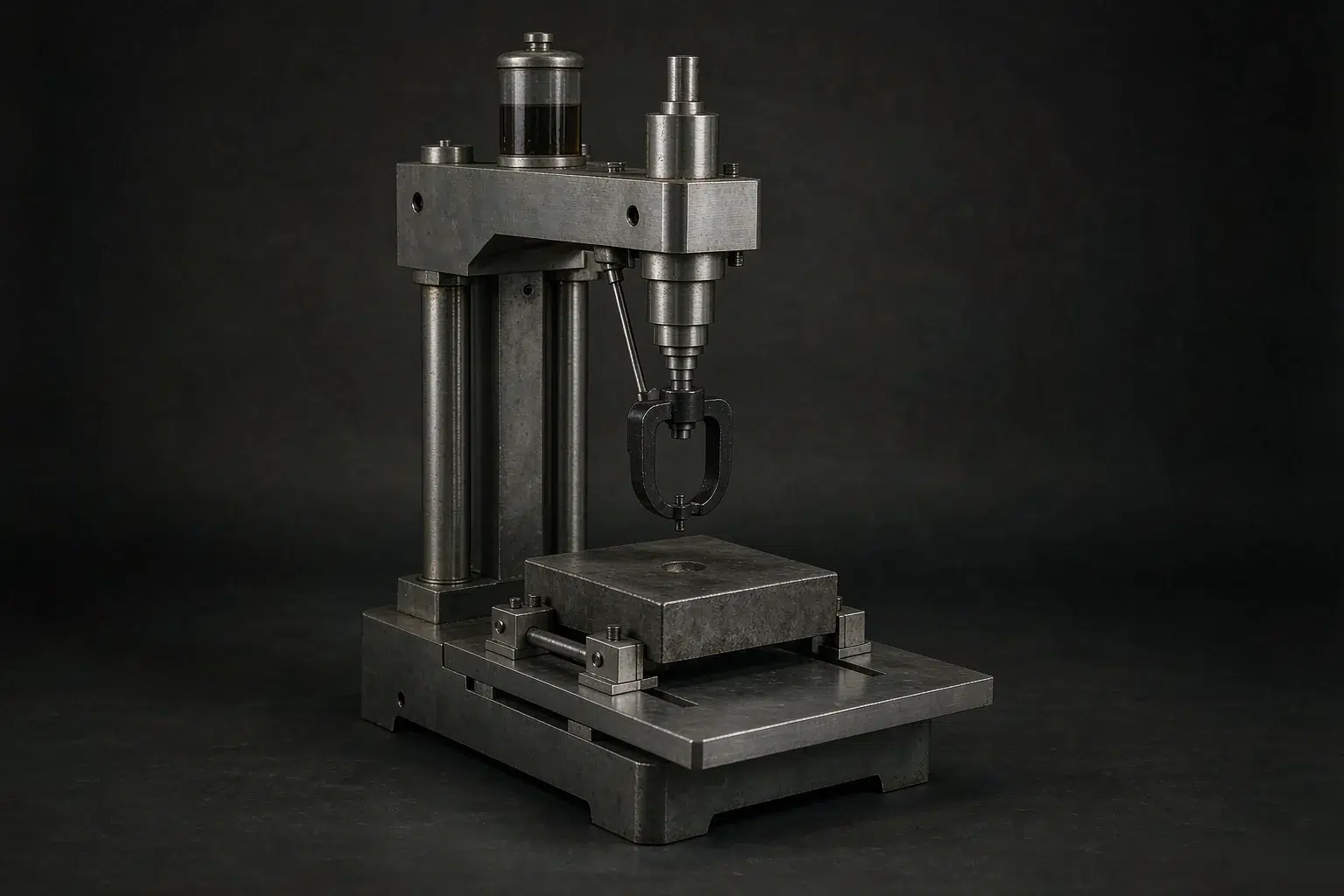
Roughly one enquiry in four that arrives asking for high chrome white iron castings should be something else. The disqualifiers are specific:
- The part takes a real impact. Crusher hammers, jaw plates, grizzly bars struck by oversize rock, and anything downstream of a tramp-metal risk. A 26% Cr part that chips in the first week is more expensive than a Hadfield manganese part that work-hardens from about 200 HB to 450–500 HB under the same blows and tolerates large plastic deformation instead of cracking.
- The section is thin. Below 15 mm, or a thin web between two heavy bosses, the part will crack in heat treatment as often as in service. Redesign the geometry before changing the alloy.
- Someone will want to repair it in the field. No weld repair is the rule, and a maintenance team with a welding set will try anyway. If a site cannot accept a scrap-and-replace policy, a steel or ductile iron part is the honest specification.
- It needs tapped holes or fine bores in the hardened condition. Threads have to be cast in as steel inserts or produced before hardening. If the design cannot accommodate that, the alloy is wrong for the drawing.
- The duty is corrosion with little abrasion. A 30% Cr iron helps, but a stainless or a rubber-lined part is usually cheaper and better. White iron is a wear solution, not a corrosion solution.
| Symptom in service | Likely cause | Correct response |
|---|---|---|
| Cracks radiating from a boss or fillet within days | Section modulus mismatch, no fillet | Redesign transition; do not raise hardness |
| Corner spalling on a hammer or jaw | Impact energy beyond the alloy | Move to Hadfield Mn steel or martensitic steel |
| Wear rate far above expectation on a certified part | Hardness measured in the wrong place, or matrix under-hardened | Require a hardness map and a test block, per the inspection methods guide |
| Even wear but a short interval | Carbide volume too low for the particle size | Raise carbon within the A532 window, or move from 12% to 26% Cr |
Specifying High Chrome White Iron Castings on the Purchase Order
Because the standard leaves a wide chemistry window for high chrome white iron castings, and no weld repair is available as a fallback, the purchase order carries most of the quality risk. Nine lines close almost all of it:
- Class, type and condition. Not “high chrome” — write A532 Class III Type A, hardened and stress relieved, ≥600 HB.
- Chemistry with a certificate. EN 10204 3.1, with carbon and the Cr:C ratio called out, not just the chromium range.
- Hardness: method, location, count. Brinell, on the casting surface or up to 3 mm below, minimum three readings per part or one per test block, recorded.
- Test block. Cast from the same ladle, same section, and shipped with the parts or retained with the heat number.
- Repair policy. No weld repair, no impregnation of through-wall defects, no cosmetic filling.
- Machining allowance and datum. State which faces are machined, how much stock, and whether the part is supplied softened for machining or hardened.
- Dimensional standard. ISO 8062 grade, plus explicit tolerances on the wear faces that matter.
- NDT where justified. Visual and dimensional on all parts; RT or UT on pump casings and anything with a pressure boundary.
- First-article requirement. A full dimensional and hardness report on the first piece of each pattern, with the sampling rule defined.
The RFQ itself is the earlier lever. A drawing that shows the wear surface, the particle size, the slurry concentration and the expected hours between changes will get a grade recommendation instead of a price; a drawing that says “wear resistant iron” will get whatever is cheapest to pour. Our casting RFQ checklist article lists the data a foundry needs, and the соглашение о качестве литья covers the acceptance clauses that turn those data into something enforceable at receiving inspection.
One more point on sourcing. High-chrome white iron is produced in quantity in China, but the capability spread is wide: induction melting and sand or shell moulding are common, controlled destabilisation and air quenching to a verified 600 HB across a heavy section are not. Ask for the hardness map from a previous heavy-section job before placing the first order, and if the duty is new or the wear mode is unclear, order a prototype casting run in the production alloy rather than guessing from a data sheet. If the part is a replica of a worn original, the measuring work described in our casting reverse engineering article is the right starting point rather than a drawing traced by hand. A foundry group that pours iron castings across several processes, such as our own iron casting solutions, can normally propose the grade and the heat treatment in one review instead of two.
Часто задаваемые вопросы
Can high chrome white iron castings be welded?
No. Above roughly 500 HB the carbide network and the martensitic matrix produce a brittle heat-affected zone, and A532 practice and OEM purchase specifications prohibit weld repair. Defects are handled by re-pouring, not by repair, which is why pattern and gating quality matters more here than in steel casting.
What hardness should I specify?
For pump internals, mill liners and chute liners, specify hardened and stress relieved at 600 HB minimum, measured by Brinell on the casting surface or up to 3 mm below it, with the number and location of readings stated. As-cast 450 HB is acceptable only for low-impact wear plate where the part is cheap relative to the change-out cost.
Is 26% Cr always better than 12% Cr?
For low-stress sliding abrasion, yes — in high chrome white iron castings the carbide volume and the M7C3 structure give roughly 1.6 times the life at an 11% price premium on a typical impeller. For high-stress grinding, and for any duty with impact, the harder grade can lose, because the carbide cracks rather than wears.
How thick a section can be through-hardened?
It depends on the alloy additions, not only on chromium. A 26% Cr iron with molybdenum, copper and nickel will harden through 100 mm and beyond; the same analysis without them may retain austenite in a 60 mm core and read soft. Ask for the hardness at the heaviest section, measured on a sectioned test block, not at the surface.
Can the part be machined after hardening?
High chrome white iron castings can be ground and faced, yes, with cubic boron nitride or ceramic tooling. Drilling, tapping and reaming, no. The practical route is to cast, soften to 400 HB or below, machine the fits and threads, then harden — with enough stock on the machined faces to absorb the distortion of the second heat cycle.
What is the difference between high chrome white iron and Ni-Hard?
Ni-Hard is ASTM A532 Class I: about 4% nickel and 2% chromium, hardness typically in the 500–600 HB range after hardening, cheaper on alloy cost and more forgiving to cast. High-chrome Class III replaces most of the nickel with 23–30% chromium, which produces harder M7C3 carbides and much better corrosion resistance in slurry. For cement raw mill duty Ni-Hard is often adequate; for fine silica slurry at speed, the high-chrome grade lasts substantially longer.
The short version: high chrome white iron castings are a wear calculation, not a material preference. Fix the wear mode first, then the carbon and chromium that produce the carbide volume for it, then the section geometry and heat treatment that let the part survive its own hardness. Price per kilogram falls out of that sequence almost automatically — and if it does not, the grade is wrong.
*Chemistry, hardness conditions and supply conditions referenced from ASTM A532/A532M and from published pump-OEM purchase specifications; casting practice and cost figures from Supro MFG shop-floor records.
 English
 Français
 Deutsch
 Italiano
 日本語
 한국어
 Polski
 Português de Angola
 Русский
 Español de Argentina