
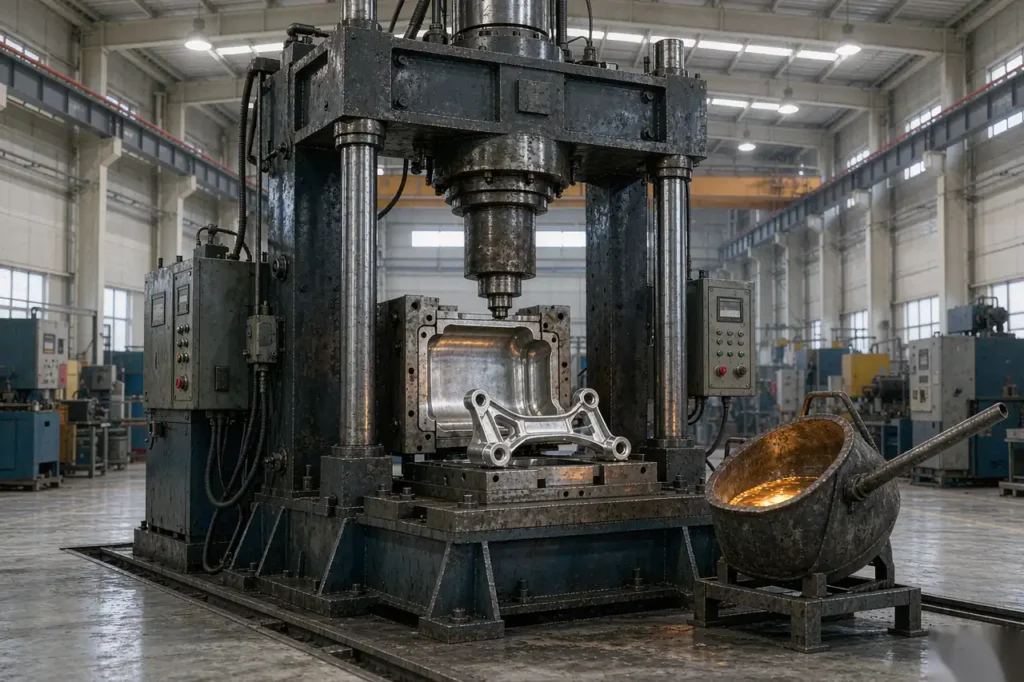
Squeeze casting is the process buyers reach for when a die casting keeps failing a leak test, a forging blows the budget, or a part has to be heat treated and welded. It fills a steel die slowly, then holds 50–150 MPa on the metal while it freezes — and that pressure is what removes the gas porosity that rules most high-pressure die castings out of structural service.
This guide covers where squeeze casting actually fits on a sourcing decision, the process window a foundry can hold, what the tooling costs, and how to write a print that gets a clean quote. Numbers come from production practice rather than lab coupons, and where an industry body publishes the reference method we link it — see the 미국 주조학회 (AFS) for casting practice and NADCA for the die casting comparison baseline. If you want the wider picture first, start with our 금속 주조 가이드, or go straight to the aluminum casting capability page.
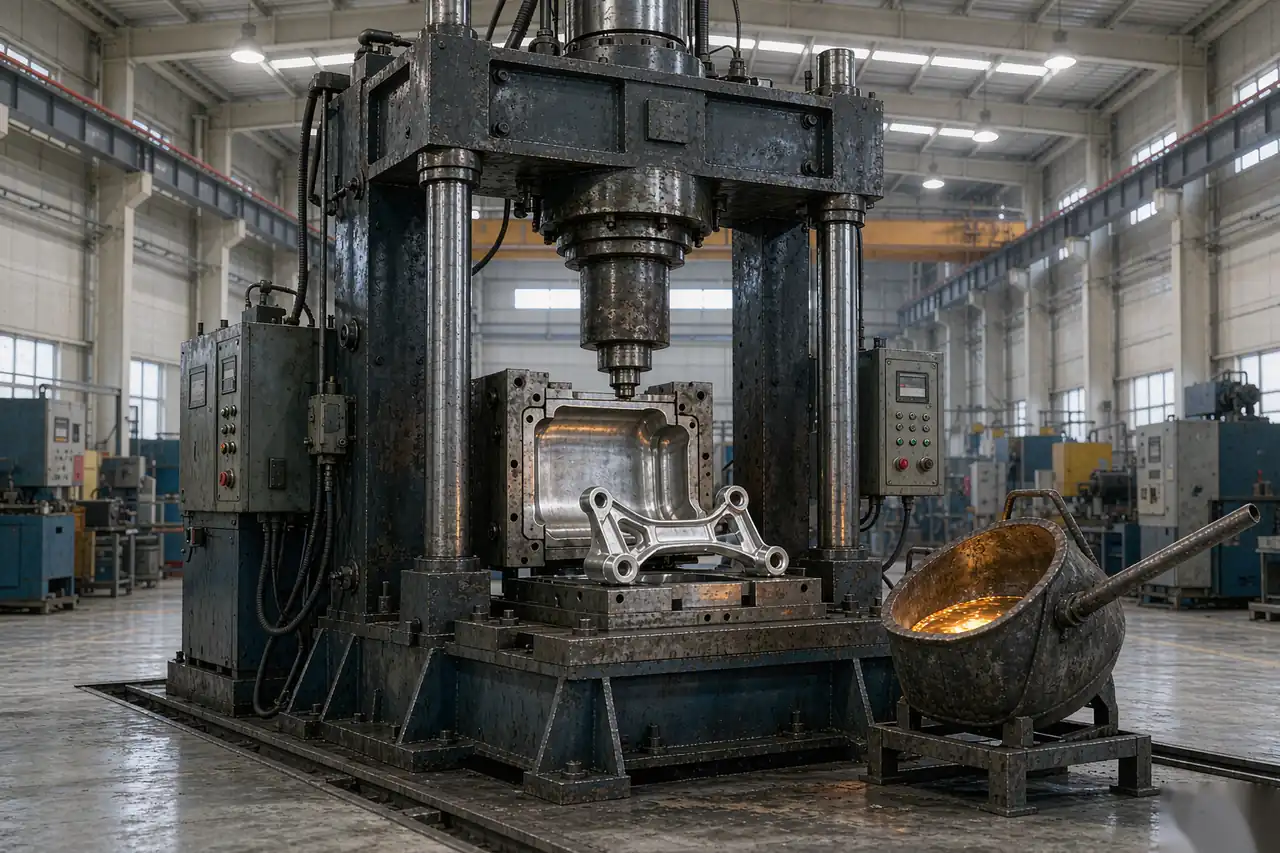
What Squeeze Casting Does Differently
Every casting process fights the same two enemies: gas dissolved or entrained in the metal, and shrinkage as liquid turns solid. Gravity processes accept both and feed them with risers. High-pressure die casting fixes shrinkage with intensification pressure but creates gas porosity by filling at 30–60 m/s. Squeeze casting attacks both at once: it fills at well under 2 m/s, so air is not beaten into the metal, and it then holds 50–150 MPa on the semi-solid mass so shrinkage cavities are squeezed shut and fed from the liquid core.
The result sits mechanically between 알루미늄 다이캐스팅 그리고 closed-die forging: near-net-shape geometry like a casting, mechanical properties close to a wrought product.
Direct and Indirect: Two Machines, One Principle
Both variants pressurize metal during solidification. They differ in how the metal gets into the cavity, and that difference decides which parts each can make.
| 요인 | Direct Squeeze | Indirect Squeeze |
|---|---|---|
| Fill path | Metal poured into open lower die; punch closes and displaces it | Low-velocity injection through a wide gate, then intensification |
| Fill velocity | 0.05–0.5 m/s | 0.3–1.5 m/s |
| Runner / gate scrap | Almost none — metal is metered, not injected | Runner and biscuit to remelt |
| 기하학적 자유도 | Simpler shapes, one main cavity axis | More complex shapes, multi-cavity possible |
| Integrity | Highest — shortest fill path, no turbulence | Very good — gate area can carry minor entrainment |
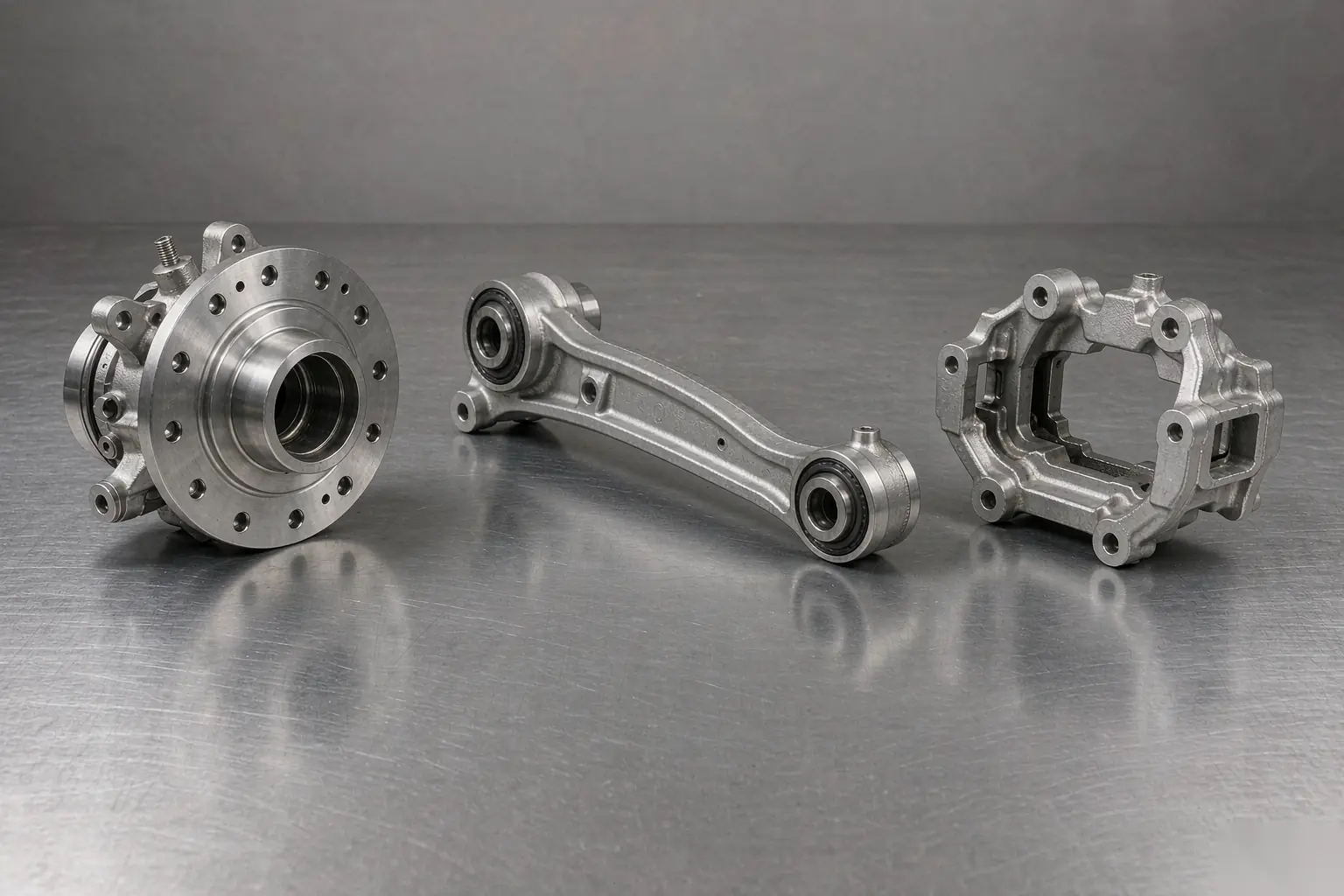
| Typical parts | Brake calipers, compressor scrolls, airbag housings, MMC rotors | Suspension knuckles, control arms, structural brackets |
Where the Tonnage Comes From
Press size is not a marketing number — it falls straight out of projected area times specific pressure: F = p × A. A bracket with a projected area of 320 cm² (32,000 mm²) squeezed at 90 MPa needs 32,000 × 90 = 2,880,000 N, about 294 tonnes. Specify a 400 t press, not a 300 t one: you need 25–30% margin for die closing force, ejection, and the fact that the last hot spot is still liquid when the rest has frozen. The die itself is a hardened tool steel assembly with ejection, thermal control and often moving cores — the same discipline we apply to casting mold and tooling work, built to a tighter pressure duty. This is the hard ceiling on part size, and it is why squeeze casting lives in the 0.2–25 kg range rather than in the hundreds of kilograms where resin sand casting 또는 shell mold casting take over.
The Squeeze Casting Process Window
These are the numbers a foundry will actually quote against. If a supplier promises values outside this band without a specific reason, ask what is different about their machine.
| 매개변수 | Typical Range | Why It Matters to the Buyer |
|---|---|---|
| Specific pressure | 50–150 MPa | Below ~50 MPa porosity returns; above ~150 MPa die life collapses |
| Fill velocity | 0.05–1.5 m/s | Two orders of magnitude below HPDC; this is the porosity fix |
| Pour temperature (Al) | 680–730 °C | Lower than gravity pouring because pressure supplies the feeding |
| Die temperature | 200–300 °C | Drives heat checking; thermal control is the main die-life lever |
| Dwell time | 8–30 s | Sets cycle time; scales with the square of section thickness |
| Minimum wall | 3–5 mm | Thinner than this and the metal freezes before the cavity fills |
| Part weight | 0.2–25 kg | Capped by press tonnage, not by mold size |
| Die steel | H13 / 1.2344, nitrided | Higher mechanical load than HPDC — expect shorter die life |
| Die life | 30,000–80,000 shots | Amortize it: at 20,000/yr a $70k tool is $3.50/part over its life |
| Dimensional tolerance | ±0.15–0.35 mm in-die (≈ DCTG 7) | Across the parting line or a moving core, drop to DCTG 8 — see our 주조 공차 가이드 |
| 가공 여유 | 0.5–1.5 mm | Half to a third of a sand casting — this is where the money is |
| As-cast surface | Ra 1.6–3.2 µm | Fine enough to anodize on non-critical faces without blasting |
| Process scrap | 1–3% | Versus 4–8% on a porosity-sensitive HPDC part |
Why Pressure Removes Porosity
Three mechanisms work together, and all three are measurable on the shop floor.
- No entrained air. At 0.05–1.5 m/s the metal front stays coherent instead of atomizing, so there is no air to trap. This is the same physics that makes flow turbulence control matter in gravity pouring — squeeze casting simply designs turbulence out of the process.
- Shrinkage is squeezed shut. Any cavity that tries to form during solidification is collapsed by 50–150 MPa of external pressure and fed from the remaining liquid. This is why the pressure must be held until the last hot spot freezes — release it 3 s too early and the shrinkage returns exactly where the section is thickest.
- Faster solidification. Pressing the metal hard against the die raises the interfacial heat-transfer coefficient from roughly 2,000–3,000 W/m²·K in gravity permanent mold to 5,000–10,000 W/m²·K under pressure. Local freezing time drops about 30–40%. Scaling from the Chvorinov case in our casting simulation article — a 20 mm aluminum plate at modulus 1 cm takes about 18.5 s in sand, 5.9 s in a gravity metal mold — squeeze brings that to roughly 4 s, which is why an 8–12 s dwell gives comfortable margin.
The microstructural payoff is dendrite arm spacing. Secondary dendrite arm spacing runs 40–60 µm in sand cast aluminum, 25–40 µm in gravity permanent mold, and 12–25 µm in squeeze cast material. Finer spacing is what turns the same alloy into a part with usable elongation — the reason a squeeze cast A356-T6 reports roughly 330 MPa UTS / 265 MPa yield / 10% elongation against about 320 MPa / 160 MPa / 3% for an as-cast A380 die casting of similar section. Full alloy-by-alloy numbers are in our A356 vs A380 comparison.
Two commercial consequences follow, and they are usually the real reason to specify squeeze casting: the part can be T6 heat treated without blistering, and it can be welded and anodized. Both are off the table for conventional high-pressure die castings because entrapped gas expands when heated. On the production side that means the part flows into 열처리 서비스 그리고 surface treatment services without a special work-around. See also our 열처리 가이드 그리고 surface finishing options.
Squeeze Casting vs HPDC vs Closed-Die Forging
Buyers rarely choose squeeze casting in a vacuum. The comparison is almost always against the two neighbours: high-pressure die casting on the cost side and forging on the performance side.
| 요인 | HPDC | Squeeze Casting | Closed-Die Forging |
|---|---|---|---|
| Minimum wall | 1.0–1.5 mm | 3–5 mm | 4–8 mm (rib) |
| Fill velocity | 30–60 m/s | 0.05–1.5 m/s | Solid-state deformation |
| Gas porosity | 1–5% | <0.5%, near zero in critical zones | 없음 |
| T6 heat treat | No — blistering risk | Yes | Yes |
| Weldable / anodizable | Generally no | Yes | Yes |
| Tooling cost | $40,000–60,000 | $60,000–90,000 | $30,000–70,000 |
| Piece price (10k/yr) | $16–20 | $19–28 | $30–45 before machining |
| Cycle time | 30–60 s | 60–150 s | 20–60 s plus heavy machining |
| Tool life | 80,000–150,000 shots | 30,000–80,000 shots | 10,000–30,000 forgings |
| Economic volume | 50,000+/yr | 5,000–60,000/yr | 10,000+/yr, high duty |
| Size limit | Machine locking force | Press tonnage (F = p × A) | Hammer / press energy |
Tooling Cost and Break-Even Volume
Squeeze casting tooling costs more than die casting tooling and less than a full forging die set for a complex part — but the decision never turns on tooling alone. Two worked cases show where the money actually moves.
Case A — Squeeze vs HPDC on a Pressure-Tight 1.8 kg Housing
The part is a pressure-tight aluminum body of the kind we build for valve and pump applications. It must pass a 100% helium leak test, take a T6, and be welded to a fitting. HPDC can make the shape but not the acceptance criteria without impregnation.
| Line Item | Squeeze Casting | HPDC |
|---|---|---|
| Tooling | $62,000 | $48,000 |
| Piece price | $19.80 | $16.40 |
| Heat treatment | $2.10 (T6) | Not permitted |
| Impregnation | $0 | $1.30 (100% of parts) |
| Process scrap | 1.5% | 6% (leak rejects) |
| Effective cost per good part | (19.80 + 2.10) ÷ 0.985 = $22.23 | (16.40 + 1.30) ÷ 0.94 = $18.83 |
Note what happened: HPDC looked $3.40 cheaper per shot and ends up $3.40 more expensive per good part once impregnation and leak rejects are counted. Tooling difference is $14,000, so the break-even is 14,000 ÷ 3.40 ≈ 4,118 pieces. At 25,000 parts a year that is about $85,000 saved annually — and the rejects stop appearing at final test, which is where they cost the most. Our 시전 비용 내역 walks through the same accounting method for other processes.
Case B — Squeeze vs Forging on a 2.4 kg Steering Knuckle
Knuckles, control arms and brackets are the classic automotive casting workload, and on a chassis part the comparison is machining, not casting. A forging has to be bought oversized and cut back; squeeze casting holds net shape. Machining is charged at $75/hour, aluminum at $2.10/kg.
| Line Item | Squeeze Casting | Closed-Die Forging |
|---|---|---|
| Starting blank weight | 2.9 kg (near net shape) | 3.9 kg (forging envelope) |
| Blank / casting price | $27.50 | $34.00 |
| Material removed | 0.5 kg | 1.5 kg |
| Machining time | 6.5 min → $8.13 | 14.0 min → $17.50 |
| Delivered cost per part | $35.63 | $51.50 |
| Tooling | $74,000 | $38,000 |
Squeeze casting saves $15.87 per part, mostly in machine time and swarf. The tooling delta is $36,000, so break-even is 36,000 ÷ 15.87 ≈ 2,268 pieces — at 12,000 a year the switch pays back in about three months and runs at roughly $190,000 a year saved. Forging still wins when the duty cycle is genuinely extreme or when a section exceeds about 50 mm; below that, the near-net-shape route usually wins on cost at equal fatigue life.
When Squeeze Casting Is the Wrong Choice
- Thin-wall parts. Below about 2.5 mm the metal front freezes before pressure can complete the fill. Use 고압 다이캐스팅 instead, and see die casting vs sand casting for the boundary — that process exists precisely for thin walls.
- Large projected area. Because F = p × A, a 1,000 cm² part at 90 MPa needs about 918 tonnes. Very few shops run presses that big; above roughly 25 kg you are better served by 로스트 폼 주조, centrifugal casting, or sand casting.
- Very high volume on a non-critical part. Above ~100,000 a year with no leak or fatigue requirement, HPDC cycle time beats every argument.
- Complex internal passages. Steel cores handle holes to about 3× diameter in depth. Deeper or convoluted internal geometry belongs in 모래 주조 또는 정밀 주조, or in a fabricated assembly — see 주조 대 제작.
- Prototype budgets. Tooling runs $60,000–90,000 and takes 10–16 weeks. For one to twenty pieces, run a prototype casting or a 3D printed pattern first, and read 3D printing vs casting for the crossover point.
How to Spec a Squeeze Cast Part
A print written for sand casting will get a poor squeeze quote. Six rules cover most of it.
- Walls: 4–8 mm nominal, and keep adjacent sections within a 2:1 thickness ratio. Pressure feeds the last hot spot, but it cannot fight a 30 mm boss next to a 4 mm web — that is where 수축 기포 still shows up.
- Ribs: 0.6–0.8 × wall thickness, height no more than 4 × thickness, 1–2° draft.
- Draft: 0.5–1° on external walls (pressure helps release), 1.5–2° on cored holes. More detail in our 금형 및 형상 설계 가이드.
- Machining allowance: 0.5–1.0 mm on faces up to 150 mm, 1.0–1.5 mm above that. Our CNC 가공 team quotes against that stock, not against the raw casting. Do not copy a sand casting allowance of 3 mm onto a squeeze print — you will pay for metal and machine time you do not need.
- Tolerances: call out ISO 8062-3 DCTG 7 for dimensions formed in one die half, DCTG 8 across the parting line or a moving core.
- Acceptance: T6 per AMS 2771, radiographic acceptance per ASTM E155 reference radiographs for aluminum castings, and leak testing to your own rate. Our 주조 검사 방법 guide explains which NDT method finds what.
Alloy choice is narrower than in sand casting: A356 and A357 dominate, Al-Mg compositions such as Magsimal-59 work where ductility matters more than castability, magnesium AZ91 is common for housings, and squeeze casting is the standard route for aluminum matrix composites — pressure infiltration pushes metal into a SiC or alumina preform at 50–100 MPa, giving 20–30% reinforcement with thermal conductivity around 160–180 W/m·K and a CTE near 13 ppm/K. If you are weighing alloys more broadly, our 주조 합금 선정 guide covers the full decision tree.
자주 묻는 질문
What is squeeze casting?
A near-net-shape 금속 주조 process in which molten metal solidifies inside a closed steel die under 50–150 MPa of pressure. It combines the geometry freedom of casting with the density and mechanical properties of a forged part, and it is the usual answer when a die casting cannot pass a leak test or survive heat treatment.
Is squeeze casting the same as liquid metal forging?
They are the same family. “Liquid forging”, “squeeze forming” and “liquid metal forging” are trade names, mostly used for the direct variant where a punch closes onto poured metal. The indirect variant — low-velocity injection followed by intensification — is closer to a hybrid of low-pressure die casting and forging.
Can squeeze cast parts be heat treated and welded?
Yes, and this is the main commercial reason to choose the process. With under 0.5% gas porosity there is no entrapped gas to expand, so T6 is safe, TIG and MIG welding works, and anodizing gives a uniform finish. None of the three is reliable on a conventional high-pressure die casting.
What wall thickness does squeeze casting need?
A 3–5 mm minimum, with 4–8 mm as the practical nominal. Heaviest sections can reach 40–50 mm if pressure can still feed them, but any isolated mass much thicker than its neighbours becomes an unfed hot spot. For genuinely thin walls under 2.5 mm, use HPDC; for the general thickness logic see our wall thickness guidelines.
What volume justifies the tooling?
Tooling runs $60,000–90,000. Against HPDC on a leak-tight part the break-even lands near 4,100 pieces once impregnation and leak rejects are counted; against closed-die forging it lands near 2,300 pieces once the machining saved is included. Below about 2,000 parts a year, look at gravity permanent mold casting or sand casting first.
Which alloys run in squeeze casting?
Aluminum A356 and A357 dominate, Al-Mg alloys such as Magsimal-59 serve high-ductility structural parts, magnesium AZ91 is used for lightweight housings, and Al-SiC or Al-alumina composites are produced by pressure infiltration of a ceramic preform. Copper alloys and iron are not practical squeeze candidates — the die temperatures are too aggressive.
*Process window, cost figures and mechanical properties referenced from AFS / NADCA industry publications and Supro MFG shop-floor records.
 English
 Français
 Deutsch
 Italiano
 日本語
日本語 한국어
한국어 Polski
 Português de Angola
 Русский
 Español de Argentina