
Most sand castings shipped out of China every year are made in green sand, yet almost no buyer ever asks how that sand is controlled. Green sand casting is the cheapest route to a shaped metal part — and also the one where a 0.4% drift in moisture can quietly turn a 3% scrap rate into 9%. This guide shows which five sand tests actually predict your scrap rate, what the material really costs per ton, and the volume at which green sand stops being the cheap option.
Everything below is written from the shop floor of a working green sand casting line: real target ranges, real test methods, and a cost model you can check against your own quotes. Where a number is a standard test method rather than an opinion, we name it — the sand testing procedures referenced here come from the Американское общество литейщиков (AFS) mold and core test handbook, and the tolerance language follows ASTM and ISO practice used in export drawings. If you are new to the process family, start with our руководство по литью металлов, then come back to the sand.
What Green Sand Casting Actually Means
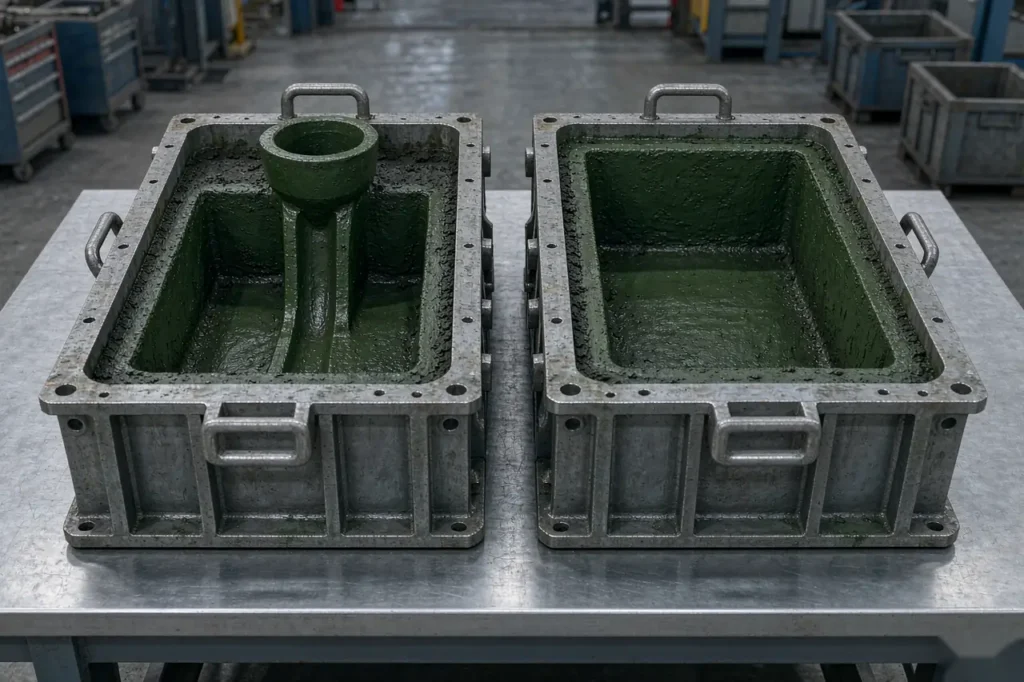
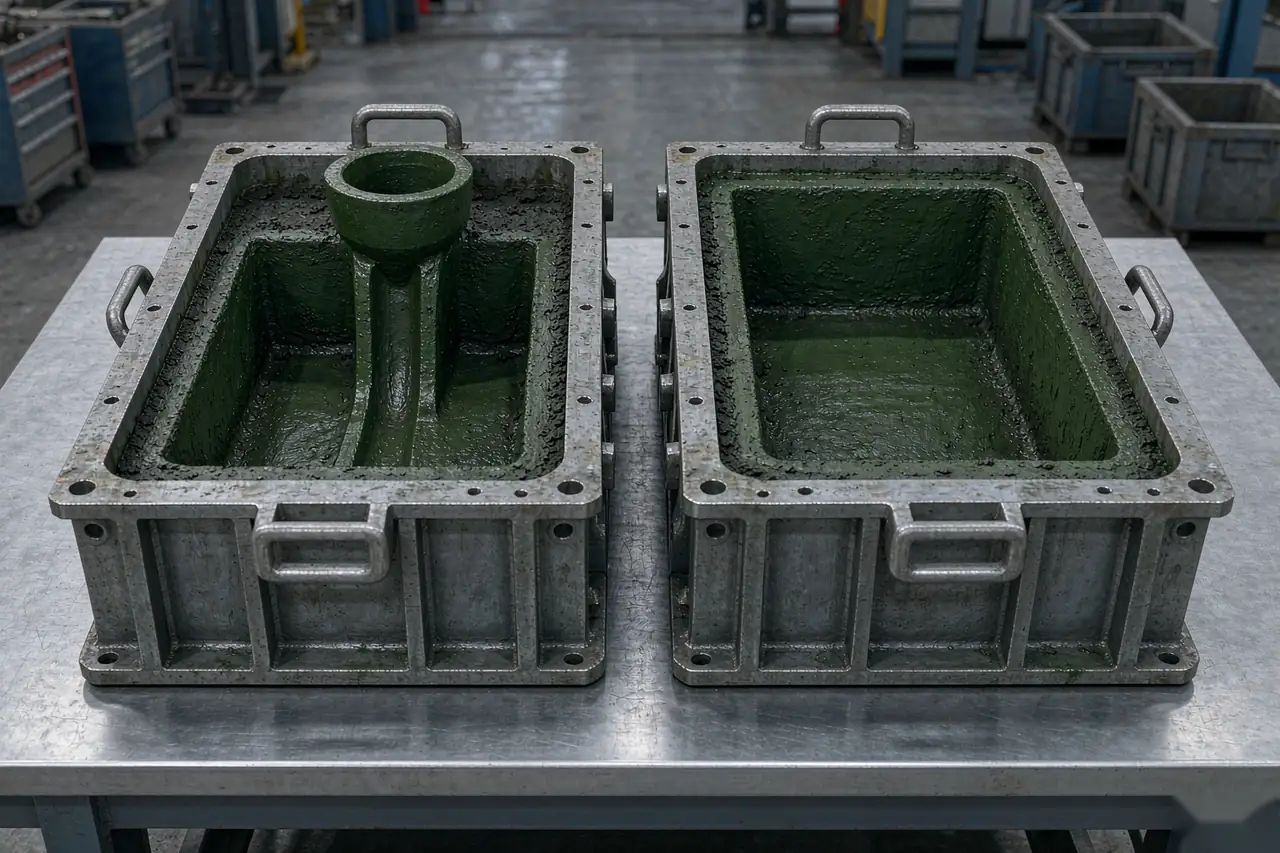
“Green” has nothing to do with colour. In литье в зелёные пески the mold is unbaked: silica sand is bonded with clay and water, compacted around a pattern, and poured while still damp. No oven, no chemical cure, no waiting. That single fact is why the process dominates — a mold is ready in seconds, the sand is recovered and reused at 90–95%, and the pattern can be a wooden or aluminium match plate instead of hardened tool steel.
The trade-off is that the mold is weak. A chemically bonded mold holds a cavity to a fixed geometry; a green sand mold holds it by friction and capillary bond, which means the cavity can move while the metal is still liquid. Every dimensional surprise buyers hit on green sand parts — oversize bores, wall thickness variation, parting-line shift — traces back to that. It is also why green sand casting dominates high-volume iron work and why it is rarely the answer for a tight-tolerance stainless part.
The four ingredients, and what each one really does
A green sand casting system is only four ingredients plus whatever comes back from shakeout. Each one pulls against the others, which is the reason no single number can be optimised in isolation:
- Silica sand (the refractory). Grain size is quoted as an AFS grain fineness number (GFN). Iron work typically runs GFN 55–70; aluminium and bronze, which need finer surfaces and thinner walls, run 70–100. Coarser sand vents better but lets metal penetrate; finer sand gives a smoother skin but gas cannot escape.
- Bentonite clay (the bond). Sodium (western) bentonite at 6–9% of sand weight develops high green strength and good thermal durability. Calcium (southern) bentonite needs 8–12% for the same green strength and holds moisture more evenly, so many shops run a blend.
- Water (the activator). Only 2.8–3.6% by weight — but it is the single most volatile variable in the whole system, because it changes between the muller, the molding machine and the pouring line.
- Carbonaceous additives (the release agent). Seacoal or a synthetic preblend at 3–6% gasifies at the metal front and forms a lustrous carbon film that stops burn-on and makes the sand strip cleanly at shakeout.
Everything else in the system — return sand, core sand ingress, dust collector fines — is dilution you have to manage. If you want the deeper version of recipe design, our sand casting mold materials guide covers grain distribution and clay selection in more detail, and our pattern and mold making service page shows how the pattern itself limits what the sand can achieve.
| Component | Typical range (iron, machine molding) | Why it is set there |
|---|---|---|
| Silica sand GFN | 55–70 | Balances permeability against surface finish |
| Bentonite (active, MB) | 6–9% sodium / 8–12% calcium | Sets green compression strength and hot durability |
| Temper water | 2.8–3.6% | Activates clay; every 0.1% moves compactability measurably |
| Seacoal / carbon preblend | 3–6% | Lustrous carbon film stops burn-on and improves stripping |
| Cellulose / wood flour (optional) | 0.5–1.5% | Burns out to give the mold room to expand → less scabbing |
| Loss on ignition (LOI) | 3–6% | Accumulated dead carbon; above 6% the sand starts gassing |
Green Sand Casting Process Control: The Five Tests That Decide Your Scrap Rate
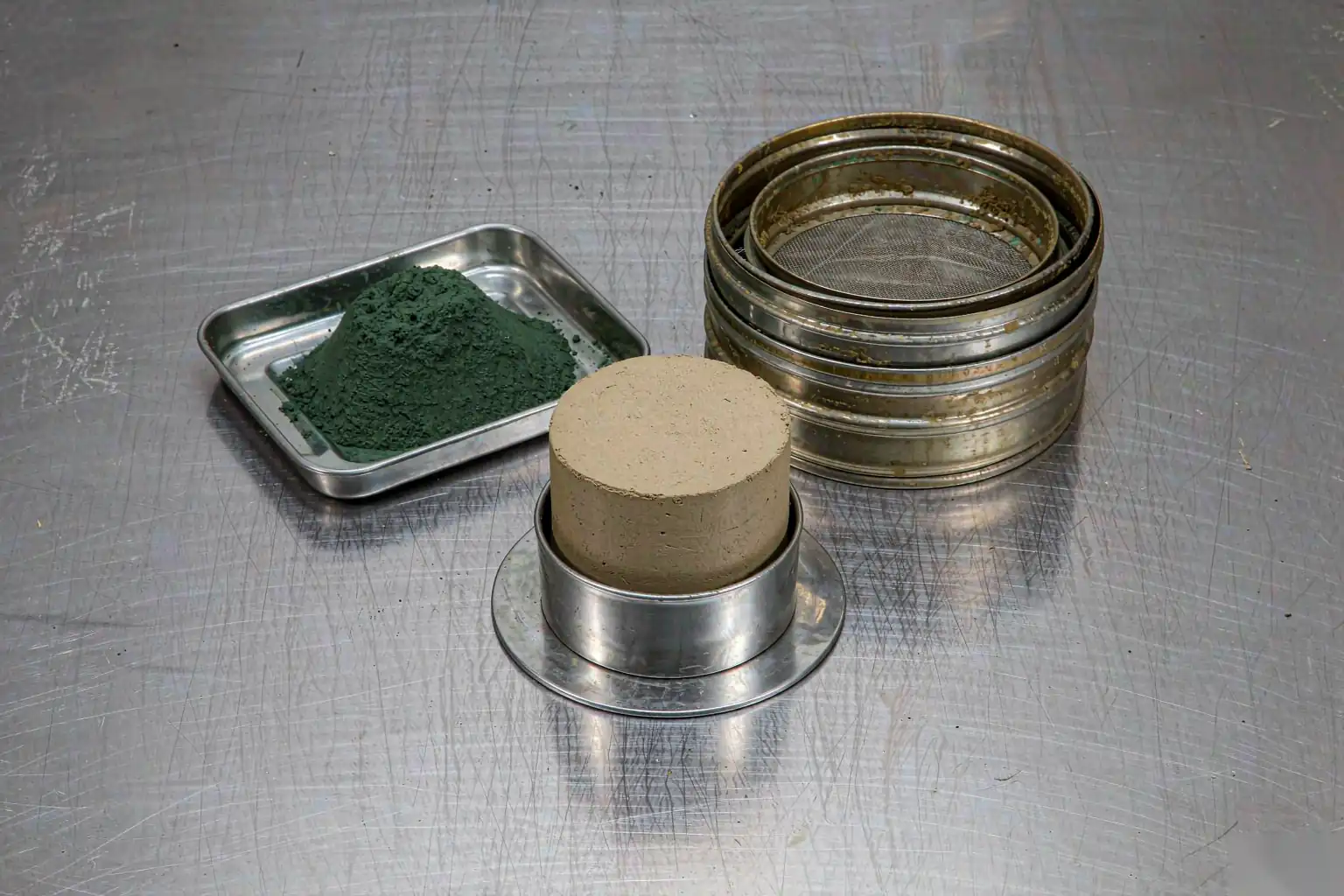
A foundry can pour good parts for a month and then lose a week to sand wash without anybody changing the drawing. The difference is almost always one of these five numbers drifting outside band. These are the tests worth putting into a supplier questionnaire — they are cheap, they are standardised, and they predict scrap far better than any certificate. You can also cross-check them against our sand casting parameter optimisation notes and the gating-side view in gating system design.
| Test | Target band | Below band → | Above band → |
|---|---|---|---|
| Compactability | 35–45% | Friable molds, sand drops, erosion at the gate | Too much water → blows, scabs, longer cooling |
| Moisture | 2.8–3.6% | Clay never fully activates, green strength collapses | Steam defects, pinholes, mold wall movement |
| Green compression strength | 110–165 kPa (16–24 psi) | Wall movement, oversize castings, sand wash | Mold too rigid → hot tearing, poor collapsibility |
| Permeability (AFS) | 80–150 | Blowholes, gas porosity, misruns in thin sections | Open grain → metal penetration, rough surface |
| Mold hardness (B-scale) | 80–95 | Dimensional spread part to part, parting-line flash | Over-compaction → cracks, hard spots, poor venting |
Why permeability is not a secondary number
Run the gas arithmetic once and permeability stops being an abstract lab figure. Take a medium-sized mold: a 900 × 700 mm flask with 200 mm cope and 200 mm drag holds 252 litres, of which roughly 34 litres is pattern, runner and casting — so about 218 litres of sand, which at a compacted bulk density near 1.55 kg/litre is 338 kg of sand per mold. With four 12 kg housings per mold and a pouring weight of 55 kg including the running system, the sand-to-metal ratio is 338 ÷ 55 = 6.1:1, squarely in the 5–8:1 band you should expect on a green sand line.
Only the sand close to the cavity gets hot enough to boil its water — call it 60 kg. At 3.2% moisture that is 1.92 kg of water. One gram of water becomes about 5.8 litres of steam at 1,000 °C (0.0556 mol × 0.0821 L·atm/mol·K × 1,273 K), so 1,920 g becomes roughly 11,000 litres of steam that has to leave the mold through the sand and the vents while the cavity fills in seconds. That is the whole reason permeability below 60 shows up as blowholes on the cope surface, and why venting and controlled filling without turbulence have to be designed together, not separately.
Reading Defects Back to the Sand
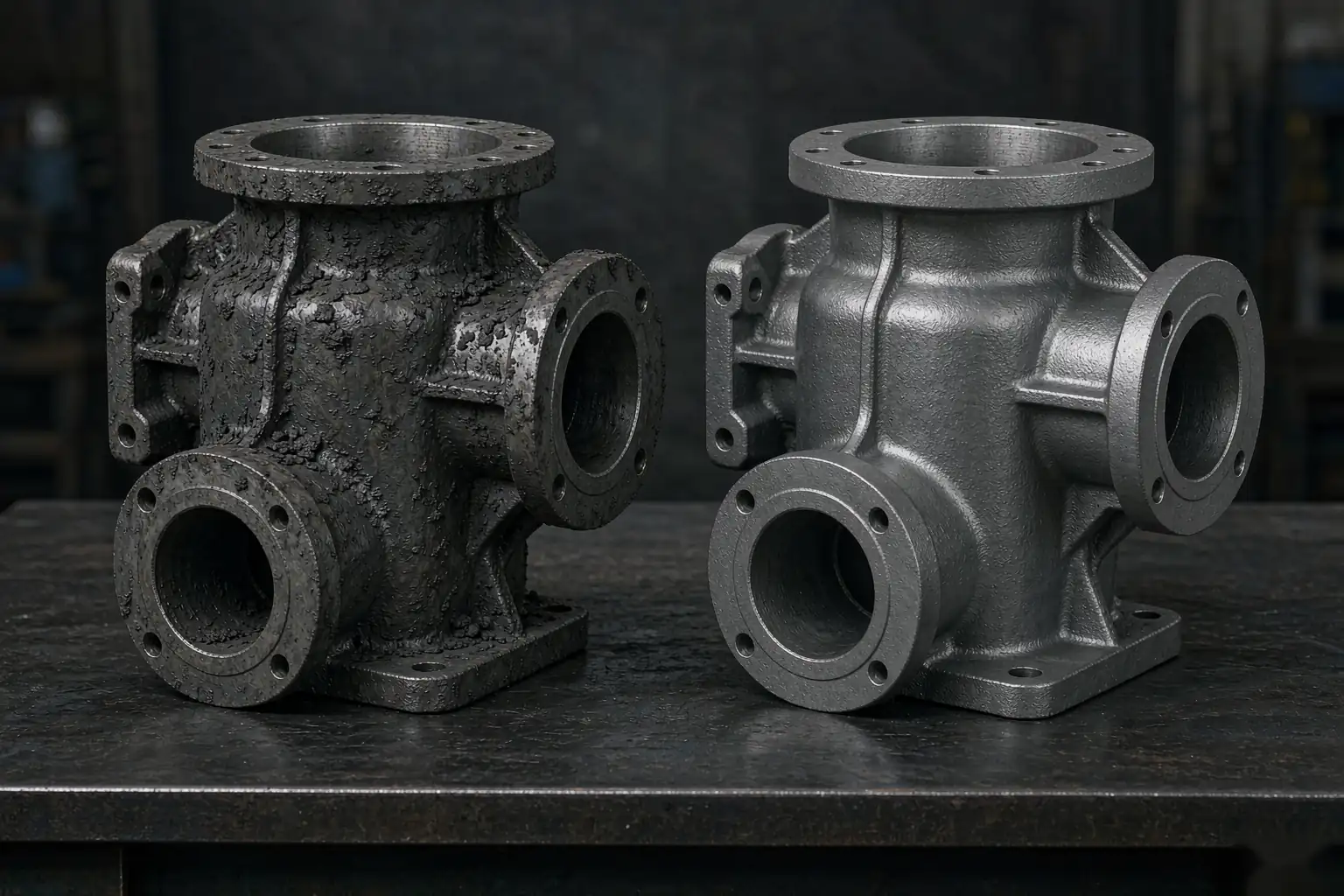
Buyers usually meet defects as a photo in a claim email. The useful question is not “is this acceptable” but “which sand property moved”. Nearly every defect in green sand casting maps to one variable, which means the fix is a process correction and not a redesign — and it is usually a same-day correction at that.
| Defect you see | Sand property that moved | First correction to try |
|---|---|---|
| Sand wash / sand inclusions | Green compression < 100 kPa, low mold hardness | Raise compaction pressure; add 0.5–1% bentonite |
| Scabs, buckles, rattails | Moisture high + permeability low + silica expansion | Cut moisture 0.2–0.3%, add 0.5–1% cellulose, coarsen GFN |
| Blowholes / pinholing | Permeability < 60, blocked vents, high LOI | Increase venting, drop new-sand addition to dilute LOI |
| Metal penetration / burn-on | Coarse sand, low hardness, high pouring temperature | Finer facing sand or zircon wash; hold pouring temp at spec |
| Veining / finning cracks | Silica α→β inversion at ~573 °C, ~1.4% volume jump | Cellulose for expansion room; chromite facing on hot spots |
| Parting-line flash / shift | Flask alignment, worn pins, uneven squeeze | Re-machine flask pins; verify squeeze plate parallelism |
Two caveats keep buyers honest. First, shrinkage cavities and micro-porosity are not sand problems — they are feeding problems, and they are solved with riser sizing and feeding rules, or with solidification simulation before the first mold is rammed. Second, a defect that appears once a quarter, in one corner of one mold, is usually a pattern or flask problem rather than a sand problem; see our дефекты литья overview for the full triage order.
What Green Sand Casting Costs per Ton (and Where the Money Actually Goes)
Sand is cheap. Scrap caused by sand is not. That distinction is the whole economics of green sand casting, and it is why the lowest quote per kilogram is rarely the lowest landed cost.
For a green sand casting line pouring 12 kg gray iron pump housings — the kind of part we run for valve and pump bodies и automotive brackets — the consumable side works out roughly like this per tonne of good castings shipped:
| Строка расходов | Consumption per tonne of castings | Cost per tonne |
|---|---|---|
| New silica sand | 90 kg | $6.75 |
| Bentonite make-up | 14 kg | $3.36 |
| Seacoal / carbon preblend | 7 kg | $3.85 |
| Sand plant: mulling, screening, cooling, dust collection | — | $9.00 |
| Sand material total | — | ≈ $23 / t |
| Sand-driven scrap at 4% | 83 pieces lost value | ≈ $93 / t |
Read that last line carefully. At 12 kg per housing there are 83 pieces in a tonne; at a $28.00 FOB piece price a tonne of shipped castings is worth $2,333. Every 1% of scrap burns $23 — and the sand itself costs about the same. So the real saving is not a cheaper sand contract, it is control: moving scrap from 4% to 2% returns roughly $47 per tonne, which on a 750 t/year program is about $35,000 a year for the price of four bench tests a shift.
This is also why the cheap quote is a trap. A foundry that skips the muller, the sand cooler or the daily test log saves about $23 a tonne and risks $93. Our разбивка затрат на литье walks through the same arithmetic for the rest of the cost stack, and our sand casting production page describes what a controlled line actually looks like on the floor.
When Green Sand Casting Stops Being the Cheapest Route
Green sand casting wins on cycle time and consumables, but it pays a tooling premium: machine molding needs a durable match plate, and that plate has to survive tens of thousands of cycles. Chemically bonded systems — furan no-bake, shell mold — use simpler, cheaper patterns and give a harder, more accurate cavity. The crossover is a volume question, and you can solve it in one line.
Same 12 kg housing, quoted both ways at 6,000 pieces a year:
| Line item | Зелёный песок | Furan no-bake |
|---|---|---|
| Оборудование | $9,400 (match plate) | $3,600 (pattern) |
| Molding cost per piece | $4.20 | $7.60 |
| Cleaning per piece | $2.40 | $2.05 |
| Net piece price | $28.00 | $31.05 |
| Срок изготовления инструментов | 5–7 weeks | 3–4 weeks |
| Practical volume window | Above ~2,000 pieces/year | 50–2,000 pieces/year |
The tooling gap is $5,800 and the piece-price gap is $3.05, so break-even is $5,800 ÷ $3.05 = 1,902 pieces. At 6,000 a year the green sand line saves $18,300 in piece price and nets about $12,500 a year after tooling — reached inside four months. Below roughly 2,000 pieces a year, the no-bake route is simply the better buy, and if your annual volume is under a few hundred you should also price lost foam и литье по выплавляемым моделям before signing anything. Where the design is still moving, a run of прототипные отливки или а Шаблон, напечатанный на 3D-принтере is cheaper than committing a match plate too early.
Geometry can override the maths in both directions. In green sand casting, very heavy sections (> 80 mm) hold heat in a green sand mold long enough to coarsen the grain and grow shrinkage risk; thin plates under about 4 mm fill poorly against a damp mold; and tight-tolerance bores push you toward shell molding или литье под давлением regardless of volume. Conversely, if your part has a generous section and a wide tolerance band, ISO 8062 tolerance grades leave green sand competitive at volumes where you would not expect it.
What to Ask a Foundry Before You Commit
Five questions, all answerable in an email, that separate a controlled line from a lucky one:
- What are your compactability and moisture bands, and how often are they logged? “We test every muller batch” is the only acceptable answer. Daily is a warning sign.
- What mold hardness do you hold, and on which machine? High-pressure compaction runs at roughly 0.7–1.2 MPa (100–175 psi) and lands mold hardness in the 85–95 range. On one 300 mm housing we tracked, hardness drifting from 90 to 75 widened bore-to-bore variation from ±0.9 mm to ±1.7 mm — enough to matter at the machining centre.
- What is your current sand-driven scrap rate? A shop that knows the number is a shop that measures it. Our own experience matches the wider sand-related porosity work: 2% is achievable with discipline, 6% is normal without it.
- How do you handle core sand ingress? Broken cores dump resin-coated sand into a clay-bonded system. If there is no dilution plan, LOI climbs and gas defects follow.
- What does the first-article package include? Dimensional report, material certificate and, where the drawing demands it, the NDT results covered in our методы контроля литья guide.
Then match the process to the material before you optimise the sand. Gray versus ductile iron changes shrinkage behaviour and therefore feeding; iron versus cast steel changes pouring temperature and therefore burn-on risk; выбор сплава sets all of it. On the production side, our чугунное литье, литье алюминия, стальное литье и литье из медных сплавов pages show which alloys each line runs. If heat treatment is on the route, confirm where it happens — our услуги по термической обработке и обработка поверхности capabilities cover the downstream steps that decide whether a cheap casting stays cheap.
Часто задаваемые вопросы
Is green sand casting accurate enough for machined parts?
Yes, with realistic expectations. Machine-molded green sand casting typically lands in the middle of the ISO 8062-3 dimensional tolerance grades, and a competent line holds ±0.9 mm on a 300 mm feature. That is why machining allowance matters more than tolerance on these parts — see our machining allowance guide for how much stock to leave, then price the second operation with our Обработка на станках с ЧПУ team before you commit to a delivered part cost.
What is the minimum wall thickness for green sand casting?
Around 4–5 mm for iron and 3–4 mm for aluminium on a well-compacted mold, but thin walls against damp sand lose heat fast and misrun. Our wall thickness guidelines give the section-by-section version.
How long does green sand tooling last?
In green sand casting, an aluminium or iron match plate on a high-pressure line routinely runs 50,000–100,000 molds before the wear starts showing up as parting-line flash. Wooden patterns for low-volume hand molding are far cheaper and far shorter-lived, which is exactly the tooling trade-off described above.
Can green sand casting be used for aluminium and bronze?
Yes, with a finer sand (GFN 70–100) and lower pouring temperatures. Aluminium’s low density means the mold sees less hydrostatic pressure, so wall movement is less of a problem; bronze brings its own shrinkage and gas concerns — start with our bronze casting notes. For stainless and duplex grades, green sand casting gives way to литье из нержавеющей стали routes for the same reason.
How does green sand affect lead time?
Molds are made in minutes and need no curing or baking, so production ramps fast once tooling is ready. The bottleneck is tooling: 5–7 weeks for a match plate versus 3–4 weeks for a no-bake pattern. Full stage-by-stage timing is in our casting lead time breakdown.
*Sand test methods referenced from AFS mold and core testing practice; cost and process figures from Supro MFG shop-floor records. Ranges vary with alloy, section size and molding equipment — confirm against your own part before specifying.
 English
 Français
 Deutsch
 Italiano
 日本語
 한국어
 Polski
 Português de Angola
 Русский
 Español de Argentina