
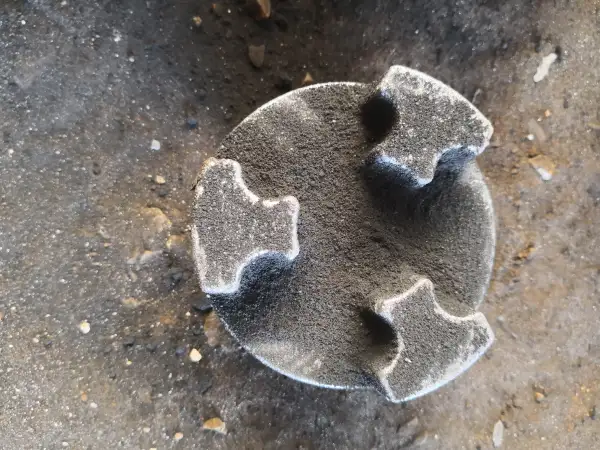
Against the backdrop of the ongoing evolution of automotive powertrains and structural components toward lightweighting and high reliability, quality control of sand casting filling has become a critical factor in determining the in-service performance of aluminum castings. This paper systematically analyzes the flow behavior of molten metal within a sand casting mold and the mechanisms by which it affects casting integrity: when the pouring speed exceeds the critical threshold of 0.5 m/s, the rupture of the liquid surface draws the oxide film and ambient gases into the leading edge of the melt, directly inducing internal defects such as porosity and oxide double layers in aluminum sand castings. By optimizing the ratio of the runner cross-sectional area, adopting a bottom-pour layout, and incorporating ceramic foam filtration, flow patterns can be effectively controlled within the laminar flow range. Furthermore, by combining CFD numerical simulation with precision sand casting tools, it is possible to predict turbulent regions prior to trial production and make targeted adjustments to process parameters. The following sections will break down, item by item, the key implementation points and process windows for these fluid control technologies in the production of automotive 알루미늄 주물.
Sand Casting Mechanics of Flow Turbulence in Automotive Aluminum Castings
During the 모래 주조 process, uncontrolled flow velocity can lead to severe turbulence on the surface of automotive structural components and cause internal degradation of the metal. When molten aluminum enters the gating system too rapidly, the rupture of surface waves traps the oxide film and ambient air within the leading edge of the advancing molten metal front. These entrained oxides directly cause downstream sand casting defects, thereby reducing the mechanical fatigue life of critical automotive components. Foundries must manage fluid momentum by properly designing gating dimensions and controlling pouring speed to maintain laminar flow. By controlling the filling kinetics, uniform metal deposition throughout the mold cavity can be ensured, resulting in the production of dense, high-strength structural components.
Critical Fluid Velocity Thresholds in Aluminum Mold Cavities
Controlling the fluid flow velocity within the sand casting mold is critical to preventing surface spatter during the pouring process. When the pouring speed of molten aluminum exceeds the critical value of 0.5 meters per second, it can lead to surface spatter and entrapped air. When the leading edge of the liquid surface breaks, surface tension fails, creating localized turbulence that leads to porosity in thick-walled sections of the aluminum sand casting. By precisely calculating the sprue ratio to ensure that the liquid surface rise rate remains below this critical threshold, smooth laminar pouring can be achieved, thereby maintaining metal purity and preventing oxide inclusions.
Oxide Bi-Film Formation and Internal Defect Mechanics
Preventing turbulence in the molten metal during the sand casting process can prevent surface oxides from migrating to critical internal areas. When turbulence causes the molten aluminum to fold and overlap, two layers of dry surface oxide lock together without fusing, forming a microscopic double layer. These submerged oxide folds create mechanical discontinuities that, under dynamic stress loads, often evolve into structural sand casting defects. By installing ceramic foam filters in the runner, surface oxide clusters can be intercepted before they reach the main mold cavity. Thus, eliminating folded oxides ensures good metallurgical bonding throughout the finished part.
Impact of Entrained Air on Structural Integrity
Air entrapped during the cavity filling process increases microporosity and directly leads to porosity issues in sand-cast components of critical housings. A turbulent liquid surface engulfs surrounding air bubbles from the gating system, breaking them down into tiny pressurized bubbles that remain trapped in the casting after solidification. The use of specialized sand casting tools equipped with venting risers helps divert this gas-rich molten metal away from structural areas. Removing trapped gas ensures uniform density in thin-walled sections, enabling structural housings to meet stringent automotive standards for pressure sealing and fatigue durability.
Advanced Gating System Design for Turbulent-Free Sand Casting
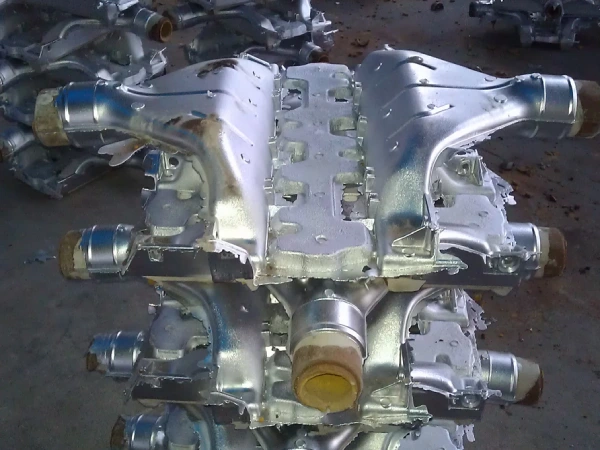
Designing a turbulence-free pouring network in a sand casting mold is critical for eliminating oxide double layers and internal porosity. By optimizing the sprue taper ratio, using a bottom sprue inlet, and placing high-porosity ceramic filters, liquid metal can fill the mold cavity with a smooth laminar flow front. A well-designed flow path structure prevents air entrapment and reduces kinetic energy at the gating inlet. The use of these controlled pouring techniques effectively prevents severe sand casting defects in critical automotive components. As a result, structural aluminum castings exhibit uniform mechanical properties and excellent pressure resistance when subjected to heavy-duty operating conditions.
Tapered Sprue and Runner Ratio Optimization
Optimizing the dimensions of the runner in a sand casting mold can prevent air entrapment and stabilize the flow of molten metal during pouring. A tapered runner helps maintain an intact column of molten metal, preventing ambient air from being drawn into the flow. This engineered reduction in cross-sectional area controls the filling rate, thereby effectively eliminating aluminum sand casting porosity in downstream .
Gating Element | Area Ratio (Unpressurized) | Engineering Function |
Sprue Exit | 1.0 (Baseline) | Controls initial gravitational flow rate |
Runner Bar | 1.2 – 1.4 | Reduces kinetic velocity and absorbs surge energy |
Ingates | 1.6 – 2.0 | Ensures smooth, low-velocity cavity entry (<0.5 m/s) |
Bottom Gating Systems for Smooth Liquid Elevation
In the sand casting process, using a bottom-gated configuration allows the molten aluminum to rise smoothly, preventing surface spatter. By entering the mold cavity at its lowest point, the molten metal avoids free-fall caused by gravity, thereby preventing the liquid surface from rupturing. Specialized sand casting tools, such as ceramic well bases and fillet gates, cushion the initial impact of the metal’s inflow. This controlled upward displacement helps maintain the integrity of the surface oxide film, allowing the molten metal to flow smoothly toward the top sprue. As a result, the solidified casting is free of oxide inclusions and gas pores.
Ceramic Foam Filtration and Flow Diffusers
Placing ceramic foam filter elements in sand casting mold not only removes non-metallic inclusions but also dampens turbulent impacts. As molten metal flows through the porous ceramic structure, linear kinetic energy is converted into a dispersed and uniform fluid flow. Using specialized sand casting tools, these filter elements are positioned near the gating junctions to ensure they remain securely in place during the pouring process. This mechanical barrier traps loose slag particles and suppresses localized micro-vortices before the metal enters the casting cavity. Ultimately, clean laminar filling ensures that the casting is dense and defect-free, capable of passing rigorous radiographic testing.
Sand Casting Tools and Numerical Simulation for Turbulence Prevention
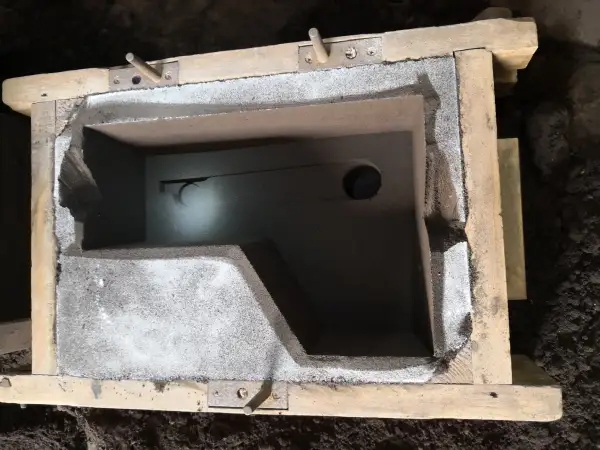
Combining digital filling simulations with high-precision 모래 주조 tools allows for proactive mitigation of turbulent behavior in molten metal. Today, foundries model the flow of molten metal within 모래 주조 mold before fabricating physical molds, thereby precisely identifying points of sudden velocity increase, surface wave breakpoints, and areas where porosity forms. Process engineers adjust the sprue radius, runner dimensions, and the placement of cooling fins based on digital flow field data. Additionally, by adding dedicated core vent holes and using permeable 금형 재료, they ensure that gases expelled during cavity filling can escape smoothly. This integrated engineering approach not only avoids time-consuming and costly trial-and-error iterations but also ensures zero-defect 자동차용 주조품.
Computational Fluid Dynamics for Mold Filling Optimization
By simulating the fluid dynamics within a sand casting mold, high-speed turbulent regions can be identified before model production begins. Additionally, MAGMA or ProCAST software can be used to plot free-surface front maps and detect localized bubble entrapment during the pouring process. By identifying these turbulent flow paths, the runner geometry can be redesigned to directly prevent sand casting defects such as oxidation wrinkles and cold shuts. Operators adjust the tapering section of the runner on the screen until the fluid velocity drops below a critical threshold. Consequently, CFD optimization ensures clean, laminar pouring of the fluid within the complex cavities of automotive body panels.
Precision Pattern Tooling and Venting Systems
The use of sand casting tools ensures precise cavity geometry and effective gas venting during the pouring process. CNC-machined metal prototypes maintain strict gate tolerances, thereby preventing unintended fluid acceleration or localized flow separation. Aluminum sand casting porosity is effectively suppressed by installing highly permeable vent plugs and overflow channels at the leading edge of the molten metal to expel trapped air. Inspecting core impressions using a coordinate measuring machine ensures precise alignment when the mold is closed. Consequently, precision molds are able to maintain controlled molten metal flow rates and uniform filling dynamics.
Integration with High-Performance Casting Alloys
Integrating fluid dynamics control into the sand casting process requires matching the fluid velocity in the runner to the specific viscosity of the selected aluminum alloy. A higher silicon content improves molten metal fluidity, while magnesium-rich alloys require stricter velocity limits to prevent severe surface oxidation. Using specialized casting tools, the tapering ratio of the runner can be adjusted according to the alloy’s solidification characteristics. To fully realize optimal mechanical properties after defect-free casting, please review our approach outlined in the [자동차의 중요 구조 부품에 대한 모래 주조용 합금 선정 지침].
신뢰할 수 있는 중국 금속 주조 공장을 찾고 계십니까?
Quality Verification for Turbulence-Free Sand Casting Defect Control
Comprehensive quality inspections have confirmed that the optimized mold filling process has successfully eliminated internal sand casting defects in safety-critical automotive components. Using industrial X-ray computed tomography (CT) and metallographic examination, it has been verified that the products are completely free of entrapped gas and oxide double layers. Furthermore, mechanical fatigue testing has confirmed that laminar flow directly maintains the structural load-bearing capacity. These rigorous validation steps ensure that all aluminum sand casting porosity issues are identified and resolved prior to final assembly. By verifying the internal integrity of each production batch, the foundry is able to deliver castings of high integrity that consistently meet stringent automotive original equipment manufacturer (OEM) standards.
Industrial X-Ray CT Inspection for Internal Discontinuities
High-resolution industrial X-ray CT scanning technology is required to inspect finished parts for internal sand casting defects. Radiographic inspectors scan critical cross-sections to generate 3D density maps, thereby identifying hidden oxide inclusions or porosity. This non-destructive testing method can detect microporosity as small as 50 micrometers, which typically forms when turbulent filling breaks surface tension. Assessing internal integrity in accordance with the ASTM E155 reference standard ensures that only dense components proceed to the final machining process. Consequently, 3D radiography technology verifies whether laminar filling during the sand casting process has successfully prevented the formation of structural discontinuities.
Metallographic Micro-Porosity and Bi-Film Analysis
By analyzing the polished cross-section, it is possible to identify residual aluminum sand casting porosity caused by entrapped air. Quality technicians cut samples from high-stress mounting flanges, polish them to a mirror finish, and examine them under an optical microscope. Microscopic examination distinguishes between circular gas pores and branched shrinkage cavities, and detects thin, unbound oxide double-layer film folds. By monitoring the microporosity rate, optimal gate flow velocity can be maintained during production. Ultimately, metallographic verification confirms that the casting mold and laminar flow system are capable of producing a dense and defect-free internal microstructure.
Mechanical Property Testing under Dynamic Fatigue Loads
A dynamic fatigue resistance evaluation of sand-cast test specimens demonstrated the practical performance advantages of turbulence-free pouring. Test technicians applied cyclic bending and tensile loads to the cut specimens until failure occurred, thereby determining their endurance limits. Clean, turbulence-free castings exhibit significantly higher fatigue life because they lack sharp oxide double layers that act as stress concentration points. A comparison of the fatigue curves with those from a reference production batch confirmed that the gate modification effectively eliminates internal sand casting defects. Consequently, automotive structural components can maintain reliable long-term durability even under severe operational stresses.
Supro MFG에 문의하기
This paper systematically analyzes the impact of molten metal filling kinetics during the sand casting process on the quality of automotive aluminum castings. By optimizing the design of the sand casting mold gating system, controlling the critical flow velocity, and applying ceramic foam filtration and bottom-pour configurations, turbulent filling can be effectively suppressed, thereby preventing sand casting defects caused by oxide entrainment and gas entrapment—particularly aluminum sand casting porosity. By combining CFD numerical simulations with precision sand casting tools, it is possible to identify turbulent regions and adjust process parameters prior to pilot production.
As a manufacturing partner with deep expertise in the automotive 알루미늄 합금 주조 sector, Supro MFG integrates the aforementioned fluid control strategies throughout the entire process, from mold design to mass production validation. During actual production, we strictly monitor the ratio of runner cross-sectional areas (main runner: cross runner: gate ≈ 1.0:1.3:1.8) and verify internal integrity batch by batch through X-ray CT and metallographic sampling. Contact the 수프로 MFG engineering team today to obtain a DFM (Design for Manufacturability) analysis and filling flow field simulation evaluation tailored to your product’s structure.
 English
 Français
 Deutsch
 Italiano
 日本語
日本語 한국어
한국어 Polski
 Português de Angola
 Русский
 Español de Argentina