
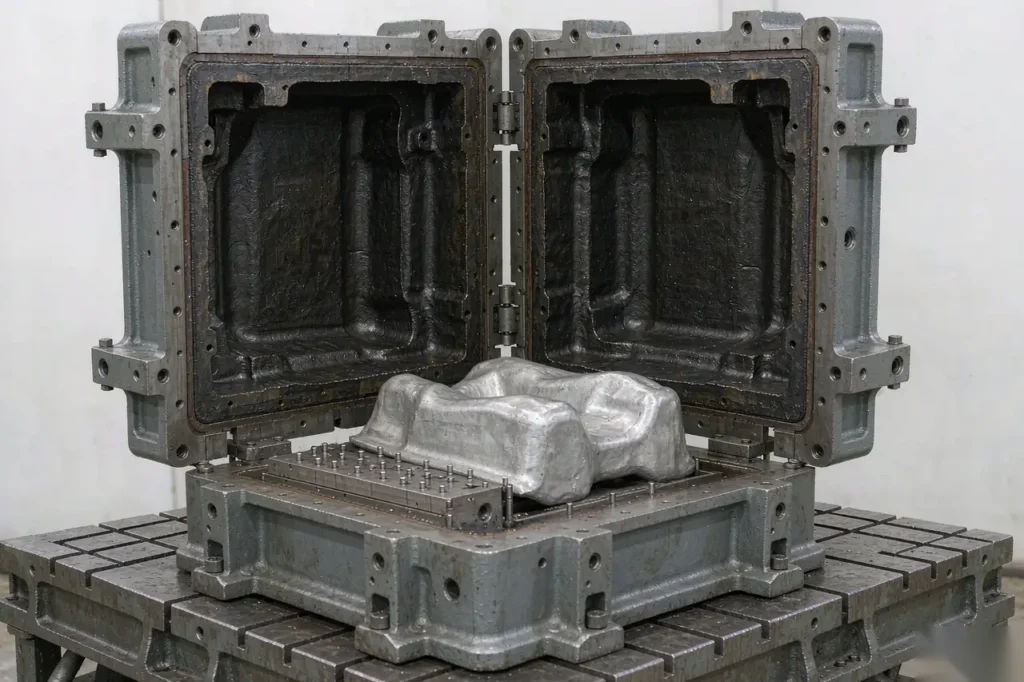
Most sourcing teams meet permanent mold casting only after sand casting fails a leak test or a machining quote comes back brutal. It is the quiet middle option: a steel or iron mold, gravity or low-pressure fill, and a part that machines in half the time of a sand casting.
This guide covers what the process actually does to your part — mechanical properties, tolerances, surface finish, tooling cost and the volume where it pays for itself. Every number comes from published standards (ASTM B26, B108, ISO 8062) or from production data we track on our own floor, and we flag the cases where AFS e NADCA guidance says to walk away from permanent mold casting. If you are still mapping the full process landscape, start with our metal casting guide.
What Permanent Mold Casting Actually Is
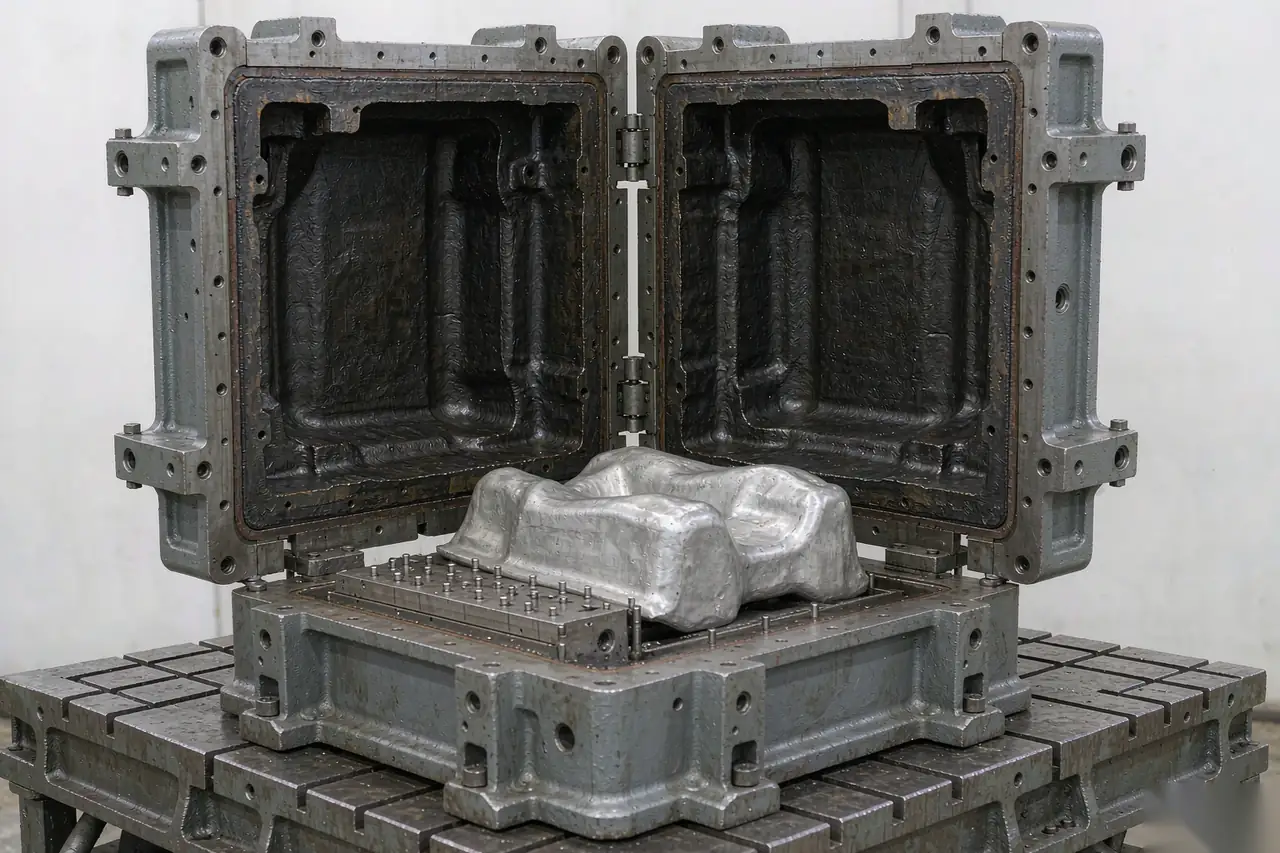
Permanent mold casting pours molten metal into a reusable metal mold — usually H13 tool steel, 4140, or a dense gray iron — and lets gravity or a low gas pressure do the filling. No sand binder, no flask, no new mold every shot. The mold is preheated to 200–350 °C, coated with a refractory wash about 0.10–0.25 mm thick, and held at 300–450 °C in production. Metal freezes against a chilled wall instead of an insulating one, which is where the property gains come from.
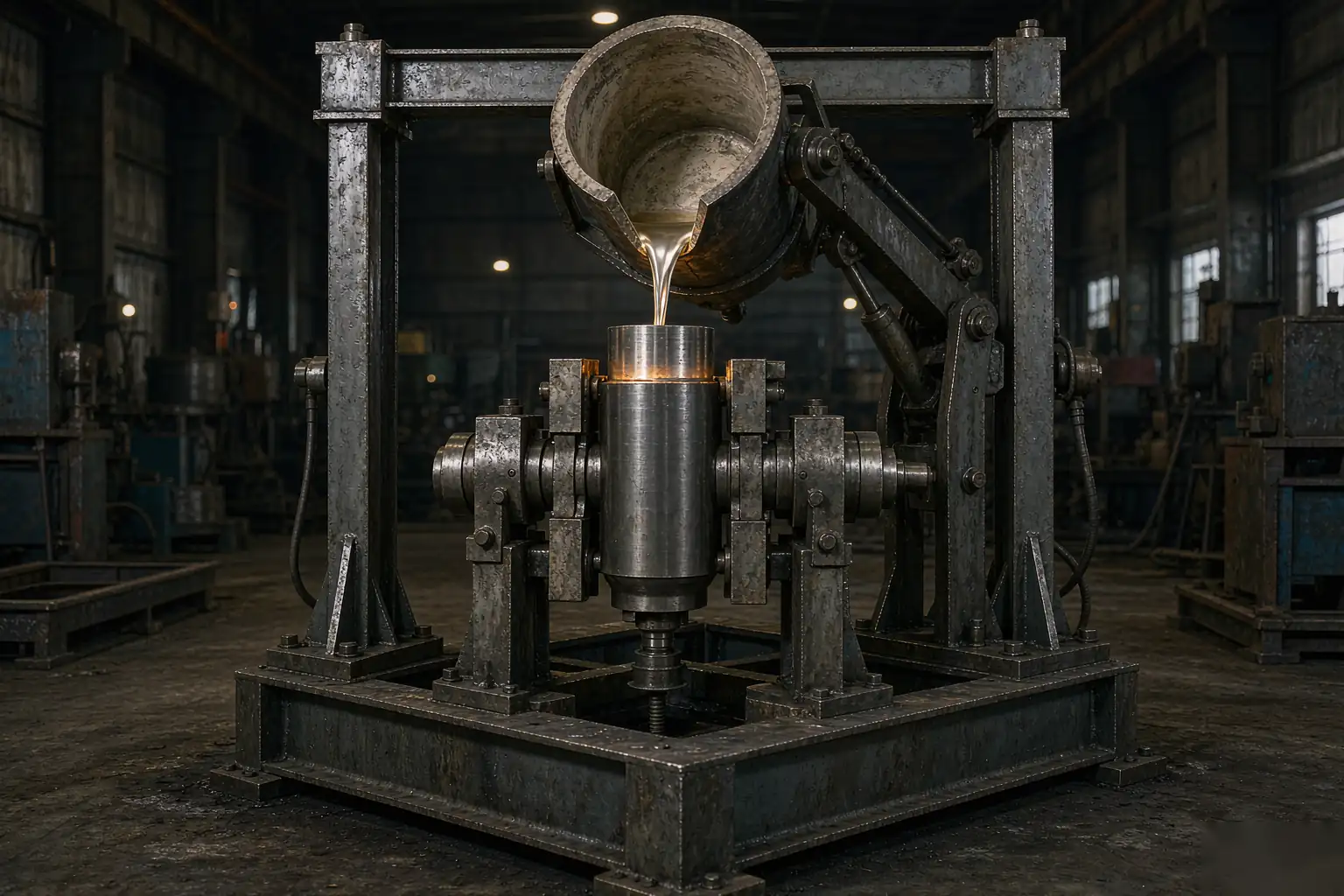
Four variants show up in supplier quotes, and they are not interchangeable:
- Static gravity. Ladle or automated pour into a fixed mold. Simplest tooling, most turbulence, cheapest to modify.
- Tilt pour. The mold rotates through 90° while filling, so metal enters from the bottom of the cavity. Oxide folding drops sharply and yields improve.
- Low-pressure (LPDC). 0.3–1.0 bar of dry air pushes metal up a riser tube. Fill is slow and laminar, and the tube feeds the casting, so risers can often be deleted — yields of 85–95% are normal against 70–85% for gravity.
- Vacuum / counter-pressure. The cavity is evacuated before fill for thin-wall or pressure-tight work.
The constraint that surprises buyers first: in permanent mold casting the mold cannot be broken away to free the part. Deep undercuts and re-entrant geometry need sand cores set into the metal mold, or retractable steel core pulls, and both add cost per shot. Where the geometry is genuinely awkward, green sand casting keeps more options open.
Permanent Mold Casting vs Sand and Die Casting
Buyers usually shortlist two of the three and miss the middle one. The table below is the short version; the details behind the die casting column are in our aluminum die casting guide, and the sand side is covered in die casting vs sand casting.
| Fattore | Green sand | Permanent mold | High-pressure die |
|---|---|---|---|
| Fill pressure | Gravity head | Gravity, tilt or 0.3–1.0 bar | 40–120 MPa |
| Mold material / life | Silica sand, one mold per pour | H13 or iron, 20,000–120,000 shots | H13, 80,000–150,000 shots |
| Minimum wall | 4–6 mm | 3–4 mm (2.5 mm in LPDC) | 1.5–2.5 mm |
| Typical as-cast Ra | 12.5–25 µm | 3.2–6.3 µm | 1.6–3.2 µm |
| Machining allowance | 2.5–4 mm | 0.8–1.5 mm | 0.5–1.0 mm |
| Usable part mass | 0.5 kg to several tonnes | 0.2–30 kg (90 kg tilt-pour) | 0.05–15 kg |
| Typical tooling | $1,500–$8,000 | $8,000–$60,000 | $30,000–$150,000 |
What the Chill Does to Mechanical Properties
Secondary dendrite arm spacing (SDAS) is the number worth arguing about. A 10 mm wall frozen in green sand lands around 50–100 µm; the same section run in permanent mold casting lands at 20–50 µm; high-pressure die casting gets down to 5–20 µm. Finer spacing means smaller eutectic particles, less microporosity between arms, and better ductility after the same heat treatment.
On A356.0-T6 the difference is not marginal. ASTM B26 minimums for sand cast test bars are 234 MPa tensile / 165 MPa yield / 3.5% elongation; ASTM B108 for permanent mold is 310 MPa / 205 MPa / 5%. That is roughly 32% more tensile strength and 43% more elongation from the same alloy and the same T6 cycle. It also shortens the cycle: solution treatment at 540 °C takes 8–12 hours for sand castings but only 4–8 hours for permanent mold, because finer DAS dissolves Mg₂Si faster. Details of the thermal cycle are in our casting heat treatment article.
| Property, A356.0-T6 | Sand (ASTM B26) | Permanent mold (ASTM B108) | Why it moves |
|---|---|---|---|
| Tensile strength | 234 MPa | 310 MPa | Finer SDAS, denser structure |
| Yield strength | 165 MPa | 205 MPa | Same, plus lower porosity |
| Elongation | 3.5% | 5.0% | Shrink pore size falls with DAS |
| Solution time at 540 °C | 8–12 h | 4–8 h | Short diffusion distance |
| Typical Brinell hardness | 70–90 HB | 90–105 HB | Denser eutectic |
Two cautions. First, minimums are minimums — a real production scatter will sit above them, and section thickness matters far more than process label. A 40 mm sand-cast boss is weaker than the B26 number, and so is a 40 mm permanent mold boss. Second, if the part needs pressure tightness, the choice of permanent mold casting only sets the starting point; the gating and feeding layout does the rest, which is why our casting riser design rules apply here too.
Tooling Cost, Lead Time and the Break-Even Volume
Permanent mold casting costs more to start and less to run. A single-cavity tool for a 6 kg housing sits around $8,000–$20,000; a two-cavity H13 tool with sand core boxes and a tilt-pour frame runs $25,000–$60,000. Lead time is 8–14 weeks against 2–4 weeks for a sand pattern. What you buy with that money is roughly $0.20–$0.60 per part of mold amortization, a cleaner near-net shape, and 40–60% less machining.
| Cost line | Green sand | Permanent mold | High-pressure die |
|---|---|---|---|
| Tooling | $4,500 | $21,000 | $45,000 |
| Tooling lead time | 3 weeks | 10 weeks | 14 weeks |
| Cast piece price (3 kg part) | $34.00 | $28.50 | $21.00 |
| Machining, same part | $12.00 | $4.00 | $3.50 |
| Finished cost at 250 pcs | $64.00 | $116.50 | $204.50 |
| Finished cost at 2,000 pcs | $49.25 | $43.00 | $47.00 |
Run the arithmetic. Permanent mold casting saves $5.50 on the casting and $8.00 on machining — $13.50 per part — and carries $16,500 more tooling. Break-even is 16,500 ÷ 13.50 = 1,222 pieces. Below roughly 1,200 units the sand pattern still wins, and below 300 units you should probably be on prototype casting or a 3D printed pattern before committing to any hard tooling.
The second break-even matters just as often. Die casting saves another $8.00 per finished part but adds $24,000 of tooling: 24,000 ÷ 8.00 = 3,000 pieces. So the practical window is roughly 1,200 to 3,000 units per year for this part — wide open at the top, and worth re-checking every time volume doubles. Our casting cost breakdown shows how to rebuild this calculation with your own numbers.
Design Rules for Permanent Mold Casting
In permanent mold casting the mold is steel, and steel does not give. That changes four rules relative to sand:
- Draft. Allow 1–2° on external walls and 2–3° on any surface formed by a retractable steel core. Sand cores inside a permanent mold relax this, which is why hybrid tooling is common.
- Wall thickness. 3–4 mm is a safe floor for gravity fill, 2.5 mm with low pressure. Below that you are in fusione a pressione territory. Keep walls within ±25% of each other or the thin sections will tear.
- Machining stock. 0.8–1.5 mm is enough on most faces, against 2.5–4 mm in sand. That is where the machining saving comes from; plan the datums early with whoever runs the Lavorazione CNC cell.
- Radii and hot spots. Generous fillets (r ≥ 0.5× wall) and no isolated heavy bosses. Steel molds chill the skin fast but cannot feed a hotspot the way a riser does — you still need the feeding rules, and you still need correct mold and pattern design.
Dimensionally, permanent mold casting commonly holds ±0.25–0.5 mm across a 150 mm dimension where the same geometry in green sand lands at ±0.8–1.5 mm — about two ISO 8062 DCTG grades tighter. Do not over-specify it: every extra grade costs tool rework and cycle time. The practical way to write the drawing is explained in our casting tolerances guide.
Where Permanent Mold Casting Fits — and Where It Does Not
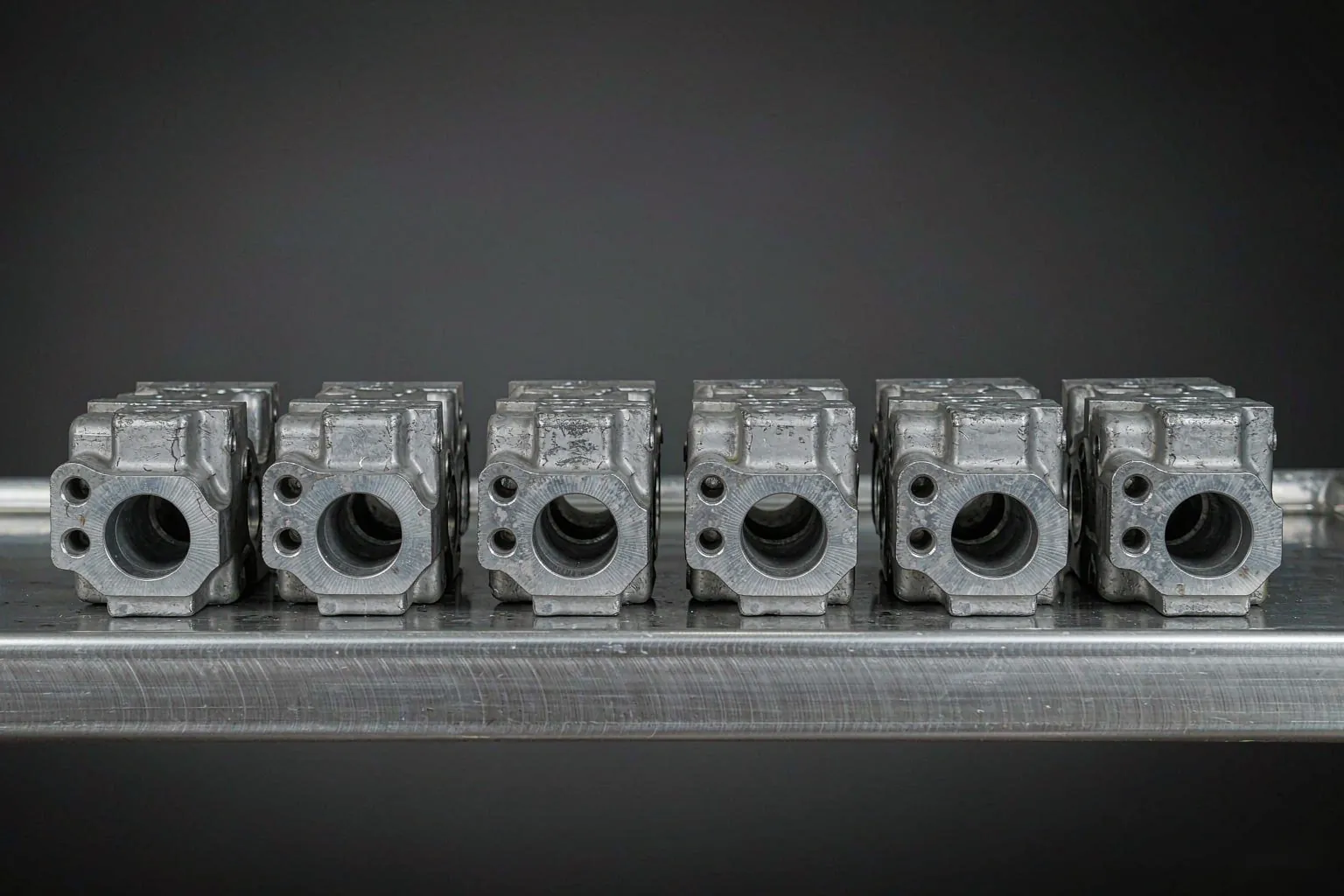
It earns its place on aluminum parts that repeat: pump and compressor housings, hydraulic valve bodies, intake manifolds, motor end shields, wheel hubs, cookware, and structural brackets that see fatigue loading. Typical mass is 0.2–30 kg, with tilt-pour cells handling up to about 90 kg.
It is the wrong answer when: the part is over roughly 50 kg; the alloy is ferrous (steel and iron destroy steel molds — use fusione in sabbia or fusione di ferro instead); annual volume is under ~1,000 pieces; the geometry needs deep undercuts that would demand complex core pulls; or the design is still changing, in which case fusione a cera persa or a printed pattern is cheaper to iterate. Alloy choice interacts with all of this — see A356 vs A380 and our scelta della lega walkthrough.
Most of this work runs on Al-Si-Mg alloys, so the fusione di alluminio route is the usual starting point, with trattamento termico e trattamento superficiale closing the loop. Tooling itself is a separate discipline — we build and maintain these molds in-house, documented on our casting mold making page.
What to Put on the Drawing and the PO
Ambiguity here is expensive. State the process family, not just the alloy: “A356.0-T6, permanent mold, ASTM B108” tells the foundry which minimums apply and which section-sensitivity to expect. Then add:
- Heat treat condition and acceptance. T6 per the applicable AMS or ASTM practice, with Brinell hardness range and tensile test frequency (one test bar per heat lot is typical).
- Soundness level. Radiographic reference per ASTM E155 on the critical sections, or a clearly defined pressure-decay leak test with the test pressure and allowable drop written in.
- Dimensional scheme. ISO 8062 DCTG grade plus a small number of GD&T datums tied to the mold parting line — not every dimension.
- Machining stock and datum targets. So the casting fixture and the machining fixture agree.
- Finish. As-cast Ra or a specified blast/powder coat, since PM surface starts at 3.2–6.3 µm and often skips a full face cut.
Sampling and NDT expectations are worth agreeing before the first article; our casting inspection methods guide lists what each method can and cannot find, and common casting defects maps the failure modes back to their cause.
FAQ
Is permanent mold casting the same as gravity die casting?
Yes — the two names describe the same family. “Gravity die casting” is the common term in the UK and in zinc work; “permanent mold casting” is the AFS and ASTM term. Both exclude high-pressure die casting, where metal is injected at 40–120 MPa instead of being poured.
What volume justifies permanent mold tooling?
For a 3 kg aluminum part with typical geometry, the break-even against sand falls near 1,200 pieces once you count the machining saving, not just the casting price. Below about 300 pieces, sand or printed patterns are cheaper overall; above roughly 3,000 pieces, high-pressure die casting starts to win on piece price.
Can permanent mold casting produce steel or iron parts?
Not in normal production. Molds for aluminum run 300–450 °C; ferrous pouring temperatures above 1,400 °C destroy them in a handful of shots. Chilled iron rolls and a few duplex applications exist, but structural ferrous castings go to sand or shell molding. See gray iron vs ductile iron for the ferrous route.
How tight are permanent mold tolerances?
Plan on ±0.25–0.5 mm across a 150 mm dimension for gravity work, roughly two ISO 8062 DCTG grades tighter than green sand for the same geometry. Every additional grade costs tool rework and cycle time, so tighten only the features that need it and leave the rest to the general tolerance block.
How long does a permanent mold last?
H13 cavities in aluminum typically run 20,000–120,000 shots before heat checking and wear put dimensions out of tolerance; gray iron or 4140 molds for short runs give 10,000–30,000. Coating is re-applied every shift, and core pins and slides are consumable items scheduled for replacement well before the cavity.
Can I convert an existing sand casting to permanent mold?
Often yes, and it is one of the most common cost-down projects we run. The part has to fit the mold (roughly under 30 kg), survive steel core pulls, and the volume has to clear the break-even. Expect one tooling iteration on feeding and draft, budget 10–14 weeks end to end, and keep the sand route live until first articles pass.
*Data referenced from ASTM B26 / B108, ISO 8062, AFS and NADCA publications, plus Supro MFG production records. Cost figures are indicative ranges — request a part-specific quote.
 English
 Français
 Deutsch
 Italiano
 日本語
日本語 한국어
한국어 Polski
 Português de Angola
 Русский
 Español de Argentina