

Every buyer who has sent out a package for a machine base, a bracket or a pump housing has hit the same fork in the road: build it as one piece of cast metal, or cut plate and weld it into an assembly. The casting vs fabrication decision is almost never about which process is “better” — it is about which route lands on your drawing, your annual volume and your delivery date at the lowest total cost.
Most casting vs fabrication comparisons go wrong for a boring reason: the two quotes are not for the same thing. This guide puts real numbers on both sides of that choice: weld-metal hours, tooling amortisation, machining stock, stress relief and inspection. The cost models come from production parts we quote both ways; the material and fatigue behaviour is cross-checked against published guidance from the American Foundry Society and the fatigue categories in AWS D1.1. If you want a refresher on the casting side first, start with our metal casting guide.

Casting vs Fabrication: What Is Actually Being Compared
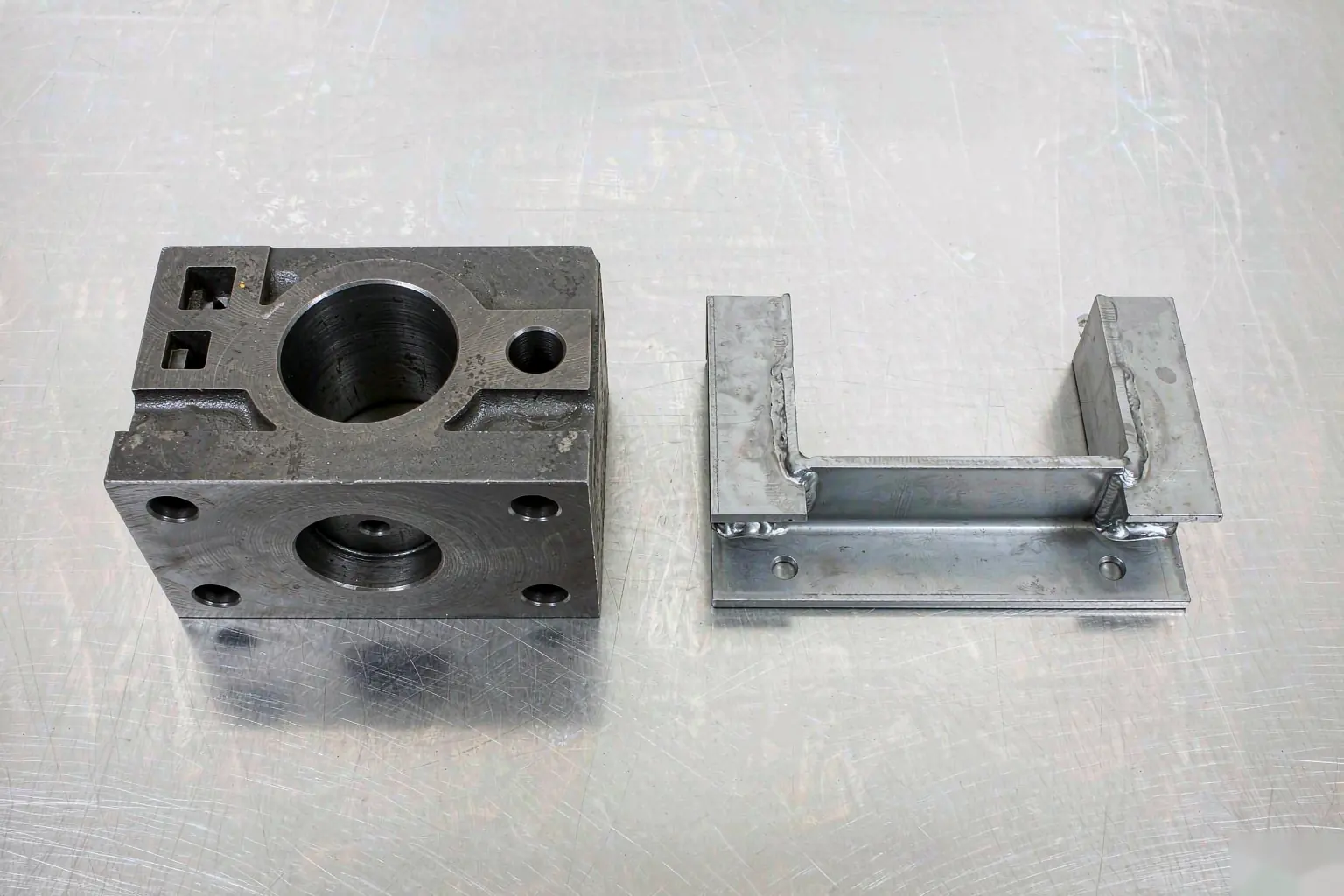
The casting vs fabrication question gets easier once you separate geometry from economics. A casting is made by pouring molten metal into a mould and letting it solidify into a near-net shape, so most of the geometry you see in the finished part was formed by the mould, not by a cutting tool. A fabrication — usually called a weldment — starts as mill plate, bar or structural section; the pieces are cut, formed, fixtured and joined by welding into an assembly that performs the same job.
That single difference cascades into everything else in the casting vs fabrication comparison: tooling cost, lead time, buy-to-fly ratio, distortion behaviour, inspection method and how much a design change costs you in week three of the project.
| Factor | Cast route | Welded fabrication |
|---|---|---|
| Starting form | Molten metal into a mould | Cut plate, bar, structural section |
| Up-front tooling | Pattern and core boxes, several thousand dollars | Weld fixtures and jigs, usually low cost |
| First-part lead time | 5–9 weeks (tooling + sample) | 2–4 weeks |
| Geometry freedom | Curved walls, internal cavities, variable sections | Limited to what plate and section can approximate |
| Buy-to-fly ratio | 1.1–1.3 (gates and risers are remelted) | 1.4–1.8 (skeleton drop is scrap) |
| Weld length per unit | Zero | 10–40 m on a typical machine component |
| Distortion control | Rigging, risers and mould design | Fit-up, weld sequence, post-weld heat treatment |
| Inspection basis | Visual, ASTM E446 surface comparators, RT or UT on critical sections | MT or UT on welds per AWS D1.1 |
| Cost of a design change | Pattern rework, 2–4 weeks | Edit the nest file, hours |
| Economic volume band | Roughly 50–200+ per year | 1–100 per year |
Where a Casting Beats a Weldment
Four mechanisms drive the win on the casting side of the casting vs fabrication comparison, and they are all about geometry and material behaviour rather than about the metal price.
Part consolidation removes weld hours
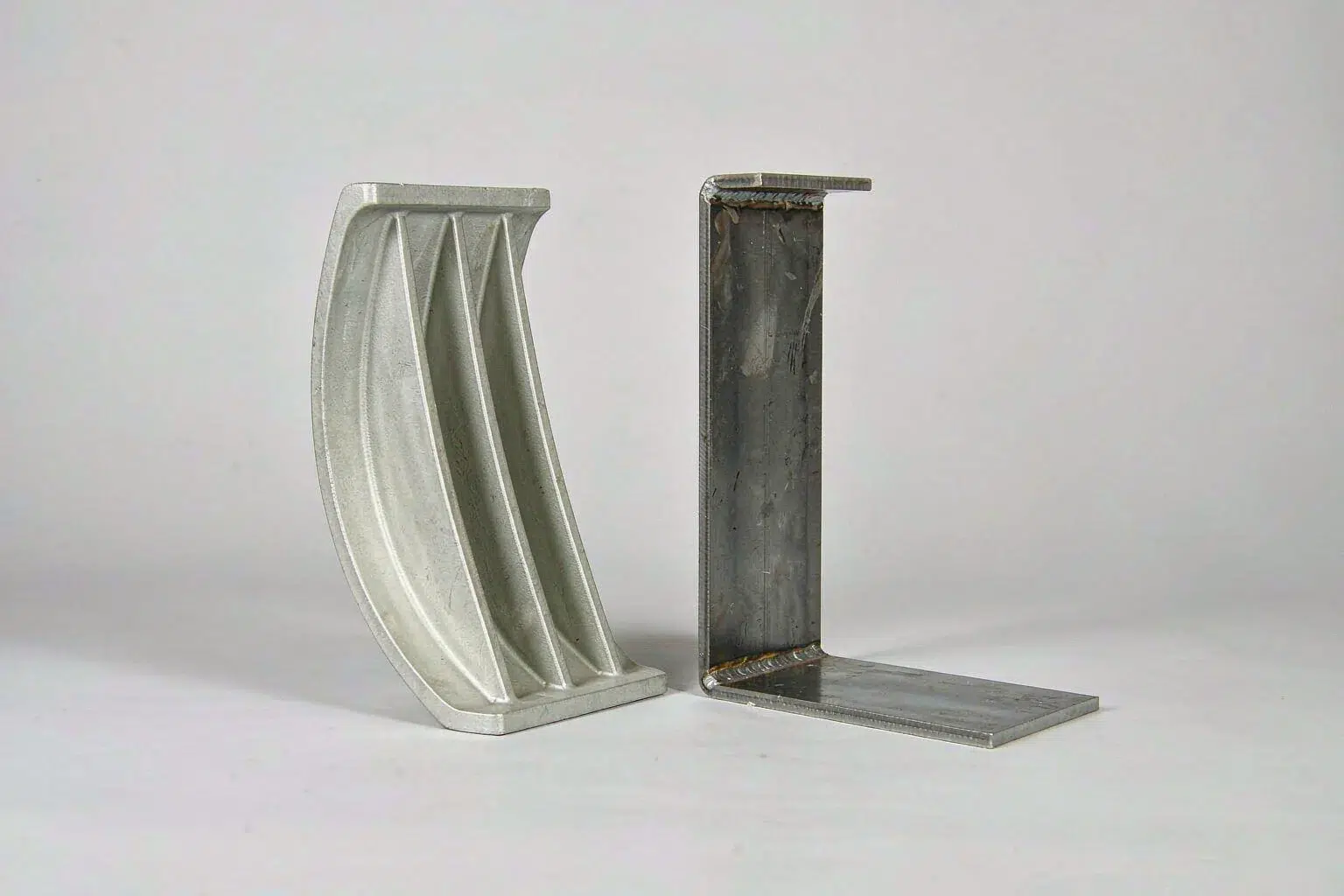
A fabricated bearing pedestal might be 14 pieces: base plate, two side webs, a bore boss, four gussets, six stiffeners. Every one of those pieces has to be cut, tracked, fixtured, tacked and welded. The same part as a casting is one piece with the ribs already there. On the cost model below, 18 m of fillet weld disappears entirely, and that is where the money is — not in the steel price.
Damping and vibration behaviour
Gray iron dissipates vibrational energy roughly an order of magnitude faster than a carbon-steel weldment, because the graphite flakes interrupt and damp the elastic wave. On machine-tool bases, compressor housings and pump frames that difference shows up as lower noise, better surface finish on the machined part and longer bearing life. It is the reason our gray iron vs ductile iron comparison gets read by anyone specifying a structural base.
Metal only where the load path needs it
Plate comes in standard thicknesses, so a weldment tends to carry a uniform 12 mm or 20 mm wall even where 6 mm would do. A casting can taper a wall from 20 mm at a loaded boss down to 7 mm in an unloaded web, and core out pockets that plate cannot reach. On the pedestal example used later in this article, purchased weight drops from 68 kg of plate to a 48 kg casting while the finished part stays at 42 kg.
Leak paths and fatigue at the joint
Leak-tightness is the shortest argument in any casting vs fabrication debate. A pressure boundary built from welds is a boundary with a continuous seam, and every metre of that seam is a candidate for MT indications, repair and re-testing. Castings have no seam, which is why valve and pump bodies are still overwhelmingly cast. Fatigue behaves the same way: AWS D1.1 gives an as-welded fillet joint loaded transverse to the weld a constant-amplitude fatigue threshold of about 69 MPa (Category C), and a joint with a severe geometric discontinuity drops to roughly 31 MPa (Category E). A cast radius in the same corner carries the fatigue strength of the parent metal, because there is no weld toe to initiate a crack.
Where Fabrication Wins — and It Often Does
Roughly half of the parts that get quoted both ways should stay welded, because the other half of the casting vs fabrication equation is tooling, not metal. Here is when.
- Low annual volume. If you build six units a year, a pattern costing several thousand dollars never pays for itself, no matter how much weld time it would remove.
- The design is still moving. A weldment absorbs change: edit the nest file, re-cut, re-weld. A casting absorbs change through pattern modification, a new sample and another 2–4 weeks.
- Very large spans or thick plate. Above roughly 3 m in any direction, or above about 80 mm plate, you start running into flask size, melt weight and crane limits; plate is simply the practical answer.
- Short delivery on the first article. No tooling means first part in 2–4 weeks instead of 5–9.
- Field repairability. A cracked weldment can be repaired on site by any competent welder. Repairing a casting needs a qualified weld procedure, preheat and often a follow-up stress relief — see the weldability discussion in our cast iron vs cast steel guide.
The Break-Even Math Behind Casting vs Fabrication
One equation settles most casting vs fabrication arguments: break-even units = tooling delta ÷ saving per unit. Everything else is bookkeeping. Below are two real models — one where the casting wins overwhelmingly, one where it barely wins at all.
Scenario A: complex weldment, 300 units per year
Scenario A is a part the casting should win: a cast steel bearing pedestal, 42 kg finished, 48 kg as-cast, versus a welded assembly built from 14 cut pieces with 18 m of 6 mm fillet weld.
| Cost element | Welded fabrication | Cast route |
|---|---|---|
| Purchased material | 68 kg × $1.35 = $91.80 | 48 kg × $2.85 = $136.80 |
| Cutting and nesting | $46.00 | Included in casting price |
| Welding labour | 4.2 h × $55 = $231.00 | $0 |
| Weld consumables and gas | $18.00 | $0 |
| Stress relief | $95.00 | $35.00 |
| Finish machining | 2.6 h × $85 = $221.00 | 1.1 h × $85 = $93.50 |
| Inspection / NDT | MT and UT on welds = $110.00 | Visual and dimensional = $12.00 |
| Scrap and rework allowance | 6% of process cost = $42.20 | Included in casting price |
| Unit total | $855.00 | $277.30 |
| One-time tooling | $0 | $8,600 (pattern and core boxes) |
Saving per unit is $855.00 − $277.30 = $577.70, so break-even is $8,600 ÷ $577.70 = 15 units. At the planned 300 units a year: the welded route costs $256,500, the cast route costs 300 × $277.30 + $8,600 = $91,790. That is $164,710 saved in the first year, and the tooling is already paid for by unit fifteen.
Where the 4.2 weld hours come from
Weld-hours are the number most casting vs fabrication quotes get wrong, so here is the arithmetic in full. A 6 mm fillet has a triangular cross-section of ½ × 6 × 6 = 18 mm², which is 0.141 kg of deposited metal per metre of weld. Eighteen metres needs 2.54 kg of weld metal. At a realistic deposition rate of 2.0 kg/h that is 1.27 h of actual arc time — and with a 30% arc-on factor, meaning the welder spends a third of the paid hour with the arc struck while the rest goes to fit-up, tacking, repositioning and slag removal, the paid time becomes 1.27 ÷ 0.30 = 4.2 hours. At $55/h fully loaded, that is the $231 in the table. Double the weld length and this line alone decides the whole comparison.
Scenario B: simple weldment, 120 units per year
Scenario B sits at the other end of the casting vs fabrication range: a mounting bracket from three cut plates, 9 kg finished, 0.8 m of weld, no post-weld heat treatment and no weld NDT. Welded: material $34.00, cutting $12.00, welding 0.6 h × $55 = $33.00, consumables $6.00, machining 0.4 h × $85 = $34.00 — $119.00 per unit. Cast: 9 kg × $3.10 = $27.90, machining 0.2 h × $85 = $17.00, fettling and inspection $8.00 — $52.90 per unit, plus $6,200 of tooling.
Saving is $66.10 per unit, so break-even is $6,200 ÷ $66.10 = 94 units. At 120 units a year the welded route costs $14,280 and the cast route costs $12,548 — a saving of only $1,732, which is not enough to justify locking the design into tooling. Below about 90 units, the bracket should stay welded.
Quality Risk: The Two Routes Fail Differently
Quality is the part of the casting vs fabrication decision that most quote reviews skip. Choosing between a casting and a weldment also means choosing which failure modes you are going to manage.
Weldment risks
- Distortion and residual stress. Asymmetric weld shrinkage pulls the assembly out of shape; heavy weldments need post-weld heat treatment around 600–650 °C and then straightening before finish machining.
- Fatigue at the weld toe. The geometry of the toe, not the base metal, sets the fatigue life: about 69 MPa constant-amplitude threshold for a Category C detail and roughly 31 MPa for Category E.
- Lamellar tearing. When a joint pulls through the thickness of a restrained plate, you need through-thickness-tested plate (Z-grade per EN 10164, or ASTM A770) — a material surcharge people forget to budget.
- Operator-dependent quality. Consistency depends on fit-up, welder skill and sequence, which is why weld NDT is a line item rather than an option.
Casting risks
- Shrinkage and gas porosity in thick sections. Managed with riser sizing and feeding rules; the standard failure catalogue is covered in our common casting defects guide.
- Section sensitivity. Properties fall as sections get thicker and cool slower, so alloy choice has to follow the wall thickness — see how to choose a casting alloy.
- Tooling lock-in. Once the pattern is cut, geometry changes cost weeks.
- Verification cost. Soundness claims have to be checked; the method set is laid out in casting inspection methods.
Dimensional Reality: Machining Stock and Datums
Dimensional behaviour is where the casting vs fabrication difference reaches the machine shop. A weldment accumulates error: 14 pieces each cut to ±1 mm, stacked through a fixture, then pulled by weld shrinkage of 1.5–3 mm per metre of weld bead. That is why fabricated parts are routinely detailed with 3–5 mm of machining stock on every critical face and often need a straightening pass before the first cut.
A casting carries its tolerance from the process instead of from a fixture. Sand castings typically land in the ISO 8062-3 range of DCTG 11–13, which on a 400 mm dimension means several millimetres, so critical faces get 2–3 mm of stock; tighter processes such as Druckguss or Feinguss cut that substantially. The practical reference is our ISO 8062 tolerance guide.
Whichever route you pick, put cast or welded datum targets on the drawing before the part is made, so the first machining setup is repeatable and the stock is actually where the cutter expects it. Our CNC-Bearbeitung team sees more lost parts from missing datums than from any mould defect, and the sequence question is covered in CNC machining vs casting. Stress relief before finish machining applies to both routes and is detailed in our heat treatment guide.
Decision Matrix: Which Route for Which Condition
Use this casting vs fabrication matrix as a first pass, then run the break-even arithmetic on the shortlist it produces.
| Condition | Route | Reason |
|---|---|---|
| Under 50 units a year, simple geometry | Fabrication | Tooling will not pay back |
| More than 15 m of weld per unit | Casting | Weld hours dominate unit cost |
| Pressure boundary or leak-tight requirement | Casting | No continuous seam to test |
| Vibration damping is critical | Casting, gray iron | Damping roughly an order of magnitude above steel |
| Design still changing | Fabrication | Changes cost hours, not weeks |
| Span above 3 m or plate above 80 mm | Fabrication | Flask, melt weight and crane limits |
| Tight weight target | Casting | Wall thickness follows the load path |
| First part needed in under 4 weeks | Fabrication | No tooling to build |
| Above 200 units a year | Casting | Unit cost wins at almost any tooling figure |
| Field repairability matters | Fabrication | Any competent welder can repair it on site |
The Hybrid Route: Cast Nodes, Welded Members
Plenty of large structures sit in the middle of the casting vs fabrication range: neither a pure casting nor a pure weldment. The common pattern is to cast the highly loaded, geometrically awkward nodes — corner blocks, bearing housings, boom pivots — and weld straight plate or section between them. You buy casting’s geometry and fatigue behaviour exactly where it pays, and you avoid the cost and weight of casting a 4 m member.
Cast-to-weld construction is also the standard rescue for an oversized casting: split one impossible part into two castable pieces and join them with a full-penetration groove weld. When you do, the casting must be a weldable grade — carbon-equivalent control, preheat and a matching filler all apply, which is exactly the boundary described in cast iron vs cast steel. Cast steel grades for this route are covered on our steel casting page, and cast iron nodes on the iron casting page.
What to Put in the RFQ So Both Routes Get Quoted Properly
Most bad casting vs fabrication comparisons come from an incomplete enquiry: the fabricator quotes to a loose drawing while the foundry adds allowances the fabricator never priced. Send the same package to both.
- Annual volume and order pattern. 300 a year in twelve releases prices very differently from 300 in one drop.
- 3D model plus a drawing with datum scheme, machined surfaces marked and stock allowance stated.
- Material to a standard, not a trade name — ASTM A48, A536, A27 or A216 as appropriate. Our alloy selection guide maps requirement to grade.
- Weld map and NDT level for the fabricated option, or ask the foundry to propose one so the two quotes are comparable.
- Heat-treatment requirement: stress relief, normalise, or full quench and temper, and whether it is before or after rough machining.
- First-article expectation separately from production delivery — they are two different clocks.
- Weight limit, if there is one. It changes section design and therefore tooling.
If the geometry is unproven, run a sample first: 3D printed prototypes or a metal prototype casting will settle fit and function before you commit to production tooling. It is the same reasoning as in our 3D printing vs casting comparison: spend a little before you spend on tooling. Every casting vs fabrication decision gets easier once there is a real part on the bench.
FAQ
Is a casting always cheaper than a fabrication?
No. Casting wins when it removes enough weld hours, machining time or scrap to pay for its tooling — and in the two models above, one part cleared that bar at 15 units while the other did not clear it until 94. On a simple bracket with 0.8 m of weld, break-even was 94 units; below that, fabrication is cheaper and safer.
At what volume does casting vs fabrication tip toward casting?
There is no single number. Simple weldments tip around 90–150 units a year; heavily welded assemblies with 15 m or more of weld can tip below 20. Compute tooling divided by per-unit saving on your own part rather than applying a rule of thumb.
Which route delivers the first part faster?
Fabrication, usually 2–4 weeks against 5–9 weeks for a casting, because the cast route has to build tooling and prove a first article. Once tooling exists, the casting is normally the faster repeat order. That lead-time gap is the most common reason a casting vs fabrication decision goes to the weldment.
Can a weldment match a casting on vibration damping?
Not with carbon-steel plate. Gray iron’s graphite structure damps roughly an order of magnitude better than a steel weldment, which is why machine bases and compressor frames stay cast. Filled or polymer-concrete structures can approach cast iron, at higher material and handling cost.
How much weight does a casting actually save?
It depends on how much of the weldment was plate thickness it did not need. In casting vs fabrication terms, weight is the argument a weldment almost never wins. In the pedestal model, purchased weight fell from 68 kg of plate to a 48 kg casting — about 29% less metal bought for the same 42 kg finished part.
Can you weld a casting into a fabrication?
Yes, and it is common practice for large frames. Cast-to-weld construction is really a third answer to casting vs fabrication, not a compromise between the two. Cast steel nodes weld to plate under AWS D1.1 with carbon-equivalent control, preheat and a matching filler. Cast iron is a different job and usually needs a specialised procedure rather than a standard structural weld.
Do castings need stress relieving too?
Often yes, especially before finish machining on a part that will be held to a tight bore or face. The cycles and temperatures are set out in our heat treatment guide, and our heat treatment services run them in batch, which is why the cast route’s stress-relief line was $35 against $95 for the weldment.
The honest answer to casting vs fabrication is arithmetic, not loyalty to a process: add up weld hours, machining stock, inspection and scrap on one side, tooling and unit price on the other, and let the break-even number decide. If you want both routes priced from one drawing, our Sandguss, Feinguss und Druckguss teams quote against a machined weldment in a single package.
*Cost models are illustrative shop-floor figures; fatigue categories referenced from AWS D1.1 and foundry practice from AFS publications. Route availability: sand casting, investment casting, die casting, stainless steel casting.
 English
 Français
 Deutsch
 Italiano
 日本語
日本語 한국어
한국어 Polski
 Português de Angola
 Русский
 Español de Argentina