
Shell mold casting is the process most buyers discover only after a machining quote comes back too high. It casts to roughly half the tolerance band of green sand, needs about half the machining stock, and still prices like a sand casting once annual volume clears a few thousand pieces. This guide walks through the real process window, the tolerance and surface numbers you can put on an RFQ, and the arithmetic that decides whether shell mold casting pays on your part.
Everything below refers to production practice on iron, steel and aluminium, with numbers that come from shop records and published AFS references rather than marketing ranges. Where a figure depends on geometry, we say so. If you need the process family background first, start with our metal casting guide; for the tolerance language used here, see the ISO 8062 breakdown in our casting tolerances reference.
What Shell Mold Casting Is, Step by Step
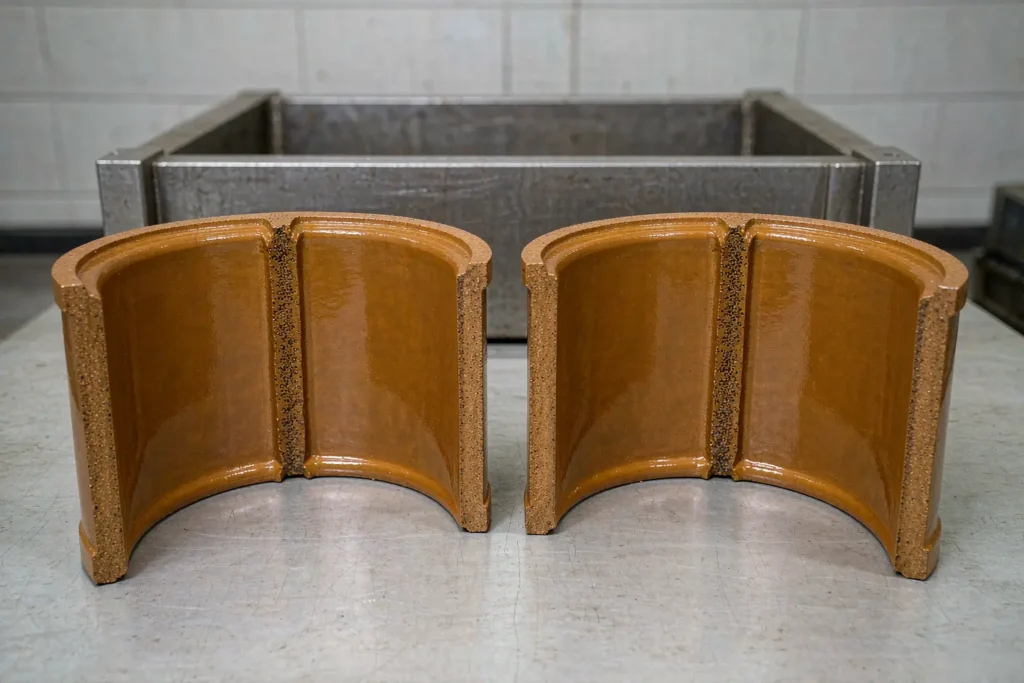
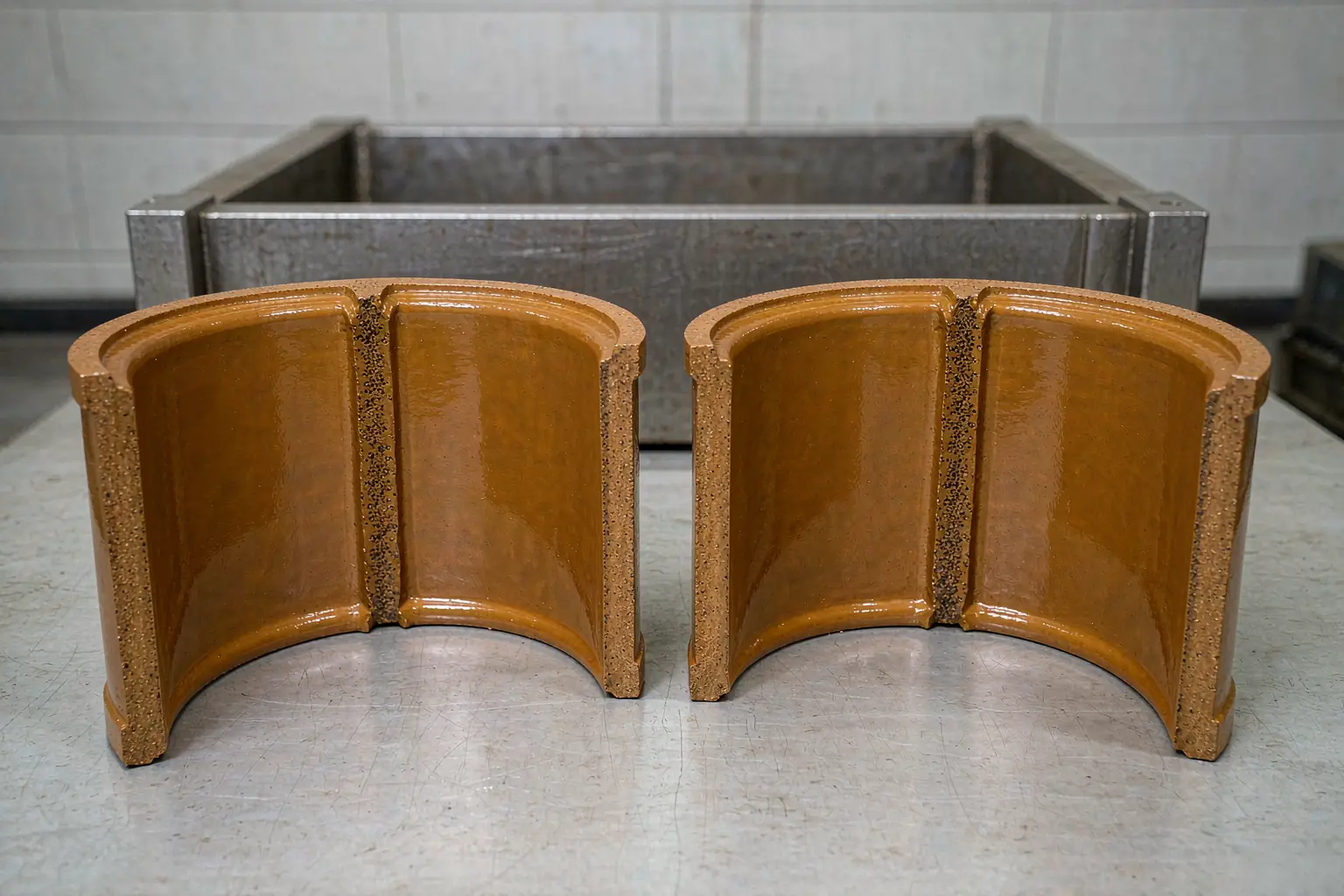
In shell mold casting the mould is not compacted sand in a flask. It is a thin, cured shell of silica sand bonded with a thermosetting resin, made on a heated metal pattern and then stripped off as a rigid half-mould. Two halves are joined, backed with steel shot, and poured. The result is a mould that holds shape far better than compacted green sand while costing a fraction of ceramic-shell investment tooling.
- Heated pattern. A machined cast-iron or steel pattern plate with ejector pins, held at 200–300 °C. Surface temperature stability matters more than the setpoint: a 20 °C drift changes cure rate enough to shift shell thickness.
- Investment of resin-coated sand. The pattern is clamped face-down over a dump box and inverted, or blown, so pre-coated silica sand (2.0–3.5 % novolac resin by weight, plus hardener) contacts the hot metal. Sand touching the pattern gels immediately.
- Dwell and return. After 15–45 s the box is righted; uncured sand falls away and is reused. The stuck layer has typically grown to 6–12 mm.
- Cure and strip. The plate returns to the oven for 30–90 s until the shell reaches a strippable strength, then ejector pins lift it off cleanly.
- Assembly and backing. Two shell halves are bonded with a hot-melt adhesive or clamped, dropped into a flask, and surrounded by steel shot so the thin shell can take ferrostatic pressure.
Because the shell is made on a metal pattern, everything you get later — tolerance, surface finish, draft angle, repeatability — traces back to that pattern. Our shell work runs through the same tooling discipline as any other casting mould tooling we build, which is why pattern cost dominates the economics discussed later.
The process window, in numbers
These are the ranges we hold on a live shell line. Anything outside them is possible but needs a conversation before the RFQ goes out.
| Parameter | Working range | What happens if you leave the window |
|---|---|---|
| Pattern temperature | 200–300 °C | Below 200 °C → soft, incompletely cured shell that distorts on strip; above 300 °C → premature cure and poor cavity definition |
| Resin content (on sand weight) | 2.0–3.5 % | Higher resin gives strength but raises gas volume and cost; lower promotes shell cracking and lamination |
| Shell thickness | 6–12 mm | Thin shells crack under ferrostatic load; thick shells slow the cure, darken the cavity and waste sand |
| Cure / dwelling time | 30–90 s after invest | Under-cure drops shell strength; over-cure embrittles it and darkens the surface |
| Typical part mass | 0.2–120 kg | Above ~120 kg the shell starts needing external support that green sand gets for free |
| Minimum practical wall | 3.0–4.0 mm iron/steel, 2.5–3.0 mm Al | Thinner sections need the design work described below |
| Shell storage life | 3–6 months dry | Resin-bonded shells absorb humidity and lose 20–40 % of their strength in a damp store |
Where the sand economy actually lands
Common assumption: resin-coated sand is expensive, so shell mold casting must cost more. It is expensive per kilogram — typically 4–8× the price of bulk green sand — but a shell uses far less of it. Take a 350 × 250 mm job: two shell halves at 9 mm contain about 0.0016 m³ of cured sand, roughly 2.4 kg at a cured density near 1.55 g/cm³. A flask-bound green-sand mould for the same part fills and compacts on the order of 55–70 kg.
Material cost therefore lands around $1.30–1.60 per casting for the shell route versus a roughly comparable binder-and-addition cost for the green-sand route once you count reclaimed-sand losses. In other words: sand is not the cost driver in shell mold casting. Machining stock is.
Shell Mold Casting Tolerances and Surface Finish
For a buyer, this is the reason to specify shell over green sand. On a linear dimension in the 100–250 mm range, resin-shell work typically holds ±0.6–1.0 mm, which sits at ISO 8062 DCTG 9–10, against ±1.0–1.6 mm (DCTG 11–12) for flask-bound green sand. Full grade-by-grade values are in our casting tolerances guide.
As-cast roughness typically lands at Ra 3.2–6.3 µm, versus roughly 12.5–25 µm on a well-run green-sand iron floor. That smoother, dimensionally stable cavity lets you drop machining stock from the usual 1.5–3.0 mm per machined face on iron and steel to about 1.0–1.5 mm, halving the volume of metal your machine tools have to chew through.
Put that into metal removal. A Ø150 mm bore, 120 mm long: going from 1.0 mm to 3.0 mm radial stock means boring away an extra annular ring of π × (76² − 75²) × 120 ≈ 56,900 mm³ (56.9 cm³) of metal. At a realistic ~30 cm³/min removal rate for grey iron in rough boring, that is about 1.9 minutes per part on that one feature alone — around 127 machine-hours per year at 4,000 pieces, before you count tooling wear. Multiply across every machined face and you can see why the machining line, not the foundry line, usually triggers a switch to shell.
Two cautions. First, the tighter as-cast band only survives if the drawing separates as-cast features from machined ones — asking for ±0.2 mm as-cast on a face that will be machined anyway wastes money, a trade-off we work through in more depth in the CNC-machining-versus-casting decision. Second, the finish is not free cosmetics; if a cosmetic or corrosion-critical surface is specified you will still want blast or coating after pouring, which our surface treatment services handle downstream.
Tooling Cost and Where Shell Mold Casting Breaks Even
The honest way to evaluate shell mold casting is not the unit price — it is the pattern amortisation against downstream savings. A heated pattern set is machined metal with ejectors and often conformal cooling lines; a green-sand match-plate pattern can be wood or aluminium. That difference has to be paid back per piece.
Here is a representative cost model for a 3 kg ductile iron housing, one machining set-up, annual usage patterns unchanged between routes:
| Cost line | Green sand route | Shell mold route |
|---|---|---|
| Pattern / tooling | $3,160 (machined aluminium match plate) | $9,400 (heated cast-iron pattern, ejectors) |
| Casting price per piece | $27.40 | $28.90 |
| Machining stock per face | 3.0 mm | 1.0 mm |
| Machining cycle | 10.0 min | 5.8 min |
| Machining cost @ $66/h | $11.00 | $6.38 |
| Finished cost per piece | $38.40 | $35.28 |
The shell casting itself is $1.50 more expensive per piece, and the finished part is $3.12 cheaper. The tooling gap is $9,400 − $3,160 = $6,240, so the break-even volume is:
$6,240 ÷ $3.12 per piece = 2,000 pieces. Below that, you are paying the pattern back faster than you are earning it. Above it, every extra piece is $3.12 of real margin. At 1,000 pieces the shell route carries a $3.12 per-piece premium; at 6,000 pieces shell mold casting is $3.12 per piece in your favour and $18,700 over the annual run.
Three things that move that number
- Machining intensity. The saving scales with machine minutes removed. A part with three set-ups and tight positional callouts can save $8–12 per piece; a part with one facing cut may save under $1 and never repay the pattern.
- Scrap rate. Dimensional rejections on a ±0.6 mm band typically run 30–50 % below the green-sand equivalent. Every point of scrap avoided widens the gap in favour of shell.
- Pattern complexity. Every core pull, side action or loose piece multiplies the tooling delta. A simple two-half plate stays near the $6,240 delta; a multi-core housing can double it and push break-even past 4,000 pieces.
Below a few hundred units, do not buy a heated pattern at all. Build the first batch through our metal prototype casting service, validate the geometry, then commit to tooling. That sequencing is the cheapest way to de-risk a shell programme.
Defect Modes Specific to Shell Mold Casting
Shell mold casting eliminates a long list of green-sand problems — no ramming variation, no moisture-related blows, very little sand inclusion. It introduces its own short list. Knowing them changes how you read an inspection report and how you write the acceptance criteria.
| Defect | Root cause in shell work | Practical countermeasure |
|---|---|---|
| Shell lamination / rat tails | Pattern too cool or invest time too short; successive layers do not fuse | Raise pattern temperature into 230–260 °C band; extend dwell; verify resin lot reactivity |
| Fins at the joint line | Shell halves not seating flat; adhesive squeeze-out or clamp pressure lost | Grind the joint faces flat on the fixture; standardise adhesive film thickness; check flask shot fill |
| Gas porosity from resin decomposition | Resin content high relative to metal section; poor venting through a low-permeability shell | Trim resin to the low end; add vent grooves in the pattern; do not over-cure |
| Hot tearing in restrained bosses | Thin shell plus steel shot gives an unusual cooling gradient across thick-thin junctions | Re-look at feeding and chills using the methods in our casting riser design guide |
| Veining / metal penetration | Silica expansion cracks in thin shell sections at high pouring temperature | Lower pour temperature; zircon-faced or refractory-coated sand at hot spots |
| Hollow-core collapse | Shell cores are shells, not solid cores — unsupported under ferrostatic load | Fill hollow cores with dry sand or shot; size core prints and supports from the same rules used in sand casting core design |
Choosing Shell Mold Casting Over Its Neighbours
Shell mold casting wins a specific slice of the market: parts that need better than green-sand accuracy, are too heavy or too simple to justify lost-wax investment casting, and are not produced in enough volume to carry high-pressure die tooling. The matrix below is how we triage an RFQ.
| Factor | Green sand | Shell mold | Feinguss |
|---|---|---|---|
| Tooling cost | Low (wood / aluminium pattern) | Medium (heated metal pattern) | High (wax die + shell room) |
| Linear tolerance, 100–250 mm | ±1.0–1.6 mm | ±0.6–1.0 mm | ±0.3–0.6 mm |
| As-cast roughness | Ra 12.5–25 µm | Ra 3.2–6.3 µm | Ra 1.6–3.2 µm |
| Machining stock | 1.5–3.0 mm | 1.0–1.5 mm | 0.5–1.0 mm |
| Typical part weight | 0.5 kg – several tonnes | 0.2–120 kg | 0.01–50 kg |
| Tooling lead time | 2–3 weeks | 4–6 weeks | 5–8 weeks |
| Volume sweet spot | 1 – 5,000 /yr | 2,000 – 50,000 /yr | 500 – 100,000 /yr |
Reading the matrix in practice: if your part is a 3–40 kg iron or steel housing, gains nothing from lost-wax’s fine detail, and currently eats 10 minutes of machine time, shell mold casting is usually the cheapest way to cut that machining bill. If geometry is genuinely intricate, look at our Feinguss line and read the side-by-side in sand casting vs investment casting. If the part is thin-wall non-ferrous and volume is very high, the comparison shifts to die casting, covered in our die casting vs sand casting article.
Designing a Part for Shell Mold Casting
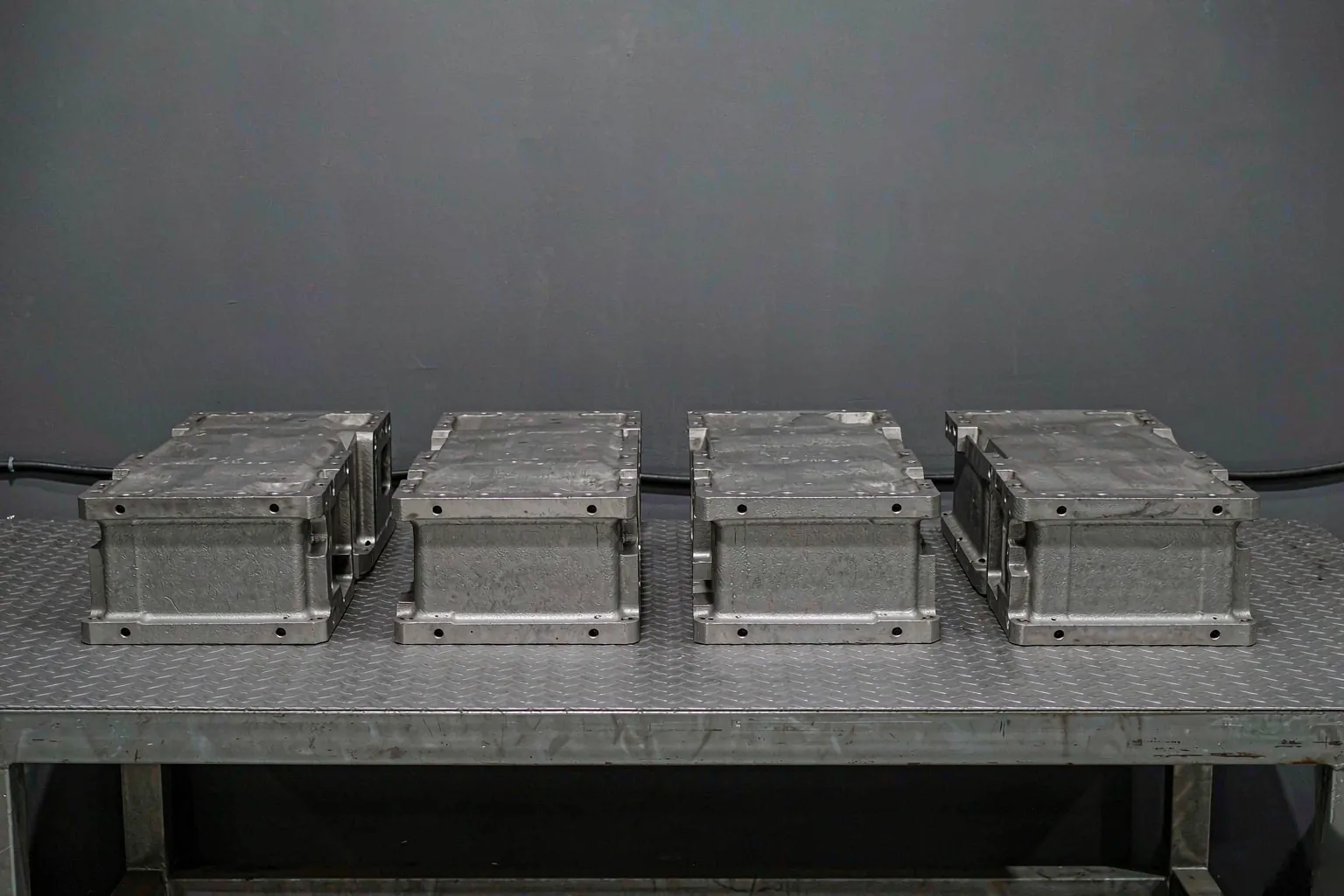
Four rules carry most of the value, and all four are negotiable at the drawing stage rather than after the pattern is cut:
- Wall thickness. Hold 3.0–4.0 mm minimum on steel and iron, 2.5–3.0 mm on aluminium. Uniform sections matter more than absolute values; the transitions are where Gussfehler start.
- Draft. Because the shell is stripped off a heated metal pattern rather than drawn out of compacted sand, draft can go down to about 0.5–1.0°, against the 1–3° usually required on green sand. The rules behind that difference are set out in our mould and pattern design guide.
- Flat areas. Wide flat faces still distort as the casting cools. Break them with ribs or a shallow crown, and remember every large face you keep flat is a face you will machine.
- Core strategy. Hollow shell cores are excellent for weight saving but need to be filled or supported. Set core prints and supports early — our Sandguss team applies the same core logic on green-sand work.
Before cutting steel, we normally run a solidification check on thick sections and set feeding from the rules in our casting riser design guide. That single step is usually what separates a clean launch from three rounds of pattern modification.
Alloy Selection for Shell Mold Casting
Shell mold casting is process-agnostic on alloy; the mould media simply sets the accuracy you get from whatever metal you pour. In practice most shell work is grey iron, ductile iron, carbon and low-alloy steel, occasionally aluminium where the part geometry suits gravity filling.
- Grey and ductile iron. The default pairing. Shell’s low moisture content reduces pinholing, and the faster, more uniform cooling tends to refine grain in thin sections. Grade selection follows normal service requirements — strength-versus-damping trade-offs are laid out in our grey iron vs ductile iron comparison.
- Carbon and low-alloy steel. Workable, but pouring temperatures above ~1,550 °C push the silica shell hard. Expect refractory coatings at hot spots and check your specified ASTM grades against what the shell system can tolerate.
- Aluminium. Less common in shell than in permanent mould work, because aluminium parts usually have wall thicknesses that permanent mould or die casting handles better. Where thermal treatment is needed afterwards, see the notes on casting heat treatment.
If you are still deciding between families, start with how to choose a casting alloy and then check whether your target grade is stocked through our iron casting, steel casting or aluminium casting lines before locking the drawing.
FAQ
Is shell mold casting the same thing as investment casting?
No. Investment casting builds a ceramic shell around a disposable wax pattern; shell mold casting builds a resin-sand shell directly on a permanent metal pattern. Shell gives you better accuracy and finish than green sand at a lower tooling cost than lost wax, but it cannot reproduce the fine detail, zero-parting-line geometry or thin sections that wax-based work achieves. Our comparison of the two routes is in sand casting vs investment casting.
What is a sensible minimum order for shell mold casting?
Economically, the heated pattern wants at least 1,500–2,500 pieces to pay back. That said, plenty of programmes start below that for reasons other than unit cost — dimensional stability, cosmetic finish, or low machining capacity in-house. Below about 300 pieces, quote the part as a prototype casting first and convert to shell tooling once geometry and demand are proven.
How much machining allowance should I put on the drawing?
Allow 1.0–1.5 mm per machined face for iron and steel shell castings, roughly half what green sand needs. On small aluminium features 1.0 mm is usually adequate. Never ask for less than 0.8 mm, or the cutter will find inclusions and hard spots on every part.
How long does a heated shell pattern last?
A well-maintained cast-iron shell pattern typically runs 50,000–100,000 shells before dimensional refurbishment, depending on alloy temperature and how often it is cycled. Keep it clean and dry between runs; thermal cycling and corrosion, not wear, are what retire these tools.
Does the process change how parts should be inspected?
The rejected defect mix changes rather than the method. You see far fewer sand-related indications and more dimensional and occasionally gas-related findings, so first-article inspection should weight layout and dimensional reporting heavily. The method selection table in our casting inspection guide still applies.
Can existing green-sand parts be converted to shell tooling?
Usually yes, and that is where most shell programmes start. Send the drawing and current scrap or machining data; if machining minutes or reject rates are the pain point, a shell conversion frequently pays in the first year. Our sand casting team can quote both routes side by side so you can see the delta rather than take it on faith.
*Data referenced from AFS / ASTM industry publications and Supro MFG shop-floor records.
 English
 Français
 Deutsch
 Italiano
 日本語
日本語 한국어
한국어 Polski
 Português de Angola
 Русский
 Español de Argentina