
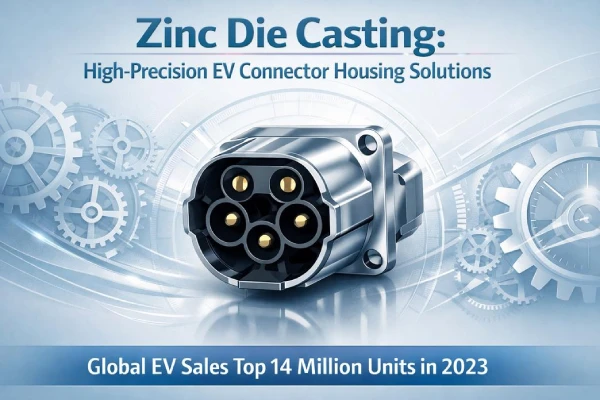
Zinc die casting is the reliable, behind-the-scenes pillar of every electric vehicle connector housing—these housings must snap into place with precision and remain as secure as ever. When production deadlines for zinc die cast parts are looming and tolerances are as tight as a hair’s breadth, what you need isn’t guesswork, but rather metal with consistent performance, durable molds, and a zinc die casting manufacturer that prioritizes micron-level precision.
Global EV sales topped 14 million units in 2023, according to the International Energy Agency’s Global EV Outlook 2024. Volume is climbing fast—and so is pressure on suppliers.
This article focuses on zinc die casting technology, providing an in-depth analysis of its key advantages in the manufacturing of electric vehicle connector housings. It details the five critical factors in the casting process and outlines a quality control strategy designed to achieve a 98% first-pass yield rate, offering professional guidance for the efficient mass production and quality assurance of precision zinc die cast components for EVs.
Why Opt For Zinc Die Casting?
Electric vehicle hardware is becoming increasingly compact and space-efficient, while performance requirements continue to rise. This is precisely why zinc die casting technology has emerged as a leading solution. From alloy stability to high-speed zinc casting cycles, this process strikes the perfect balance between precision and cost. For electric vehicle brands seeking consistency and scalability, adopting zinc die casting technology is undoubtedly a wise choice.
Precise Alloy Control for Consistent EV Connector Housings
Precise alloy control is central to the production of electric vehicle connector housings. The use of zinc die casting ensures stable and controllable material properties. The chemical composition of zinc alloys remains consistent across batches; their low melting point minimizes thermal deformation, and their excellent fluidity ensures complete filling of complex cavities. The strict dimensional accuracy and smooth surface finish of zinc die cast parts ensure reliable performance consistency. Combined with controlled solidification and minimal shrinkage variation, the geometric dimensions of each batch of zinc die castings can be consistently replicated. These advantages enable the parts to meet the stringent reliability requirements for connectors in electric vehicles.
Through advanced zinc die casting process control, Supro MFG ensures consistent alloy composition and repeatable production of zinc die cast parts. This results in lower scrap rates and stable, reliable connector performance.
The following table compares the key performance parameters of zinc alloy (Zamak 3) and aluminum alloy (ADC12):
Property | Zinc Alloy (Zamak 3) | Aluminum Alloy (ADC12) | Impact on EV Connector Housing |
Melting Point (°C) | ~385 | ~660 | Lower thermal stress |
Tensile Strength (MPa) | 280 | 310 | Stable structural integrity |
Density (g/cm³) | 6.6 | 2.7 | Better vibration damping |
Tool Life (cycles) | 1,000,000+ | 100,000–150,000 | Longer mold durability |
Faster Turnaround: Rapid Prototyping with Zinc Die Casting
By leveraging zinc die casting for rapid prototyping in electric vehicle projects, teams can efficiently achieve:
Quick adjustments to mold designs
Short cooling cycles
Accelerated design iterations
The typical process is as follows:
- Optimization of CAD models for electric vehicle connector housings
- Rapid mold modification
- die casting mold trial runs
- Dimensional inspection
- Immediate feedback loop
Zinc die casting causes less wear on molds, allowing them to maintain high precision even after multiple modifications. This boosts production speed without sacrificing accuracy. In short bursts: faster sampling. Cleaner parts. Less waiting.
Cost Efficiency Meets High-Volume Production
In the mass production of electric vehicle connector housings, zinc die casting offers significant scalability:
Long mold life, reduced replacement frequency, and lower unit manufacturing costs.
Minimal machining requirements, low scrap rates, and consistent cycle times ensure continuous, high-efficiency production line operation.
This results in significant economies of scale, predictable component pricing, and substantially improved overall cost-effectiveness—ideal for long-term, stable supply.
Since zinc die casting achieves near-net-shape precision, secondary machining processes are reduced. Less trimming is required. Less scrap is generated. More parts are available per shift.
For electric vehicle suppliers striving to meet production targets, Supro MFG—as a professional zinc die casting manufacturer—combines die casting expertise with rigorous cost control. We help our customers strike the balance between performance, price, and production pace—exactly what modern electric vehicle hardware demands.
Looking for a reliable China metal foundry?
- We can help you optimize product design and save costs.
- We can help you with high quality high volume cast parts.
- We can deliver on time and get more sales market opportunities.
- You will benefit from Supro MFG metal casting service.
5 Key Factors in Zinc Die Casting for Electric Vehicle Connector Housings
Electric vehicles place stringent demands on materials. Factors such as high temperatures, vibration, and humidity all come into play simultaneously; for this reason, zinc die casting plays a critical role in the production of electric vehicle housing components. From thin-wall molding to corrosion control, the appropriate selection of die casting processes directly determines a product’s durability, assembly precision, and cost. The following are the key factors in producing high-performance zinc die cast electric vehicle components.
Factor 1 – Material Flow and Thin-wall Filling
In zinc die casting, thin-walled structures often determine the integrity of the overall component. To precisely control the behavior of molten zinc during the die casting process, rigorous engineering design is required: controlling the flow field and balancing the filling rate by optimizing the gate’s entry angle and cross-sectional area. Precise segmented injection profiles are employed to prevent early entrapment of air and effectively reduce cold shut defects. By strategically arranging venting and overflow systems to facilitate the smooth evacuation of trapped gas from the mold cavity, the porosity of zinc die castings is minimized.
Using advanced Moldflow Simulation modeling, engineers can accurately simulate the flow path of molten zinc alloy within the mold cavity during zinc die casting and perform detailed thermal distribution analyses of thin-walled casting areas, effectively preventing shrinkage cavities and cold shuts in zinc die cast parts. Through continuous optimization of the segmented pressure curve, we ensure that the flow of zinc alloy is both smooth and rapid without ever becoming uncontrolled.
This comprehensive control over the zinc die casting process enables us to deliver EV components and housings with dense structures and uniform grain, ensuring that our zinc die cast parts are not only ready for direct use in precision assemblies but also perform reliably throughout their service life in high-stress environments.
Factor 2 – Tooling Design for Complex Geometries
Electric vehicle housings demand extreme attention to detail. Connectors, ribs, and seals—all components are tightly packed together. When dealing with complex geometries, mold design directly determines the cost of zinc die cast parts. Multi-slider mechanisms and hardened blades are used to handle details such as chamfers and ribs; precision cavity design ensures balanced metal distribution and controlled shrinkage paths. These are the core technical challenges in the high-precision zinc die casting of electric vehicle connector housings.
Integrated cooling channels enhance thermal stability and reduce cycle times. Combined with a stable ejection system layout, this enables the one-shot molding of complex shapes, fully demonstrating the process advantages of zinc die casting for complex geometries. Supro MFG uses high-precision zinc die casting molds to ensure consistent accuracy throughout thousands of production cycles for electric vehicle housings.
Factor 3 – Surface Finish and Post-processing
The surface quality of zinc die castings affects sealing performance, coating adhesion, and appearance, and the surface treatment of the mold influences the quality of the final product. Surface treatment should begin with the interior of the mold; the cavities should be polished to achieve a smooth surface, and surface texture should be controlled to enhance coating adhesion on zinc die cast parts.
Post-processing steps for zinc die casting include CNC machining of critical features, edge deburring, mirror polishing of necessary areas, and functional plating or coating. High-quality surface finishes on zinc die cast parts help reduce rework and accelerate production on electric vehicle assembly lines.
Factor 4 – Dimensional Accuracy and Tolerance Control
In the production of electric vehicle connector housings, dimensional accuracy directly determines whether assembly proceeds smoothly. By employing a consistent zinc die casting process, we ensure dimensional stability through thermal control, predictive shrinkage modeling, and proactive warpage control, thereby locking in tolerances from the outset.
An online measurement system, combined with SPC tracking, ensures the repeatability of every batch of zinc die castings and meets strict tolerance requirements. Regular mold calibration ensures precise alignment between the housing and the seals, connectors, and electronic modules, eliminating the need for forced fitting. This is the precision framework upon which high precision zinc die cast electric vehicle connector housings rely—stable, controllable, and repeatable.
The following are typical performance specifications for zinc die cast electric vehicle housings:
Parameter | Target Value | Tolerance Range | Test Method | Production Impact |
1.2 mm | ±0.05 mm | CMM Measurement | Seal Integrity | |
Flatness | 0.10 mm | ±0.03 mm | Optical Scan | Assembly Fit |
Shrinkage Rate | 0.6% | ±0.05% | Thermal Analysis | Dimensional Control |
Surface Roughness | Ra 1.6 μm | ±0.3 μm | Profilometer | Coating Adhesion |
Porosity Level | <1% | Max 1.5% | X-ray Inspection | Structural Strength |
Factor 5 – Corrosion Resistance in EV Environments
Electric vehicle housings are frequently exposed to de-icing salts, moisture, and thermal shock, placing extremely high demands on corrosion resistance. High-quality zinc die cast material, combined with judicious alloy selection and an enhanced corrosion protection system, enables die cast parts to easily withstand 240–480 hours of salt spray testing, as well as accelerated moisture and thermal cycling evaluations. Electroplated surface treatments and sealing coatings applied to zinc die castings enhance the housings’ long-term weather resistance in harsh environments.
As a professional zinc die casting manufacturer, Supro MFG combines optimized die casting with protective surface treatments to extend the service life of electric vehicle housings under real-world driving conditions. When corrosion issues are addressed early on, warranty risks are significantly reduced.
High-quality zinc die casting is about more than just the metal in the mold. It involves intelligent runner design, precision tooling, tight tolerances, and road-tested coatings. This is the secret to creating durable electric vehicle body panels.
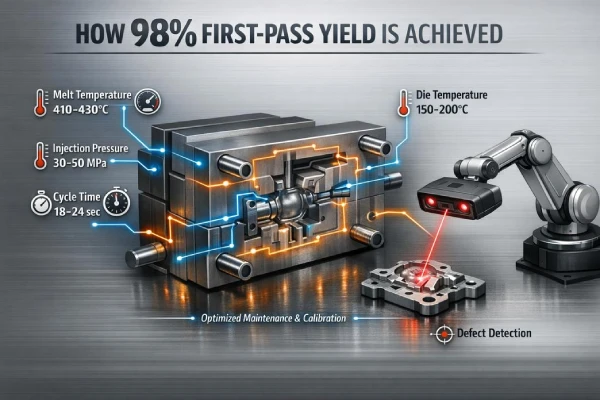
How does Zinc Die Casting Achieve a First-Pass Yield of 98%?
Maintaining a 98% yield rate for zinc die castings is no matter of chance. It stems from rigorous discipline, detailed data, and strict control over every aspect of the zinc material, molds, and casting process. From mold maintenance to sensor-based process monitoring and automated inspection, the consistent quality of die cast parts is the result of a comprehensive system that never cuts corners.
Optimized Mold Maintenance and Calibration
Stable zinc die casting relies on meticulous mold maintenance and strict mold calibration procedures:
Cavity cleaning is performed according to schedule after each specified number of shots to protect the integrity of the die casting mold by removing metal deposits.
Regular inspections of slides and ejector pins help detect cracks early, thereby extending mold life.
In terms of dimensional control, core alignment is verified, and gates and runners are measured to ensure the precision of every batch of zinc die castings.
Cavity balance verification—primarily through runner simulation reviews and comparisons of shot weights across cavities—ensures consistent quality in zinc die cast parts.
In the zinc die-casting process, even the slightest imbalance in the mold cavities can lead to a sharp increase in scrap rates. Companies like Supro MFG treat molds as production assets rather than consumables. This approach ensures long-term stability in casting production.
Real-time Process Monitoring with Sensors
In the modern die-casting industry, relying solely on guesswork based on experience is a thing of the past. As a professional zinc die-casting manufacturer, we rely on sensor-based process monitoring to ensure that process parameters are strictly controlled and maintained consistently.
Through high-precision temperature control, we can monitor the flow behavior of zinc die casting material within the mold in real time; simultaneously, our pressure monitoring system maintains a stable filling rate, effectively preventing porosity. In addition, our zinc die casting services include comprehensive cycle time optimization, which improves product consistency without accelerating solidification, ensuring that every die cast part meets stringent industrial standards.
Data is transmitted via a structured data acquisition system, enabling rapid parameter adjustments during the zinc die casting process. The table below illustrates how our zinc die casting services improve product yield through strict sensor tolerance control:
Parameter | Target Range | Sensor Tolerance | Impact on Yield (%) |
Melt Temperature (°C) | 410–430 | ±2°C | +1.8 |
Injection Pressure (MPa) | 30–50 | ±0.5 MPa | +2.3 |
Cycle Time (sec) | 18–24 | ±0.3 sec | +1.2 |
Die Temperature (°C) | 150–200 | ±3°C | +1.5 |
Automated Inspection to Catch Defects Early
High-volume zinc die casting requires a tiered automated inspection system. A vision inspection system identifies surface defects, flash, and burrs on zinc die castings. Laser scanning is used to capture key features and track statistical deviations. Post-casting verification primarily involves surface roughness measurements, coating suitability assessments, as well as porosity scanning and structural integrity reviews. Feedback loops enable real-time defect detection, while digital marking aids in root cause analysis and facilitates rapid corrections to processes in upstream zinc die casting stages.
“Manufacturers integrating inline inspection with closed-loop controls report measurable yield gains and scrap reduction above 15%,” noted Deloitte’s 2025 manufacturing industry outlook.
Supro MFG applies its closed-loop control logic to all zinc die casting production lines, ensuring consistent performance of zinc castings and low rework rates. Precision molds, smart sensors, and rigorous inspection—a simple formula for high output.
Contact Supro-Mfg
The combined pressures of market demands and technological advancements ultimately translate into stringent requirements for the precision die casting process: stricter technical specifications, faster time-to-market, and uncompromising cost targets. A well-executed zinc die casting solution can reduce machining steps, improve first-pass yield, and effectively resist corrosion—ensuring that your high-precision zinc die casting production line for EV connector housings operates efficiently, stably, and continuously. In this industry, precision is never a luxury—it is the very foundation of survival.
 English
 Français
 Deutsch
 Italiano
 日本語
日本語 한국어
한국어 Polski
 Português de Angola
 Русский
 Español de Argentina