
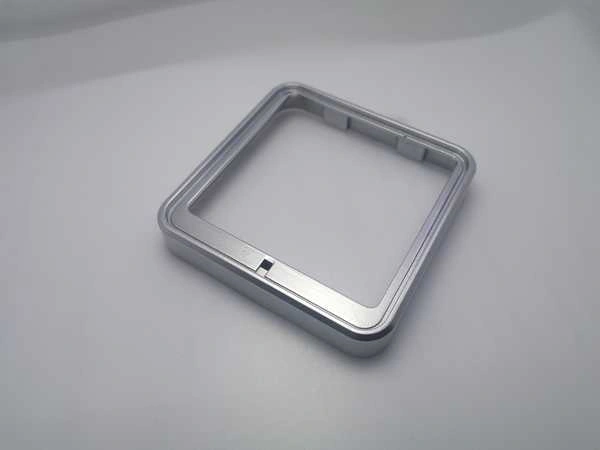
In high-volume industrial production, zinc die castings are constantly subjected to rigorous manufacturing pressures. Even a single microscopic porosity defect within a casting is enough to throw the entire production process into a state of high tension. For buyers, porosity issues in zinc die castings trigger a series of chain reactions: a sharp increase in production scrap, defects such as peeling of the plating layer, and continuous delays in order delivery.
“Stability equals profit,” says a process engineer at Supro MFG, a sentiment echoed by 2025 North American metal casting data—which shows that reducing defect rates directly boosts profit margins. Therefore, the key to controlling porosity in zinc die castings lies in managing the melt and taming the gases; once these are controlled, the chaos subsides.
This article analyzes the core causes of porosity in zinc die castings, covering key factors such as alloy composition, melt temperature, and cooling processes, and introduces multi-layer non-destructive testing methods. By optimizing the die casting process, implementing SPC control, and using appropriate mold coatings, porosity rates can be significantly reduced. With its professional zinc die casting manufacturing system, Supro MFG effectively improves the density and batch consistency of die cast parts, meeting the demands of high-volume precision production.
Why Porosity Plagues Zinc Die Castings
Tiny pores hidden within the dense structure of zinc die castings not only compromise strength but also affect surface finish. From adjusting the alloy composition to controlling the cooling process, every step influences the final quality of the product. Precise control over the alloy composition to eliminate the risk of micro-pores caused by impurities, combined with meticulous regulation throughout the entire process, is essential for ensuring that high-volume zinc die castings deliver both consistent quality and reliability.
How alloy composition influences pore formation
Porosity issues in zinc die castings often stem from chemical composition. The chemical equilibrium within the zinc alloy directly determines the behavior of gases and the metal’s shrinkage characteristics. At the same time, uncontrolled impurities and trace elements can significantly increase the solubility of gases in the molten metal and reduce the elongation of zinc die casting products. If the melt is not clean, gases may become trapped during injection, exacerbating porosity defects.
The narrower the solidification zone, the smoother the metal shrinkage. If the range is too wide, isolated liquid zones can easily form, directly leading to shrinkage porosity. As a professional die casting manufacturer with 25 years of experience and dual ISO 9001 and IATF 16949 certifications, Supro MFG implements strict alloy validation and composition control to ensure the quality of zinc die castings from the source and eliminate the risk of porosity associated with production based solely on experience.
The key elements in zinc alloy die castings serve to enhance performance, but an imbalance in their proportions can also pose quality risks, as detailed below:
Specific Element / Parameter | Positive Effects on Zinc Die Castings | Porosity Defects and Quality Risks Caused by Excessive Amounts or Improper Control |
Aluminum | Improves the strength and fluidity of zinc die castings | Excessive amounts widen the solidification range and increase the risk of solidification shrinkage |
Magnesium | Enhances corrosion resistance | Excessive levels accelerate oxidation, leading to porosity formation |
Copper | Increases the hardness of zinc castings | Excessive levels narrow the solidification window but may exacerbate internal stresses |
The role of melt temperature and cooling rate
In the mass production of zinc die castings, melt temperature and cooling rate are the key process parameters that determine the internal density of the castings and prevent porosity defects at the source; the precision with which these parameters are controlled directly affects the quality of mass-produced zinc alloy castings.
Precise control of melt temperature is a critical aspect of the die casting process. If the melt temperature exceeds the standard range, the gas adsorption capacity of the molten zinc increases significantly, causing large amounts of gas to become trapped in the molten metal and ultimately leading to a sharp rise in the porosity of zinc die castings; Conversely, maintaining the temperature within the optimal process range ensures smooth flow of the molten zinc and uniform filling of the mold cavity, thereby reducing defects such as porosity and cold shuts at the source.
The cooling rate and the uniformity of mold temperature are equally critical factors. An excessively slow cooling rate significantly prolongs the metal solidification cycle and exacerbates the formation of shrinkage porosity. This not only increases the volume of the pores but also causes them to interconnect, severely compromising the structural strength of zinc die castings. An uneven distribution of mold temperature, on the other hand, can lead to abnormal grain size and a loose, brittle microstructure, further increasing the risk of porosity defects. Conversely, rapid and uniform cooling can effectively refine the grain structure of zinc alloys, significantly improve the density of die cast parts, and block the formation pathways of shrinkage porosity.
In the actual production and quality control of zinc die cast products, it is necessary to maintain the melt temperature within a precise process range, ensure uniform temperature throughout the die using a temperature control system, optimize the layout of the die’s cooling channels to reduce solidification time, and continuously monitor the consistency of production cycles across batches.
As a professional zinc die casting manufacturer, Supro MFG relies on a standardized process control system to conduct real-time, end-to-end monitoring of melt temperature and cooling rates. This ensures that high-volume zinc die castings exhibit high density and dimensional accuracy, minimizes hidden porosity defects, and meets the stringent requirements of high-end manufacturing applications.
Inspection methods for detecting internal voids
Even with precise control throughout the zinc die casting process, hidden internal porosity may still occur. X-ray radiography can clearly capture shrinkage voids and gas pores inside die cast parts, and is typically the primary method used for batch sampling and production inspection of large-volume zinc die castings. CT scanning provides three-dimensional imaging of the internal cavities of castings, precisely locating microscopic porosity in complex structures and areas of thickness transition, thereby offering comprehensive defect detection for precision zinc die castings; ultrasonic testing, on the other hand, focuses on critical load-bearing structural areas, efficiently identifying internal discontinuities and ensuring the structural integrity of the castings.
Surface and microstructural analysis are equally indispensable. Penetrant testing can quickly detect voids in zinc die castings that are connected to the surface, thereby preventing quality issues during subsequent electroplating and assembly processes; Metallographic analysis, through cross-sectional examination, precisely analyzes microstructure and pore morphology, providing technical evidence for tracing the root causes of defects. Density measurement of zinc die cast products quantifies casting density by comparing theoretical mass with actual formed mass. All inspection procedures must adhere to standardized non-destructive testing protocols to issue professional certification.
As a professional zinc die casting manufacturer, Supro MFG has established a multi-tiered inspection system that integrates non-destructive testing, microscopic analysis, and density verification to ensure that every batch of zinc die castings meets the required mechanical properties and dimensional accuracy. Comprehensive inspection data and a traceability system significantly reduce assembly risks, resulting in more stable and reliable quality for high-volume zinc die castings.
Looking for a reliable China metal foundry?
- We can help you optimize product design and save costs.
- We can help you with high quality high volume cast parts.
- We can deliver on time and get more sales market opportunities.
- You will benefit from Supro MFG metal casting service.
3 Steps to Control Porosity Defects in Zinc Die Castings
Pores can rapidly compromise the surface quality and strength of die castings. If air infiltrates the molten zinc, the resulting zinc die casting products will be compromised. Optimizing melt temperature and filling time, fine-tuning injection pressure and venting, and implementing SPC-based cavity filling are essential for ensuring that castings are dense, clean, and meet production requirements.
Step 1: Optimize melt temperature and filling time
In the mass production of zinc die castings, controlling melt temperature and filling time is essential for producing consistent castings. When controlling the temperature of zinc alloys, the melt temperature should be maintained within a narrow range. Excessively high temperatures significantly increase gas solubility, exacerbating oxidation and gas entrapment issues; conversely, excessively low temperatures can lead to defects such as insufficient filling and poor bonding in thin-walled parts. Maintaining a stable furnace temperature setting is key to ensuring consistency in the production cycle of zinc die cast products.
Properly controlling the filling time of zinc die castings can effectively reduce air entrapment. Matching gate dimensions to cavity wall thickness and optimizing runner layout allows molten metal to fill the cavity smoothly, minimizing turbulence and bubble formation. As a professional zinc die casting manufacturer with 25 years of experience and dual certifications, Supro MFG engineers simultaneously fine-tune temperature profiles and gate designs to ensure more uniform filling and fewer defects, laying the foundation for stable high-volume production.
Step 2: Fine-tune injection pressure and venting
Stable injection pressure and intelligent venting design are key to improving the density of zinc die castings. The low-pressure phase allows the molten metal to advance smoothly, reducing entrapped air; the high-pressure phase fully fills the mold cavity, enhancing the density of thick-walled die castings. By incorporating micro-vent holes at the end of the filling process, designing overflow channels for complex molds, and coordinating with the ejection timing, air is efficiently expelled from the mold cavity.
If there is no escape route for the air, air pockets will appear on zinc die cast products in the form of bubbles or pits. Proper venting and intelligent venting help keep the mold cavity clean. Supro MFG matches pressure control curves with custom mold designs to help customers upgrade standard zinc die castings into high-reliability products suitable for the electronics and hardware industries.
Step 3: Implement SPC for consistent cavity filling
When SPC is combined with real-time process control, the porosity of zinc die castings decreases rapidly. Key die casting parameters to monitor include injection pressure, mold temperature, filling time, and metal weight per shot. These signals are fed into statistical process control charts, allowing for the early detection of even minor deviations in cavity filling behavior. This is the solution for achieving long-term consistency in the mass production of zinc die castings.
In 2025, the North American Die Casting Association noted that process monitoring and data-driven control are among the top drivers reducing scrap rates in zinc die casting operations, especially for high-volume precision components.This observation aligns with the actual conditions on the shop floor. Rigorous SPC not only reduces the defect classification rate but also ensures dimensional accuracy, guaranteeing that every batch of zinc castings meets specification requirements.
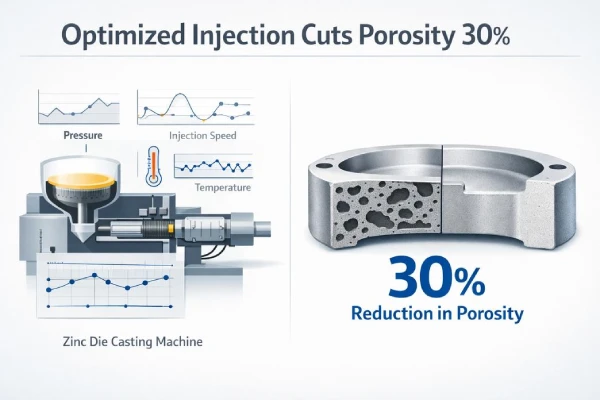
Optimizing the injection process to reduce porosity in zinc die castings by 30%
In high-volume zinc alloy die casting production, even minor optimizations to injection parameters can yield significant results. When the molten zinc, die, and die casting process are properly coordinated, porosity rates drop rapidly. For manufacturers seeking to produce zinc die castings of higher quality, the data clearly shows that controlling the process leads to improved quality.
Statistical process control of injection parameters
The key to ensuring process stability in professional zinc die casting services lies in implementing standardized statistical process control over critical injection parameters. The monitoring system includes:
Process monitoring, such as tracking melt temperature and ensuring injection speed consistency;
Plotting cavity pressure X-bar control charts and cooling fluctuation R control charts;
Identifying abnormal process fluctuations, conducting root-cause data analysis, and implementing parameter optimization.
Through this refined process control solution, zinc die castings have achieved a tangible improvement in quality. It effectively reduces gas entrapment during melt flow and significantly enhances casting density, resulting in a marked improvement in both the structural strength and batch consistency of the finished products. As a seasoned zinc die casting manufacturer, Supro MFG relies on rigorous SPC (Statistical Process Control) throughout the entire production process, moving away from traditional, experience-based production methods to achieve precise and controllable quality in zinc alloy die cast parts.
Correlating fill time reductions with fewer voids
Shorter filling times can directly reduce the porosity of zinc die castings. By controlling the gate velocity to suppress turbulence, optimizing metal flow through uniform wall thickness, and stabilizing cavity pressure, the formation of porosity is minimized at the source of filling.
Engineers at Supro MFG have confirmed through porosity analysis that faster, smoother filling reduces die casting defects. The key lies in the coordinated adjustment of process parameters—adjusting the injection speed while preventing spatter and entrapped air. When zinc alloy die cast parts fill smoothly, their internal structure becomes denser, resulting in superior machinability.
Verifying improvement via non-destructive testing
Drawing on extensive practical experience and validated through standardized non-destructive testing and a traceable quality assurance system, Supro MFG has reduced the porosity of its zinc die castings by 30%. Testing methods include X-ray inspection to detect internal shrinkage and porosity, as well as ultrasonic testing to assess density variations and bond integrity. Subsequently, defect detection data is recorded, baseline data is compared with optimized batches, and improvements in porosity metrics are verified. Ongoing validation demonstrates that the quality of zinc alloy die cast parts improves with each batch, translating data into tangible production benefits.
Can mold coatings reduce porosity in zinc die castings?
Air pockets can insidiously compromise the strength and surface quality of zinc die castings. Even when the die casting process is well-established, the presence of gas entrapment or shrinkage defects can still disrupt production. An appropriate mold coating can help regulate temperature and improve release properties, thereby ensuring consistent quality in zinc die casting without complicating the production process.
Selecting Coating Thickness for Optimal Release
The selection of coating thickness directly determines the demolding performance and quality consistency of zinc die castings. A thin coating effectively improves lubricity, ensuring smooth demolding of castings; conversely, an excessively thick coating reduces heat transfer efficiency and can easily lead to dimensional deviations. Balanced heat transfer is key to maintaining consistent casting quality. Prior to mass production, spray patterns must be thoroughly tested, and coating parameters finely optimized to ensure smooth demolding of die castings without surface scratches, thereby comprehensively improving production yield and product consistency.
Textural Requirements and Die Life Expectancy
Appropriate mold surface textures are not only a matter of appearance but also significantly influence heat transfer and metal filling efficiency, making them a critical factor in ensuring consistent surface quality in zinc die castings. Fine textures help improve paint adhesion, while polished cavities allow for stricter control over surface quality. Excessively rough textures accelerate mold wear, whereas overly smooth surfaces increase the risk of part sticking. Scientific die casting mold maintenance and cavity design not only ensure the integrity of the castings but also extend the service life of the mold.
Maintenance schedule to prevent coating breakdown
Ensuring the long-term effectiveness of coatings depends on a standardized maintenance plan for zinc alloy die casting production.
During routine operations, inspect coating integrity according to established production cycles and monitor the condition of hot spots on the molds. At the same time, use appropriate mold cleaning methods to prevent abrasion damage. Strict standards for recoating frequency must be established for the lifecycle of zinc die casting products, and the impact of coatings on production efficiency and mold life must be monitored.
Supro MFG provides preventive maintenance solutions for the production of high-quality zinc die castings, ensuring the stable operation of zinc alloy die casting production lines and proactively mitigating the risk of porosity expansion.
Contact Supro-Mfg
In summary, porosity defects in zinc die castings are caused by multiple factors, including alloy composition, melt temperature, and cooling processes. By optimizing temperature and filling time, adjusting injection pressure and the venting system, and combining these measures with SPC-based data management, along with multi-layer non-destructive testing and scientific mold coating maintenance, porosity rates can be effectively reduced.
As a professional zinc die casting manufacturer in China, Supro MFG leverages its dual-certification system and proven processes to significantly enhance the density and stability of die cast parts, meeting the stringent requirements of high-volume precision manufacturing.