
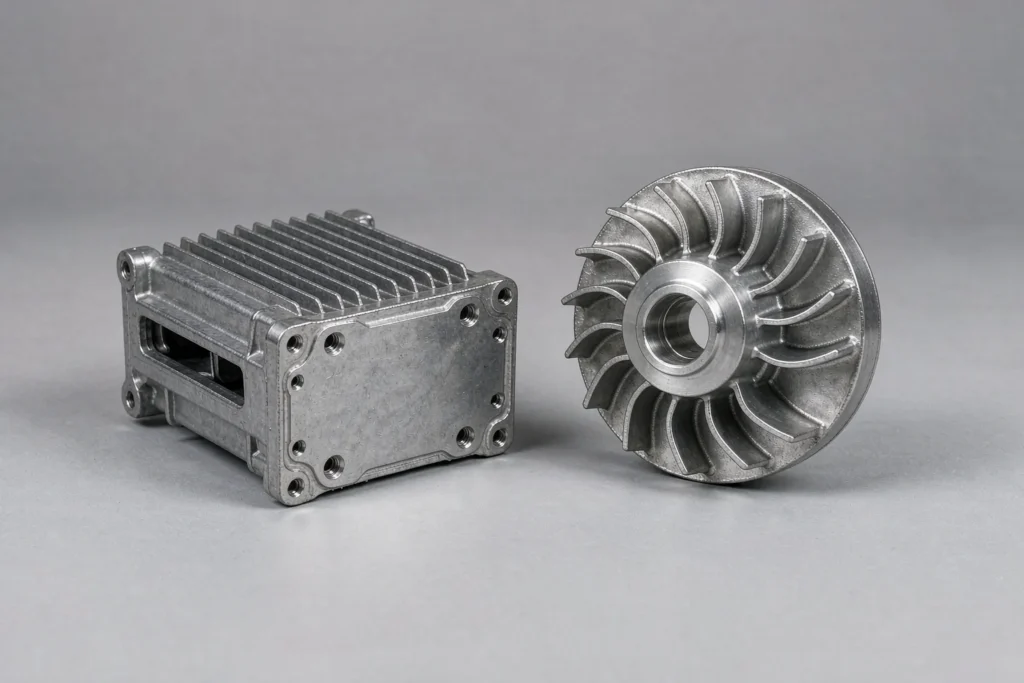
Die casting vs investment casting is rarely a close call once you write down three numbers: the alloy you must have, the annual volume you will really buy, and how many machining hours you are willing to pay for. Get those three right and one process usually disqualifies itself inside five minutes — the rest is arithmetic.
This guide walks through that arithmetic with real shop numbers: tooling quotes, cycle times, NADCA and ISO 8062-3 tolerance practice, wall-thickness limits, heat-treatment restrictions and two worked cost cases (one where die casting wins big, one where it cannot even enter the race). If you want the die casting vs investment casting verdict in one line, it is this: alloy and geometry pick the process, volume only picks the winner. Standards referenced come from the Amerykańskie Stowarzyszenie Odlewników (AFS) and the North American Die Casting Association (NADCA); everything else is measured the same way we quote it on the floor.

Die Casting vs Investment Casting in 60 Seconds
Read the decision in this order — with die casting vs investment casting, the first filter usually ends the debate:
- Alloy. Need stainless, carbon steel, tool steel or a nickel-base alloy? Then it is investment casting, full stop. High-pressure die casting (HPDC) only runs low-melting alloys: aluminium, zinc and magnesium.
- Geometry. Cored internal passages, undercuts on every face, zero draft allowed on sealing surfaces? Investment casting handles that in one monolithic piece; a die casting would need slides, inserts and usually a second machining operation.
- Volume. If both processes can make the part in aluminium, the crossover usually lands between roughly 2,000 and 4,000 units per year. Below it, the cheap tool wins. Above it, the fast cycle wins.
- Heat treatment and welding. Conventional HPDC parts blister in solution treatment and are generally not weld-repairable. If you need true T6 properties or field weldability, plan on investment casting, squeeze casting or a different route entirely.
Everything below explains why those four rules hold, and gives you the die casting vs investment casting numbers to plug into your own sourcing sheet. If you are earlier in the process selection stage, start with our przewodnik po odlewaniu metali, then come back here for the two-process decision.
What Each Process Actually Does
Underneath the marketing language, die casting vs investment casting is a question about where capital sits: one route buys a hardened steel die and pays almost nothing per shot, the other buys a cheap tool and pays skilled labour on every tree.
Odlewanie ciśnieniowe
Molten aluminium at roughly 640–680 °C is injected into a hardened H13 steel die at gate velocities of 30–100 m/s, under intensification pressures of 60–120 MPa, then held while it freezes. A small aluminium part cools in 10–25 seconds; the whole shot cycle, including die open, ejection, spraying and closing, lands at 45–90 seconds on a mid-size machine. That single fact — under 90 seconds per part family — is where the entire cost advantage comes from.
The flip side is the die itself: single-cavity aluminium tooling typically runs from about $25,000 for a small bracket die to well past $120,000 for a large structural part with multiple slides. Die life for aluminium is commonly quoted at 80,000–150,000 shots before major refurbishment, so the tooling cost must be amortised across real volume. Our die cast tooling cost breakdown covers what moves that number.
Investment casting (lost wax)
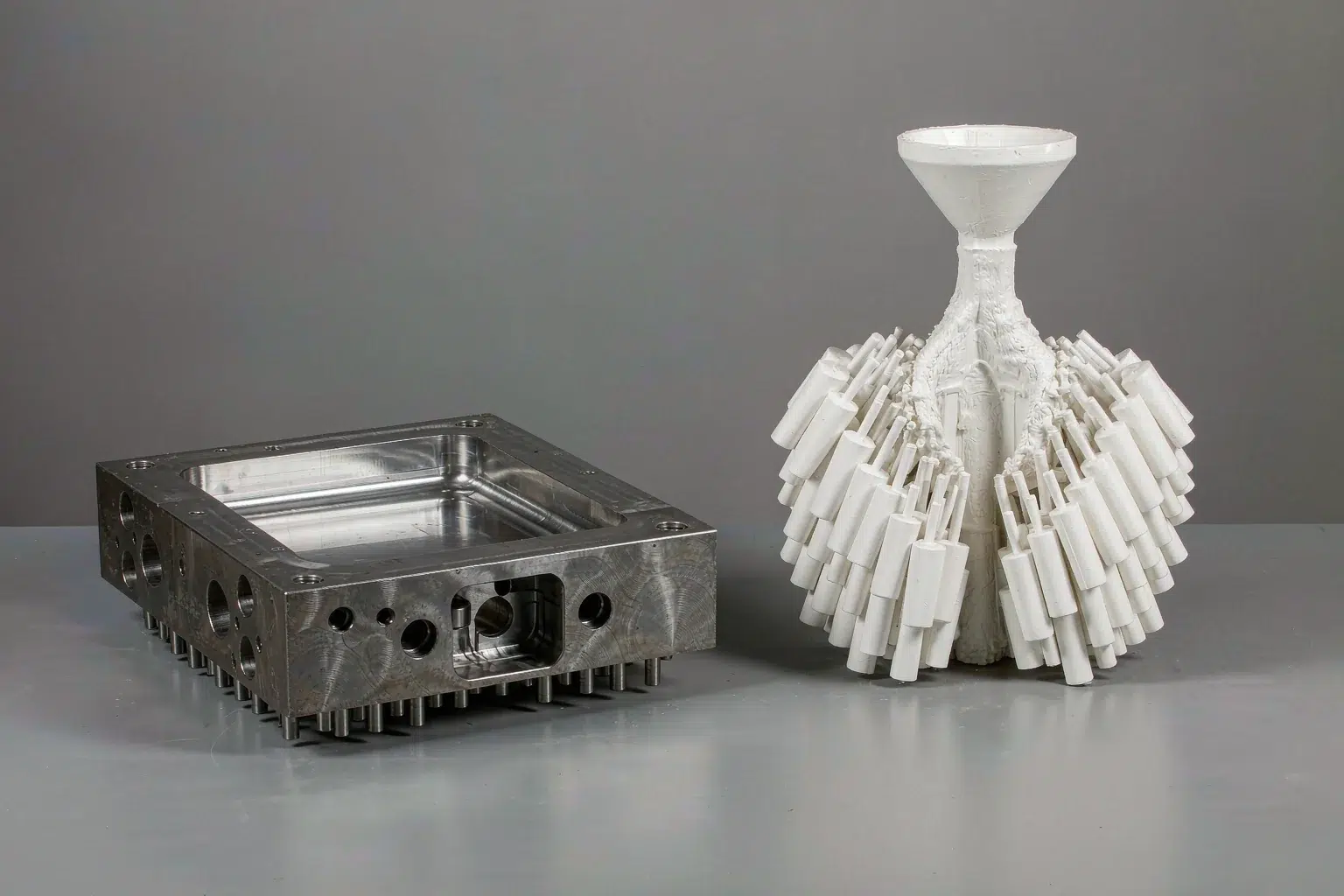
Wax is injected into an aluminium tool, the wax patterns are assembled onto a tree, the tree is dipped and stuccoed through six to ten ceramic coats, then dewaxed in an autoclave at about 150–180 °C and 0.6–0.8 MPa, fired at 900–1,100 °C, and poured hot into a ceramic shell that carries no parting line. One tree can hold 20–60 small components, so per-piece cycle time is misleading: the tree takes 12–36 hours from dip to knockout, but that cost is divided across the whole tree.
Tooling is far cheaper — which is the other half of the die casting vs investment casting story. An aluminium wax die for the same-size component often costs a fifth to a tenth of an HPDC die — because it sees wax at 60 °C, not aluminium at 660 °C. But every part consumes shell material, ceramic core (when used), hand finishing and inspection labour. That recurring cost is why the same part can cost three times as much as a die casting even after tooling is paid off. Our usługi odlewania precyzyjnego page walks through the whole cell.
Process Window: Where Each One Operates
Most quoting confusion clears up as soon as the two process windows sit next to each other. Use the table below as a first screen on any die casting vs investment casting decision — if your part falls outside a row, that process is already out.
| Parametr | Odlewanie ciśnieniowe | Odlewanie precyzyjne |
|---|---|---|
| Castable alloys | Al (A380 / ADC12 / ADC10), Zn (Zamak 3/5/7), Mg (AZ91D) | Any castable alloy: Al A356, CF8M/304 stainless, carbon & low-alloy steel, Ni/Co alloys, bronze |
| Pour / injection temperature | Al ≈ 640–680 °C | Al ≈ 700–740 °C; steel ≈ 1,560–1,620 °C |
| Practical minimum wall | 1.0–1.5 mm aluminium (0.8 mm on small areas) | 1.0–1.5 mm aluminium; 2–3 mm steel (0.5–0.8 mm possible on small features) |
| Typical part mass | 10 g – 10 kg (limited by machine locking tonnage, commonly 250–4,000 t) | 5 g – 100 kg, sweet spot 0.1–15 kg |
| Cycle per unit | 45–90 s per shot (multi-cavity multiplies output) | 12–36 h per tree, divided across 20–60 parts |
| Tooling cost (same part) | $25,000 – $120,000+, hardened H13 | $3,000 – $18,000, aluminium wax die + fixtures |
| Tool life | 80,000–150,000 shots (Al), refurb at 50,000–70,000 | Wax dies often exceed 100,000 wax injections at low stress |
| Economic volume | Rarely below ~2,000–4,000 units/year | 1–10,000 units/year without tooling pain |
Tolerance, Finish and Machining Allowance
This is where die casting vs investment casting RFQs go wrong most often: buyers assume one process is simply “the precise one.” Neither is universally better. Die casting holds very repeatable dimensions in a fixed steel die; investment casting delivers a monolithic part with no parting-line mismatch, but shell movement and ceramic expansion loosen absolute figures slightly. Both are usually quoted against casting tolerances to ISO 8062-3 or to NADCA’s standard practice, so make sure both quotes name the same standard before comparing them.
| Capability | Odlewanie ciśnieniowe | Odlewanie precyzyjne |
|---|---|---|
| Linear tolerance, 25 mm feature | ±0.08–0.12 mm (NADCA standard practice, same die half) | ±0.10–0.15 mm typical production |
| Dimensions across the parting line | Add ±0.15–0.30 mm for die shift / die wear* | No parting line — no mismatch term |
| Typical DCTG band (ISO 8062-3) | DCTG 4–6 | DCTG 5–7 |
| Draft angle required | 1–2° per side (0.5° with special lub / high-precision work) | 0.5–1° typical, near-zero draft possible on some faces |
| As-cast surface | Ra 1.6–3.2 µm, Ra 0.8 µm achievable on good die surfaces | Ra 3.2–6.3 µm as-cast; Ra 1.6 µm after light bead blast |
| Machining allowance normally left | 0.3–1.0 mm on sealing faces and bores | 0.5–2.0 mm depending on section size and alloy |
| Secondary finishing that follows | Trim, shot blast, impregnation for pressure-tight parts | Cut-off, gate grind, shell removal, optional HIP |
*NADCA practice treats dimensions crossing the parting line differently precisely because die halves can shift and wear; that single line is why a complex die cast part sometimes needs more machining than a seemingly “looser” investment casting.
Surface expectations matter too. A die casting often ships straight from trim to surface finishing, while an investment casting usually needs a Kirksite gate-removal pass before it looks clean. Neither process produces a cosmetic defect-free part every shot — which is another reason to judge die casting vs investment casting on total cost to finish, not on as-cast appearance — see the common casting defects guide and the specific five defect types that dominate high-pressure die casting.
Alloy Rule: The Filter That Ends Most Comparisons
The die casting vs investment casting filter that ends most arguments is the tool itself. Molten aluminium at 660 °C already erodes H13 die steel by soldering and heat checking; steel poured at 1,580 °C would destroy the die cavity in one shot. So the rule is blunt: any ferrous alloy, stainless or nickel-base is investment casting (or a competing ferrous route such as steel casting lub stainless steel casting).
| Requirement | HPDC answer | Investment casting answer |
|---|---|---|
| Aluminium grades available | A380, ADC12, ADC10, AlSi9Cu3 — high Si for castability | A356, A357, AlSi10Mg (weldable, higher elongation) |
| Full T6 solution treatment | Blisters above ~500 °C; usually limited to T5-type ageing | Yes — A356-T6 routinely specified |
| Weld repair / rework | Generally not recommended — entrapped gas expands | Routine, followed by re-inspection |
| Pressure-tight without resin | Vacuum-assisted casting helps; otherwise impregnation | Better, especially after HIP |
| Zinc / copper alloys | Zamak hot-chamber work is the gold standard | Bronze and brass are routinely poured |
The porosity reason behind the T6 row is worth understanding. Because fill takes 30–80 ms, air is entrained as fine bubbles rather than escaping through the vents. Put that part in a 540 °C solution furnace and the bubbles expand into surface blisters, so most die castings skip true solution treatment. If your spec calls for both pressure tightness and T6 strength, read our heat treatment for castings guide, then look at A356 versus A380 properties — A356 only exists as an option if you leave HPDC behind.
When aluminium is mandatory from the start, the comparison usually narrows to die casting versus sand casting; when precision and near-net aluminium both matter, sand versus investment casting is the better read.
Case A: Where Die Casting Wins — and by Exactly How Much
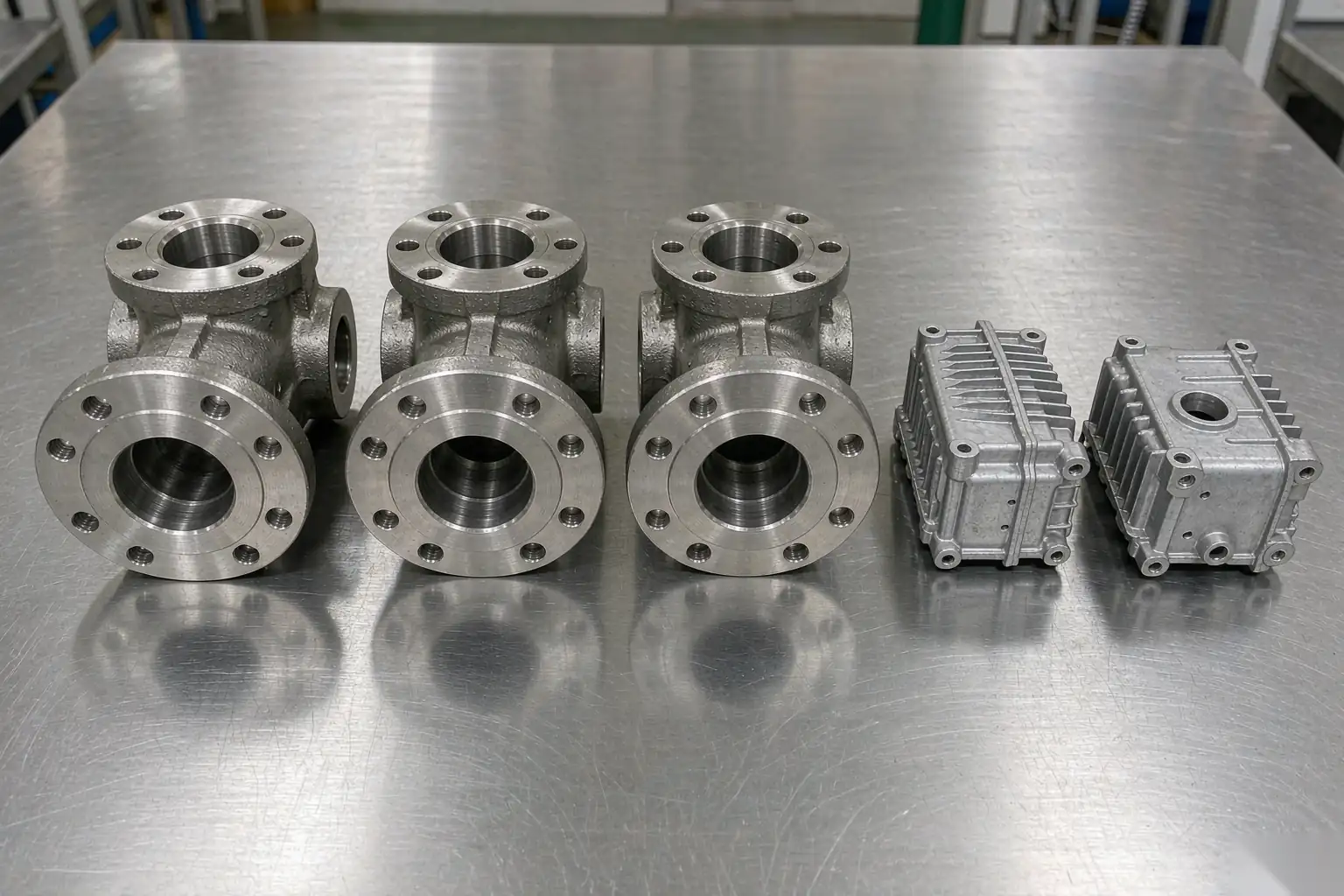
Here is the die casting vs investment casting arithmetic on a part both processes can actually make. The part: an aluminium electronics enclosure, 180 × 120 × 45 mm, nominal wall 2.5 mm, finished weight 0.62 kg, machined only on the mounting face. Forecast: 15,000 units per year for a three-year programme. Both processes can make it.
| Pozycja kosztowa | HPDC (single cavity) | Odlewanie precyzyjne |
|---|---|---|
| Tooling, quoted | $46,000 | $7,200 |
| Tool amortisation at programme volume | $46,000 ÷ 45,000 units = $1.02/unit | $7,200 ÷ 45,000 units = $0.16/unit |
| Recurring per unit | $6.85 (metal, casting, trim, blast) | $21.80 (wax, shell, pour, cut-off, finish) |
| Machining per unit | $3.10 (one face, 4 min cycle) | $4.60 (extra stock to clean) |
| Landed unit cost | $10.97 | $26.56 |
The crossover sits lower than most buyers expect. Add machining in and the per-unit gap is ($21.80 + $4.60) − ($6.85 + $3.10) = $16.45. Divide the $38,800 tooling difference by that number and the breakeven lands at roughly 2,400 units — about eight weeks of production at the planned annual rate. Everything above it is die casting territory: at 15,000 units per year the recurring saving is about $246,750 annually, and the tooling premium is recovered inside the first couple of months.
Two cautions worth pricing into any die casting vs investment casting spreadsheet. First, the HPDC die must be reconditioned around 50,000–70,000 shots, so budget roughly $6,000–$9,000 per refurbishment across a three-year 45,000-piece programme. Second, that $6.85 recurring figure assumes a stable cycle of about 75 seconds; on a multi-cavity die it falls further, which moves the crossover point down to near 2,000 units. Our podział kosztów rzucania zaklęć shows how each line behaves when aluminium moves ±10%.
Case B: Where Die Casting Cannot Quote at All
The part: a CF8M (cast 316 stainless) valve body, overall 150 × 110 × 80 mm, finished weight 3.2 kg, with three cored ports and a curved internal flow passage. Forecast: 900 units per year. This is not a price race — high-pressure die casting simply does not run stainless steel, so the useful die casting vs investment casting comparison becomes near-net casting versus machining everything away. So the honest comparison is investment casting versus machining from solid stock.
| Pozycja kosztowa | Machined from Ø160 bar | Investment casting + finish machine |
|---|---|---|
| Purchase weight | Ø160 × 90 mm = 1,810 cm³ × 8.0 g/cm³ = 14.5 kg | 4.6 kg casting (3.2 kg finished + gates) |
| Material cost | 14.5 kg × $7.10/kg = $103.00 | 4.6 kg × $6.40/kg = $29.40 |
| Machine time | 3.4 h × $72/h = $244.80 | 0.75 h × $72/h = $54.00 |
| Tooling / fixtures | $2,600 | $8,600 (wax die + core die + gauges) |
| Recurring subtotal | $347.80 | $83.40 |
Investment casting saves about $264 per unit before tooling, against an extra $6,000 in tooling — a breakeven of fewer than 25 pieces. At 900 units per year that is roughly $238,000 saved annually, plus a part whose internal passage follows the flow instead of being drilled with straight intersections that create pressure drop. Grade selection (CF8M versus CF8C versus duplex) changes both cost and corrosion behaviour; our stainless investment casting grades guide covers that trade-off in detail.
Lead Time: Where the Two Curves Cross Again
Tooling, not casting, decides first-article timing — and it is the stage where die casting vs investment casting expectations most often break. A hardened HPDC die with slides takes 6–10 weeks to build, plus two to three trial rounds; first articles typically land in 8–12 weeks. An aluminium wax die takes 2–3 weeks, so first articles normally arrive in 4–6 weeks — but production batches flow far slower, because shell building and firing are batch processes rather than a 75-second cycle.
| Stage | HPDC | Odlewanie precyzyjne |
|---|---|---|
| Design review & DFM | 3–5 days | 3–5 days |
| Tool build | 6–10 tygodni | 2–3 weeks |
| Sample & trials | 1–2 weeks | 1–2 weeks |
| Typical T1 to approval | 10–14 weeks total | 5–7 weeks total |
| Production rate after approval | Thousands per week | Hundreds per week per cell |
| Rush levers | Overtime CNC on die; rarely cheaper | Extra shift in shell room; printed wax patterns instead of tooling |
Note that last lever. If you need five samples next month and the volume is still unproven, printing wax patterns instead of cutting a metal tool gets physical parts in your hands without committing to either process — see our 3D printing prototype oraz metal prototype casting routes. Tooling timeline is the single largest block in either schedule, which is why we break it out separately in the die cast tooling cost and lifecycle guide.
Where Each Route Sits in a Real Sourcing Programme
Pull this back to what you actually buy. Die casting vs investment casting rarely shows up as a single line item; it shows up as a supplier list, a finishing sequence and a machining schedule.
- Die casting: usługi odlewania ciśnieniowego for aluminium and zinc alloy casting for hot-chamber work, followed by CNC. Typical buyers: consumer electronics housings, power tool bodies, EV connectors, heat sinks.
- Investment casting: lost wax casting services for stainless, additive-like geometries with cored passages, and everything needing T6 or weld repair. Typical buyers: pump and valve bodies, food equipment fittings, marine hardware, medical device arms.
- Either: aluminium parts with clean geometry and moderate volume — quote both. Ask for the same tolerance standard in both quotes, then compare machining hours rather than casting price alone.
- Neither: very large structural parts, heavy-section designs that need a riser study, or anything above roughly 100 kg — those belong to odlewanie w formach piaskowych lub odlewy żeliwne.
Before you send either RFQ, run the alloy choice through our casting alloy selection framework and check thin-wall feasibility against the guidance in the aluminium die casting guide. Ten minutes there usually saves a round of quoting, and it is the cheapest way to keep a die casting vs investment casting comparison honest.
What to Send With Your RFQ
- Annual volume and programme life. Not “expected volume” — the actual number you will order in year one, because tool amortisation is the swing factor.
- 3D model plus tolerance callouts on the critical features only. Over-tolerancing a drawing pushes every quote to machining.
- Alloy and any mandatory heat treatment. “T6” alone eliminates conventional HPDC.
- Pressure requirements. Test pressure, medium, and whether leak testing is 100% or sampled.
- Finish specification. Ra target on which faces, coating type, and whether cosmetic surfaces are Class A.
Najczęściej zadawane pytania
Is die casting always cheaper than investment casting?
No. Below roughly 2,000–4,000 units per year, the cheaper tool usually wins even though each piece costs more — and that is why die casting vs investment casting answers differ between a 500-unit pilot and a 20,000-unit launch. In the housing above, the crossover was about 2,600 units; above it, die casting saved around $15 per unit.
Which process holds tighter tolerances?
For a simple dimension in one die half, die casting is marginally tighter (±0.08–0.12 mm at 25 mm). But dimensions crossing the parting line add ±0.15–0.30 mm of die shift, and investment casting has no parting line at all — so on complex multi-face geometry, the “looser” process often delivers less variation.
Can die cast parts be heat treated or welded?
Not fully, and it is the trap most often missed in a die casting vs investment casting spec review. Entrained air blisters above roughly 500 °C, so genuine T6 is usually off the table for conventional HPDC; ageing-only treatments and weld repair are limited. If your spec needs either, move to investment casting, or look at pore-free variants covered in our odlewanie w formach stałych discussion.
Which gives a better surface finish?
Die casting, typically Ra 1.6–3.2 µm as-cast versus Ra 3.2–6.3 µm for investment casting, which usually receives a light blast before coating. Both reach similar values after finishing — see the full surface finishing options.
Can I prototype in one process and produce in the other?
Yes, and it is common. Printed wax patterns plus a soft tool let you validate form and fit in three to four weeks, then commit to hardened die tooling once the volume is real. Just re-check wall thickness: what prints easily may not fill reliably at production speed.
What size and weight limits should I expect?
Size is another place where die casting vs investment casting assumptions go wrong. Die casting is capped by machine locking force — commonly 10 kg of aluminium or less in practice, with anything bigger pushing into very large tonnage. Investment casting routinely reaches 15 kg and occasionally 100 kg, though shell handling cost climbs steeply past about 20 kg.
*Data referenced from AFS / NADCA industry publications and Supro MFG shop-floor records.
 English
 Français
 Deutsch
 Italiano
 日本語
日本語 한국어
한국어 Polski
 Português de Angola
 Русский
 Español de Argentina