
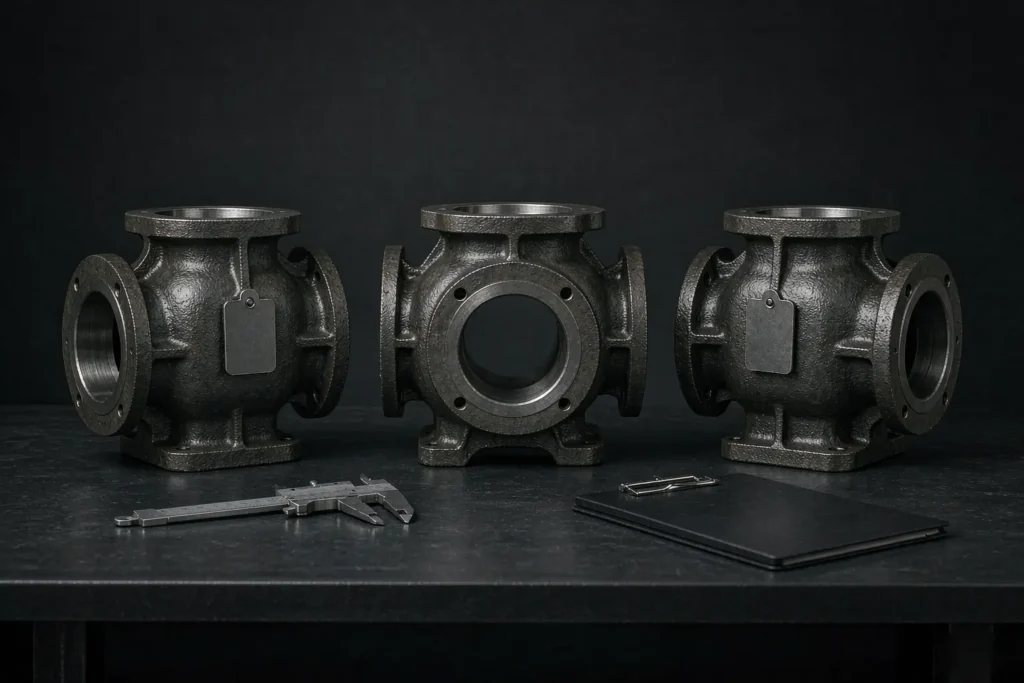
A casting nonconformance is not a verdict on a part. It is a decision point that sits between an inspection result and a commercial agreement, and how a buyer handles that decision usually costs more than the off-spec casting itself.
This article turns a casting nonconformance into a repeatable arithmetic exercise: how to classify the departure, which of four dispositions is legally available, what a use-as-is concession should actually cost, how to close the loop with an 8D corrective action, and which six clauses stop the same problem returning on the next lot. Every number below comes from a worked 1,800-piece ductile iron pump housing order. Reference points follow ASTM E446 for severity grading, AIAG for 8D and PPAP discipline, and NIST metrology guidance for measurement traceability.
What Counts as a Casting Nonconformance
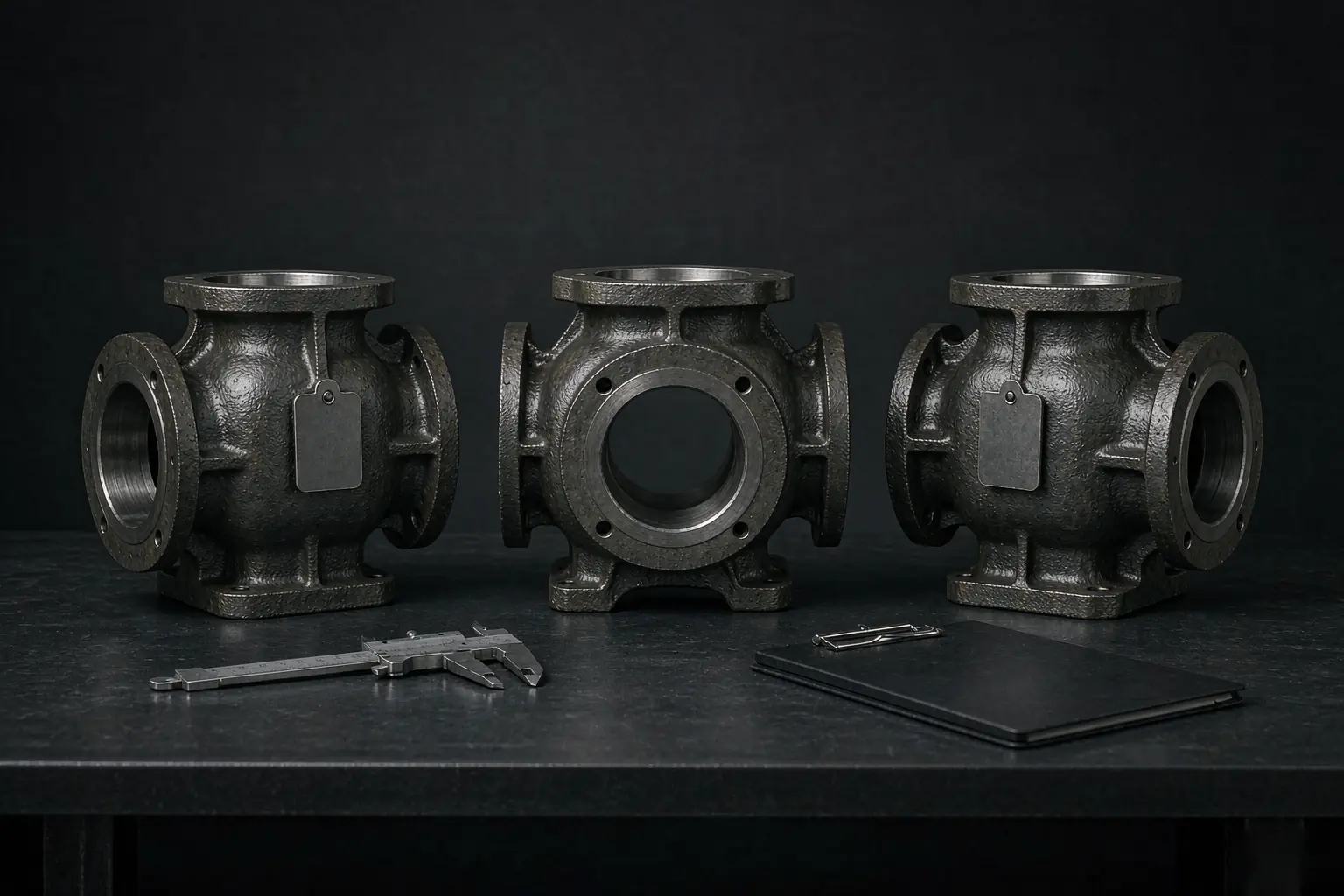
A casting nonconformance is any departure from the drawing revision, the agreed dimensional grade, the approved material specification, or the documentation package that was named in the purchase order. It is deliberately broader than “defect”. A part can be functionally sound and still carry a casting nonconformance: the chemistry is right, the bore is in tolerance, but the heat-lot number on the certificate does not match the number stamped on the casting. That single mismatch blocks receipt at goods-in even though no metal is wrong. Buyers who define the term narrowly discover the gap only when a shipment is quarantined. Start from our Guida alla fusione dei metalli for the process vocabulary, then use the casting incoming inspection plan to decide what gets measured at receipt.
Four families cover almost every case seen in production castings. The table below records the evidence that establishes each one, the reference used to judge it, and the disposition that is normally available. Note that the fourth row is administrative, not metallurgical, and is the one most often left out of a quality agreement.
| Class | Evidence that establishes it | Governing reference | Default disposition |
|---|---|---|---|
| Dimensional | CMM or bore-gauge report; 85 mm bore measured 85.28 mm against H8 (+0.054/0) | Drawing GD&T, ISO 8062 DCTG grade | Rework or use-as-is concession |
| Metallurgical | Spectrometer result; Mg 0.28% against 0.30-0.45% spec; missing nodularity count | ASTM A536 / approved heat certificate | Downgrade or scrap |
| Surface and internal | Radiograph graded level 3 where level 2 is the acceptance limit; MT indications | ASTM E446 reference radiographs | Weld repair, re-cast, or scrap |
| Documentation | MTR heat lot does not match the casting stamp; calibration certificate expired | EN 10204 3.1, gage calibration records | Hold – no disposition until evidence closes |
Measurement disputes are the most expensive kind of casting nonconformance because both parties can be right. A bore gauge with 18% GR&R will disagree with a supplier CMM on a 0.05 mm tolerance band, and the argument then becomes about the measurement system rather than the casting. Require GR&R at or below 10% on every characteristic declared critical, and keep calibration traceable to NIST metrology guidance. The metodi di controllo dei getti article compares PT, MT, UT and RT by what each one can actually prove; ISO 8062 casting tolerances guide maps ISO 8062 grades to real achievable bands; and casting tolerance stack shows how a single datum choice can move an entire tolerance chain by 0.3 mm.
The documentation family deserves its own control. A first article inspection that was approved against revision B does not cover a casting made to revision C, and a heat certificate without a spectrometer correlation is a piece of paper, not evidence. In practice roughly one in five holds at goods-in is paperwork-driven, which is why a casting nonconformance log should have a dedicated “evidence incomplete” category instead of forcing every case into a defect taxonomy.
Build the evidence pack before the argument starts
A usable pack contains the drawing revision, the CTQ list with actual measured values, the heat and melt record, the inspection method and gage ID with calibration date, photographs of the marked location, and the quantity with a lot identifier. Assembling it after the supplier has already responded costs days; assembling it at detection costs minutes. The same pack is what a later claim or an audit will ask for, so build it once.
Casting Nonconformance Disposition: The Four Available Outcomes
Every casting nonconformance ends in one of four dispositions: rework, use-as-is concession (also called “accept as is” or “concession”), downgrade to a different application, or scrap and replace. The decision belongs to a material review board (MRB) with quality, engineering and procurement represented. A supplier quality engineer may propose a disposition, but on a bought-out casting only the buyer MRB can approve a concession, because the buyer owns the downstream functional risk.
| Disposition | Who signs | Typical window | Cost owner | Traceability requirement |
|---|---|---|---|---|
| Rework / weld repair | Supplier QE; buyer engineering if welding or heat treatment is involved | 3-10 working days | Supplier | New traveler, re-inspection record, revised serial link |
| Use-as-is concession | Buyer MRB only (quality + engineering + procurement) | 24-72 hours | Shared, priced into the unit | Concession number, lot isolation, permanent part mark, expiry or quantity cap |
| Downgrade / alternate use | Buyer engineering | 2-5 working days | Negotiated | New part number, removal from original BOM |
| Scrap and replace | Supplier | 5-20 working days | Supplier | Scrap tag, root-cause link, replacement lot identification |
Rework is the default answer when the casting nonconformance is dimensional and there is stock left to remove. A bore that is 0.28 mm oversize can be sleeved and re-machined; a shallow surface indication can be excavated and filled under a qualified procedure. Our casting weld repair guide sets out when weld repair is legitimate and when it merely moves the problem, and AWS publishes the filler and procedure qualification frameworks those decisions should reference. Rework after servizi di trattamento termico oppure servizi di trattamento superficiale is a different cost class entirely, because the finish has to be stripped and reapplied.
A concession is only defensible when the departure does not change a function the buyer cares about. That is a functional question, not a statistical one: a 0.28 mm oversize bore in a static O-ring groove may be harmless after a pressure test, while the same 0.28 mm in a bearing seat destroys an interference fit. The MRB should therefore start from the fit and load path, not from the deviation magnitude. Where the answer is no, the clean path is scrap or replacement, and the event should be recorded in the casting scrap rate ledger with its true cost rather than quietly written off as sorting.
Why use-as-is is a commercial decision, not a quality one
Quality engineering determines whether the part still works. Procurement determines what that residual risk is worth, and the two answers are independent. Treating a concession as a quality favour rather than a priced transaction is how buyers end up absorbing the same deviation lot after lot with no discount and no corrective action. A concession always has three outputs: a written approval, a price, and a CAPA owner.
Time limits matter as much as authority. A casting nonconformance raised within 24 hours of detection can still be resolved while the lot is intact and the melt records are fresh. The same case raised two weeks later, after the parts have been machined and partly assembled, has no clean evidence left and typically turns into a casting defect claim instead of a disposition. Specify the notification window in the purchase order, not in an email thread.
Concession Pricing: Putting a Number on a Casting Nonconformance
Price a casting nonconformance by comparing the full cost of the concession path against the full cost of the next-best disposition, then sharing the difference. The concession path is not free: it carries verification cost, identification and quarantine cost, buyer engineering review time, a residual warranty reserve, and a commercial discount. The rework path carries machining, replacement castings for the units damaged during rework, re-inspection, and the schedule delay. Only after both are on the table can a discount be called rational.
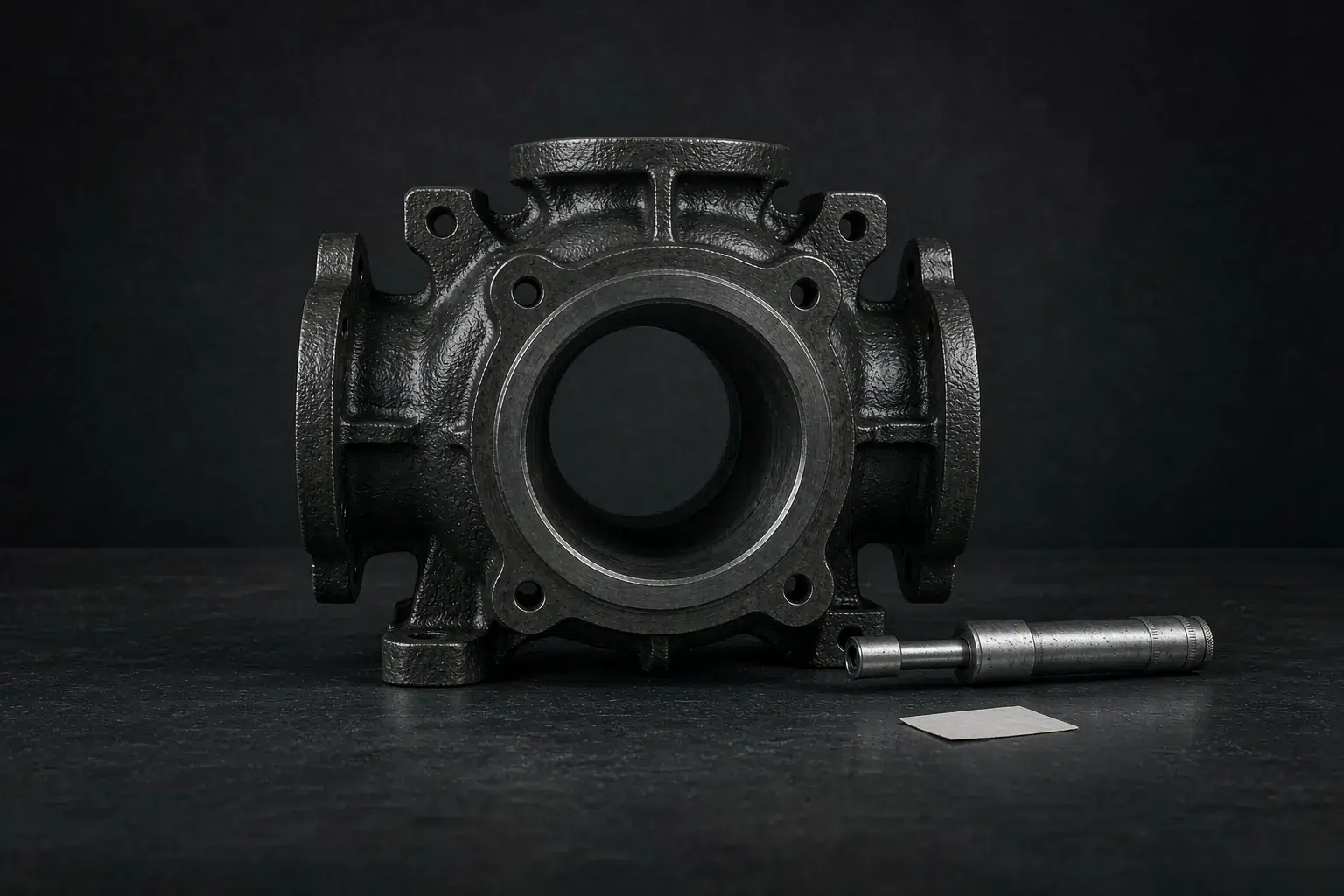
Worked case: 1,800 ductile iron pump housings, 12.4 kg each, bored 85 mm H8. Incoming inspection on an ISO 2859-1 level II, AQL 1.0 plan found 38 castings (2.11% of the lot) with a bore between 85.12 and 85.28 mm against an upper limit of 85.054 mm. The maximum departure is 0.226 mm. The bore is an O-ring static seal groove, not a bearing seat. Two paths were quoted and costed in full.
| Cost line | Base | Amount (USD) |
|---|---|---|
| 100% pressure test of the 38 parts | 38 x 4.50, 0.6 MPa for 30 min each | 171.00 |
| Concession tagging and quarantine handling | 38 x 1.60 | 60.80 |
| Buyer engineering review | 3 h x 60.00 | 180.00 |
| Residual warranty reserve | 38 x 2.10 | 79.80 |
| Commercial price reduction | 38 x 8.00 concession discount | 304.00 |
| Concession path total | all five lines | 795.60 |
| Rework path total | 38 x 27.00 (sleeve + bore + re-inspect) + 3 x 92.00 replacement castings | 1,302.00 |
| Net difference | rework minus concession | 506.40 |
The concession is USD 506.40 cheaper and avoids a 12-day rework queue that would have missed the assembly window. But the number only holds because the function gate was satisfied: three sample castings were pressurised and held, and a compression check showed O-ring squeeze falling from 22% to 14%, still above the 12% minimum for a static face seal. Had the bore been an H7/p6 bearing seat, the same 0.226 mm would have turned a 0.02-0.05 mm interference into a clearance of roughly 0.18 mm and no discount would be defensible. A casting nonconformance is priced on function, never on the size of the deviation.
| Feature and deviation | Functional effect | Gate result |
|---|---|---|
| 85 mm O-ring groove, +0.226 mm | Squeeze 22% to 14%; leak risk verifiable by pressure test | Conditional concession allowed |
| 85 mm H7/p6 bearing seat, +0.226 mm | Interference 0.02-0.05 mm becomes ~0.18 mm clearance; torque capacity lost | Never concede – rework or scrap |
| M12 tapped hole position 0.30 to 0.75 mm | Bolt pattern drift; assembly interference at the flange | Rework with oversize insert, then re-FAI |
| Nominal wall 6.0 mm measured 5.1 mm | Bending section modulus falls (5.1/6.0)^2 = 0.72, i.e. -28% | Scrap or FEA-approved downgrade only |
The function gate that overrides the cheapest option
Create a short list of characteristics that can never be conceded – interference fits, pressure-boundary wall thickness, fatigue-critical fillets, and any surface that will be plated or anodised for corrosion protection. Everything outside that list can be evaluated on evidence. This single page, agreed before the first article, removes most of the late-night arguments and is the cheapest control in the whole process.
On the commercial side, a concession discount should be a line item, not a handshake. It affects the landed unit cost, so it belongs in the same model as the casting price per kg calculation and the total cost of ownership comparison. If the supplier instead offers a credit against a future order, record the credit against the lot that generated the casting nonconformance; otherwise the cost silently migrates into next quarter and the corrective action never gets funded. Where the deviation recurs, escalate to the casting defect claim procedure rather than negotiating a third concession.
The 8D Loop: Closing a Casting Nonconformance With CAPA
A disposition closes one lot; a corrective action closes the cause. The casting nonconformance record should feed an 8D structure: contain the lot (D0-D3), find the escape point as well as the root cause (D4), validate a permanent action (D5-D6), prevent recurrence on similar parts (D7), and close with measured evidence (D8). AIAG publishes the automotive 8D and PPAP conventions that most casting suppliers already work to, so referencing them avoids inventing a second vocabulary.
| Metric | Before CAPA | After CAPA | How it was achieved |
|---|---|---|---|
| Bore 85 H8 Cpk | 0.62 | 1.45 | Core-print clearance and coating thickness control |
| Estimated out-of-spec PPM | 31,400 | 14 | Normal model: z = 3 x Cpk |
| First-pass yield on this feature | 96.1% | 99.4% | In-process bore check after shakeout |
| Concession requests per quarter | 11 | 1 | CTQ list moved into the tooling setup sheet |
| Heat-lot trace closed within 10 min | 42% | 100% | Stamp-to-certificate scan at packing |
The root cause in this case was not the machining setup. It was a core print that allowed 0.4-0.7 mm of movement when the coating built up on the core, which showed up as a shifted bore rather than an undersize one. casting simulation is useful here because a solidification study will not catch a mechanical core shift; casting riser design covers the feeding side that a shrinkage-driven departure would need instead. Cross-referencing difetti comuni di fusione helps keep the team from labelling every dimensional miss as “porosity”.

Verification over two consecutive lots, not one
A single good lot proves containment, not correction. Require the permanent action to hold across two consecutive production lots with Cpk recalculated on each, and attach the gage R&R result to the closure report. If the second lot drifts, the 8D stays open and the concession authority for that characteristic is suspended. This is also the point where most supplier CAPAs quietly fail: the containment is real, the root cause is a guess, and the deviation returns four months later on a different part number.
Records should survive longer than the commercial relationship. A casting nonconformance file with the deviation, the disposition, the concession number, the CAPA and the verification data is exactly what an auditor will sample. The foundry audit checklist walk-through includes a ten-minute trace test on this chain, and the verifica dei fornitori di fusione desk review checks whether a supplier can produce it at all. Buyers who keep only the email approval discover the gap during a customer audit, not before.
Casting Nonconformance Clauses to Write Into the Purchase Order
Six clauses convert the process above into something enforceable. Without them, every casting nonconformance is renegotiated from scratch, usually under time pressure and usually in the supplier’s favour. Keep the wording short and put it in the PO or the attached quality agreement rather than in a separate “terms” PDF that nobody references at goods-in.
| Clause | Wording to specify | What it prevents |
|---|---|---|
| 1. Definition | Any departure from drawing rev X, the agreed ISO 8062 grade, or the approved FAI | Arguing about whether the case is a defect at all |
| 2. Notification | Written notice within 24 h of detection, before any disposition or rework begins | Loss of evidence and unilateral repair |
| 3. MRB authority | Only the buyer MRB may approve use-as-is; supplier cannot self-concede | A deviation becoming an unpriced standing practice |
| 4. Written concession | Number, lot, quantity, expiry or quantity cap, permanent part mark | Mixing conceded parts back into normal stock |
| 5. Cost and reservation | Acceptance does not waive warranty or latent-defect rights; discount recorded per unit | Silent cost migration and lost recovery |
| 6. CAPA closure | 8D within 15 working days; permanent action verified over 2 consecutive lots | Repeat concessions on the same characteristic |
These clauses sit naturally inside a accordo sulla qualità del casting, and they should be referenced in the richiesta di preventivo per il casting so the supplier prices the control before quoting. A supplier that objects to clause 3 is telling you something useful about how it has handled deviations in the past. Note that clause 5 matters even when the concession is free: an acceptance without an explicit reservation can be read as a waiver of a later casting defect claim, and the total cost of ownership model then absorbs a failure nobody budgeted for.
Make the clause set technology-neutral. It should apply equally to a green sand housing, a shell-moulded valve body and an investment-cast impeller, because the failure mode is commercial rather than metallurgical. What changes by process is the CTQ list and the evidence pack, not the authority chain.
What a Casting Nonconformance Costs at Each Detection Stage
The familiar 1:10:100 rule understates casting. A casting nonconformance caught at shakeout costs a re-pour; the same deviation caught on an assembly line costs a line stop, teardown and expedited freight; caught in the field it costs a warranty event and a credibility problem that no credit note reverses. The table uses the same 38-part lot to keep the comparison honest.
| Detection stage | Unit cost (USD) | 38-part lot | Why the jump |
|---|---|---|---|
| Foundry in-process | 1.60 | 60.80 | Core fix or re-pour before value is added |
| Buyer goods-in | 20.94 | 795.60 | Verification, tagging, review time, discount |
| Assembly line | 140.00 | 5,320.00 | Line stop, teardown, sorting, express freight |
| Field / warranty | 900.00 | 34,200.00 | Service visit, replacement, claim handling |
That is a 561x multiple between the earliest and latest detection of the same casting nonconformance. It explains why a concession process that takes 72 hours is worth funding even when the discount itself is small: the alternative is a decision deferred until the parts are already inside an assembly. It also explains why an casting incoming inspection plan with a defensible sampling plan pays for itself, and why the casting scrap rate denominator should be reported by detection stage rather than as one blended number.
One caution: 100% inspection does not remove nonconformance, it only moves the detection point. Adding a sorting gate without fixing the core print changes the foundry yield but not the process capability, and it adds a measurement system that can itself generate false rejects. Spend the first dollar on the root cause, the second on in-process control at the station that creates the feature, and only then on additional inspection.
Building a Casting Nonconformance-Resistant RFQ
The cheapest casting nonconformance is the one the quotation never allows. Eight fields in the RFQ determine whether a deviation can be judged objectively later. Leave any of them out and the first disagreement becomes a discussion about interpretation instead of a measurement.
| RFQ field | What to state | Ambiguity it removes |
|---|---|---|
| Drawing revision and datum scheme | Rev X, GD&T to ASME Y14.5, datum targets named | Which surface the deviation is measured from |
| Acceptance grade | ISO 8062 DCTG/CTG grade, ASTM E446 radiographic level | Subjective visual acceptance calls |
| CTQ list with capability target | 3-6 characteristics, Cpk >= 1.33 at FAI | Inspecting everything and controlling nothing |
| Sampling plan | ISO 2859-1 level II, AQL 1.0, lot defined by heat | Disputes over how many parts to check |
| Measurement method and GR&R | CMM or bore gauge by gage ID, GR&R <= 10% | Supplier and buyer gages disagreeing |
| Concession authority and notice | 24 h notice, buyer MRB only, written concession number | Unilateral use-as-is decisions |
| Documentation pack | EN 10204 3.1 / MTR, heat lot, FAI, calibration certs | Paperwork holds at goods-in |
| CAPA and cost recovery | 8D in 15 working days, warranty rights reserved | Repeat deviations with no owner |
Match the CTQ list to the process route. A fusione in sabbia housing needs core position and parting-line control; fusione a cera persa shifts the risk to shell build and wax dimensional stability; servizi di pressofusione is dominated by die temperature, fill velocity and ejector distortion; and CNC machining services can only add precision to a blank that has enough stock. Where the CTQ list is unrealistic for the chosen route, fix it at casting molds making rather than writing a concession process for a tolerance the tooling cannot hold. The tolleranza di lavorazione per fusione article gives the stock numbers that make this conversation concrete.
Use metal prototype casting e 3D printed prototype to validate the datum scheme before cutting production tooling, and check that iron casting solutions e steel casting solutions routes quote the same documentation pack as the prototype. Downstream servizi di trattamento termico e servizi di trattamento superficiale steps can introduce their own departures, so include them in the CTQ review rather than treating them as cosmetic. Where a legacy part has no usable drawing, casting reverse engineering e casting tolerance stack rebuild the baseline first; otherwise every measurement is a negotiation. The Guida alla fusione dei metalli covers the route selection logic, and our contact page is where the eight fields can be sent as a single RFQ package.
Domande frequenti
Is a casting nonconformance the same as a casting defect?
No. A defect is a physical condition that impairs fitness for use. A casting nonconformance is any departure from an agreed requirement, including missing or inconsistent documentation. A part with an expired calibration certificate on its inspection record is nonconforming even if every dimension is perfect. The broader definition is what lets a buyer hold a lot before the metal is proven wrong.
Who can approve a use-as-is concession?
The buyer material review board, with quality, engineering and procurement represented. A supplier may propose the concession and supply the evidence, but should not approve its own deviation. Put this in the purchase order; an email from a supplier quality engineer is not an approval and will not survive an audit or a later warranty claim.
Should every casting nonconformance concession come with a price reduction?
It should come with a priced decision, which is not always a discount. If verification and review cost more than the rework alternative, the rational outcome is rework at the supplier’s cost. Where a concession is cheaper, the shared saving is normally split through a per-unit discount plus a warranty reserve, and the amount is recorded against the lot that generated the deviation.
How long should casting nonconformance records be retained?
At least as long as the field service life of the part plus the contractual warranty period, and commonly ten years for safety-related castings. The file needs the deviation, measurements with gage ID, heat lot, disposition, concession number, the 8D and the two-lot verification. Retaining only the approval email leaves the trace broken.
Does 100% inspection prevent casting nonconformance?
No. It moves detection closer to the buyer and adds a measurement system with its own false-reject rate. Capability comes from the tooling and the process control at the station that creates the feature. Use 100% inspection as temporary containment after a deviation, then retire it once two consecutive lots hold the agreed Cpk.
*Worked figures are from a 1,800-piece ductile iron pump housing order; reference frameworks from ASTM E446, AIAG 8D/PPAP practice and NIST measurement guidance.
 English
 Français
 Deutsch
 Italiano
 日本語
 한국어
 Polski
 Português de Angola
 Русский
 Español de Argentina