
Two quotes land in the same inbox on the same day. One supplier states a casting price per kg of $1.26, the other $1.05. Same drawing, same alloy, same lot size — and the 20% cheaper rate costs $5.19 more per casting. Neither supplier is lying. They are pricing different kilograms.
That is the whole difficulty with per-kg quoting: it is a quotient, and a quotient hides both its numerator and its denominator. This guide takes one 12 kg ductile iron pump housing through four quoting conventions that are all in daily commercial use, converts each into a per-piece number, and shows where the money actually moves after the order is placed. The reference points are the ones your suppliers already work to: ASTM A536 for ductile iron grades, NADCA for die casting practice and worldstainless for stainless grades. If process selection is still open, read the Guida alla fusione dei metalli before you read prices.
What a Casting Price per Kg Actually Covers
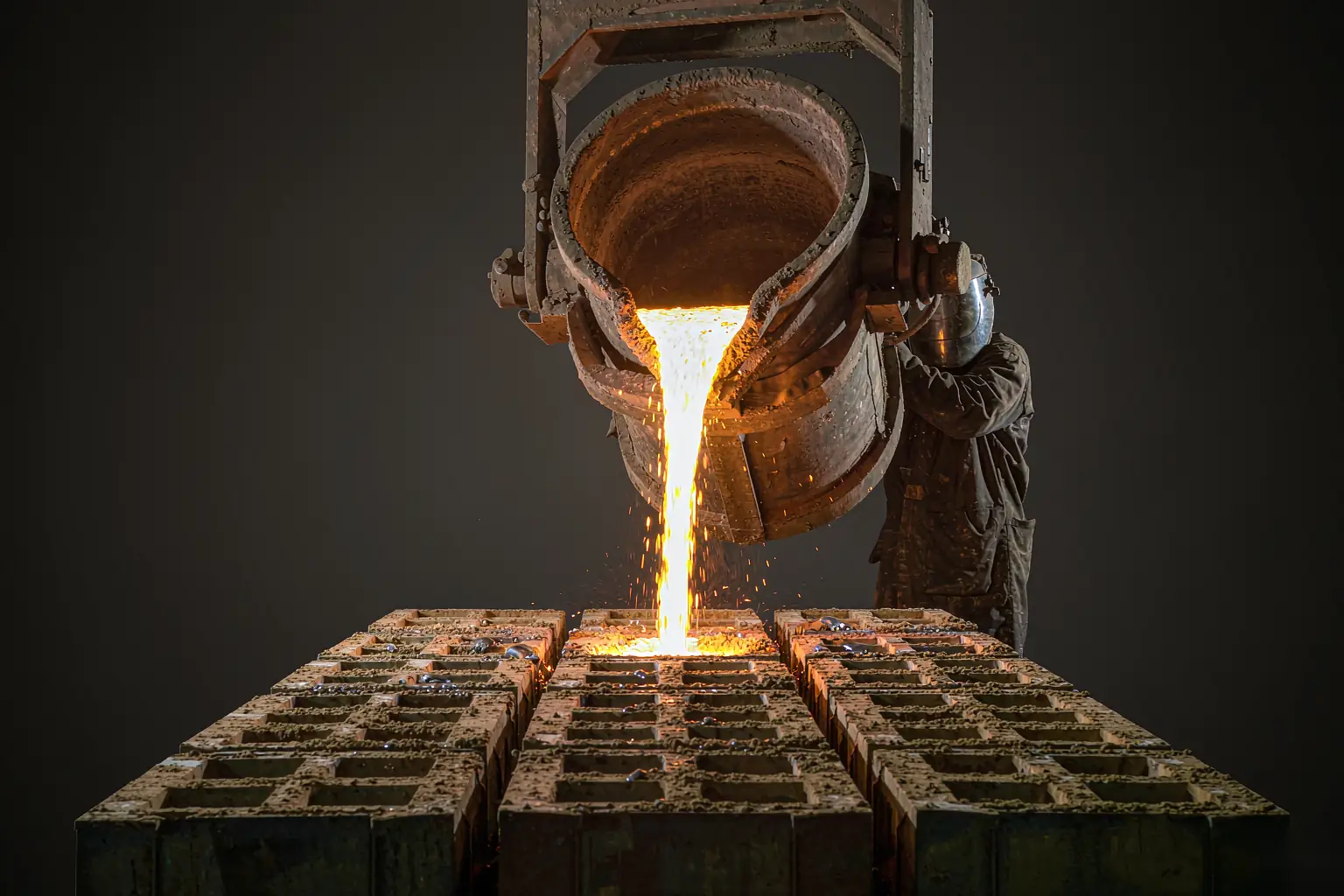
A casting price per kg is built from three blocks, and only the first one is metal. Take a 12 kg ductile iron pump housing poured in green sand at 62% yield — 19.35 kg of iron enters the mold, 12.00 kg ships, 7.35 kg comes back as gates, runners and risers. That geometry alone decides how many kilograms you are billed for.
| Cost block, per kg shipped | Base | Amount |
|---|---|---|
| Metal consumed | Charge metal at $0.52/kg, 62% yield, 12% remelt loss | $0.558 |
| Melting energy | 0.60 kWh per kg melted, 0.97 kWh per kg shipped, $0.085/kWh | $0.082 |
| Conversion and margin | Molding, cores, sand, labor, cleaning, overhead, profit | $0.620 |
| Total | As-cast weight, ex-works | $1.26 |
So the 12 kg housing prices at $15.13 per piece. Metal is 44.3% of it, energy 6.5%, and everything you actually buy from a foundry — pattern handling, molding, coring, pouring discipline, fettling, inspection — is the remaining 49.2%. A cost breakdown of the same part, block by block rather than per kg, is set out in what drives casting cost.
The Metal Component Is Not the Metal Price
Here is the counter-intuitive part that most buyers never check. With internal remelting, low yield does not multiply your metal cost by 1.61. It multiplies it by 1.075. The formula is:
metal cost per net kg = charge price × [1 + (1 ÷ yield − 1) × remelt loss]
For the housing: 0.52 × [1 + (1 ÷ 0.62 − 1) × 0.12] = 0.52 × 1.075 = $0.558 per kg. The 7.35 kg of returns are not thrown away — they are remelted, and only the 12% melt loss is genuinely consumed. Push the yield down to 55% and metal cost per net kg rises to $0.571, a difference of 1.3 cents. Push it up to 72% and it falls to $0.544.
This matters because it demolishes the most common justification for gross-weight quoting. If a supplier bills you for the 19.35 kg poured and calls it a pass-through of metal cost, the metal line on your invoice is 2.6 times the actual metal cost of $7.70 per casting. That is not a cost basis. That is a 61% uplift on metal, dressed as a measurement. Yield discipline does matter to a foundry — it consumes furnace hours, sand and mold capacity — but it belongs in the conversion line, where it can be discussed honestly, not hidden inside a weight basis.
Four Quotes, One Part: Where Casting Price per Kg Misleads
Four quotes for the identical housing, all expressed per kg, all defensible on their own terms. Read the rate column first, then the per-piece column.
| Quote | Weight basis | kg billed | Rate | Al pezzo |
|---|---|---|---|---|
| A | Net as-cast weight | 12.00 | $1.26 | $15.13 |
| B | Gross poured weight | 19.35 | $1.05 | $20.32 |
| C | Net weight, machining excluded | 12.00 | $1.26 + $6.40 machining | $21.53 |
| D | Net weight, machining included | 12.00 | $1.78 | $21.36 |
- B looks 17% cheaper and is 34% dearer. At $1.05 the gross-weight rate is genuinely the lowest number in the table. At $20.32 per casting it is the second most expensive outcome.
- C and D are the same price wearing different labels. A 41% higher rate on D buys you the $6.40 of machining that C lists separately, and the two totals land 17 cents apart. Which one is “cheaper” depends entirely on whether your own shop is the cheaper machinist.
- Only A is a clean baseline. Net as-cast weight, scope stated, ex-works. Every other quote needs one adjustment before it can be compared to A.
Note what has not changed across all four rows: the process. Every quote is ordinary fusione in sabbia from the same pattern, and the casting price per kg still ranges from $1.05 to $1.78 on presentation alone. A buyer who collects rates without collecting bases is not comparing suppliers. They are comparing vocabularies.
The Gross Weight Trap
Gross-weight quoting survives because it is the easiest number to verify. The weight bridge or the shipping scale sits at the door, the invoice multiplies tonnes by a rate, and nobody has to agree on what a finished casting weighs. It is auditable, and auditors like it. But it converts a foundry’s internal yield into your commercial exposure, which inverts the incentive: a supplier paid on poured weight has no reason to improve gating, and every reason to pour more.
The practical check is arithmetic, not argument. Ask for the gross weight poured, the net as-cast weight, and the rate. Divide the per-piece price by the net weight. In the example above, quote B works out to $1.69 per kg of metal that actually ships — 34% above quote A. Any supplier quoting gross weight should be able to state their yield, and 60–68% is a normal sand casting range for a housing of this shape. If the stated yield is 45% and the rate is not discounted accordingly, the yield is a pricing device, not a process fact.
Why Casting Price per Kg Falls as Parts Get Heavier
A second reason per-kg rates refuse to compare: the conversion block is not proportional to weight. A 0.5 kg bracket and a 12 kg housing both need a mold box, a pour, a shakeout, a grind and an inspection — cost that arrives per piece, not per kilogram. As weight rises, that fixed per-piece burden spreads over more kilograms and the per-kg rate falls.
| Part weight | Indicative rate, ductile iron sand casting | What dominates |
|---|---|---|
| 0.5 kg | $2.40 – $3.20 / kg | Handling, molding labor, per-piece inspection |
| 2 kg | $1.70 – $2.20 / kg | Molding, coring, cleaning |
| 5 kg | $1.40 – $1.75 / kg | Balanced metal and conversion |
| 12 kg | $1.20 – $1.55 / kg | Metal, melting, sand throughput |
| 50 kg | $1.00 – $1.30 / kg | Metal and furnace time |
| 200 kg | $0.90 – $1.15 / kg | Crane time, mold handling, metal |
These ranges are indicative, ex-works, alloy at mid-2026 indices, and they move with the metal market rather than with the foundry’s mood. Use them to sanity-check a rate, never to benchmark two different parts. A 0.5 kg stainless impeller at $18 per kg is not expensive next to the housing at $1.26; it is a different product. The only legitimate cross-part comparison is the implied conversion per piece, and even that needs the same tooling and lot assumptions. For the buyers who ask which alloy to start from, A356 versus A380 covers the aluminum side of that decision.
Reading Casting Price per Kg for Aluminum and Stainless
Metal share is what makes one per-kg number behave like a commodity ticker and another behave like a machining quote. Run the same three-block model across three processes and the difference becomes obvious.
| Case | Yield | Metal / kg | Conversion / kg | Metal share |
|---|---|---|---|---|
| Ductile iron, sand, 12 kg | 62% | $0.558 | $0.702 | 44% |
| ADC12 aluminum, HPDC, 1.2 kg | 75% | $2.626 | $1.900 | 58% |
| CF8M stainless, investment, 0.8 kg | 42% | $4.896 | $2.350 | 68% |
Two practical consequences follow. First, price sensitivity to the metal market scales with metal share: a 10% move in the iron index adds 4.4% to the housing rate, while the same percentage move in the stainless index adds 6.8% to the valve body. That is the quiet reason a stainless casting price per kg behaves so differently from an iron one — on fusione a cera persa, the alloy specification is most of the commercial decision before a single hour of labor is discussed. Second, and more useful in negotiation, the room a foundry has to compete shrinks as metal share rises. On the stainless part, 68 cents of every dollar is a pass-through; a supplier who is 15% cheaper on such a part is almost certainly quoting a different alloy condition, a different yield, or a different year’s metal price. That is the moment to ask for the mill certificate rather than another discount round.
Turning Casting Price per Kg Into a Per-Piece Number
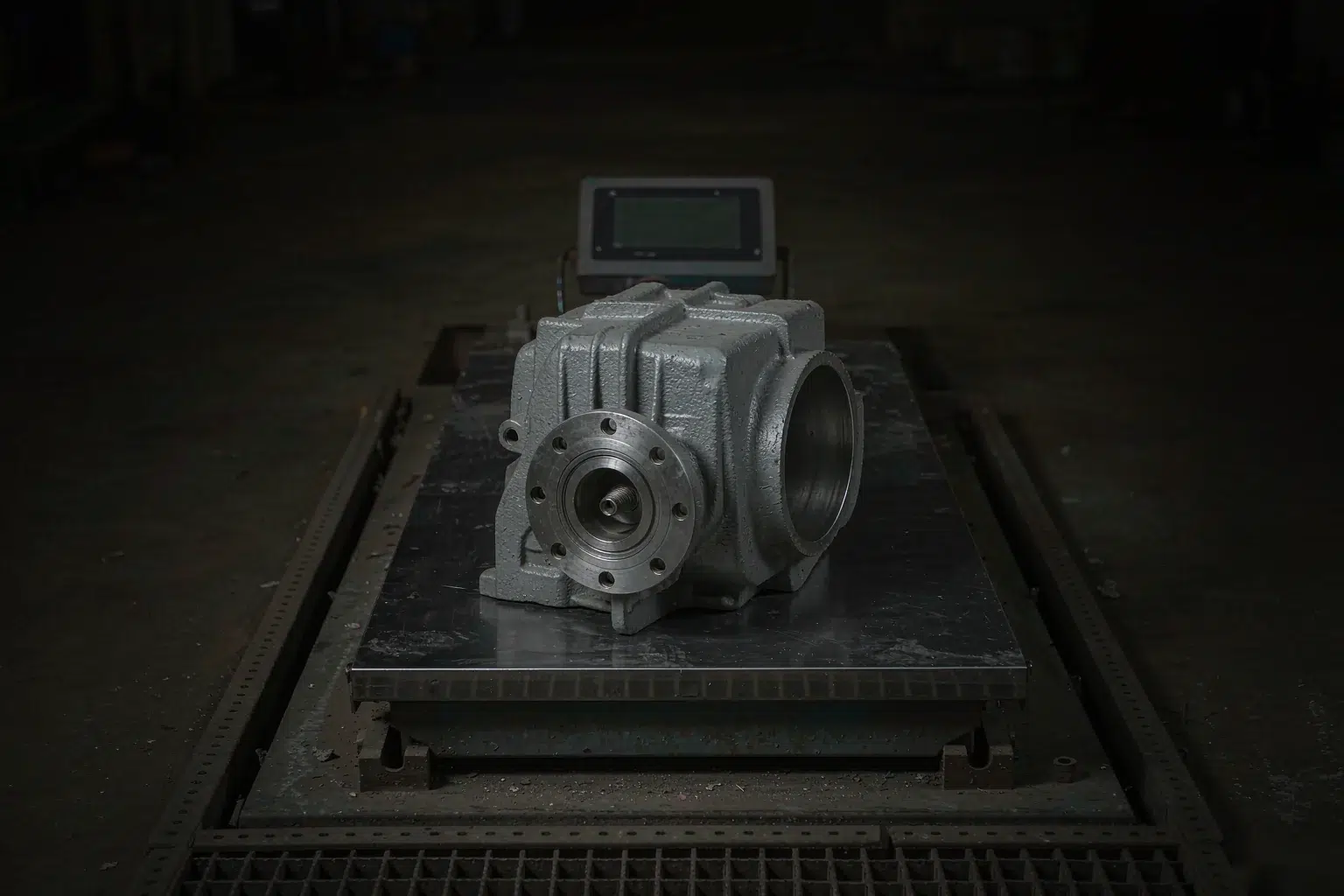
The conversion takes four inputs and about ten minutes per part number. Do it once, keep the spreadsheet, and never argue about rates again.
- Fix the weight basis. Net as-cast, net finished, or gross poured. Write the number the supplier used in the same row as the rate.
- Fix the scope. Machining in or out, heat treatment in or out, NDT, coating, packing, and the delivery term. A rate quoted CIF against a rate quoted EXW differs by freight and risk, not by casting skill — the Incoterms walk-through sets out what each term moves.
- Multiply to per piece. kg billed × rate. This single column eliminates 80% of the confusion in the table above.
- Add tooling at your real volume. Pattern and core box cost divided by total pieces over the program life, not by the first order — tooling cost per part shows how fast amortisation collapses at low volume.
- Add the lot-size premium. Rates assume a lot size. Below it, a per-kg surcharge appears, which is the same arithmetic that drives minimum order quantity.
- Add the quality allowance. If 4% of pieces need sorting or replacement, that cost belongs in the comparison — scrap rate explains why the tidy per-kg quote and the real cost per good piece diverge.
A Worked Normalisation
Take quote A for the 12 kg housing at 5,000 pieces a year, $18,400 of pattern and core box over a five-year program, export packing at $0.85 per piece and CIF freight at $1.10 per piece. The quoted equivalent is $15.13. The landed cost is 15.13 + 0.74 + 0.85 + 1.10 = $17.82 per piece, or $1.485 per kg of shipped metal — 17.8% above the rate on the quote. That gap is not padding by anyone. It is simply what the rate excludes, and it is identical in structure for every foundry you are comparing. Run the same three additions for each quote and the casting price per kg becomes a ranking you can defend in an internal review, rather than a number two colleagues interpret differently.
What Moves Casting Price per Kg After the Quote Is Signed
A per-kg rate feels permanent and is not. Four mechanisms move it during a normal annual program, and all four are visible in advance if you model them. Assume 5,000 pieces a year at 12 kg, which is 60 tonnes of shipped casting and roughly $75,600 of spend at $1.26 per kg.
| Mover | Effect on the rate | Annual effect |
|---|---|---|
| Iron index +10% | +4.4% at 44% metal share | +$3,350 |
| Pattern wear, +2.5% as-cast weight | +$0.38 per piece on a per-kg basis | +$1,891 |
| Lot size 5,000 → 1,500 pieces | +$0.42 per kg small-lot surcharge | +$5.04 per piece on the affected lots |
| Machining pulled into scope | +$6.40 per piece, rate unchanged | +$32,000 |
The index line is the one to write into the contract, because it is the only mover that is nobody’s fault. A workable clause states the reference, the base date, the frequency and a dead band: adjustment applied if the published index moves more than 5% from the base, recalculated quarterly, applied only to the metal share. Price adjustment clauses covers the mechanics and the three common formulas. The weight-creep line is the one to write into the drawing: a cast weight tolerance of ±3% is normal, and paying per kg means you absorb the top end of that band every single year.
Scope creep deserves its own sentence because it is the most expensive and the least discussed. Moving machining from your shop into the foundry does not change the per-kg rate at all. It adds $32,000 a year at this volume. The rate is the wrong place to look for that decision; the per-piece number is the right one, and the CNC machining service page shows what is actually included when a foundry machines in-house. If you only track the casting price per kg in your cost file, a change of this size will not appear anywhere in it.
Eight Fields That Make Casting Price per Kg Comparable
A per-kg number without these eight fields is a preference, not a price. Put them in the RFQ as a required table so every reply arrives in the same shape — the general casting RFQ structure covers the rest of the document.
| Field | Why it changes the answer | What to require |
|---|---|---|
| Weight basis | 61% swing between net and gross on a 62% yield part | Net as-cast kg per piece, stated to 0.01 kg |
| Yield assumption | Distinguishes a process claim from a pricing device | Gross poured kg and expected yield % |
| Machining scope | $6.40 per piece at this size, invisible in the rate | In or out, stock removal mm, datum scheme |
| Heat treatment and NDT | Normalising or PWHT can add 8–18% to the rate | Specify standard and acceptance class |
| Coating and packing | Primer and export packing are per piece, not per kg | System, DFT, packing spec, pallet count |
| Incoterm and port | EXW to CIF moves 5–9% on a 12 kg part | State the term, port and who pays what |
| Lot size the rate applies to | Below the assumed lot, a surcharge appears | Rate at your annual, quarterly and minimum lot |
| Metal index reference | Decides who carries the index risk and when | Index name, base date, dead band, review frequency |
Two notes on how foundries read this table. First, a supplier who can fill all eight fields quickly is not doing you a favour — they are showing that their quoting is built on a cost model rather than on a rate card, which usually means the rate survives contact with production. Second, the fields are also the agenda for a cost-reduction conversation. Metal share, yield, conversion and scope are the only four levers that exist, and each one maps to a field you now have in writing. A casting price per kg that cannot be decomposed into those four is a black box with a decimal point.
For the parts where weight is the dominant driver — housings, covers, counterweights, valve bodies — the per-kg view is a reasonable first filter, and iron casting solutions covers the alloy and section combinations that keep weight honest. For small, intricate parts where handling dominates, skip the per-kg filter entirely and quote per piece from the start. Wall thickness and minimum section usually explain a rate that looks out of line better than any market argument, and the same is true when the part is a thin-wall aluminum housing: servizi di pressofusione quotes deliberately on a per-shot basis for exactly this reason. Where the part is a one-off or a re-design, the prototype casting route prices tooling separately so that the comparison stays clean.
Finally, the delivery date and the price are the same conversation. A rate that requires a 12-week window is not comparable to one that promises six weeks, and tempi di consegna del casting breaks down where the weeks actually go. If your program needs both a stable rate and a committed window, the pattern and core box investment is where the leverage sits — mold making lead time sets the floor for everything downstream.
Domande frequenti
Is a lower casting price per kg always cheaper per piece?
No. On the 12 kg housing, a $1.05 rate on gross poured weight costs $20.32 per piece against $15.13 at $1.26 on net as-cast weight — 34% more, on a rate that looks 17% lower. Weight basis alone can move the answer by a third. Convert to per piece before comparing, then add tooling, packing and freight.
Does a better yield lower my casting price per kg?
Much less than most buyers expect, and only if the quote is on net weight. With internal remelting, moving yield from 55% to 72% changes metal cost per net kg from $0.571 to $0.544 — about 2.7 cents, because returns are remelted and only the melt loss is consumed. Yield still matters commercially because it consumes furnace hours, sand and mold capacity, which is why it belongs in the conversion line rather than in a hidden weight basis.
Why do per-kg rates fall so sharply as parts get heavier?
Because molding, pouring, shakeout, fettling and inspection cost roughly the same per piece regardless of weight. On a 0.5 kg bracket those steps are spread over half a kilogram; on a 200 kg block they are spread over two hundred. Typical ductile iron sand castings run $2.40–3.20 per kg at 0.5 kg and $0.90–1.15 per kg at 200 kg. Rates from different weight classes are never comparable.
Should machining be inside or outside the casting price per kg?
Neither is better in principle; the two must simply be compared on the same basis. At 12 kg the machining adds $6.40 per piece, which is 42% of the as-cast price and completely invisible in a per-kg rate. Keep machining out of the rate and quote it as a separate line, so you can see which shop is the cheaper machinist and move that step later without renegotiating the casting.
How much of a casting price per kg should be metal?
Between 40% and 70%, depending on alloy and process. Ductile iron sand castings typically sit near 44%, aluminum die castings near 58%, and stainless investment castings near 68% at current indices. The share tells you how much of the rate is a metal pass-through and how much is genuine conversion competition — and therefore what a 10% index move will do to your annual spend.
Can a casting price per kg be fixed for a multi-year program?
Only the conversion part can reasonably be fixed. Ask for a split quote: a conversion rate held for 12 months and a metal component indexed to a published reference with a dead band, applied quarterly to the metal share only. That structure protects both sides — the foundry is not forced to absorb an index spike, and you are not paying for one that never happened.
*Cost model built on ASTM A536 ductile iron charge and yield data, NADCA die casting practice notes and Supro MFG shop-floor records; rates are indicative ex-works ranges and move with published metal indices.
 English
 Français
 Deutsch
 Italiano
 日本語
 한국어
 Polski
 Português de Angola
 Русский
 Español de Argentina