
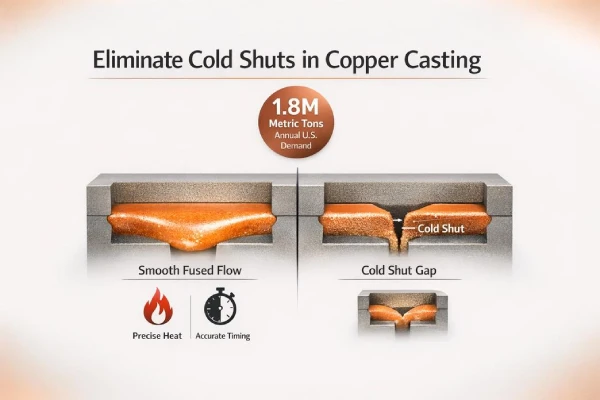
Nella produzione di colate di rame ad alto volume, le giunzioni fredde possono causare perdite significative. Un singolo errore di fusione può portare a rallentamenti della produzione e a un accumulo di scarti. Per gli acquirenti di componenti in rame fuso che richiedono tolleranze rigorose e tempi di consegna più stretti, ciò può aumentare notevolmente i costi di produzione. Tuttavia, il rame si raffredda rapidamente, il che ostacola il flusso e rende difficile la corretta fusione del metallo liquido. Senza un controllo preciso della temperatura e dei tempi, i profitti sfuggiranno dallo stampo.
Lo U.S. Geological Survey riferisce che la domanda di rame negli Stati Uniti supera gli 1,8 milioni di tonnellate metriche all'anno, una prova che questo metallo mantiene l'industria in piena attività. Come nota ASM International, “Solidificazione" il controllo è fondamentale per il casting integrità.”
Questo articolo fornisce un'analisi approfondita delle cause delle giunzioni fredde nella fusione del rame, coprendo le sfide tecniche associate alla fusione in sabbia, alla fusione in conchiglia, alla fusione centrifuga e fusione a cera persa. Vengono inoltre delineate strategie pratiche per il controllo della temperatura, le proprietà delle leghe e l'ottimizzazione delle simulazioni per aiutare le fonderie a mitigare il rischio di giunzioni fredde.
Cause comuni di colate fredde nella fusione del rame
Le chiusure fredde nella fusione del rame sono causate da sottili variazioni di calore, velocità di flusso o comportamento della lega durante l'effettivo processo di fusione. Che si tratti di fusione in sabbia o fusione centrifuga, ogni processo di fusione ha le sue vulnerabilità. La sezione seguente analizzerà le cause di difetti come le chiusure fredde nella fusione del rame e come evitare questi problemi attraverso una produzione di fusione intelligente.
Sfide della fusione in sabbia nelle colate di leghe di rame
In fusione in sabbia di rame, i difetti di giunzione fredda si verificano spesso durante la colata di leghe di rame ad alta conducibilità termica. Questo perché stampaggio in sabbia rapidamente sottrae calore dal metallo fuso, causando la solidificazione prematura del fronte di flusso e impedendo la corretta fusione nel punto in cui i flussi di metallo convergono.
Nella produzione effettiva, i principali fattori che portano alla chiusura fredda difetti nei getti di rame includere
- L'elevata conducibilità termica di ottone e bronzo accorcia l'intervallo di solidificazione, riducendo il tempo di fusione nel punto di convergenza.
- Se il canale di colata è progettato troppo stretto, la pressione del metallo diminuisce, rendendo le aree a parete sottile più soggette a solidificazione precoce.
- Il preriscaldamento insufficiente della staffa, l'eccessiva umidità nella sabbia e la scarsa aerazione aggravano ulteriormente i cali di temperatura improvvisi.
Una maggiore conducibilità termica significa una finestra temporale più stretta. Nel suo produzione di casting, Supro MFG ha ottimizzato il sistema di colata e la simulazione termica per i getti in lega di rame per garantire che il rischio di giunzioni fredde sia ridotto al minimo prima che il metallo entri nella cavità dello stampo.
Il seguente è un tipico confronto termico per i getti in rame:
Tipo di lega | Temperatura di versamento (°C) | Intervallo di solidificazione (°C) | Conducibilità (W/m·K) |
Ottone C360 | 930–970 | 890–905 | 120 |
Bronzo C932 | 1020–1050 | 950–990 | 60 |
Rame puro | 1085–1150 | ~1085 | 390 |
Al Bronze | 1040–1080 | 1020–1040 | 35 |
Bronzo stagnato | 1000–1030 | 900–950 | 50 |
In che modo la bassa duttilità nel rame al tellurio innesca le fessurazioni
Sebbene le leghe di tellurio-rame mostrino un'eccellente lavorabilità, la loro bassa duttilità durante la solidificazione può portare a difetti di giunzione fredda. La causa principale risiede nel fatto che quando questo la lega è usata nella fusione del rame processo, le proprietà del materiale nella regione ad alta temperatura e a corto raggio riducono la sua resistenza alla trazione e limitano la deformazione plastica. Quando due flussi di metallo convergono, la fusione è incompleta e la presenza di un film di ossido superficiale porta a una micro-separazione nel giunto. Infine, sotto l'azione dello sforzo di contrazione, il micro-gap continua ad allargarsi, determinando fessurazioni significative nel rame parti del cast.
In rame officine di fusione che danno priorità alla velocità rispetto al controllo, i componenti elettronici a parete sottile sono particolarmente vulnerabili ai danni dovuti al comportamento meccanico di questa lega. Geometrie complesse combinate con un rapido raffreddamento possono causare una resistenza insufficiente alla linea di fusione. Rame la fusione comporta la fusione del metallo fronte sotto sforzo di ritiro. Per produrre rame di qualità superiore parti del cast, it is necessary to control overheating, balance gate flow rates, and ensure the purity of the melt composition.
Gating system design flaws in permanent mold casting
In permanent mold casting, heat dissipates from metal molds even faster than from sand molds. When cold shuts occur in copper castings, they are typically caused by defects in the gating system design. Excessively long horizontal runners and sharp bends cause turbulence in the molten metal, leading to a sudden drop in temperature before the cavity is filled; uneven wall thickness results in varying cooling rates, and the absence of overflow channels causes gas bubbles to become trapped. If the flow velocity in the copper casting process is too low or the sprue deviates, the surface oxide film is prone to folding, while excessively high flow velocity exacerbates turbulence.
In copper casting, laminar flow is the golden rule, while turbulent flow can compromise fusion. Supro MFG uses simulation tools to optimize permanent mold pouring systems for casting projects, particularly in fields such as electrical connectors and heat transfer components where the clarity of the fusion line is critical.
Inconsistent mold temperature in centrifugal casting
Centrifugal casting incorporates a rotational step into the process; while this can increase the density of copper castings, it also rapidly exposes trattamento termico defects. When the mold temperature is unstable, subsurface cold shuts may form in the castings. This occurs because uneven preheating creates localized cold spots, causing the thin outer layer to solidify prematurely during rotation; subsequently, the molten metal coming into contact with the semi-solid layer fails to bond, resulting in interlayer separation.
Key control points for centrifugal copper casting include: maintaining preheating uniformity within ±15°C, ensuring stable rotational speed, maintaining a consistent metal feed rate, and controlling heat distribution. At Supro MFG, centrifugal copper casting projects utilize controlled preheating mapping technology to ensure uniform fusion throughout the wall thickness—a factor that is particularly critical for bushings and bearing sleeves, where structural integrity is paramount.
Cerchi una fonderia di metalli affidabile in Cina?
- Possiamo aiutarti a ottimizzare il design del prodotto e a ridurre i costi.
- We can help you with high quality high volume cast parti.
- Possiamo consegnare in tempo e ottenere maggiori opportunità di mercato per le vendite.
- Beneficerai di Supro MFG fusione dei metalli servizio.
5 Hidden Causes of Cold Shuts in Copper Casting
The risk of cold shuts in the copper casting process can be attributed to five underlying causes. Even minor deviations in control parameters can accumulate rapidly; once the flow of molten metal, mold temperature, and alloy composition deviate from equilibrium, cold shuts can form unnoticed, disrupting the solidification and shaping of the casting.
Improper wall thickness in gravity casting
In gravity casting, uneven wall thickness design can interfere with the solidification and flow of the rame casting. When the progettazione di stampi is unbalanced, thin-walled areas cool too quickly, while thick-walled areas retain heat for longer. During pouring, the molten metal front splits and forms an oxide layer, ultimately leading to reduced fusion strength. Once the copper casting has cooled, defects and hidden bonding gaps become clearly visible.
For copper castings with sharp transition surfaces, even the slightest variation in thickness can alter the thermal gradient. In copper fusioni in lega, this mismatch hinders proper fusion and directly leads to cold shuts.
Slow fill speeds during lost wax casting
In lost-wax casting, if the filling rate is too slow, the molten metal will lose heat before the mold cavity is filled. Major signs of failure in copper casting include poor spout design, excessively narrow runners, and excessive back pressure.
When the molten flow stagnates, the leading edges of the two streams meet in a cold area, and the resulting oxide layer prevents proper fusion. In the production of investment-style copper castings, adjusting the casting process speed allows for maintaining good fluidity while rapidly reducing cold shuts.
Low thermal conductivity in phosphor bronze pours
Phosphor bronze has relatively low thermal conductivity, which causes heat to diffuse slowly during the casting process and makes it prone to the formation of localized hot spots. Uneven temperature distribution during pouring can lead to uneven solidification during cooling. Therefore, co-casting copper alloys and bronze requires stricter thermal control. Otherwise, isolated cooling zones may form within the copper casting, preventing proper fusion at the leading edge of the molten pool.
Inadequate mold preheating and heat treatment gaps
Cold shuts can typically be traced to improper mold preheating during copper casting. If the initial mold temperature is too low, the surface metal will cool rapidly. Combined with an uneven post-casting heat treatment cycle, this will cause a rapid decline in the quality of the copper casting. To avoid this problem, the solutions are:
- Raise the mold temperature to a level consistent with the alloy’s melting point range.
- Ensure the temperature is stable before pouring the molten copper.
- Maintain consistent thermal management throughout the pouring process.
- Perform consistent heat treatment after pouring.
Overlooking ASTM specifications for material certification
ASTM standards are often overlooked in the copper casting process, specifically regarding unverified material certifications, lax quality control, and inconsistent material properties. Fluctuations in chemical composition can affect the copper’s fluidity, ductility, and corrosion resistance. This alters solidification behavior and increases the risk of cold shuts in copper castings.
Partnering with a meticulous copper casting foundry like Supro MFG helps ensure the use of certified alloys, controlled casting parameters, and more rigorous inspection processes. For teams that prioritize the reliability of metal castings, Supro MFG ensures the predictability of copper castings—which is key to preventing cold shuts.
Reverse the Chill: Copper Casting Pouring Temperature Secrets
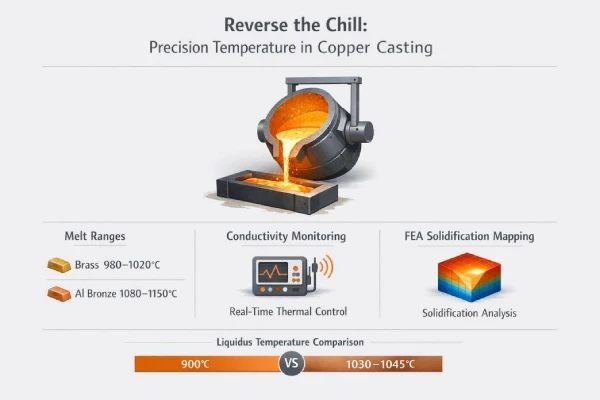
Precise temperature control is essential for successful copper casting. From brass to bronze, once the molten metal begins to flow, each copper alloy reacts differently. In modern foundries, precise temperature control translates to fewer defects and tighter tolerances.
Optimal melt ranges for brass and aluminum bronze
In copper casting, the optimal melting temperature range ensures smooth melt flow without causing the loss of alloying elements. For brass and bronze, strict temperature control helps maintain the alloy’s chemical composition and final strength. As a professional copper casting foundry in China, Supro MFG typically adjusts the following parameters based on the actual mold geometry to consistently ensure the stable performance of cast parti.
Different types of brass (Cu-Zn series) are affected by their composition in different ways. For 60/40 brass (which has a higher zinc content), the liquidus temperature is lower. Lead-containing brass, on the other hand, has a narrower melting temperature range and offers better machinability. When controlling the temperature range, pouring at too high a temperature can lead to zinc oxidation, while pouring at too low a temperature can cause gate defects in thin-walled copper castings.
For aluminum bronze (Cu-Al series), the aluminum content (8–12%) causes the liquidus line to shift upward and makes the alloy susceptible to oxidation, so the furnace atmosphere must be carefully controlled. The following table compares common copper alloys:
Tipo di lega | Liquidus (°C) | Recommended Pour Temp (°C) | Oxidation Risk Level |
60/40 Brass | 900 | 980–1020 | Medium |
Leaded Brass | 890 | 950–1000 | Medium-High |
9% Al Bronze | 1030 | 1080–1120 | High |
11% Al Bronze | 1045 | 1100–1150 | High |
Leveraging electrical conductivity data to dial in heat
During the copper casting process, changes in electrical conductivity reflect both composition and temperature. A change in conductivity indicates an anomaly within the molten metal: elevated conductivity may indicate high copper purity and low alloy content, while a sudden drop in conductivity may indicate overheating or contamination. Stable conductivity readings indicate that the pouring temperature is well controlled.
Many copper casting foundries follow these standard operating procedures:
1) Measure the baseline conductivity of the target alloy.
2) Monitor readings during the holding phase in the furnace.
3) Adjust the burner or induction input in small increments.
The 2025 International Copper Study Group noted that energy efficiency and thermal monitoring are “key cost drivers in non-ferrous foundry competitiveness.”
“Advanced process monitoring, including thermal and conductivity tracking, is accelerating yield improvement across global copper-based casting operations.” — International Copper Study Group, 2025 outlook
For foundries specializing in large-scale copper casting, electrical conductivity data plays a critical role. Supro MFG has successfully used this method to stabilize the production processes for both small- and large-batch copper parti del cast.
Using FEA analysis to predict solidification patterns
Modern FEA tools integrate science into everyday casting operations. In copper casting, predicting solidification patterns helps reduce shrinkage and porosity before the metal enters the mold. By inputting the thermal conductivity and latent heat of the copper alloy, along with mold boundary conditions, solidification patterns can be predicted to identify hot spots and areas of high shrinkage. When optimizing the copper casting process, modifying wall thicknesses and adjusting risers and gating channels can effectively reduce cold shuts and porosity.
For any copper casting production, digital simulation can shorten the trial-and-error phase. Supro MFG combines actual furnace data with FEA results to ensure that cast copper parts are dimensionally accurate and structurally sound.
Contact Supro-Mfg
Eliminating cold shuts in copper casting requires systematic control of alloy properties, mold temperature, and gating system design. From fusione in sabbia to centrifugal casting, optimizing parameters through electrical conductivity monitoring and FEA simulation can significantly improve casting density.
 English
 Čeština
 Français
 Deutsch
 Italiano
 日本語
日本語 한국어
한국어 فارسی
فارسی Polski
 Português de Angola
 Русский
 Slovenčina
 Español de Argentina
 Українська