
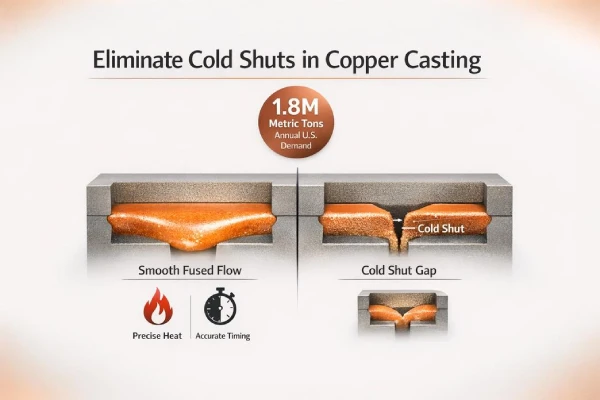
En la producción de fundición de cobre de alto volumen, las juntas frías pueden generar pérdidas significativas. Un solo error de fundición puede provocar retrasos en la producción y una acumulación de chatarra. Para los compradores de piezas fundidas de cobre que exigen tolerancias estrictas y plazos de entrega más ajustados, esto puede aumentar sustancialmente los costos de producción. Sin embargo, el cobre se enfría rápidamente, lo que dificulta el flujo y hace que sea difícil para el metal fundido fusionarse adecuadamente. Sin un control preciso de la temperatura y el tiempo, las ganancias se escaparán del molde.
El Servicio Geológico de EE. UU. informa que la demanda de cobre en Estados Unidos supera los 1,8 millones de toneladas métricas al año, una prueba de que este metal mantiene la industria en marcha. Como señala ASM International: “Solidificación el control es fundamental para el casting integridad.”
Este artículo proporciona un análisis detallado de las causas de las juntas frías en la fundición de cobre, cubriendo los desafíos técnicos asociados con la fundición en arena, la fundición en molde permanente, la fundición centrífuga y fundición a la cera perdida. También describe estrategias prácticas para el control de la temperatura, las propiedades de las aleaciones y la optimización de la simulación para ayudar a las fundiciones a mitigar el riesgo de juntas frías.
Causas comunes de juntas frías en la fundición de cobre
Las juntas frías en la fundición de cobre son causadas por cambios sutiles en el calor, la velocidad de flujo o el comportamiento de la aleación durante el proceso de fundición real. Ya sea fundición en arena o fundición centrífuga, cada proceso de fundición tiene sus vulnerabilidades. La siguiente sección analizará las causas de defectos como las juntas frías en la fundición de cobre y cómo evitar estos problemas mediante una producción de fundición inteligente.
Desafíos del moldeado en arena en vertidos de aleaciones de cobre
En fundición de arena de cobre, los defectos de junta fría suelen ocurrir al verter aleaciones de cobre de alta conductividad térmica. Esto se debe a que molde de arena rápidamente extrae calor del metal fundido, lo que hace que el frente de flujo se solidifique prematuramente e impide la fusión adecuada en el punto donde convergen los flujos de metal.
En la producción real, los principales factores que provocan juntas frías defectos en fundiciones de cobre incluir:
- La alta conductividad térmica del latón y del bronce acorta el intervalo de solidificación, lo que reduce el tiempo de fusión en el punto de convergencia.
- Si el canal de colada se diseña demasiado estrecho, la presión del metal disminuye, lo que hace que las áreas de paredes delgadas sean más propensas a la solidificación prematura.
- El precalentamiento insuficiente del molde, el exceso de humedad en la arena y una ventilación deficiente agravan aún más las caídas repentinas de temperatura.
Una mayor conductividad térmica significa un margen de tiempo más estrecho. En su producción de casting, Supro MFG ha optimizado el sistema de colada y la simulación térmica para las piezas fundidas de aleación de cobre para garantizar que se minimice el riesgo de juntas frías antes de que el metal entre en la cavidad del molde.
La siguiente es una comparación térmica típica para las piezas fundidas de cobre:
Tipo de aleación | Temp. ambiente (°C) | Rango de solidificación (°C) | Conductividad (W/m·K) |
Latón C360 | 930–970 | 890–905 | 120 |
C932 Bronce | 1020–1050 | 950–990 | 60 |
Cobre puro | 1085–1150 | ~1085 | 390 |
Al Bronze | 1040–1080 | 1020–1040 | 35 |
Bronce al estaño | 1000–1030 | 900–950 | 50 |
Cómo la baja ductilidad en el cobre al telurio provoca grietas
Aunque las aleaciones de telurio-cobre exhiben una excelente maquinabilidad, su baja ductilidad durante la solidificación puede provocar defectos de junta fría. La causa raíz radica en el hecho de que cuando este la aleación se utiliza en la fundición de cobre proceso, las propiedades del material dentro de la región de alta temperatura y corto alcance reducen su resistencia a la tracción y limitan la deformación plástica. Cuando dos flujos de metal convergen, la fusión es incompleta y la presencia de una película de óxido superficial provoca una microseparación en la unión. En última instancia, bajo la acción del esfuerzo de contracción, la microbrecha continúa ensanchándose, lo que resulta en grietas significativas en el cobre piezas de fundición.
En cobre talleres de fundición que priorizan la velocidad sobre el control, los componentes electrónicos de paredes delgadas son particularmente susceptibles a daños debido al comportamiento mecánico de esta aleación. Las geometrías complejas combinadas con un enfriamiento rápido pueden resultar en una resistencia insuficiente en la línea de fusión. Cobre la fundición implica la fusión del metal tensión de contracción frontal. Para producir cobre de mayor calidad piezas de fundición, es necesario controlar el sobrecalentamiento, equilibrar los caudales de las compuertas y garantizar la pureza de la composición del baño fundido.
Defectos de diseño del sistema de alimentación en la fundición en molde permanente
De manera permanente fundición en molde, heat dissipates from metal molds even faster than from sand molds. When cold shuts occur in copper castings, they are typically caused by defects in the sistema de control de acceso design. Excessively long horizontal runners and sharp bends cause turbulence in the molten metal, leading to a sudden drop in temperature before the cavity is filled; uneven espesor de la pared results in varying cooling rates, and the absence of overflow channels causes gas bubbles to become trapped. If the flow velocity in the copper casting process is too low or the sprue deviates, the surface oxide film is prone to folding, while excessively high flow velocity exacerbates turbulence.
En la fundición de cobre, el flujo laminar es la regla de oro, mientras que el flujo turbulento puede comprometer la fusión. Supro MFG utiliza herramientas de simulación para optimizar el molde permanente sistemas de vaciado de moldes para proyectos de fundición, particularly in fields such as electrical connectors and heat transfer components where the clarity of the fusion line is critical.
Inconsistent mold temperature in centrifugal casting
Centrifugal casting incorporates a rotational step into the process; while this can increase the density of copper castings, it also rapidly exposes tratamiento térmico defects. When the mold temperature is unstable, subsurface cold shuts may form in the castings. This occurs because uneven preheating creates localized cold spots, causing the thin outer layer to solidify prematurely during rotation; subsequently, the molten metal coming into contact with the semi-solid layer fails to bond, resulting in interlayer separation.
Key control points for centrifugal copper casting include: maintaining preheating uniformity within ±15°C, ensuring stable rotational speed, maintaining a consistent metal feed rate, and controlling heat distribution. At Supro MFG, centrifugal copper casting projects utilize controlled preheating mapping technology to ensure uniform fusion throughout the wall thickness—a factor that is particularly critical for bushings and bearing sleeves, where structural integrity is paramount.
¿Busca una fundición de metales confiable en China?
- Podemos ayudarte a optimizar el diseño de tus productos y a reducir costos.
- Podemos ayudarte con un alto fundición de alta calidad y gran volumen piezas.
- Podemos entregar a tiempo y conseguir más oportunidades en el mercado de ventas.
- Usted se beneficiará de Supro MFG fundición de metales servicio.
5 Hidden Causes of Cold Shuts in Copper Casting
The risk of cold shuts in the copper casting process can be attributed to five underlying causes. Even minor deviations in control parameters can accumulate rapidly; once the flow of molten metal, mold temperature, and alloy composition deviate from equilibrium, cold shuts can form unnoticed, disrupting the solidification and shaping of the casting.
Improper wall thickness in gravity casting
In gravity casting, uneven wall thickness design can interfere with the solidification and flow of the copper casting. When the diseño de moldes is unbalanced, thin-walled areas cool too quickly, while thick-walled areas retain heat for longer. During pouring, the molten metal front splits and forms an oxide layer, ultimately leading to reduced fusion strength. Once the copper casting has cooled, defects and hidden bonding gaps become clearly visible.
For copper castings with sharp transition surfaces, even the slightest variation in thickness can alter the thermal gradient. In copper piezas fundidas de aleación, this mismatch hinders proper fusion and directly leads to cold shuts.
Slow fill speeds during lost wax casting
In lost-wax casting, if the filling rate is too slow, the molten metal will lose heat before the mold cavity is filled. Major signs of failure in copper casting include poor spout design, excessively narrow runners, and excessive back pressure.
When the molten flow stagnates, the leading edges of the two streams meet in a cold area, and the resulting oxide layer prevents proper fusion. In the production of investment-style copper castings, adjusting the casting process speed allows for maintaining good fluidity while rapidly reducing cold shuts.
Low thermal conductivity in phosphor bronze pours
Phosphor bronze has relatively low thermal conductivity, which causes heat to diffuse slowly during the casting process and makes it prone to the formation of localized hot spots. Uneven temperature distribution during pouring can lead to uneven solidification during cooling. Therefore, co-casting copper alloys and bronze requires stricter thermal control. Otherwise, isolated cooling zones may form within the copper casting, preventing proper fusion at the leading edge of the molten pool.
Inadequate mold preheating and heat treatment gaps
Cold shuts can typically be traced to improper mold preheating during copper casting. If the initial mold temperature is too low, the surface metal will cool rapidly. Combined with an uneven post-casting heat treatment cycle, this will cause a rapid decline in the quality of the copper casting. To avoid this problem, the solutions are:
- Raise the mold temperature to a level consistent with the alloy’s melting point range.
- Ensure the temperature is stable before pouring the molten copper.
- Maintain consistent thermal management throughout the pouring process.
- Perform consistent heat treatment after pouring.
Overlooking ASTM specifications for material certification
ASTM standards are often overlooked in the copper casting process, specifically regarding unverified material certifications, lax quality control, and inconsistent material properties. Fluctuations in chemical composition can affect the copper’s fluidity, ductility, and resistencia a la corrosión. This alters solidification behavior and increases the risk of cold shuts in copper castings.
Partnering with a meticulous copper casting foundry like Supro MFG helps ensure the use of certified alloys, controlled casting parameters, and more rigorous inspection processes. For teams that prioritize the reliability of metal castings, Supro MFG ensures the predictability of copper castings—which is key to preventing cold shuts.
Reverse the Chill: Copper Casting Pouring Temperature Secrets
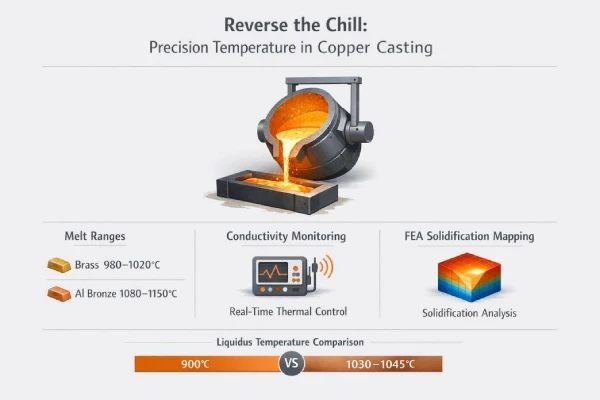
Precise temperature control is essential for successful copper casting. From brass to bronze, once the molten metal begins to flow, each copper alloy reacts differently. In modern foundries, precise temperature control translates to fewer defects and tighter tolerances.
Optimal melt ranges for brass and aluminum bronze
In copper casting, the optimal melting temperature range ensures smooth melt flow without causing the loss of elementos de aleación. For brass and bronze, strict temperature control helps maintain the alloy’s chemical composition and final strength. As a professional copper casting foundry in China, Supro MFG typically adjusts the following parameters based on the actual mold geometry to consistently ensure the stable performance of cast piezas.
Different types of brass (Cu-Zn series) are affected by their composition in different ways. For 60/40 brass (which has a higher zinc content), the liquidus temperature is lower. Lead-containing brass, on the other hand, has a narrower melting temperature range and offers better machinability. When controlling the temperature range, pouring at too high a temperature can lead to zinc oxidation, while pouring at too low a temperature can cause gate defects in thin-walled copper castings.
For aluminum bronze (Cu-Al series), the aluminum content (8–12%) causes the liquidus line to shift upward and makes the alloy susceptible to oxidation, so the furnace atmosphere must be carefully controlled. The following table compares common copper alloys:
Tipo de aleación | Liquidus (°C) | Recommended Pour Temp (°C) | Oxidation Risk Level |
60/40 Brass | 900 | 980–1020 | Medio |
Leaded Brass | 890 | 950–1000 | Medium-High |
9% Al Bronze | 1030 | 1080–1120 | Alto |
11% Al Bronze | 1045 | 1100–1150 | Alto |
Leveraging electrical conductivity data to dial in heat
During the copper casting process, changes in electrical conductivity reflect both composition and temperature. A change in conductivity indicates an anomaly within the molten metal: elevated conductivity may indicate high copper purity and low alloy content, while a sudden drop in conductivity may indicate overheating or contamination. Stable conductivity readings indicate that the pouring temperature is well controlled.
Many copper casting foundries follow these standard operating procedures:
1) Measure the baseline conductivity of the target alloy.
2) Monitor readings during the holding phase in the furnace.
3) Adjust the burner or induction input in small increments.
The 2025 International Copper Study Group noted that energy efficiency and thermal monitoring are “key cost drivers in non-ferrous foundry competitiveness.”
“Advanced process monitoring, including thermal and conductivity tracking, is accelerating yield improvement across global copper-based casting operations.” — International Copper Study Group, 2025 outlook
For foundries specializing in large-scale copper casting, electrical conductivity data plays a critical role. Supro MFG has successfully used this method to stabilize the production processes for both small- and large-batch copper piezas de fundición.
Using FEA analysis to predict solidification patterns
Modern FEA tools integrate science into everyday casting operations. In copper casting, predicting solidification patterns helps reduce shrinkage and porosity before the metal enters the mold. By inputting the thermal conductivity and latent heat of the copper alloy, along with mold boundary conditions, solidification patterns can be predicted to identify hot spots and areas of high shrinkage. When optimizing the copper casting process, modifying wall thicknesses and adjusting risers and gating channels can effectively reduce cold shuts and porosity.
For any copper casting production, digital simulation can shorten the trial-and-error phase. Supro MFG combines actual furnace data with FEA results to ensure that cast copper parts are dimensionally accurate and structurally sound.
Comuníquese con Supro-Mfg
Eliminating cold shuts in copper casting requires systematic control of alloy properties, mold temperature, and gating system design. From fundición en arena to centrifugal casting, optimizing parameters through electrical conductivity monitoring and FEA simulation can significantly improve casting density.
 English
 Français
 Deutsch
 Italiano
 日本語
日本語 한국어
한국어 Polski
 Português de Angola
 Русский
 Español de Argentina