

Resin sand casting is often the practical middle ground when a part is too large, too low-volume, or too dimensionally demanding for green sand, yet does not justify permanent tooling. The binder makes a rigid mold without mechanical compaction, but that same chemistry creates new controls for gas, reclaim quality, working time, and shakeout.
This guide explains the no-bake sequence, binder choices, realistic tolerance and surface-finish ranges, defect controls, and a cost model for industrial buyers. Treat the numbers as RFQ starting points, not universal guarantees: alloy, section thickness, flask size, core loading, and foundry process capability still govern the final drawing limits. For general process context, start with our Guide sur la fonderie des métaux. Dimensional agreements should reference the current ISO 8062-3:2023 framework, while defect terminology and corrective actions can be aligned with resources from the Société américaine de la fonderie.
What Is Resin Sand Casting?
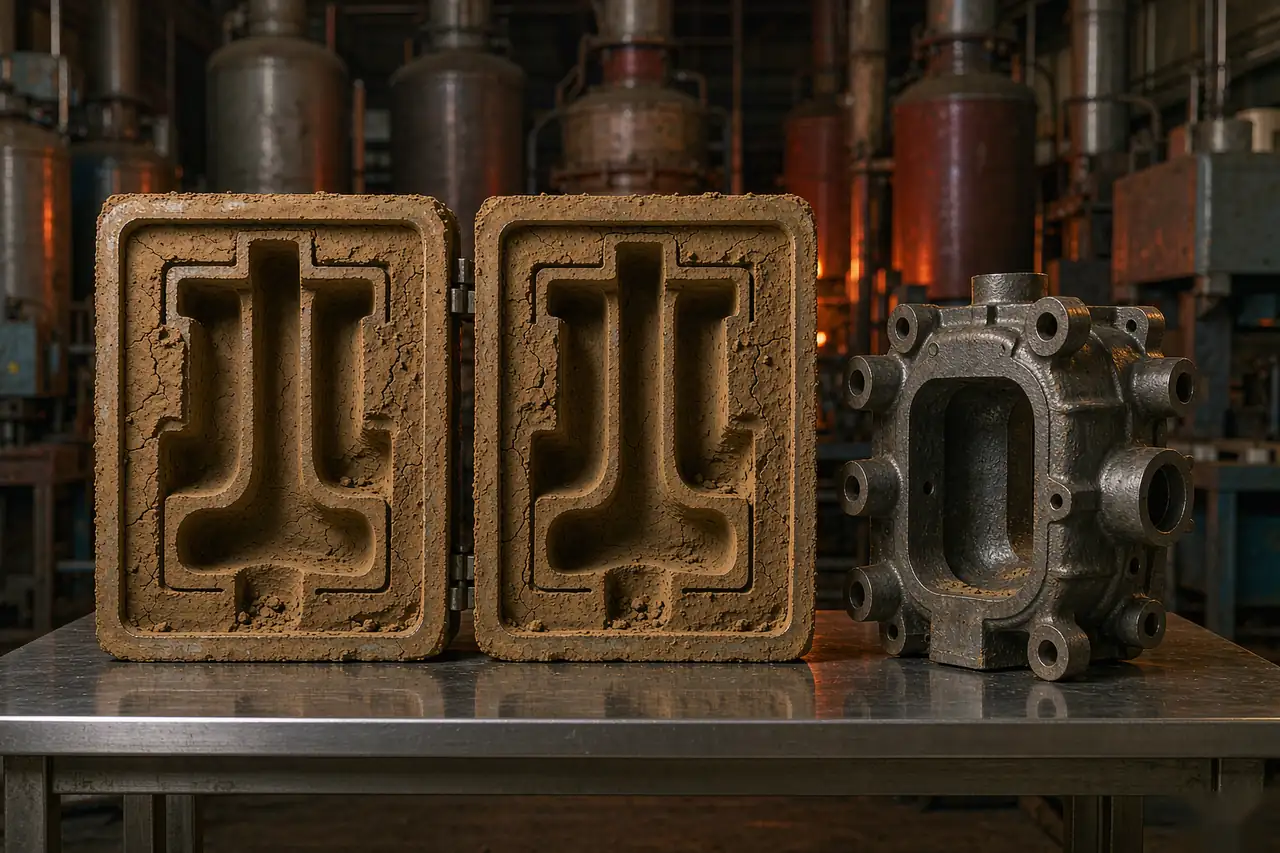
Resin sand casting is an expendable-mold process in which clean silica, chromite, zircon, or specialty sand is mixed with a liquid binder and catalyst. The mixture is packed around a pattern and cures at room temperature. Foundries commonly call it no-bake casting, chemically bonded sand, or air-set molding. Unlike green sand, the mold does not depend on clay, moisture, and squeeze pressure for strength.
The process is useful for medium and large housings, pump bodies, valve bodies, machine bases, agricultural castings, and short-to-medium production runs. It supports complex cores and large flasks while holding a more stable mold cavity than hand-rammed green sand. Buyers considering large iron or steel parts can compare the capability with Supro MFG’s sand casting service, iron casting capability, and steel casting capability.
- Main advantage. A rigid, self-setting mold can reproduce large geometry without a high-pressure molding line.
- Main constraint. Binder percentage, sand temperature, catalyst ratio, and reclamation quality directly affect working time, gas evolution, and final surface quality.
- Best commercial fit. Large or complex castings, moderate annual demand, frequent engineering changes, and applications where machining stock must be controlled.
How the No-Bake Process Works
The resin sand casting cycle looks simple, but its timing window is unforgiving. Mixed sand begins curing as soon as catalyst and binder contact each other. If molding takes longer than the working time, the mold may appear hard while its internal bonds are weak. If stripping happens too early, edges tear and dimensions move.
1. Prepare the pattern and flask
The pattern includes draft, shrinkage allowance, machining stock, core prints, and gating features. A split pattern may be mounted on a board, while large one-off patterns can be loose pieces. Review draft and core support before tooling release; our guide to casting mold and pattern design explains the geometry rules that influence stripping and dimensional stability.
2. Meter sand, resin, and catalyst
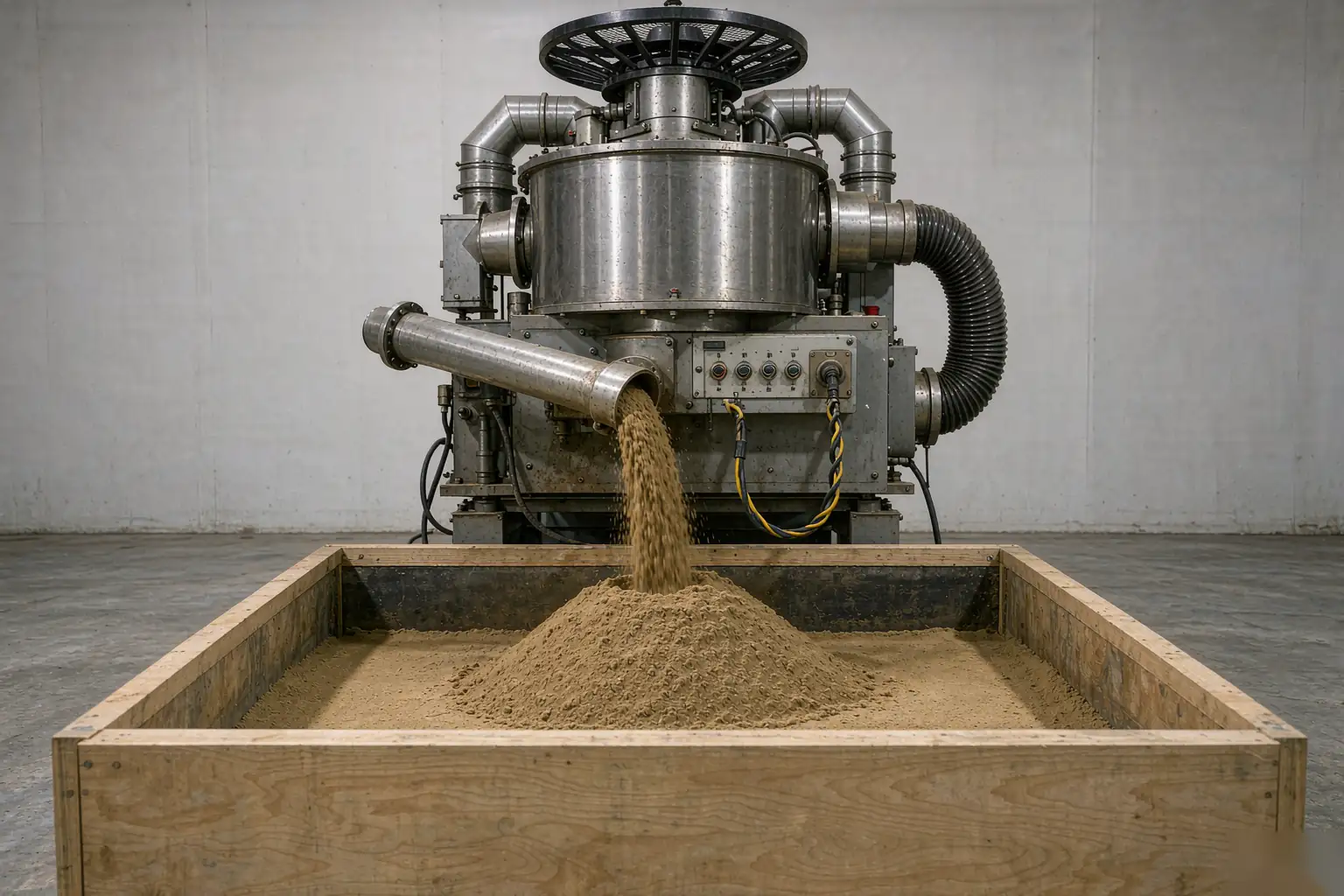
A continuous mixer meters sand and binder into the flask. The foundry records sand temperature, binder percentage, catalyst percentage, mixer output, and ambient conditions. Typical total binder additions sit near 0.8% to 1.5% of sand mass, but the supplier’s data sheet and the foundry’s strength tests control the actual recipe. More binder is not automatically safer: excess organic material raises gas generation, odor, collapsibility problems, and reclamation load.
3. Fill, compact, and strike off
The mixed sand is distributed around the pattern and compacted by vibration, hand tools, or controlled placement. Uniform density matters more than maximum density. Soft pockets near deep ribs can erode during pouring; overworked corners can become locally dense and vent poorly.
\n\n
4. Cure, strip, coat, and dry
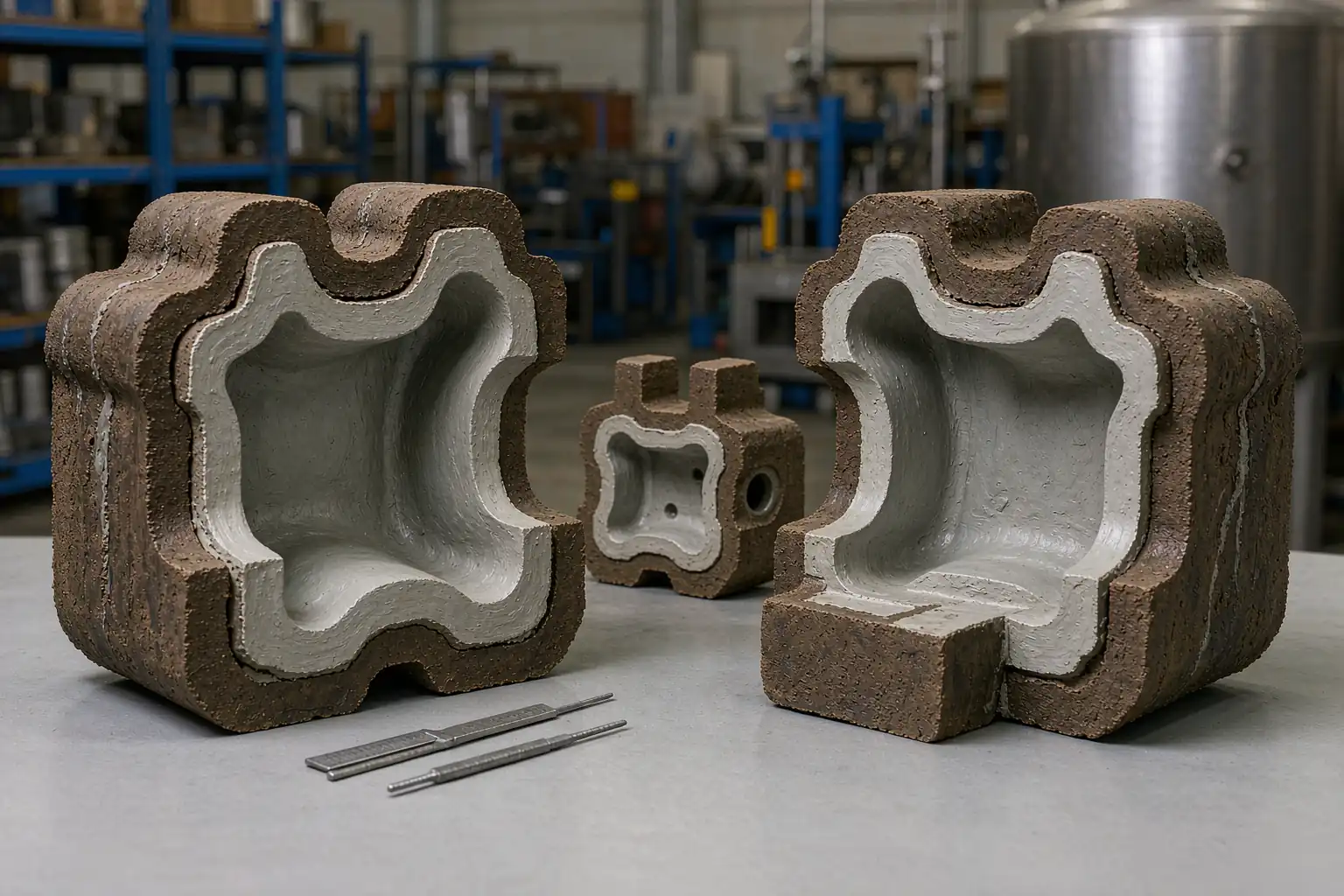
The mold cures until it has enough strip strength to retain edges and core prints. Refractory coating may then be brushed, sprayed, or flow-coated onto the cavity. Coating viscosity, penetration, and drying are controlled because trapped carrier or an uneven layer can create blows, scabs, runs, or burn-on. Thick steel sections often need higher-refractoriness facing than gray iron.
5. Set cores, close, pour, and shake out
Cores are positioned, prints are checked, and the mold is closed with controlled alignment. The gating and feeding system must fill the cavity without excessive turbulence and must feed the final hot spots. For shrinkage control, connect the design review to casting riser design. After solidification, the mold breaks down and sand is separated for mechanical or thermal reclamation.
Binder Systems: Furan, PUNB, and Phenolic-Ester
Not every resin system behaves the same. The foundry selects chemistry around alloy temperature, required bench life, strip time, reclaim equipment, emissions controls, and the risk of sulfur or nitrogen pickup. The ranges below are practical screening values; the approved formulation must come from supplier data and foundry trials.
| Binder system | Typical strengths | Watch points | Common fit |
|---|---|---|---|
| Furan acid-cured | Good flowability, strong cured mold, widely reclaimable | Acid control, sulfur exposure, odor, hot strength | Large iron and many steel castings |
| Phenolic urethane no-bake (PUNB) | Fast cure, good dimensional accuracy, broad alloy use | Part I/II ratio, nitrogen-related gas risk, humidity sensitivity | Iron, steel, and nonferrous jobbing work |
| Alkaline phenolic ester-cured | Low sulfur and nitrogen contribution, useful hot behavior | Reclamation method, bench life, coating compatibility | Steel and ductile iron where surface chemistry matters |
For ductile iron, binder sulfur and reclaimed-sand history deserve explicit review because sulfur at the mold-metal interface can reduce nodularity near the surface. For steel, the team usually pays more attention to hot strength, collapsibility, coating refractoriness, and crack resistance. Alloy choice must therefore be coordinated with mold chemistry, not handled as a separate purchasing decision. See our casting alloy selection guide et gray iron vs ductile iron comparison.
Resin Sand Casting Process Window
A stable resin sand casting line uses a control chart rather than a fixed recipe copied across seasons. Sand at 12°C and sand at 32°C will not provide the same working time. Reclaimed sand with high residual binder or fines will not respond like new sand. The control plan should connect test results to an allowed adjustment range.
| Control | Typical starting window | Why it matters |
|---|---|---|
| Total binder addition | About 0.8%–1.5% of sand mass | Balances strength against gas, cost, and reclaim load |
| Working time | Commonly 2–10 minutes | Must exceed mix, transport, filling, and compaction time |
| Strip time | Commonly 5–30 minutes | Too early causes edge damage; too late blocks flask flow |
| One-hour tensile strength | Often targeted near 1.0–2.0 MPa | Confirms handling strength; exact target depends on mold size |
| Reclaim addition | Often 70%–95% after qualification | Controls new-sand cost, LOI, fines, and residual chemistry |
| Coating dryness | Verified by method, not appearance alone | Residual carrier can become gas during pouring |
Mass calculation: a mold using 4,050 kg of sand at 1.0% total binder consumes 40.5 kg of binder. Reducing the addition from 1.2% to 0.9% cuts binder by 12.15 kg per mold. That saving is valid only after tensile strength, erosion resistance, coating response, and casting defects remain within limits. Cutting binder without a test plan simply moves cost into scrap and rework.
The most useful records are sand temperature at the mixer, actual resin and catalyst flow, work-time test, strip-time observation, one-hour and 24-hour strength, reclaimed-sand loss on ignition, and casting defect trend. If a supplier only reports the nominal recipe, the process is not yet controlled.
Tolerances, Surface Finish, and Machining Stock
Resin sand casting normally holds shape better than hand-rammed green sand because the cured mold is rigid and moisture-free. It still does not match shell molding, investment casting, or a machined billet. For a new RFQ, a sensible discussion may begin around ISO 8062 DCTG 8–11, then tighten only dimensions backed by process capability. Large dimensions, split-line mismatch, long cores, and heavy sections need separate tolerances.
| Characteristic | Practical RFQ range | Buyer action |
|---|---|---|
| General casting tolerance | Start near DCTG 8–11; confirm by size and alloy | State the ISO grade in the title block |
| As-cast surface roughness | About Ra 6.3–25 μm with qualified coating and sand | Define a comparator area; do not specify one Ra for every face |
| Machining allowance | Often 2–8 mm per machined face | Increase for large steel castings, distortion, and datum transfer |
| Draft | Often 0.5°–2° on external walls; more on deep internal pockets | Confirm pattern draw direction before CAD release |
Do not convert these broad ranges into blanket drawing tolerances. The correct method is to identify functional datums, sealing faces, bores, and interface dimensions; cast the rest economically; then use a machining plan tied to those datums. Our casting tolerances guide explains grade selection, while Supro MFG’s Service d'usinage CNC covers the post-cast datum strategy.
Defects and Process Controls
A rigid mold can improve dimensions yet amplify other risks. Resin sand casting defects are usually traced through four interacting systems: mold chemistry, sand condition, coating and venting, and metal delivery. A defect name alone is not a root cause.
| Symptom | Likely contributors | Evidence to collect |
|---|---|---|
| Gas holes or pinholes | High binder, wet coating, poor venting, high reclaim LOI, metal gas | Binder log, coating dryness, LOI trend, defect section and location |
| Veining or penetration | Silica expansion, low refractoriness, coating gap, high local temperature | Sand mineral, grain distribution, coating thickness, hot-spot map |
| Erosion or sand inclusion | Low early strength, long fill path, direct metal impingement, loose cavity sand | One-hour strength, gate velocity, cavity inspection, inclusion microscopy |
| Hot tear or crack | Rigid mold, poor collapsibility, restrained geometry, alloy sensitivity | Crack timing and morphology, junction geometry, shakeout time |
| Mismatch or core shift | Worn locators, weak prints, closure error, buoyancy load | CMM pattern, locator checks, core setting record, wall map |
For diagnosis, map defect position to gates, risers, cores, and upper or lower mold surfaces. Then separate gas cavities from shrinkage by shape, location, and metallographic evidence. The workflow in common casting defects and prevention helps organize corrective action. Confirm the result with the appropriate casting inspection methods rather than relying on visual appearance alone.
Sand Reclamation: The Hidden Cost Driver
Sand and disposal cost can decide whether resin sand casting remains competitive. Mechanical reclamation removes lumps and part of the binder film by attrition. Thermal reclamation burns off residual organic binder and can restore more consistent sand, but it adds capital, energy, and process-control requirements.
Reclaim example: assume a 900 kg casting uses a sand-to-metal ratio of 4.5:1. The mold therefore contains 4,050 kg of sand. At 85% qualified reclaim, new sand demand is 607.5 kg. At an illustrative delivered sand price of $0.12/kg, new-sand input falls from $486 to $72.90, a gross difference of $413.10 per mold. That is not net savings: reclamation energy, dust collection, screening losses, binder monitoring, and disposal remain.
A buyer does not need to audit every machine, but the RFQ should ask whether reclaimed sand is separated by alloy or binder family, how fines and loss on ignition are trended, and what triggers fresh-sand correction. These answers often predict consistency better than a brochure statement about recycling percentage.
Cost and Break-Even Example
The quoted casting price is only one part of the comparison. Include pattern equipment, cores, mold labor, metal yield, shakeout and cleaning, machining stock, scrap, inspection, and engineering changes. Our répartition des coûts de moulage provides the full cost structure.
Consider an illustrative 420 kg ductile-iron machine housing with 80 units of annual demand. A hand-molded green-sand route needs $5,200 of tooling and costs $2,120 per accepted casting after cleaning, machining stock, and expected scrap. A resin no-bake route needs $7,800 of tooling but costs $1,950 per accepted casting because the more rigid mold reduces cleanup and machining stock.
- Extra tooling: $7,800 − $5,200 = $2,600.
- Unit saving: $2,120 − $1,950 = $170.
- Break-even quantity: $2,600 ÷ $170 = 15.3, so the 16th accepted casting recovers the extra tooling.
- First-year difference at 80 units: green sand totals $174,800; resin no-bake totals $163,800, an illustrative $11,000 advantage.
This example is not a market price. Change casting weight, annual demand, labor rate, yield, or rejection assumption and the answer changes. The useful lesson is to compare accepted, machined parts, not raw casting price. For prototype and bridge production, a combined metal prototype casting plan can also reduce the cost of late design changes.
Resin Sand vs Green Sand vs Shell Mold
| Decision factor | Resin no-bake | Green sand | Shell mold |
|---|---|---|---|
| Typical part fit | Medium to very large, complex cores | Small to large, especially repeat volumes | Small to medium, repeatable geometry |
| Tooling intensity | Low to medium | Low for manual; high for automated lines | Medium to high heated tooling |
| Dimensional repeatability | Good when cure and alignment are controlled | Moderate; line capability varies widely | Good to very good |
| Main process risk | Binder gas, cure window, reclaim chemistry | Moisture, compaction, mold handling | Hot tooling, shell thickness, tooling cost |
| Best buying question | How are work time, strength, and LOI trended? | How are moisture and compactability controlled? | What annual volume repays the heated tool? |
For broad process selection, compare sand casting vs investment casting. If surface appearance drives the decision, include downstream blasting, grinding, coating, or polishing from the beginning; the casting surface finishing guide explains those operations.
What to Put in a Resin Sand Casting RFQ
A useful RFQ lets the foundry design the mold around real acceptance criteria rather than guess at every dimension. Send the following:
- 3D model and controlled drawing. Identify datums, machined faces, critical wall thicknesses, and dimensions that require individual tolerances.
- Material standard and grade. State heat treatment, mechanical-property test location, hardness range, and any weld-repair restriction. Review our casting heat treatment guide where properties depend on the final condition.
- Order profile. Include prototype quantity, annual demand, lot size, expected program life, and likely design revisions.
- Inspection plan. Define visual standard, dimensional sampling, NDT method and zone, pressure test, and traceability.
- Delivery state. Clarify as-cast, heat-treated, shot-blasted, primed, rough-machined, or finish-machined.
Application context also matters. A valve casting may prioritize pressure integrity and flange datums, while agricultural castings may prioritize impact load, abrasion, and serviceability. The same resin sand casting process can require different gating, testing, and machining plans.
When Resin Sand Casting Is the Right Choice
Choose resin sand casting when the part is large or core-intensive, annual volume does not support hard tooling, and the project benefits from a more rigid mold than manual green sand. It is especially persuasive when lower machining stock, better cavity stability, or easier engineering changes offset the extra binder and reclamation cost.
Do not choose it by process name alone. Green sand may win on high-volume parts already matched to an automated line. Shell molding may win on smaller repeat parts that need a finer finish. Investment casting may win on complex small parts where machining elimination justifies higher process cost. A foundry should compare accepted-part cost, capacity, quality evidence, and delivery risk before locking the route.
FAQ
Is resin sand casting the same as no-bake casting?
Usually, yes. No-bake describes chemically bonded sand that cures at room temperature without baking. Resin sand casting is the broader practical term; specific systems include furan, phenolic urethane no-bake, and alkaline phenolic.
What metals can be poured in resin-bonded molds?
Gray iron, ductile iron, carbon and alloy steel, stainless steel, aluminum, copper alloys, and other metals can use resin-bonded molds. Binder chemistry, facing sand, coating, venting, and reclaim segregation must match the alloy and pouring temperature.
What surface finish can resin sand casting achieve?
A practical RFQ range is roughly Ra 6.3–25 μm with qualified sand and coating, but geometry and alloy matter. Specify a reference area and comparator method instead of demanding one roughness value on every surface.
Why not add more resin for a stronger mold?
Excess binder can increase gas, odor, cost, shakeout difficulty, and reclaim load. The correct addition is the lowest stable level that still meets working-time, strip-strength, erosion, handling, and casting-quality requirements.
What is the first document a buyer should request?
Request a process-specific control plan that links mold variables to inspection evidence: binder and catalyst records, sand tests, coating control, first-article dimensions, NDT zones, and the reaction plan for an out-of-control result.
*Typical ranges are engineering starting points and must be confirmed for the specific alloy, geometry, binder supplier, and foundry process. Standards references include ISO 8062-3:2023 and AFS technical resources.
 English
 Français
 Deutsch
 Italiano
 日本語
日本語 한국어
한국어 Polski
 Português de Angola
 Русский
 Español de Argentina