

Most buying teams meet bronze casting the same way: a stainless shaft keeps galling, a cast iron bushing keeps scoring, or a valve body keeps pitting in seawater. Bronze solves all three — and it is also the most expensive per kilogram of any common casting alloy, so every kilogram you specify has to earn its place.
This guide is written for engineers and purchasers who already know they need copper-base bronze casting and now have to pick a grade, a process and a supplier. It uses real shop-floor numbers: pouring temperatures, shrinkage allowances, PV duty limits, a full cost model with a break-even volume, and the lead-content rule that quietly disqualifies the most popular bearing bronze in Europe. Wherever we quote a standard, it is traceable to ASTM or to published data from the Copper Development Association et le Société américaine de la fonderie. For the wider process picture, start with our Guide sur la fonderie des métaux.
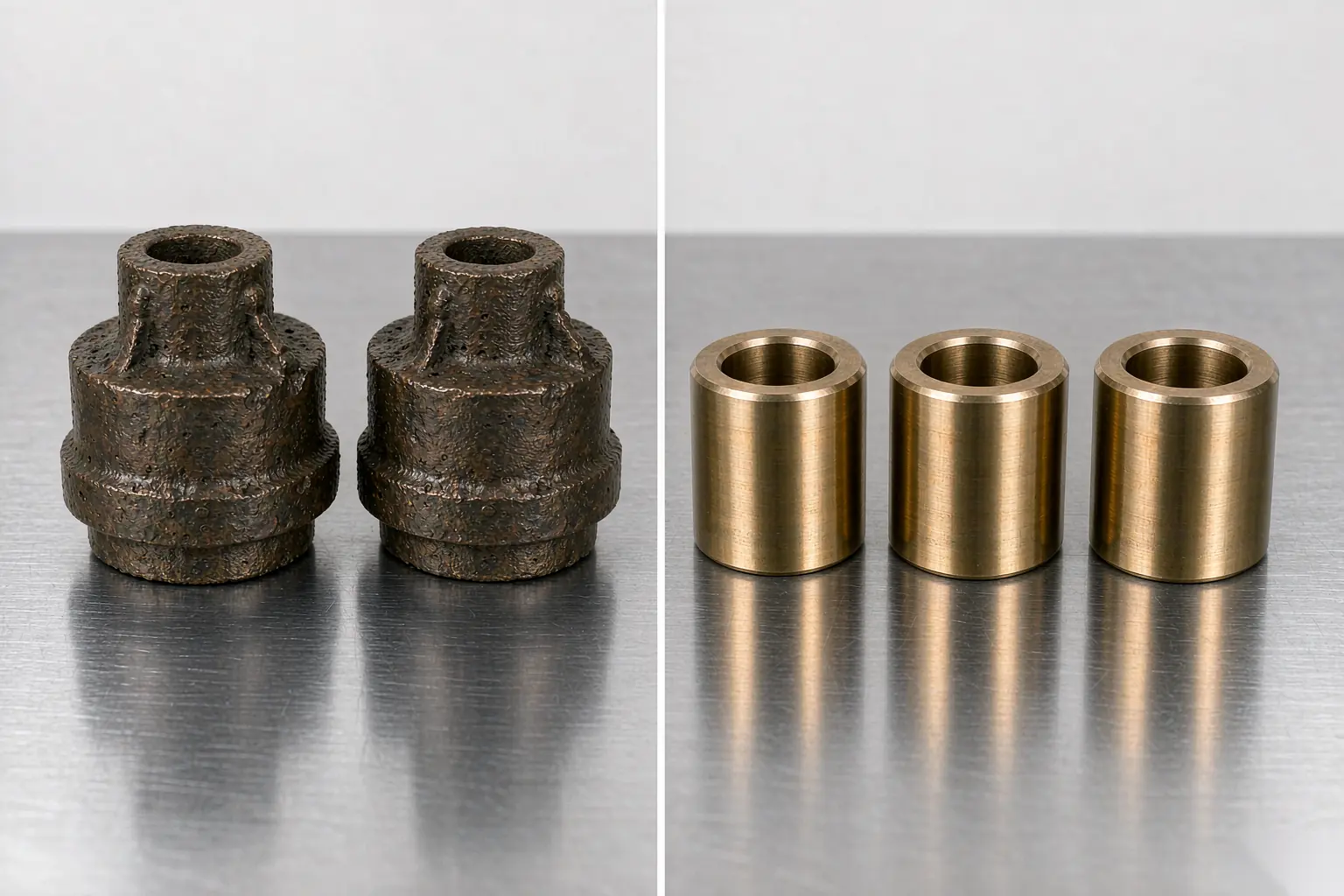
What Bronze Casting Actually Covers
In a foundry, “bronze” is a family name, not one alloy. Ask three suppliers for a bronze casting and you may get three completely different materials, all correctly labelled. Getting the family right is the first decision, because it sets the melting practice, the shrinkage allowance, the machining allowance and the price.
- Tin bronze (Cu-Sn). The true bronzes: C93200 bearing bronze and C83600 red brass. Wide freezing range, low shrinkage, superb machinability when leaded. Covered by ASTM B584 for sand castings.
- Aluminium bronze (Cu-Al-Fe / Cu-Al-Ni-Fe). C95400 and C95500. High strength, outstanding seawater corrosion resistance, and the highest shrinkage in the family. Covered by ASTM B148.
- Manganese bronze. C86300. Despite the name it is a high-strength yellow brass, Cu-Zn-Mn-Fe-Al. Buyers pick it for strength, not for bearing duty.
- Silicon bronze / lead-free grades. C87850 and the bismuth-tin grades such as C89844. Chosen when RoHS or potable-water rules rule out lead.
Because the families behave so differently during solidification, there is no single “bronze” shrinkage allowance or gating rule. A shop that pours C95400 the way it pours C93200 will produce scrap — the aluminium bronze needs roughly 50% more feed metal. That feeding topic is covered in depth in our casting riser design article.
Bronze Casting Alloys Compared
The table below lists the five grades that cover the large majority of industrial bronze casting orders, with typical as-cast properties and the duty each one is actually bought for.
| Grade | Nominal composition | Tensile / yield (MPa) | Elong. / hardness | Typical duty |
|---|---|---|---|---|
| C93200 (SAE 660) | Cu 83 / Sn 7 / Pb 7 / Zn 3 | 241 / 124 | 10–20% / 65 HB | Bearings, bushings, thrust washers |
| C83600 (85-5-5-5) | Cu 85 / Sn 5 / Pb 5 / Zn 5 | 255 / 117 | 25–35% / 60 HB | Pump bodies, valve bodies, flanges |
| C95400 (Al bronze) | Cu 85 / Al 11 / Fe 4 | 586 / 221 | 12–18% / 170 HB | Worm gears, valve seats, marine hardware |
| C95500 (Ni-Al bronze) | Cu 81 / Al 11 / Ni 5 / Fe 4 | 655–760 / 310–380 | 8–12% / 190–210 HB | Landing gear parts, high-load gears |
| C86300 (Mn bronze) | Cu 63 / Zn 25 / Mn 3 / Fe 3 / Al 6 | 760–830 / 400–480 | 12–18% / 200–250 HB | Hydraulic cylinder parts, large gears |
Note the pattern: the bearing grade has the lowest strength in the list. That is deliberate. Leaded tin bronze is soft so that it embeds dirt, conforms to shaft misalignment and never seizes against steel. If you specify C95500 for a bushing simply because it is “stronger”, you will usually shorten the life of the shaft instead. For a structured way to work through that trade-off, see how to choose a casting alloy.
Bronze Casting Processes: Which One Fits the Shape
The alloy choice narrows the process choice, but shape and volume decide it. Four routes handle nearly all commercial bronze work.
Moulage au sable
The default bronze casting route for pump bodies, valve bodies and anything with a one-off geometry. Tooling is a pattern, not a die, so entry cost stays low. Pour roughly 1,090–1,150 °C for tin bronze and 1,180–1,250 °C for aluminium bronze. See our sand casting service for the sizes we run, and sand casting vs investment casting for the accuracy trade-off.
Centrifugal casting
The standard route for bushings, sleeves and bearing rings. Rotating the mould throws the dense metal to the wall and pushes oxides and dross to the bore, where they are machined away. Density runs measurably higher than a static casting, and you get a hollow shape with no core. Our centrifugal casting article works through the G-factor and the tolerance window.
Continuous and permanent mould casting
Continuous bronze casting to ASTM B505 produces bar, tube and solid rounds with a fine, uniform structure — the feedstock most machine shops buy when they turn bushings from stock instead of casting them. When volumes justify a reusable metal mould, permanent mould casting gives a tighter tolerance and a faster cycle than sand.
Moulage de précision
Used when a bronze casting has detail a sand mould cannot reproduce — impeller blades, thin ribs, cast-in lettering. Cost per kilogram is the highest of the four, so it earns its place through reduced machining rather than through material savings. Details on our fonderie à cire perdue et lost wax casting lines.
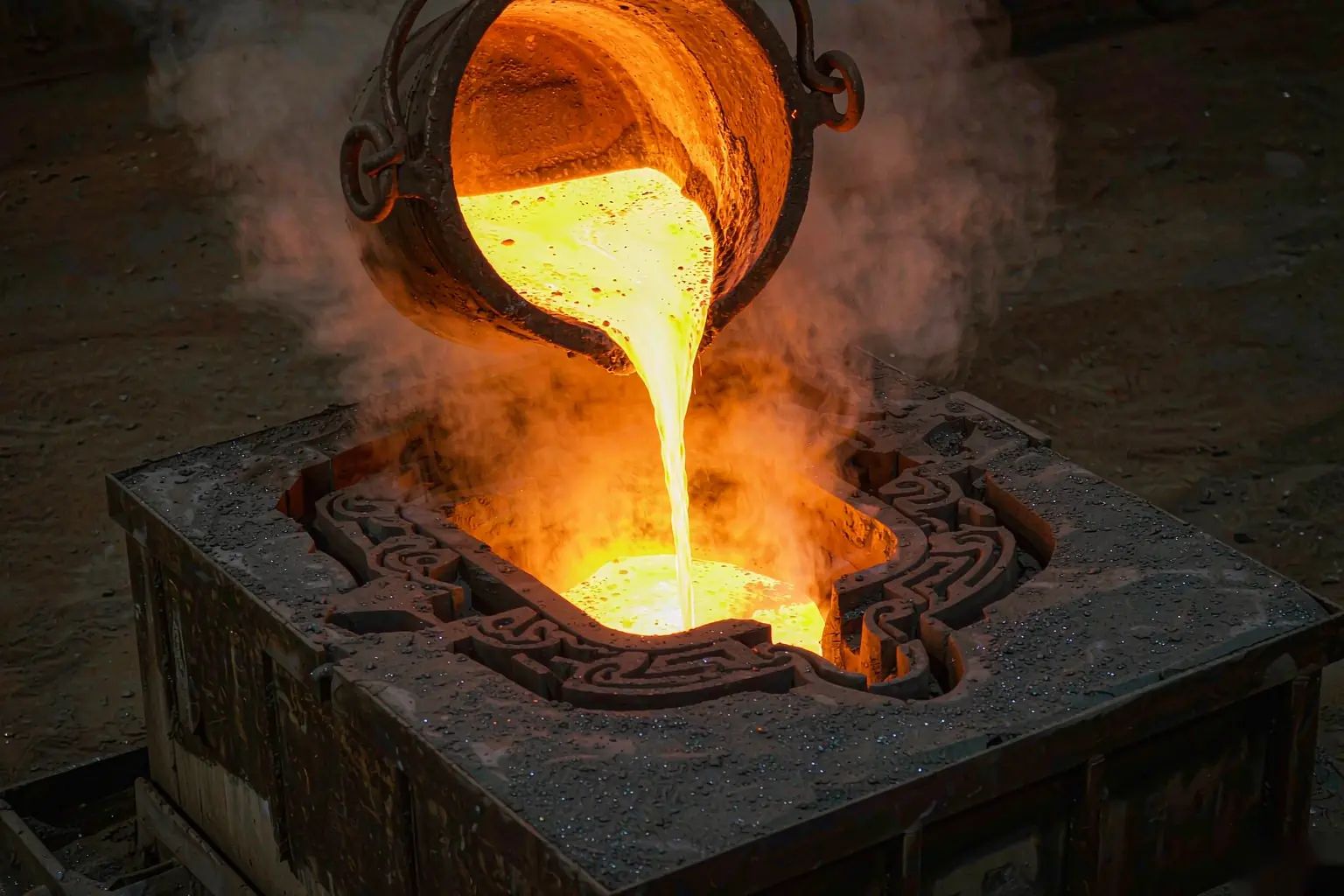
Bronze Casting vs Brass vs Cast Iron vs Cast Steel
Bronze is rarely chosen because it is cheap. It is chosen because nothing else survives the duty. This comparison is the one we use in RFQ reviews.
| Factor | Bronze | Brass | Gray iron | Cast steel |
|---|---|---|---|---|
| Density (g/cm³) | 8.9 | 8.4 | 7.2 | 7.85 |
| Tensile range (MPa) | 241–830 | 340–620 | 200–300 | 485–620 |
| Galling against steel shaft | Excellent | Poor | Poor | Poor |
| Seawater corrosion | Excellent (Al bronze) | Fair, dezincification risk | Poor | Poor |
| Machinability | Excellent when leaded | Good | Good | Fair |
| Raw metal cost (USD/kg) | 9–16 | 7–11 | 1.2–2.0 | 2.0–3.5 |
Read the last row carefully: bronze feedstock costs roughly five to seven times what gray iron costs per kilogram. That is exactly why the economics below matter so much — the winning move is almost always to cast closer to net shape and buy less metal, not to switch to a cheaper alloy. See cast iron vs cast steel et aluminium casting alloys compared for the neighbouring comparisons.
Bronze Casting Shrinkage, Machining Allowance and Tolerances
These are the three numbers that decide whether a bronze casting machines clean or becomes scrap at the last operation.
| Alloy family | Pattern shrinkage allowance | Feeding behaviour | Pouring temperature |
|---|---|---|---|
| Leaded tin bronze | 1.5% (15 mm/m) | Wide freezing range, forgiving | 1,090–1,150 °C |
| Aluminium bronze | 2.0–2.5% (20–25 mm/m) | High volume shrinkage, needs large risers | 1,180–1,250 °C |
| Manganese bronze | 2.0% (20 mm/m) | Moderate, but zinc fumes need capture | 1,050–1,120 °C |
| Silicon bronze | 1.8% (18 mm/m) | Good fluidity, thin walls fill well | 1,100–1,180 °C |
For machining allowance, the practical rule on sand cast bronze under 200 mm is 3 mm on each machined surface, rising to 4–5 mm above 300 mm, plus 2 mm on parting-line faces. Centrifugal tube typically needs 2–3 mm on the bore and 2 mm on the OD because the dross band sits at the bore.
On dimensional capability, sand cast bronze typically lands in ISO 8062 DCTG 11–13 and centrifugal or permanent mould work reaches DCTG 9–11. The full grading system is explained in our casting tolerances guide; the machining side of that same trade-off is covered in Usinage CNC vs moulage.
Bearing Duty: Running the PV Number Before You Order
Bronze bushings fail from heat, not from load. The standard screening calculation is PV — contact pressure times sliding velocity. Here is a real example worked end to end.
A C93200 bushing, finished bore 140 mm, length 120 mm, radial load 12 kN, shaft speed 200 rpm.
- Projected bearing area = bore × length = 140 mm × 120 mm = 16,800 mm².
- Pressure P = 12,000 N ÷ 16,800 mm² = 0.71 MPa.
- Sliding velocity v = π × 0.140 m × 200 ÷ 60 = 1.47 m/s.
- PV = 0.71 × 1.47 = 1.05 MPa·m/s.
C93200 is commonly rated near 2.6 MPa·m/s, so this design sits at about 40% of the limit and will run cool. Now raise the speed to 500 rpm: v becomes 3.67 m/s and PV becomes 0.71 × 3.67 = 2.62 MPa·m/s — right on the ceiling. The cheapest fix is not a different alloy. Lengthening the bushing to 150 mm drops P to 12,000 ÷ 21,000 = 0.57 MPa and PV to 2.09 MPa·m/s, back inside the window, for a few grams more bronze per part. That is the kind of change you want to make on paper, not after the first failure report.
Where PV genuinely cannot be brought down, move to C95500 nickel aluminium bronze — but budget for a hardened shaft of at least 300 HB and for full-film lubrication, because the harder bearing will no longer sacrifice itself to protect the shaft.
What Bronze Casting Costs, and Where It Breaks Even
The decision most buyers actually face is not bronze versus iron. It is cast-and-machine versus buy-bar-and-machine. Here is the arithmetic on the same bushing, in C93200, annual demand 60 pieces.
Finished part: OD 180 mm, ID 140 mm, length 120 mm. Volume = π/4 × (180² − 140²) × 120 = 1,206 cm³, so at 8.9 g/cm³ the finished mass is 10.7 kg.
| Line item | Route A: sand cast + machine | Route B: machine from bar/tube |
|---|---|---|
| Purchased weight | 14.3 kg casting | 16.8 kg tube stock |
| Metal removed | 3.6 kg (25%) | 6.1 kg (36%) |
| Metal cost | 14.3 kg × $15.80 = $226 | 16.8 kg × $13.40 = $225 |
| Machine time @ $85/h | 1.4 h → $119 | 2.6 h → $221 |
| Piece cost | $345 | $446 |
Route A saves $101 per piece and needs a pattern at about $1,850. Break-even is 1,850 ÷ 101 = 19 pieces. At 60 pieces a year that is $6,060 saved in year one, or $4,210 net after the pattern.
Two things flip the answer. Below about 19 pieces, machining from stock is cheaper and faster to start. And if the geometry is a plain cylinder, centrifugal casting beats sand casting again, because it removes the dross band and cuts the purchased weight further. The general cost drivers behind these numbers are broken down in what drives casting cost. Tooling for the pattern itself is described under casting mould making, and the machining is quoted through CNC machining services.
The Lead Rule That Disqualifies the Most Popular Bronze
C93200 carries roughly 6.3–7.5% lead. That lead is what makes it machine beautifully and what makes it forgiving in a bearing. It is also the reason the grade cannot be used in a lot of products sold in Europe.
The EU RoHS exemption for copper alloys allows up to 4% lead by weight. At 7% nominal, C93200 is out. The same pressure comes from potable-water rules, where lead-leaching limits have pushed fittings away from the traditional 85-5-5-5 grades.
- C89844 (bismuth-tin). The closest drop-in for bearing and bushing duty with lead held to a trace level.
- C87850 (silicon bronze). Lead-free, good fluidity, widely used for plumbing and marine fittings.
- C95400 / C95500. Naturally lead-free and already the default for structural and marine bronze casting.
Say which rule applies in the RFQ. A foundry pouring to a drawing that only says “bronze” will default to the leaded grade, and you will find out at customs or at audit. Our fonderie de cuivre line covers both leaded and lead-free grades, and copper vs copper alloys explains where the composition lines sit.
Common Bronze Casting Defects and Their Root Causes
Bronze casting has a few failure modes that do not appear in aluminium or iron. Knowing them saves a round of sampling.
| Defect | Root cause | Practical fix |
|---|---|---|
| Tin sweat (surface beads) | Tin-rich low-melting phase pushed to the surface during slow solidification | Faster cooling, chills, hold Sn at the low end of the range |
| Gas porosity | Hydrogen picked up from moisture or overheating | Melt under cover, degas, deoxidise with P-Cu to 0.03–0.05% residual P |
| Lead segregation | Lead is insoluble and dense; it settles during slow cooling | Stir before pouring, chill heavy sections, keep sections uniform |
| Oxide / dross inclusion | Al₂O₃ skin on aluminium bronze torn into the stream | Bottom-pour ladle, ceramic foam filter, quiet fill, no turbulence |
| Misrun / cold shut | Thin walls, low superheat, oxide film blocking flow | Raise pouring temperature, shorten fill time, add flow-offs |
The oxide point deserves emphasis on aluminium bronze: the Al₂O₃ film reforms instantly every time the stream is broken. Almost every scrap aluminium bronze part we have seen was a gating problem, not a melting problem. More on the general defect vocabulary in défauts courants de moulage, and on verification in casting inspection methods.
How to Specify a Bronze Casting in an RFQ
A purchase order that says “bronze bushing, machine to drawing” will get you a quotation, but not necessarily a part you can use. Send this instead:
- UNS grade and ASTM specification. C93200 to ASTM B584, C95400 to ASTM B148, centrifugal work to ASTM B271, bar stock to ASTM B505.
- Process. Sand, centrifugal, permanent mould or investment — this drives tolerance and surface condition.
- Compliance rule. RoHS, potable-water or neither. This decides whether leaded bronze is even legal.
- Duty data for bearings. Load, speed and shaft hardness, so PV can be checked before tooling is cut.
- Annual volume. It decides tooling spend, and it is the single biggest lever on piece price.
- Inspection and certification. Chemistry report, tensile test bar results, PT or UT where required, and any heat treatment such as stress relief — see heat treatment for castings.
- Finish. As-cast, blasted, machined, or a specified coating — see services de traitement de surface.
If you are still at prototype stage, a small run through metal prototype casting is usually cheaper than committing to production tooling on a grade you have not tested. Typical applications cluster in valve casting, marine casting and pump hardware, where corrosion and galling are the real failure modes.
FAQ
Is bronze casting more expensive than brass casting?
Per kilogram, usually yes — tin carries a higher premium than zinc. But bronze buys corrosion resistance and bearing behaviour that brass cannot match, and on seawater duty the cheaper part is the one you replace twice.
What is the difference between bronze and brass in a casting?
Bronze is copper-tin or copper-aluminium; brass is copper-zinc. In practice the strongest grade on many spec sheets, C86300 manganese bronze, is a brass despite the name — which is why UNS numbers beat trade names on a drawing.
What minimum wall thickness works for bronze casting?
Sand cast bronze is comfortable at 4–5 mm on small parts and 6–8 mm on larger ones. Silicon bronze fills thinner sections than aluminium bronze; centrifugal and investment casting push thinner again.
Can bronze castings be welded or repaired?
Leaded tin bronze should not be welded — the lead makes it crack and it releases fumes. Aluminium bronze can be welded with a matching filler and preheat, but repair needs a qualified procedure and the customer’s agreement.
Which bronze is best for seawater?
C95400 aluminium bronze and C95500 nickel aluminium bronze. Both form a protective alumina film that resists erosion-corrosion and biofouling far better than tin bronze.
How long does bronze casting tooling last?
A well-made metal pattern for sand casting runs tens of thousands of moulds. The limiting factor is usually the foundry’s storage and maintenance discipline rather than the pattern material itself.
*Data referenced from ASTM B584 / B148 / B271 / B505, Copper Development Association publications, AFS foundry practice and Supro MFG shop-floor records. Cost figures are indicative workshop rates, not a quotation.
 English
 Français
 Deutsch
 Italiano
 日本語
日本語 한국어
한국어 Polski
 Português de Angola
 Русский
 Español de Argentina