
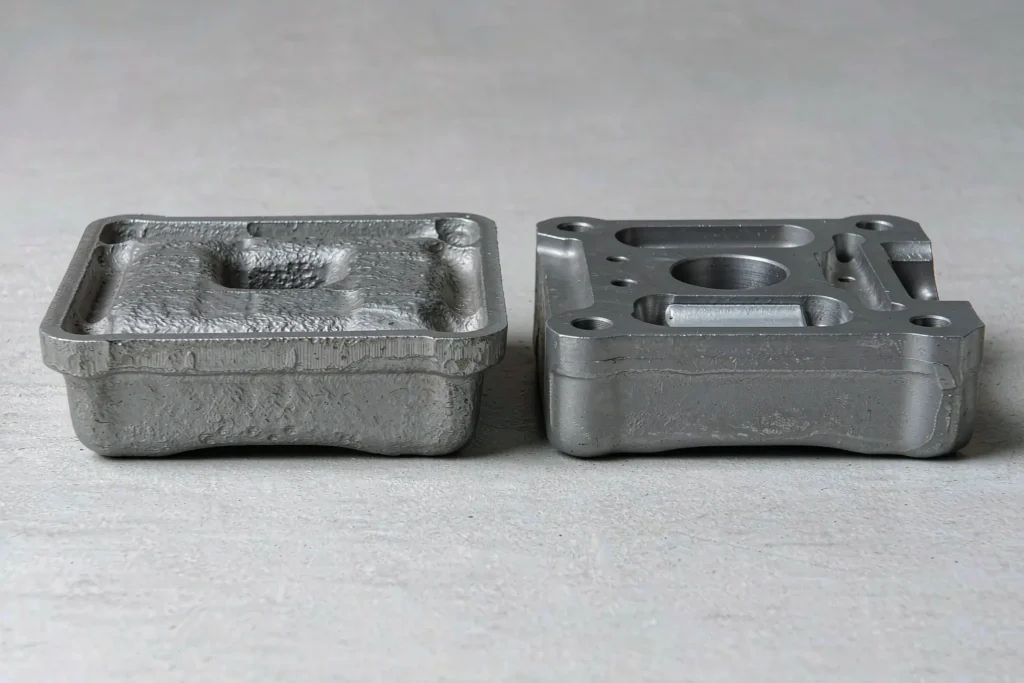
One part number, two routes. A 12 kg valve body can be poured into a sand mould for about $22 a piece, or squeezed from a hot billet in a closed die for about $38. Both will pass a dimensional check on the shipping dock. Only one of them will still be intact after ten million load cycles. The casting vs forging decision is almost never settled by static tensile strength — it is settled by grain flow, internal soundness, tooling amortisation and how much machining stock you are willing to pay for. Choose wrong and you either overpay for the next five years or lose a batch at the fatigue test.
This guide is the decision framework we run on our own shop floor whenever a casting vs forging question lands on the desk. It gives you the real numbers behind the choice: property comparisons against the standards, tolerance bands in millimetres, two worked tooling-breakeven calculations and the design rules each process imposes. Standards references draw on ASTM and the American Foundry Society (AFS), with the forging side benchmarked against the Forging Industry Association (FIA). Property data is quoted from ASTM product specifications, not from marketing sheets.

Casting vs Forging: What Actually Changes in the Part
Both processes start with the same liquid steel, the same aluminium or the same brass. The difference is how the shape is obtained, and that difference leaves a fingerprint in the metal.
Liquid metal versus deformation
Casting pours liquid metal into a mould and lets it solidify into the final shape. The mould is sacrificed or reused; the part is created by solidification. Forging takes a solid billet, usually heated to 1,100–1,250 °C for carbon steel, and squeezes it with a press or hammer so the metal flows plastically inside a die cavity. No melting, no pouring, no risers — just deformation. That mechanical difference is the whole of casting vs forging in one sentence.
That single difference decides everything downstream. Solidification creates grains from the melt and can trap gas, shrinkage and inclusions. Deformation breaks up the cast ingot structure, welds internal porosity shut and stretches the grains into a directional pattern. Process fundamentals are covered in our Guide sur la fonderie des métaux if you want the mould-side detail first.
Why the route changes the properties
A casting is isotropic: strength is roughly the same in every direction, because there is no dominant grain direction. That is an advantage when the load path is unpredictable or multi-axial. A forging is anisotropic by design: grain flow follows the die contour, so the part is strongest along the direction the metal was forced to move. Put the grain flow along the load path and you get a component that shrugs off fatigue. Put it across the load path — or buy a forging with a poor grain-flow pattern — and you have paid forging prices for cast-level performance. Orientation, not alloy, is what separates the routes.
Grain Flow: The Property Buyers Rarely Specify
Here is the part of the casting vs forging conversation most quotes ignore. On static tensile strength, a properly made casting already competes. Sand-cast carbon steel to ASTM A216 grade WCB is specified at 485–655 MPa tensile, 250 MPa minimum yield and 22% minimum elongation. Normalised carbon steel forgings to ASTM A668 land in the same 485–620 MPa tensile band. If your load case is a steady pull, the two are effectively interchangeable on paper. That is exactly why casting vs forging arguments which stop at tensile data never settle anything.
The gap opens under cyclic or impact loading, and it comes from three things: surface condition, internal soundness and grain orientation.
- Fatigue limit. As-cast surfaces retain the mould skin, which is rough and often decarburised or shot-blasted. With that skin plus internal porosity, the endurance limit for steel castings commonly falls in the 30–40% of ultimate tensile strength band. A forged part that is machined, has polished fillets and carries favourable grain flow regularly reaches 45–55% of UTS. On a 600 MPa steel that is the difference between a 200 MPa and a 300 MPa fatigue limit — a 2–3× life difference at the same stress, and the single largest performance gap in any casting vs forging comparison.
- Impact toughness. Charpy V-notch results on forged steel are both higher and more consistent, which matters for low-temperature service, hydraulic shock and any part that sees accidental overload. Cast impact values scatter more because they depend on where the test coupon sat relative to the last-fed section.
- Defect population. The two routes fail differently. Castings fail on shrinkage porosity, gas porosity and sand or slag inclusions; forgings fail on laps, seams and forging bursts. Different defects need different inspection. Castings are radiographed to ASTM E94/E446 or ultrasonically tested to ASTM A609; forgings are ultrasonically tested to ASTM A388. Our article on défauts courants de moulage breaks down the casting side in detail.
Casting has one strong counter-move: hot isostatic pressing. Running the part in argon at 100–150 MPa and 900–1,200 °C for 2–4 hours closes internal porosity by diffusion and creep. Published fatigue-life gains for aluminium castings after HIP commonly run 2–5×, which brings a casting close to wrought behaviour at a fraction of forging tooling cost. The thermal side of that work sits with the same equipment used for casting heat treatment, and for high-integrity parts HIP plus T6 is now a standard sequence rather than an exotic add-on. In a casting vs forging review it is the strongest counter-argument a foundry can bring.
| Property | Sand-cast carbon steel (ASTM A216 WCB) | Closed-die forged carbon steel (ASTM A668) |
|---|---|---|
| Tensile strength | 485–655 MPa | 485–620 MPa |
| Yield strength (min) | 250 MPa | 260–310 MPa |
| Elongation (min) | 22% | 20–24% along grain flow |
| Grain structure | Isotropic, no direction | Directional, follows die contour |
| Typical fatigue limit | 30–40% of UTS as-cast; 40–50% after HIP + machining | 45–55% of UTS with favourable flow |
| Impact consistency | Scatters with section location | Higher and tighter scatter |
| Dominant defect risk | Shrinkage, gas porosity, inclusions | Laps, seams, forging bursts |
How Casting vs Forging Compares on Tolerances and Machining Stock
The second half of the decision is metrology, not metallurgy. In most casting vs forging evaluations, tolerance band and machining stock settle the choice faster than any property discussion does. Forging wins on predictability even when it loses on raw geometry freedom, because die-worn surfaces repeat far better than a sand mould.
The tolerance spread in millimetres
Casting tolerances are graded by ISO 8062-3. A green-sand shop will typically hold DCTG 10 without a price penalty, which on a 100 mm dimension means ±1.0 mm. Investment casting holds DCTG 5–7, roughly ±0.2–0.4 mm at the same length. Full grade tables per process are in our casting tolerances reference.
Forging tolerances follow DIN 7526 and behave differently in two directions. A dimension contained inside one die half is tight: commonly ±0.3–0.5 mm on a 100 mm feature. A dimension that crosses the parting plane is far looser: ±0.8–1.5 mm, because it now includes die closure variation, flash thickness and mismatch. This is worth designing around — put your critical datum, locating bore or press-fit feature entirely within one die half and you buy casting-grade repeatability with forging-grade toughness. Plenty of casting vs forging cost overruns trace back to a critical feature placed on the wrong side of the parting line.
| Process | Linear tolerance at 100 mm | Machining stock per face | Draft angle |
|---|---|---|---|
| Green sand casting | ±1.0 mm (DCTG 10) | 2–5 mm | 1–3° |
| Moulage de précision | ±0.2–0.4 mm (DCTG 5–7) | 0.5–1.5 mm | 0–1° |
| High-pressure die casting | ±0.10 mm first 25 mm, +±0.02 mm per extra 25 mm | 0,3 à 0,8 mm | 1–2° |
| Closed-die forging (steel) | ±0.3–0.5 mm within a die half; ±0.8–1.5 mm across the parting plane | 1.5–3 mm | 3–7° |
Practical consequence: a forged part usually needs more stock per face than a sand casting, but the stock is more evenly distributed, so CNC fixtures locate better and cycle time is shorter. A casting with DCTG 12 on a 200 mm span can vary by nearly 3 mm, which means the first machining pass is cutting air on one part and taking a 6 mm bite on the next. That single fact settles more casting vs forging contests than metallurgy does. That variation is a real cost driver — see the répartition des coûts de moulage for how it shows up in piece price, and the CNC machining versus casting comparison for the sequencing question.
Tooling Cost and the Volume Breakeven
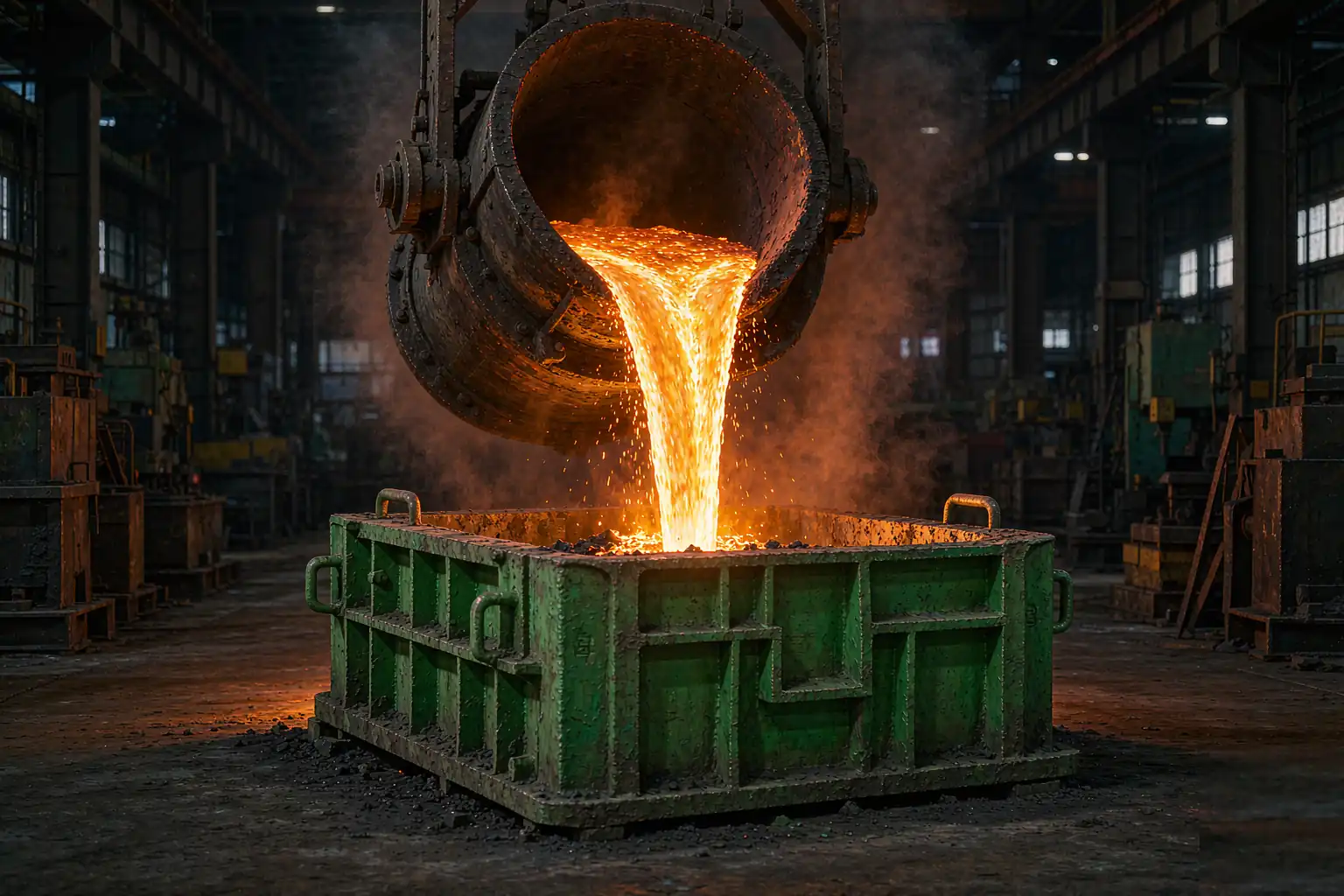
Tooling is where the casting vs forging equation flips, and it flips at a calculable volume. Typical shop ranges: a sand pattern set for a mid-size part runs $400–3,000, with core boxes adding $300–2,500 each. A closed-die forging die set runs $8,000–40,000 depending on size, number of impressions and whether a separate trim die is needed. Die casting dies start around $15,000 and climb past $80,000 for large multi-slide tools.
Worked example 1: sand casting versus closed-die forging
Quote A, sand casting: $2,000 tooling plus $22 per piece. Quote B, closed-die forging: $18,000 tooling plus $14 per piece. Setting the totals equal answers the casting vs forging question for a given part shape:
2,000 + 22Q = 18,000 + 14Q → 8Q = 16,000 → Q = 2,000 pieces.
At 1,000 pieces the casting route costs $24,000 ($24.00 each) against $32,000 ($32.00 each) for forging. At 5,000 pieces the positions reverse: casting $112,000 ($22.40 each) versus forging $88,000 ($17.60 each). Below 2,000 pieces the cheaper tooling wins outright; above it, forging’s lower piece price dominates.
Worked example 2: machining from bar versus forging
This is the comparison that decides most low-volume steel parts, because machining from bar needs no tooling at all — and it is the casting vs forging question most often answered by habit rather than by arithmetic. A 4.5 kg machined link: $38 material plus 45 minutes of machining at $1.20 per minute = $92 per piece, zero tooling. The forged alternative: $16,000 tooling, $26 per forging plus $12 finish machining = $38 per piece.
16,000 = (92 − 38) × Q → Q ≈ 297 pieces.
At 100 pieces, machining from bar costs $9,200 against $19,800 for forging. At 1,000 pieces the numbers are $92,000 against $54,000. Any annual demand above roughly 300 pieces justifies the die — and if the part is fatigue-critical, the die is justified well before that on performance grounds alone.
What Each Process Can and Cannot Make
Geometry freedom is where casting’s lead is largest, and it is the reason most complex parts are cast even when fatigue matters. This is the one section where casting vs forging stops being a close call.
Casting can produce internal cavities, hollow sections and cooling passages that no die can form, because a sand or ceramic core is destroyed after the pour. Green sand holds minimum wall thickness around 3–4 mm on small parts and cored holes down to roughly 8 mm diameter, with a depth-to-diameter limit of about 2:1. Investment casting pushes that to 1–2 mm walls and cored features around 1.5–2 mm. Die casting reaches 0.8–1.5 mm on aluminium. Forging offers none of this: a closed die cannot be filled with a re-entrant cavity, so any internal passage must be machined afterwards. The rules for cores, draft and parting lines are collected in our mold and pattern design guide.
Forging’s advantage is size and strength per kilogram for relatively simple, load-bearing shapes: shafts, levers, hooks, yokes, connecting rods, flanges, gear blanks. Forging also wastes far less metal at the mould stage — no risers, no gating system. The trade is flash, typically 5–15% of billet weight, plus the requirement for draft angles of 3–7° that a casting does not need on vertical faces.
Scale matters too. Castings span grams to several tonnes, which is why pièce moulée en acier routinely handles pump housings and valve bodies above 50 kg. Closed-die forging is practical up to roughly 100–200 kg; beyond that you are in open-die territory with much looser tolerances and far more machining — which is why casting vs forging at this scale is barely a contest. When you are still at the design stage and want both routes priced, the service de moulage de prototypes métalliques et 3D printing versus casting comparisons cover the low-volume end.
Decision Table: When Casting Wins, When Forging Wins
Before you open a casting vs forging debate inside your own team, run the part through this grid. The answer is usually obvious by the third row.
| Your requirement | Better route | Raison |
|---|---|---|
| Internal passages, cores or hollow sections | Casting | Forging cannot form re-entrant cavities |
| High-cycle fatigue in a known load direction | Forging | Grain flow aligned with stress, no internal porosity |
| Annual volume under 500 pieces | Casting or machined bar | Tooling cannot be amortised |
| Simple shape, 5,000 pieces per year | Forging or die casting | Low piece price pays back the die |
| 1–3 mm walls on a complex body | Casting | Dies cannot fill thin deep sections |
| Impact or low-temperature toughness is critical | Forging | Higher and tighter Charpy values |
| Part weight above 50 kg | Casting | Closed-die forging becomes impractical |
| Design still changing every few weeks | Casting | Pattern changes cost a fraction of die changes |
| Minimum near-net shape, least machining | Casting | Investment casting holds ±0.2–0.4 mm without extra stock |
Choosing Between Casting vs Forging on a Real RFQ
When a drawing lands with no process specified, we work through five questions in this order. It takes about twenty minutes and it removes almost all of the guesswork.
- Load case. Steady load, cyclic load or impact? If fatigue or impact dominates, the burden of proof is on casting — and you should ask for HIP plus radiographic inspection before you accept it.
- Geometry. Any internal cavity kills the forging option immediately. Any draft-sensitive vertical face pushes the other way.
- Volume. Run the two-line breakeven above with your own quotes. Most disagreements inside a sourcing team disappear once the number is on the board.
- Acceptance criteria. If the customer standard names a forged part, casting is a re-validation project, not a substitution — plan for the testing budget.
- Total landed cost. Include machining time, scrap rate, NDT, heat treatment and freight. A casting at a lower piece price can lose on total cost if it needs 3 mm of extra stock removed from six faces.
The middle path is worth naming explicitly, because it wins more often than either extreme. A casting plus hot isostatic pressing plus finish machining reaches roughly 80–90% of forged fatigue performance in many steel and aluminium applications while requiring 30–50% of the forging tooling investment. That combination is how we handle most structural parts where the customer wants forging-like integrity but cannot justify a die at their annual volume. If your part is a match on corrosion or high-alloy requirements, the gray iron versus ductile iron selection logic applies the same way — first get the material right, then the process. Production routes for each casting family are covered under moulage au sable, fonderie à cire perdue et moulage sous pression.

FAQ
Is forging always stronger than casting?
No, and the casting vs forging question is worth reframing. On static tensile and yield strength, cast and forged carbon steel overlap — A216 WCB is specified at 485–655 MPa, broadly the same band as forged carbon steel to ASTM A668. Forging’s real advantage is fatigue and impact performance, coming from continuous grain flow and the absence of internal porosity. For a steadily loaded bracket that never sees cycles, that advantage may buy you nothing.
Can a casting replace a forging in a safety-critical part?
It can be engineered to, but it is a validation project rather than a drop-in substitution. The usual route is HIP to close internal porosity, tighter radiographic or ultrasonic acceptance to ASTM A609, machining to remove the as-cast skin from all fatigue-critical fillets, and shot peening on the highest-stress features. If the governing standard names a forged part, expect to fund a full fatigue and impact test programme before approval.
Which is cheaper at 500 pieces?
Almost always casting, and often machining from bar is cheaper still. In the worked example above, closed-die forging needed 2,000 pieces to beat sand casting and roughly 300 pieces to beat machining from bar. Below those thresholds the tooling amortisation dominates the piece price, and no amount of process optimisation closes that gap. Run your own casting vs forging quotes through the two-line equation before you commit to a route.
Does casting vs forging change the machining process?
Yes, and it is the most underestimated half of the casting vs forging decision. Stock allowance differs — 2–5 mm per face for green sand casting versus 1.5–3 mm for forging — so cycle time and tool load change even for the same finished part. Stock consistency differs more: forging holds a tighter and more even envelope, so fixtures locate reliably on the first pass, while a loose-tolerance casting can leave one part cutting air and the next taking a heavy interrupted cut. See CNC machining services for how we handle both.
How should NDT be specified for each route?
For castings, specify radiography to ASTM E94 or E446 for internal shrinkage and gas porosity, or ultrasonic testing to ASTM A609 for heavier sections, with acceptance levels written against the drawing. For forgings, ultrasonic testing to ASTM A388 is the standard internal inspection, with magnetic particle inspection for surface laps and seams. Do not copy an NDT clause from one route to the other — the defect populations are different, so the techniques and acceptance criteria must be too. Whichever way the casting vs forging call goes, write the acceptance level against the drawing rather than against habit.
What does the casting route include beyond the pour?
Tooling design and manufacture, gating and feeding layout, pouring and shakeout, heat treatment to the specified temper, NDT, and any required surface finishing or impregnation. If you need tooling built to your own pattern standard, see casting molds making; if the part needs post-cast thermal work, heat treatment services covers stress relief through to T6. A casting vs forging review should always be followed by a look inside the casting family itself; a sibling comparison worth reading next is die casting versus sand casting, which applies the same cost-and-volume logic inside the casting family itself.
*Data referenced from ASTM product specifications, AFS and NADCA industry publications, DIN 7526 and Supro MFG shop-floor records.
 English
 Français
 Deutsch
 Italiano
 日本語
日本語 한국어
한국어 Polski
 Português de Angola
 Русский
 Español de Argentina