

Stainless steel investment casting appears on more of the RFQs we review than any other alloy family, and it is also the one where a single wrong grade costs the most. A pump housing bought as CF8 instead of CF8M can pit inside a season of chloride wash-down; a bracket bought as 17-4PH without the ageing condition on the drawing can arrive 300 MPa below the strength the designer assumed.
This guide compares the five cast grades that cover the large majority of industrial demand — CF8 (304), CF8M (316), CB7Cu-1 (17-4PH), ASTM A995 Grade 4A (2205 duplex) and CA15 (410) — against the ASTM specifications they are actually bought to. It includes the corrosion maths, heat-treatment routes, machining behaviour and tolerance limits that separate a clean first article from a re-quote. Numbers below are ASTM minimums, standard industry practice or our own shop records — not marketing figures. For the broader process background, start with our metal casting guide, and for independent process references see AFS und ASTM International.

What Stainless Steel Investment Casting Actually Buys You
“Stainless” is a corrosion mechanism, not a single material. Once chromium in the alloy exceeds roughly 10.5%, a chromium-oxide film forms on the surface and re-forms instantly when scratched in an oxygen-bearing environment. That film is why the part survives; everything else in the specification exists to protect or strengthen it.
Pairing stainless with the lost-wax route buys three things at once. First, near-net shape: an as-cast surface typically lands at Ra 3.2–6.3 µm, so most non-sealing faces need no cut at all. Second, thin walls — 2–3 mm is routine on small parts, which is where stainless earns its keep against sand routes. Third, detail: cored passages, logos and part numbers come out of the tool rather than off a machine. If your part is large and blocky, read our comparison of sand casting vs investment casting before committing, because the cost curves cross surprisingly early.
Where the process fits
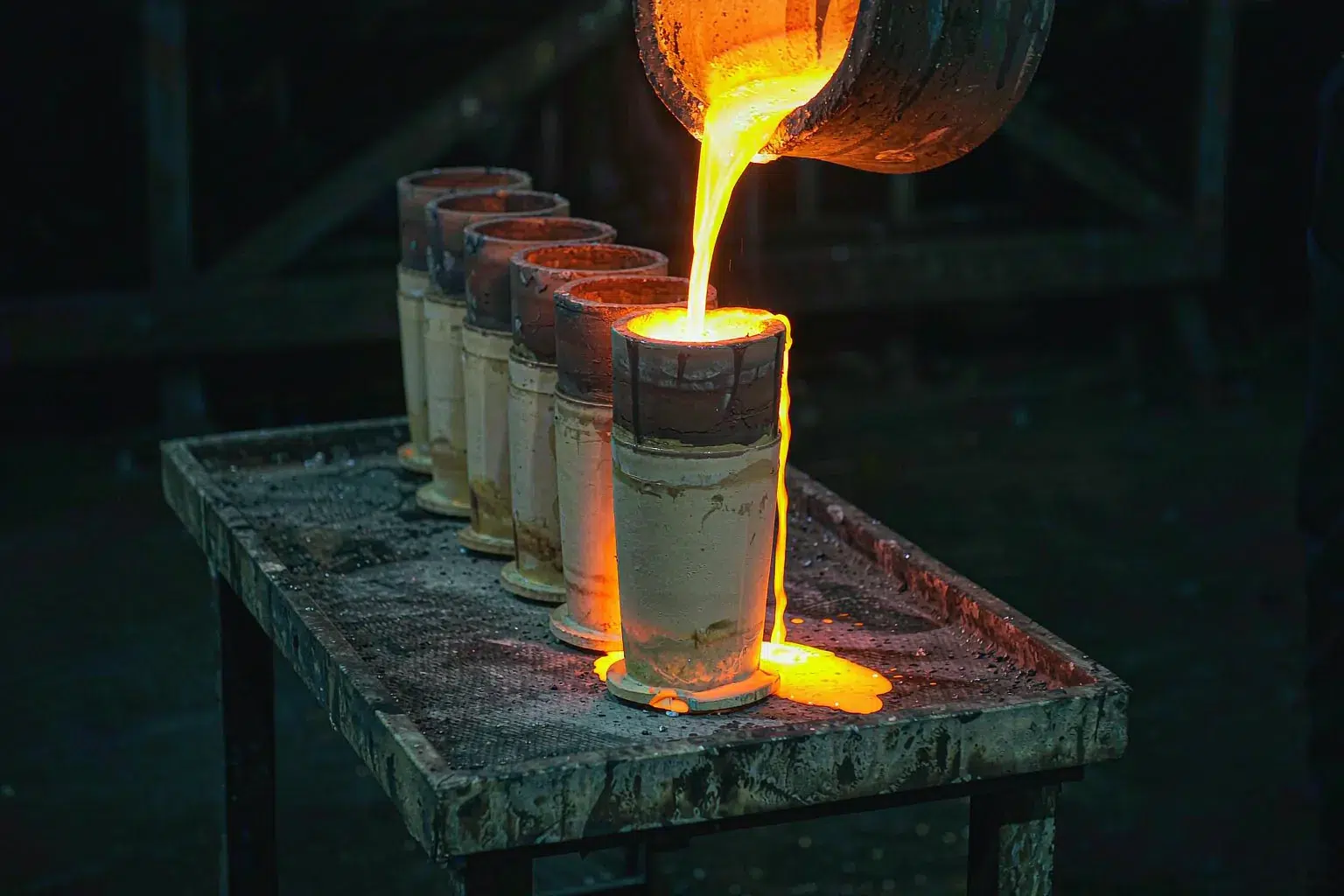
Investment casting covers parts from a few grams up to roughly 50 kg, with the sweet spot under 10 kg. Beyond that, shell handling and pour weight push cost up fast. Stainless is melted in an induction furnace, usually AOD-refined when low carbon is required, and poured at about 1550–1650°C into shells pre-fired to roughly 950–1050°C. Those temperatures are the reason wall thickness and gating must be settled at design stage — stainless does not feed like aluminium, and thin sections freeze quickly. Our investment casting service team reviews this before tooling is cut.
Cast Grade Equivalents for Stainless Steel Investment Casting
The most common sourcing error in stainless steel investment casting is quoting a wrought number and assuming the foundry will translate it. Cast specifications are separate documents with separate chemistries and separate mechanical minimums. ASTM A743/A744 covers corrosion-resistant castings for general service, ASTM A351/A351M covers austenitic castings for pressure-containing parts, and ASTM A995 covers duplex. Ask for the cast designation and the specification year — that removes most disputes later. If you are still at the alloy-family stage, our guide to choosing a casting alloy walks through the trade-off logic.
| Cast grade (ASTM) | Wrought analogue | Key chemistry | Tensile / yield (min) | PREN (typ.) |
|---|---|---|---|---|
| CF8 (A351/A743) | 304 | 18–21 Cr, 8–11 Ni, C ≤0.08 | 485 / 205 MPa | ≈20 |
| CF3 (A351/A743) | 304L | 17–21 Cr, 8–12 Ni, C ≤0.03 | 485 / 205 MPa | ≈20 |
| CF8M (A351/A743) | 316 | 18–21 Cr, 9–12 Ni, 2–3 Mo | 485 / 205 MPa | ≈27 |
| CF3M (A351/A743) | 316L | 17–21 Cr, 9–13 Ni, 2–3 Mo, C ≤0.03 | 485 / 205 MPa | ≈27 |
| CB7Cu-1 (A747) | 17-4PH | 15.5–17.7 Cr, 3–5 Ni, 3–5 Cu, Nb | 1310 / 1170 MPa (H900) | ≈17 |
| Grade 4A (A995) | 2205 duplex | 21–23.5 Cr, 4.5–6.5 Ni, 2.5–3.5 Mo, N 0.10–0.30 | 620 / 415 MPa | ≈35 |
| CA15 (A743) | 410 | 11.5–14 Cr, Ni ≤1, C ≤0.15 | 620 / 450 MPa | ≈12 |
CF8 and CF3 — the default austenitic grades
CF8 is the workhorse grade in stainless steel investment casting. It is ductile (35% minimum elongation), non-magnetic, weldable and the cheapest of the austenitic cast grades. It handles food contact, indoor architectural hardware and general industrial atmospheres well. Its weakness is chlorides: in coastal air, bleach wash-down or brine service, CF8 will pit and stress-corrosion crack. Specify CF3 (the low-carbon version) whenever the part is welded or will see service between 425–815°C, because that is the range where chromium carbides precipitate at grain boundaries and strip the passive film locally — the classic sensitisation failure.
CF8M and CF3M — molybdenum for chlorides
Adding 2–3% molybdenum is the single cheapest insurance policy in the family. CF8M resists pitting and crevice attack in marine spray, chemical processing and pharmaceutical clean-in-place cycles where CF8 fails. On most B2B projects the material premium is far smaller than the cost of a field failure or a recall. For anything welded, move to CF3M. This is the grade behind most of the marine castings and quick-connect fittings we produce, including the camlock couplings covered in our dedicated stainless steel camlock casting article.
CB7Cu-1 — precipitation-hardening 17-4PH
When strength-to-weight matters, 17-4PH is the usual answer in stainless steel investment casting. Solution-anneal at about 1040°C, then age: H900 at 482°C gives roughly 1310 MPa tensile and 40 HRC; H1150 at 620°C drops to about 930 MPa and 30 HRC but restores toughness and stress-corrosion resistance. Two specification traps. First, always state the ageing condition on the drawing — “17-4PH” alone is meaningless. Second, watch section size: heavy sections do not cool fast enough to reach full H900 properties through the core, so design to the through-thickness value, not the test-bar value. Corrosion resistance sits near CF8, not CF8M, so it is not a free upgrade.
Grade 4A — 2205 duplex
In stainless steel investment casting, Grade 4A combines roughly equal ferrite and austenite. You get about twice the yield strength of CF8M, excellent chloride stress-corrosion cracking resistance, and better resistance to erosion-corrosion — which is why it dominates pump impellers and slurry handling. The constraint is thermal: never hold duplex between roughly 315–480°C in service or stress relief, because sigma phase precipitates and embrittles the part. Solution-anneal at 1040–1150°C and water quench.
CA15 — martensitic 410
CA15 is the value option when you need hardness and abrasion resistance rather than corrosion resistance: pump wear rings, knife edges, turbine blades, valve trim. It is magnetic, hardenable by quench and temper, and machines far better than the austenitic grades. Its corrosion resistance is modest — think clean water and steam, not seawater. It is also the least forgiving in the foundry: it cracks on cooling if the section changes abruptly. Our casting defects guide covers hot tearing and how gating design prevents it.
Matching Stainless Steel Investment Casting Grades to Applications
Grade selection in stainless steel investment casting is really a service-environment decision. The table below maps the applications we see most often to the grade that usually wins and the reason it wins.
| Anwendung | Usual grade | Why it wins | Watch out for |
|---|---|---|---|
| Valve bodies, pump casings | CF8M / CF3M (A351) | Pressure-grade spec, Mo for process fluids, weldable | Radiographic soundness on heavy sections |
| Marine hardware, deck fittings | CF8M, electropolished | Chloride pitting resistance, cosmetic finish | Passivation after blasting (ASTM A967) |
| Food, beverage, pharmaceutical | CF3M, Ra ≤0.8 µm after polish | Low carbon for welding, cleanable surface | Crevice-free design; no blind pockets |
| Pump impellers, slurry parts | A995 Gr 4A (2205) | Erosion-corrosion resistance, 2× yield of CF8M | Sigma-phase window 315–480°C |
| Aerospace brackets, defence hardware | CB7Cu-1 (17-4PH) H900/H1075 | 1310 MPa tensile at low section weight | Ageing condition must be on the drawing |
| Wear rings, valve trim, blades | CA15 (410), quenched and tempered | Hardness and abrasion resistance at low alloy cost | Hot tearing on abrupt section changes |
| General industrial brackets, housings | CF8 | Lowest material cost, high ductility | Pitting in any chloride environment |
Corrosion Performance: PREN, Sensitisation and Chloride Limits
Rather than argue from brand names, use the pitting resistance equivalent number: PREN = %Cr + 3.3 × %Mo + 16 × %N. It is a ranking tool, not a service prediction, but it makes grade conversations objective.
Take two real chemistries. A CF8M heat at 18.5% Cr, 2.25% Mo and 0.05% N gives PREN = 18.5 + 7.4 + 0.8 = 26.7. A 2205 heat at 22.2% Cr, 3.1% Mo and 0.17% N gives 22.2 + 10.2 + 2.7 = 35.1. That gap of about eight points is the difference between a part that survives brackish cooling water and one that needs replacing. CF8, with no molybdenum, sits near 20 — fine indoors, marginal outside.
Three things PREN does not capture. Temperature: pitting risk rises sharply above roughly 50–60°C in chloride service, whatever the grade. Stagnation: crevices and deposits create local chemistry that defeats any alloy. And surface condition: a blasted but un-passivated part will flash-rust in days. Passivate to ASTM A967 (citric or nitric) after any abrasive or machining operation, and clean to ASTM A380 before it. Our casting surface finishing guide sets out the blast–passivate–polish sequence in detail.
Heat Treatment, Machining and Dimensional Reality
Heat treatment is where stainless steel investment casting quietly adds cost. CF8, CF3, CF8M and CF3M need solution annealing at 1040–1150°C followed by a rapid quench — a full furnace cycle plus water treatment, not a footnote. Duplex needs the same cycle with a strictly controlled quench. 17-4PH needs two cycles: solution anneal plus ageing. CA15 needs quench and temper. Each cycle adds energy, handling, straightening risk and scale removal. Budget for it explicitly; our casting heat treatment article prices the routes side by side, and our heat treatment service runs them in-house.
Machining behaviour in stainless steel investment casting separates the grades more than most buyers expect. Austenitic grades work-harden aggressively: dwell a tool on CF8M and the surface hardens under the insert, wrecking tool life and finish. Use sharp carbide, positive rake, constant feed and never let the cut rub. Typical turning speeds with carbide run around 120–150 m/min for CF8 and 90–120 m/min for CF8M; 17-4PH at H900 drops to roughly 60–90 m/min, and 2205 to 70–100 m/min. CA15, in the annealed condition, is the friendliest of the set. Where a part is machining-dominated, our comparison of CNC machining vs casting shows how to split the geometry so the foundry does the shaping and the machine does only the sealing faces. Most of our stainless parts go straight to CNC-Bearbeitung for those final datums.
On dimensions, stainless steel investment casting typically holds ISO 8062 CT5–CT6. On a 30 mm feature that is about ±0.38 mm at CT5 and ±0.54 mm at CT6 — good enough to delete most roughing operations, not good enough to skip finish machining on a bore. Also allow roughly 2% linear shrink when you sanity-check a casting against your assembly model; a 200 mm flange will come out about 4 mm smaller than the tool. The full grade-by-grade breakdown is in our casting tolerances guide.
Cost Drivers on a Stainless Steel Investment Casting RFQ
Two quotes for the same stainless steel investment casting drawing can differ by 40% and both be honest. The spread comes from five places.
- Alloy surcharge. Nickel, molybdenum and chromium are traded commodities. CF8M carries more Ni and Mo than CF8; 2205 and 17-4PH carry more again. Surcharges are usually indexed monthly, so a quote valid for 30 days is normal — ask what date the alloy price was struck.
- Melting route and melt size. Low-carbon grades (CF3, CF3M) and tight chemistry control push you toward AOD-refined or virgin-charge melts. Small heats cost more per kilogram.
- Heat treatment and NDT. Solution anneal plus quench, ageing, plus penetrant testing on every part or radiography on pressure sections — each line is real furnace and labour time.
- Yield. Stainless is poured hot and feeds poorly. A design that needs heavy risers on a 3 kg part may melt 6 kg to ship 3 kg. Yield is the single biggest hidden variable between foundries.
- Machining and finish. Choosing CF8M over CF8 raises cutting time; specifying Ra 0.8 µm electropolish over as-cast adds several operations.
Unser casting cost breakdown walks through each line with worked examples. If you are weighing stainless against the light alloys, the aluminium investment casting comparison is the natural counterpoint — roughly a third of the density, and a very different corrosion story.
How to Specify the Grade on Your Next RFQ
Put these six lines on the stainless steel investment casting drawing or the enquiry and you will get comparable, buildable quotes first time:
- Cast designation and specification. “CF8M per ASTM A351/A351M” — not “316 stainless”.
- Heat-treat condition. Solution annealed; or 17-4PH H900 / H1075 / H1150 stated explicitly.
- Service environment. Chlorides yes or no, temperature range, whether the part is welded.
- NDT level. Penetrant per ASTM E165, radiography per ASTM E446 and which zones, or none.
- Finish and passivation. As-cast, blasted, machined Ra, plus ASTM A967 passivation where required.
- Certification. EN 10204 3.1 mill cert with heat number traceability, or 3.2 for pressure service.
If the part is new, run one or two prototype castings in the production grade before you commit to tooling — a prototype in CF8 will not tell you how CF8M machines or how 17-4PH responds to H900. For pressure-containing stainless work, our valve casting und Edelstahlguss teams handle the radiography and certification package end to end, and lost wax casting covers the tooling and shell side.

FAQ
Is 316 always better than 304 for cast parts?
Not always. For stainless steel investment casting, CF8M (316) wins wherever chlorides are present — marine, chemical, food wash-down, swimming pool plant. In dry indoor or general industrial atmospheres, CF8 (304) delivers the same mechanical performance for less money. Paying for molybdenum you do not need is the more common mistake, but under-specifying in a chloride environment is the more expensive one.
Can I ask for “316” instead of “CF8M” on the drawing?
We can translate it, but you lose control. Wrought 316 and cast CF8M have overlapping but different chemistry ranges and different mechanical minimums, and they are tested to different specifications. Naming the cast designation and the ASTM document makes the requirement enforceable if a batch fails.
Which stainless grade machines most easily?
Among these five, annealed CA15 (410) is the easiest, followed by CF8. CF8M is noticeably tougher on tools because of its work-hardening rate, and 17-4PH at H900 is the hardest of the group. If machining dominates your part cost, raise it at design stage — often a small geometry change moves material from a machined face into the as-cast surface.
Do stainless castings need passivation?
Yes, if they are blasted, machined, heat-treated or handled with carbon-steel tooling. Those operations embed free iron in the surface, and it rusts — the part looks like bad stainless even though the alloy is correct. Passivating to ASTM A967 removes the free iron and rebuilds the chromium-oxide film. It is a low-cost step that prevents a high-volume cosmetic rejection.
What tolerances should I design to for stainless investment castings?
Plan on ISO 8062 CT5–CT6 for general dimensions, and hold machined allowances of 1–2 mm on faces that must seal or locate. Dimensional capability degrades with size and with thin, poorly fed sections, so agree critical tolerances with the foundry before tooling — not after first article.
When is 2205 duplex worth the premium over CF8M?
For stainless steel investment casting, 2205 duplex pays off when the failure mode is chloride stress-corrosion cracking, erosion-corrosion, or when you need higher strength to reduce section thickness. Duplex roughly doubles yield strength over CF8M, so a pressure boundary designed on yield can get thinner. It is not worth the premium for dry indoor service, and it must stay out of the 315–480°C range.
*Mechanical and chemistry values referenced from ASTM A351/A351M, A743/A744, A747 and A995 minimums, ASTM A967/A380 surface practice, and Supro MFG shop-floor records. Alloy surcharges vary monthly with Ni, Mo and Cr markets.
 English
 Français
 Deutsch
 Italiano
 日本語
日本語 한국어
한국어 Polski
 Português de Angola
 Русский
 Español de Argentina