
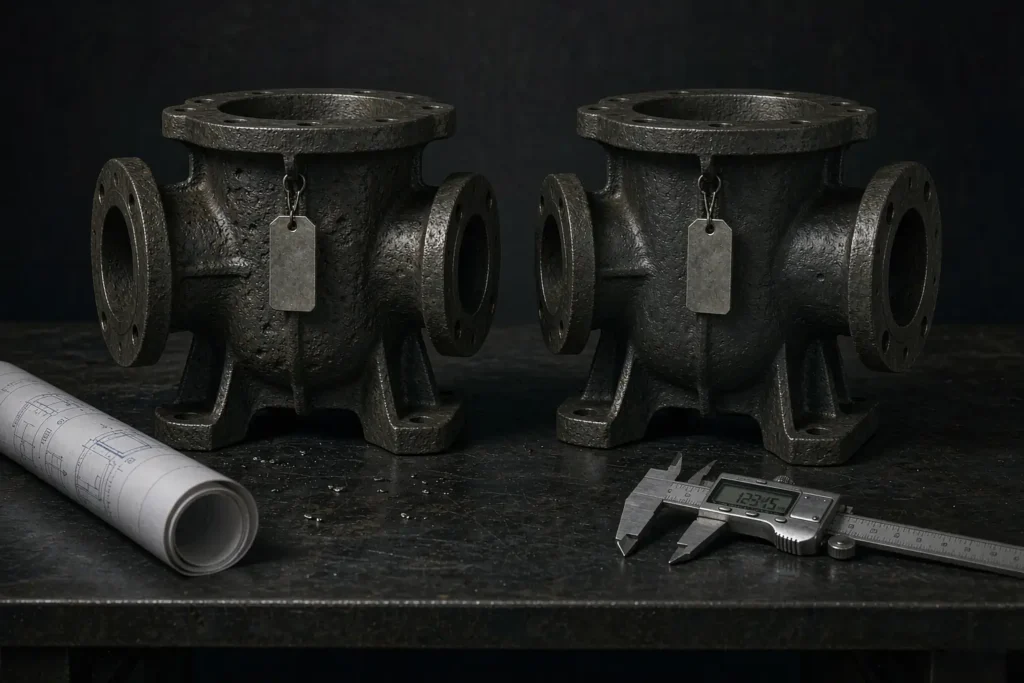
Single-source buying works right up to the day it doesn’t. A furnace transformer fails, a grid curtailment cuts melt capacity in half, or a quality hold freezes your releases — and your line stops because nobody else on earth can pour that part. Casting dual sourcing is the obvious answer, and the obvious version of it is expensive: a second tooling set, a second first-article package, a second process audit, and a permanent volume penalty. This guide turns the decision into arithmetic instead of anxiety.
What follows is the model we use with buyers who run 500 to 20,000 castings a year: what a second foundry genuinely costs to keep alive, what a disruption genuinely costs when it lands, and the break-even probability that tells you which parts deserve casting dual sourcing and which ones just need deeper safety stock. Cost bands and process capability data below come from shop-floor quoting records and industry references including the American Foundry Society and NADCA; every number in the worked examples is shown with its inputs so you can substitute your own.
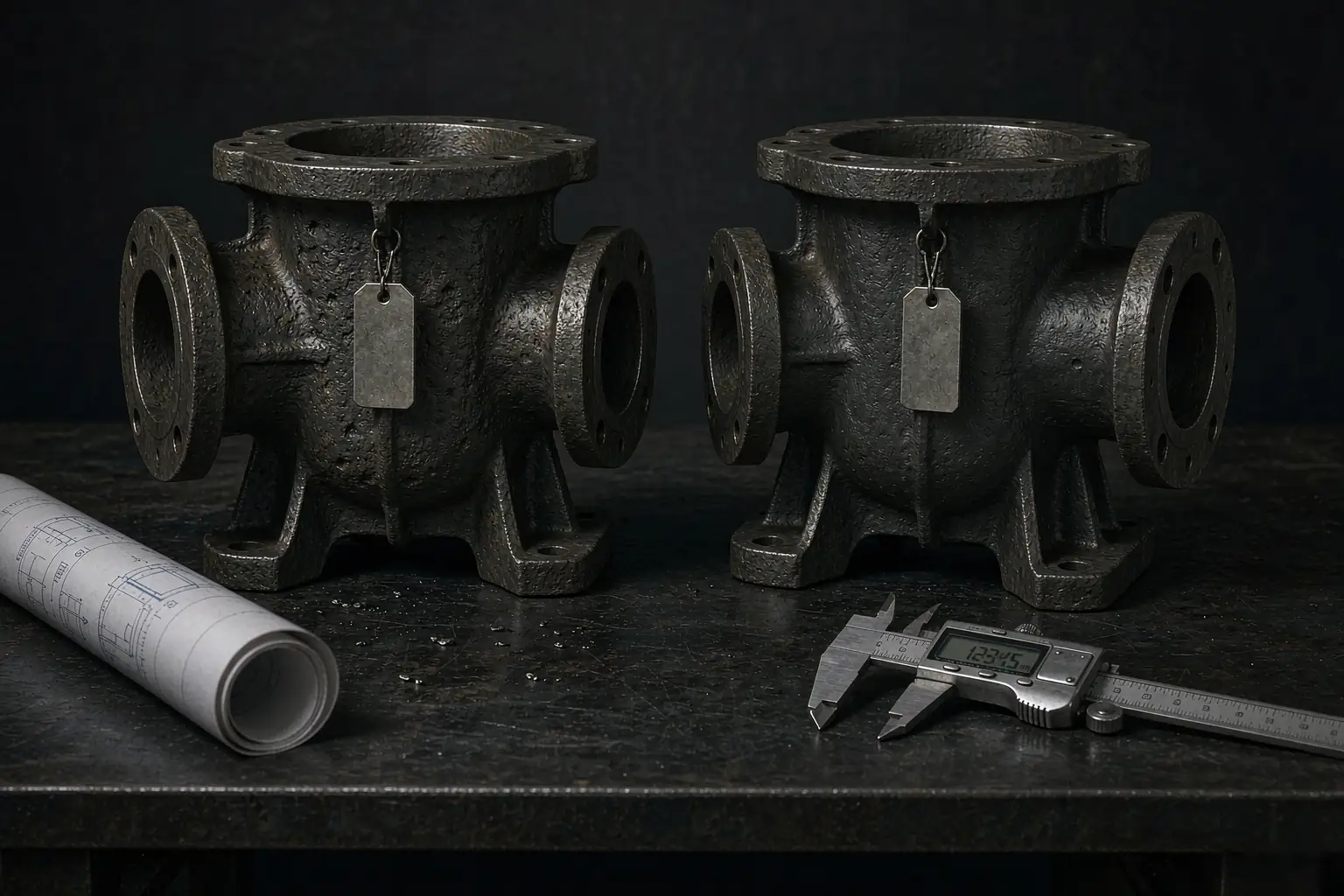
What Casting Dual Sourcing Actually Buys You
Most buyers say “dual sourcing” and mean three very different things. The three models carry wildly different costs and deliver wildly different protection, and mixing them up is the single most common reason a second-source programme gets cancelled after year one.
| Model | Volume to source B | Ramp to full rate | Typical annual carry | Best for |
|---|---|---|---|---|
| Paper alternate — drawings, material spec and tooling drawings on file, no tooling built | 0% | 12–20 weeks | $400–$900 | Low-consequence parts with deep safety stock |
| Warm backup — full tooling built, B runs 1–2 keep-alive batches a year | 10–15% | 3–5 weeks | $5,000–$8,000 | Critical parts where you cannot tolerate a 12-week gap |
| Parallel split — B runs continuously, typically 70/30 | 25–40% | 3–5 days | $7,000–$11,000 | Growth programmes, customer-mandated second sources |
The ramp column is the one that gets ignored, and it is the one that decides everything in casting dual sourcing. A paper alternate does not protect you from a three-week outage — by the time its tooling is cut, the outage is over. A warm backup still needs tooling pulled from storage and refurbished, a sand system re-set, operators re-briefed, and first-off parts re-qualified before rate climbs. Only a source that has poured your part in the last 30 days can surge inside a week. If your part is a green-sand casting or investment casting design, the tooling step dominates that ramp; for high-pressure die casting the die exists at B only if you paid for a second one.
The Real Cost of a Second Foundry
Take a concrete part: an ASTM A536 65-45-12 ductile iron pump housing, 18.0 kg as-cast, 2,400 pieces a year (46 per week), FOB $41.80 per piece — roughly $100,320 of annual buy. Here is what a casting dual sourcing programme actually costs to stand up properly, not on paper.
One-time qualification bill
| Line item | Cost | Why it cannot be skipped |
|---|---|---|
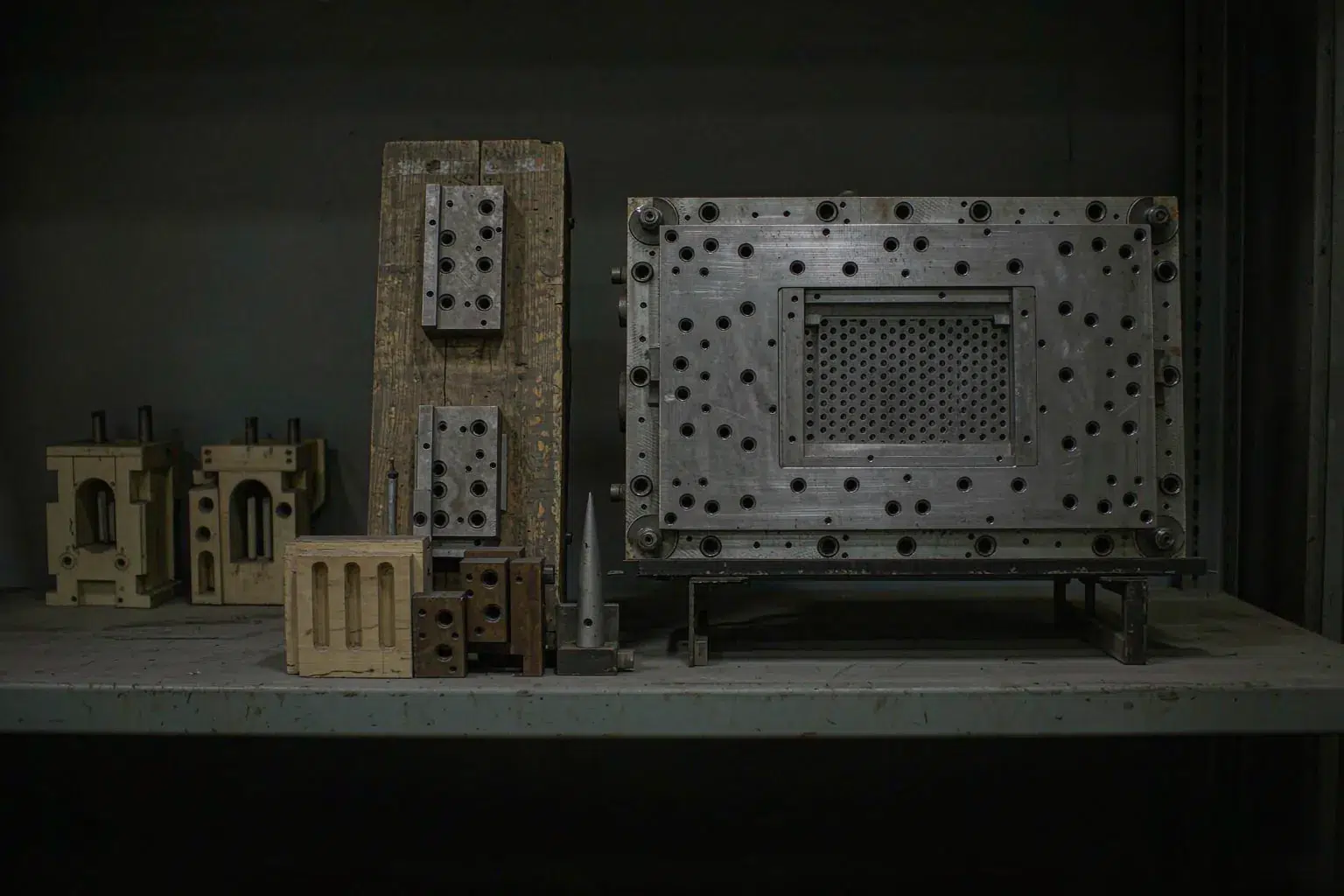
| Duplicate tooling set — matchplate plus core boxes, aluminium | $6,800 | Your existing pattern is sized to foundry A’s flask and moulding line — see how casting moulds are made and why a second set is rarely a copy. Budget 60–100% of original tooling for a true second set; see our casting tooling cost breakdown for the band by process. |
| First-article inspection, full dimensional layout | $950 | Different gating means different as-cast geometry. Cost structure per our FAI cost pack. |
| Material verification — chemistry, tensile, hardness, nodule count | $640 | Same spec on paper is not the same microstructure in the ladle. |
| Machining trial plus capability study, 30 pieces, 5 CTQ features | $2,150 | The only way to know B holds your datums is to cut it on the same CNC machining routing you run in production. |
| On-site process audit, 2 auditors, 1.5 days plus travel | $3,400 | Scope per our casting supplier audit checklist. |
| PPAP Level 3 / control plan documentation | $1,200 | Without a control plan, the second source is a rumour. |
| Internal engineering time, 40 h at $75/h | $3,000 | Drawing review, tooling reviews, FAI adjudication, PPAP sign-off. |
| Total one-time | $18,140 | Amortise over the 5-year tooling life → $3,628/year. |
Annual carry for a warm backup
| Annual line | Amount |
|---|---|
| Amortised qualification, 5-year tooling life | $3,628 |
| Keep-alive volume: 300 pieces at a +$3.10/pc small-batch premium | $930 |
| Second tooling set: storage, annual condition inspection, minor refurb | $420 |
| Audit refresh plus dual control-plan maintenance, 1 day/year | $1,400 |
| Total annual carry (C) | $6,378 |
That $3.10 keep-alive premium is not a penalty the foundry invents — it is the standing cost of any casting dual sourcing arrangement — it is the arithmetic of batch size. A 150-piece batch still eats a full moulding-line set-up and a full melt, so the fixed cost is spread over fewer pieces. The mechanics are laid out in our piece on casting minimum order quantity.
What a Disruption Actually Costs
Now the other side of the casting dual sourcing business case. Assume the buyer holds two weeks of safety stock (92 pieces) and the incumbent suffers a six-week outage. Two weeks are covered by stock; four weeks are not.
| Loss line, single source, 6-week outage | Amount |
|---|---|
| Air freight differential on the 4-week gap: 184 pcs × 18 kg = 3,312 kg at $5.50/kg = $18,216, less ocean $828 | $17,388 |
| Assembly line stoppage, 4 days at $4,600/day | $18,400 |
| Expedite / re-sequencing premium at the foundry | $2,800 |
| Late-delivery exposure to your own customer | $6,000 |
| Internal firefighting, 60 h at $75/h | $4,500 |
| Total loss per event | $49,088 |
With a warm backup, B ramps over four weeks. Safety stock covers the first two; the remaining two weeks run short. The residual: air freight on roughly 92 pieces (1,656 kg at $5.50 = $9,108, less ocean $414) = $8,694, plus two days of line stoppage $9,200, plus $2,000 expedite, $3,000 customer exposure and $3,000 internal time — $25,894. So the loss avoided per event is $23,194.
The Break-Even Probability: Casting Dual Sourcing as a Number
One more input into the casting dual sourcing decision. A live second source changes the annual negotiation: with credible competitive tension, the incumbent’s increase typically lands near +1.8% instead of +4.2%. On 2,100 pieces at $41.80 that 2.4-point gap is worth $2,107 a year — call it the leverage credit V.
Net annual value of the programme = P × L + V − C, where P is your honest annual probability of a disruption longer than four weeks.
Break-even: P* = (C − V) / L = ($6,378 − $2,107) / $23,194 = 18.4%.
Read that carefully. On pure outage arithmetic, a warm backup only pays if you genuinely believe a four-week-plus outage is more likely than roughly one year in five. For a single-furnace foundry on an unreliable grid, that is plausible — and for a ductile iron casting programme with no second melt route, casting dual sourcing is cheap insurance against a melt outage. For a modern multi-line foundry with redundant melt capacity, it is not — and paying $6,378 a year to hedge an 8% risk is a losing trade.
Why the parallel split beats the warm backup
Upgrade from warm backup to a 70/30 live split and two things change. Cost rises: 720 pieces move to a smaller volume tier ($44.30 vs $41.80 = +$2.50/pc = $1,800), offset against the $930 keep-alive premium you were already paying, so +$870; plus ten extra receiving and incoming-inspection events at $90 each, +$900. Extra carry $1,770, total C = $8,148.
But B is now pouring every month, so ramp collapses from four weeks to three to five days. Safety stock covers it entirely: no line stoppage, no air freight, only a $700 expedite and $750 of coordination — residual $3,340, so L rises to $45,748.
| Model | Annual carry C | Loss avoided L | Break-even P* |
|---|---|---|---|
| Single source, do nothing | $0 | — | — |
| Warm backup (85/15) | $6,378 | $23,194 | 18.4% |
| Parallel split (70/30) | $8,148 | $45,748 | 13.2% |
The counterintuitive result: the more expensive model has the lower break-even. A warm backup carries about 78% of the split’s cost while capturing only 51% of its benefit, because the expensive part of a disruption is the four-week ramp, not the tooling. If you are going to do casting dual sourcing at all, do it as a live split or do not do it.
When Casting Dual Sourcing Is the Wrong Answer
Same method, different part. A 6.5 kg grey iron counterweight — a textbook case where casting dual sourcing is the wrong answer: 900 pieces a year, FOB $9.40, no machining, no pressure boundary, and the buyer already holds six weeks of stock.
- Carry. Duplicate wood pattern $2,400 (amortised $480), FAI and dimensional $620/5 = $124, material verification $380/5 = $76, remote audit $900/5 = $180, keep-alive 150 pcs at +$1.85 = $278, storage and refresh $700 → C ≈ $1,838/year.
- Loss avoided. Six weeks of stock means a six-week outage produces no line stoppage at all. Worst case is a late replenishment at spot premium plus ten hours of coordination: about $2,500, against $700 residual with a backup → L ≈ $1,800.
- Leverage. 900 × $9.40 × 2.4% → V ≈ $203/year.
P* = ($1,838 − $203) / $1,800 = 90.8%. There is no realistic disruption probability that justifies it. For this part the right answer is a paper alternate refreshed once a year (roughly $600) and a spot-buy plan, not a second tooling set. Depth of stock beats breadth of supply when the part is cheap, simple and non-critical — the same logic that separates a cheap unit price from the full casting cost breakdown of the whole buy.
What the Second Source Has to Match
A second foundry is not a copy of the first, and that is where most casting dual sourcing programmes quietly fail. Same drawing, same material spec — different gating, different risering, different cooling rate, different as-cast surface. Seven things must be re-established from scratch, and skipping any one of them turns your second source into a second problem.
- Machining allowance and datum stability. New tooling puts the parting line and core prints in new places. Re-verify that every machined face still cleans up at worst-case shift — see casting machining allowance.
- Capability on the CTQ features, not pass/fail. Two sources can both be “in spec” and still not interchangeable downstream.
- Material and heat-lot traceability. Same ASTM number is a claim, not evidence. Require chemistry, tensile, hardness and — for ductile iron — nodule count and pearlite fraction per heat.
- NDT coverage re-established. Different solidification means the shrinkage and inclusion risk moves to different zones; your RT/UT/PT coverage map from source A does not transfer. Method selection in casting inspection methods.
- Heat treatment recipe and the resulting property band. B does not have to use A’s cycle; B has to land in A’s acceptance band, verified on their heat treatment equipment. Tie this into your casting heat treatment specification, not A’s work instruction.
- Surface and coating. As-cast roughness and blast profile differ; primer adhesion and salt-spray hours must be re-qualified on the surface treatment line (casting surface finishing).
- Packaging, labelling and heat-lot tagging. Two sources with different labelling will eventually get mixed in your own warehouse — standardise before the first shipment, and validate the revised geometry on a prototype casting before you commit B’s tooling (casting packaging).
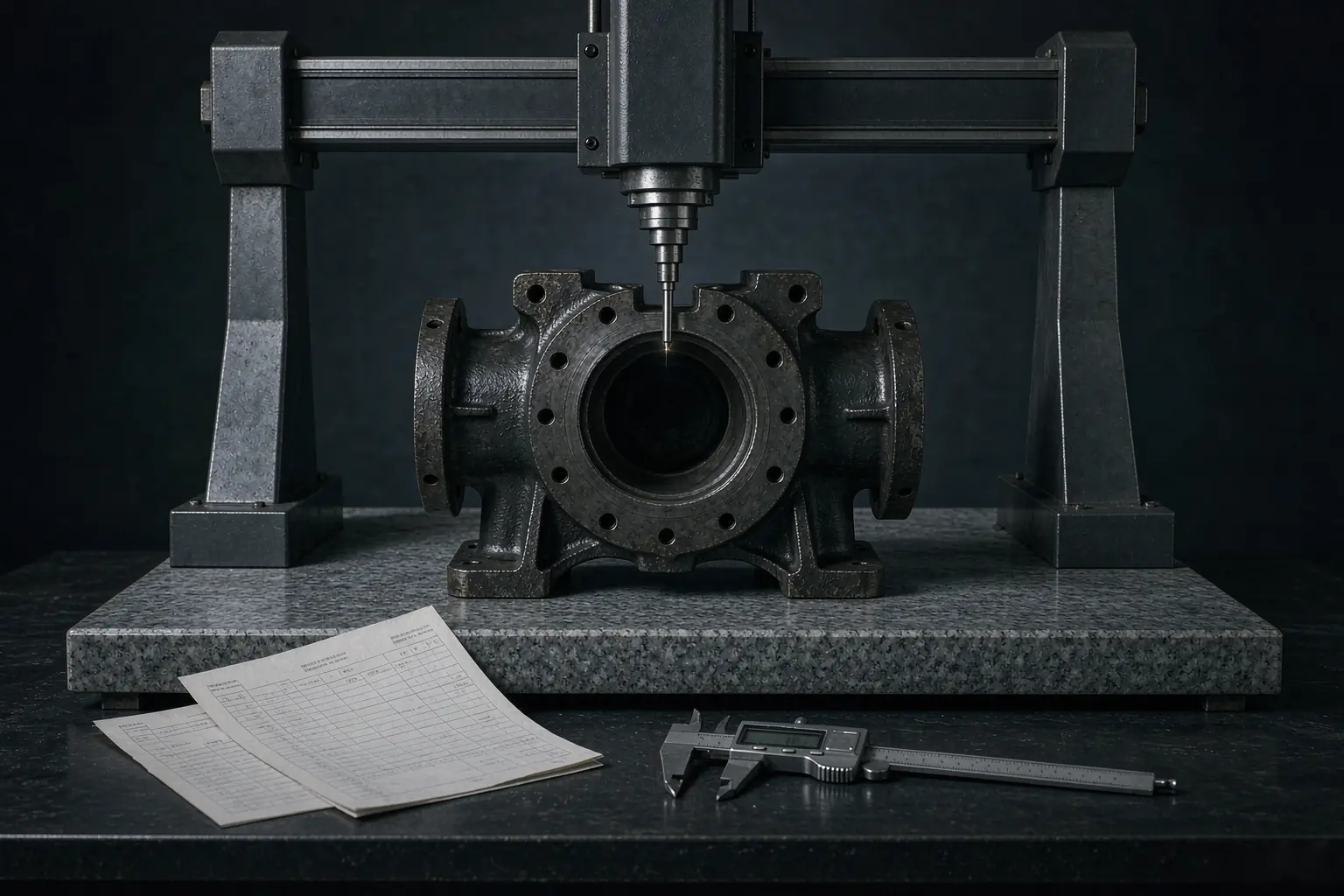
The capability gap that pass/fail hides
Bore Ø62.000 +0.030/−0.000. Source A: mean 62.012 mm, σ 0.004 mm. Cpk = min((62.030 − 62.012)/(3 × 0.004), (62.012 − 62.000)/(3 × 0.004)) = min(1.50, 1.00) = 1.00. Source B: mean 62.021 mm, σ 0.006 mm. Cpk = min(9/18, 21/18) = 0.50.
Both pass every part you measured in the 30-piece trial, and B still misses your 1.33 target by a mile. On the upper side, B sits 1.5σ from the limit: P(z > 1.5) = 6.68%, so 6.68% of B’s 720 annual pieces — 48 parts — arrive oversize. If your first detection point is after machining, at roughly $144.50 of lost value per piece, that is $6,936 a year of quiet scrap that never appears in the dual-sourcing business case. Tolerance and capability language to put in the contract is covered in casting tolerances and casting quality agreement.
Running Two Sources Without Doubling Your Quality Noise
Two foundries produce two distributions. The job in casting dual sourcing is to keep those distributions inside one specification, using one measurement system.
- One drawing, one datum scheme, one control plan. Never let B work to “their version” of the print.
- One gauge and one CMM program. Measurement drift between sites will otherwise be read as process drift.
- Golden sample exchange twice a year. Ship a retained part from A to B and vice versa and run both on the same program.
- Change notification on both sides. Any change to sand system, melt practice, core binder, sub-tier heat treat or coating supplier triggers re-qualification of the affected characteristic.
- Shared nonconformance data. If B’s scrap rate on a characteristic doubles and A’s does not, the root cause is usually B’s method — not the drawing.
Where the two sources diverge on downstream operations — machining, impregnation, coating — standardise the hand-off too, using the same casting secondary operations routing for both, or you will run two different process chains into one assembly.
Geography: What a Second Country Does and Does Not Hedge
Adding a second foundry inside the same country hedges foundry risk but nothing else — a distinction that decides whether casting dual sourcing is worth the bill. Adding one in a different country hedges country-specific measures but not metal-content duties, which follow the metal rather than the flag. Before you assume a second origin fixes your duty exposure, read the mechanics in casting import duty and HS codes.
Illustrative scenario, not a rate quote: move 30% of volume (720 pcs) to a non-China source at a +12% FOB premium = 720 × $41.80 × 0.12 = $3,613/year. If a 25% country-specific additional duty applies to the China-origin goods on your HS code, the saving is 720 × $41.80 × 0.25 = $7,524/year, netting about +$3,911/year. Verify the current rate against the live HTS before you book it — the number moves, and the classification line decides it.
Two more hedges worth pricing before you build a second tooling set:
- Capacity reservation. Reserving 10 t/month at $45/t costs $5,400/year. One avoided air shipment of 200 pieces (3,600 kg at $5.50 = $19,800, less ocean $900) is worth $18,900 — so one avoided event every 3.5 years justifies the fee. This is usually the cheapest real hedge for a buyer who is under 5% of the foundry’s tonnage.
- Tooling escrow and release rights. Costs nothing in cash and must be written. Without a release clause, your pattern is hostage to the commercial relationship exactly when you need it most.
And ask the question most buyers forget: is the incumbent’s constraint capacity or process? If they are running at high utilisation with automation limited to the moulding line only, their surge headroom is thin and a reservation is worth more than a second source. The six-layer view in foundry automation tells you where their bottleneck actually is.
Eight Contract Clauses That Make the Second Source Real
- Second-source right with tooling release. You may have a duplicate set made and, on defined trigger events, have the incumbent’s tooling released to you or transferred.
- Capacity reservation and allocation priority. Stated tonnage or moulds per month, and your rank if the foundry has to allocate.
- Price protection on the keep-alive volume. Otherwise the 300 pieces you must buy to keep B warm get repriced the moment B knows you need them. Pair with the index mechanics in casting price adjustment.
- Tooling condition and refurb responsibility. Who inspects, who pays, and what “unfit to run” means.
- Lead-time commitment and expedite ladder. Contractual casting lead time, plus who pays for air freight when it is missed.
- Change notification and re-qualification trigger. Including sub-tier and raw-material changes.
- Business-continuity disclosure. Single furnace? Single shift? Single melt source? Single power feed? This is the input to your P.
- IP and non-use. Drawings may be used for your parts only, and not quoted to third parties.
Get these into the same document as your quality agreement, not into an email thread, because casting dual sourcing is only as strong as the weakest clause. The full request list — what to ask a foundry before you award — is in casting RFQ, and the unit-economics input you need for the tier comparison is in casting cost breakdown.
FAQ
Is casting dual sourcing worth it for a 500-piece-per-year part?
Usually no. Run the break-even: carry costs in casting dual sourcing are largely fixed, so they scale badly against a small buy. At 500 pieces a year the qualification bill amortises over one-fifth the volume, pushing P* far above any realistic disruption probability. Buy a paper alternate and hold more stock instead.
Can I just move the existing pattern to the second foundry?
Sometimes, and it saves the largest line item in the casting dual sourcing bill. It works when the pattern is a standard matchplate that fits the second foundry’s flask and moulding line, and when the gating still feeds correctly on their equipment. It fails when the pattern is sized to one machine, or when their sand system needs different feeding. Budget 60–100% of the original tooling and treat any saving as upside.
How much volume does a backup source need to stay qualified?
Enough to run at least one full production batch every six months — the question that separates real casting dual sourcing from a tooling set gathering dust — typically 10–15% of annual volume, split into two releases. Below that, tooling drifts, operators turn over, and your “qualified” source is effectively a paper alternate with a tooling bill attached.
Does a second source always raise my unit price?
Splitting volume usually does, because you drop a volume tier on both sides. In the worked example, moving 30% out cost $1,800 a year in tier penalty. Against that, competitive tension cut the incumbent’s annual increase from 4.2% to 1.8%, worth $2,107 a year — a net gain, which is the case for choosing the live split over the warm backup.
What is the single most important question to ask the incumbent?
“How many independent melt lines do you have, and what is your current utilisation?” That answer is your P. A single-furnace shop at 90% utilisation has thin surge capacity and a materially higher disruption probability than a two-line shop at 65% — and it is the one input that decides whether the whole programme pays.
Should the two sources use the same process?
Where the part allows it, yes — same process means comparable tooling, comparable capability and a shorter qualification. Diverging processes (one sand, one investment) can be legitimate when the second source also needs to cover a volume range the first cannot, but expect a full re-qualification and a wider capability spread. A 3D printed prototype validated on both routings is the cheapest way to settle it before tooling. Start from the process comparison in our metal casting guide.
*Cost bands, capability figures and disruption inputs are worked examples built from AFS / NADCA industry references, ASTM A536 material requirements and Supro MFG shop-floor quoting records. Substitute your own volume, buy price and disruption probability before applying the break-even model.
 English
 Français
 Deutsch
 Italiano
 日本語
 한국어
 Polski
 Português de Angola
 Русский
 Español de Argentina