
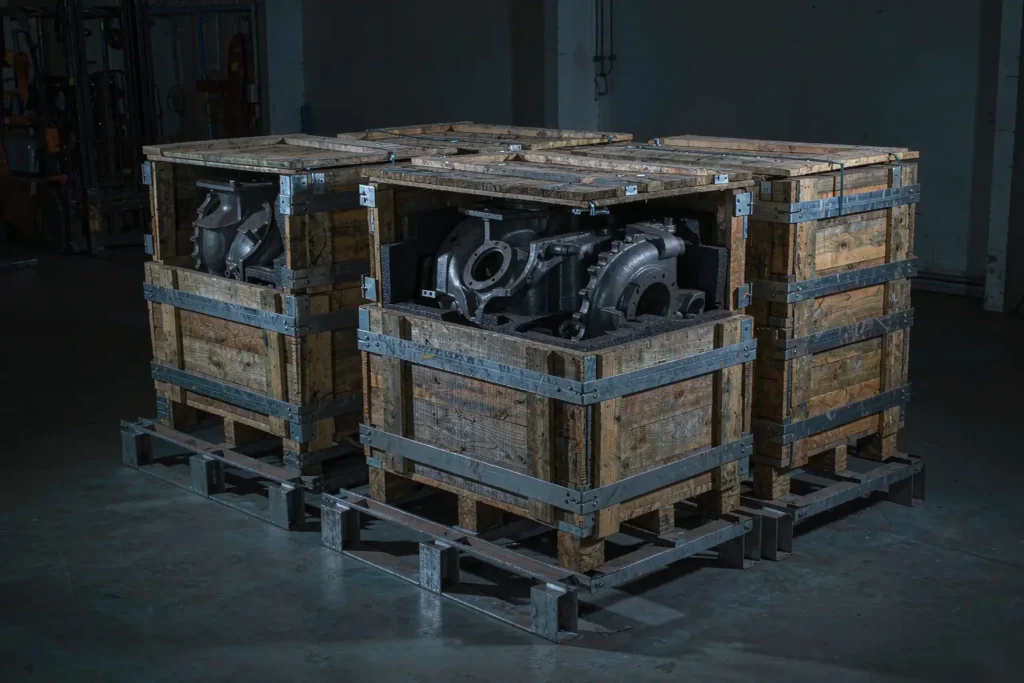
Two foundries quote the same ductile iron pump housing at USD 1.79 and USD 2.22 per kilogram. The cheaper supplier is not the one with the lower number. The gap is not a discount or a markup — it is the delivery term printed after the price, and everything that term moves onto your side of the ledger. Casting Incoterms decide who books the vessel, who buys the insurance, who clears customs, and, the part most buyers miss, who still owns the risk while the goods sit on a terminal six thousand miles from the melt shop.
This guide works through casting Incoterms the way a purchasing team actually meets them: on a quotation, next to a per-kilogram price. It uses one shipment profile — 18 tonnes of ductile iron castings in six ISPM-15 crates, Shanghai to Los Angeles — to price all seven terms on the same cost stack, and then shows the four places where the term on paper and the exposure in practice stop matching. The rule text is cited as published by the International Chamber of Commerce for the 2020 revision; US entry formalities follow US Customs and Border Protection practice.
Why Casting Incoterms Change the Price You Actually Pay
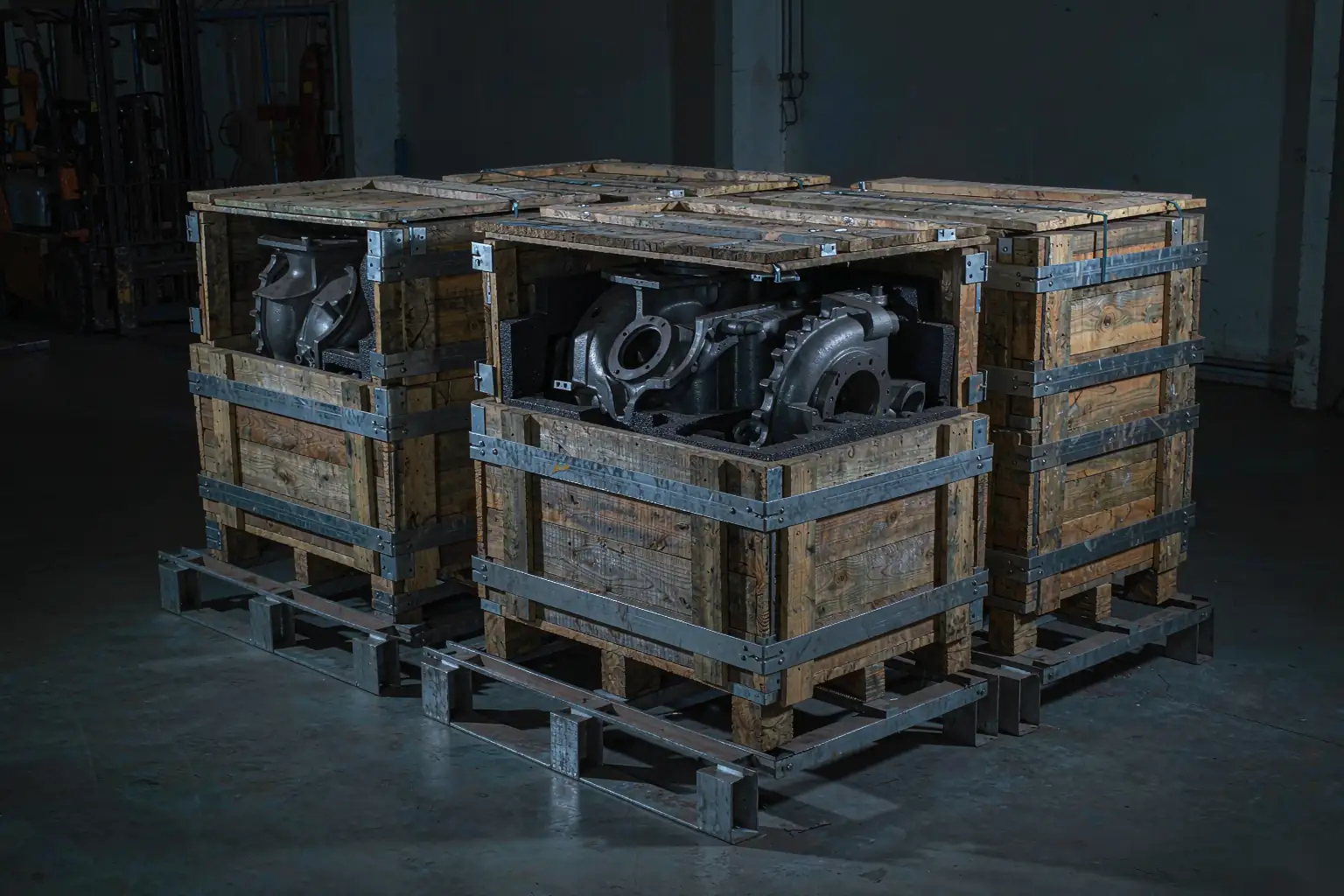
How these parts are made is covered in the metal casting guide. The commercial side starts with one line: “FOB Shanghai USD 1.79/kg”. Three letters and a city. Those three letters move about USD 2,850 of ocean freight, USD 123 of marine insurance, USD 495 of destination terminal charges, USD 165 of broker fees and USD 1,145 of duty and merchandise processing fee between the two parties. They do it silently, because the number in front of the term looks like a price and reads like a comparison. It is neither until the casting Incoterms are fixed and written into the inquiry.
- Cost handover is not risk handover. Under the C-rules the seller pays freight to the destination but the risk passes when the goods are loaded on board at origin. For five to six weeks the cargo is at sea, insured by whoever the term says, and owned in risk terms by a party who may not be the one holding the claim file.
- Castings are heavy, low-value-density cargo. A 40-foot high cube fills to roughly 24 percent of its volume before it hits 72 percent of its payload. Freight is priced on weight and on chargeable tonnage, not on the empty air above the crates, so term selection moves a larger share of total cost than it does for light consumer goods.
- The term sets the customs value. Duty and merchandise processing fee are assessed on the transaction value brought to the US border, which includes international freight and insurance. A term that bundles freight into the unit price raises the taxable base unless the entry is built properly — a detail covered in our guide to casting import duty and HS codes.
The Handover Point Is Not the Cost Point
Under CFR and CIF the seller pays for main carriage to the named destination port, yet risk passes at the port of shipment. That split is not a technicality for castings. A ductile iron housing that chips a machined flange face in a container is still the buyer’s loss under CIF even though the seller paid the freight, because the damage happened after the on-board handover. Conversely under DAP the seller carries the risk to the buyer’s dock but not the import declaration, so a customs hold of nine days becomes the buyer’s problem while the goods are still legally the seller’s risk.
The matrix below is the one worth pinning above a desk. It is the same seven terms, the same shipment, and the same question asked four different ways: who clears export, who pays carriage, who insures, who clears import and pays duty, and where risk actually moves.
| Term | Export clearance | Main carriage | Marine insurance | Import clearance and duty | Risk passes |
|---|---|---|---|---|---|
| EXW | Buyer | Buyer | Buyer | Buyer | At seller’s premises |
| FCA | Seller | Buyer | Buyer | Buyer | On delivery to buyer’s carrier |
| FOB | Seller | Buyer | Buyer | Buyer | Once goods are on board the vessel |
| CFR | Seller | Seller | Buyer | Buyer | Once goods are on board the vessel |
| CIF | Seller | Seller | Seller (ICC C minimum) | Buyer | Once goods are on board the vessel |
| DAP | Seller | Seller | Seller | Buyer | At named place, not unloaded |
| DDP | Seller | Seller | Seller | Seller | At named place, import cleared |
Read the last column twice, because it is where most casting Incoterms decisions go wrong. Under the three C-terms the seller pays carriage but the buyer carries risk from the moment the container clears the rail. That is why a casting buyer who books CIF and then discovers six cracked housings at destination has no claim against the foundry — the foundry performed its contract. The claim belongs to whoever holds the insurance policy, and under CIF that is still the seller, for the buyer’s benefit, at the minimum cover level the rules allow.
The Seven Casting Incoterms You Will See on a Quote
In practice a foundry quotation sheet carries four or five casting Incoterms, not seven. Which ones appear tells you something about the supplier before you read a single number: a shop that quotes only EXW is telling you it has no freight desk; a shop that quotes DDP to the US without asking who the importer of record will be is telling you it has not done the compliance work.
EXW and FCA: Who Is Legally Allowed to Export
EXW puts export clearance on the buyer. On paper that is the smallest possible seller obligation, and it produces the smallest possible number on the quote. The problem is legal, not commercial: a US or German buyer has no Chinese export licence and cannot file a Chinese export declaration. In practice the buyer must hire an export agent, at roughly USD 350–450 per shipment, and the agent — not the buyer — holds the export documents and the VAT refund position. For an 18-tonne shipment that agent fee alone is 420 dollars, which is more than the entire EXW-to-FCA price difference on the same cargo.
FCA is the container-appropriate alternative, and the only one of these casting Incoterms that fixes the export problem without handing freight control to the supplier. The seller completes export clearance and hands the goods to the carrier the buyer nominates, at a named place — usually the container yard or a forwarder facility. The buyer keeps control of freight and insurance, which is exactly what a procurement team with a freight contract wants. When a foundry quotes FCA alongside EXW, the delta is normally 2.5 to 4 percent, and it buys a compliant export declaration and a clean bill of lading chain.
FOB, CFR and CIF: The Container Trap
FOB exists for goods that go over the ship’s rail. The 2020 rules are explicit: risk passes once the goods are placed on board. A container of castings is not placed on board by the seller — it is gated into a terminal, stacked by the terminal operator, and lifted by the terminal’s crane three to seven days later. Between gate-in and lift-on, the seller has paid for the move but controls nothing. If the stack collapses, the seller argues the terminal was at fault, the terminal points at the booking, and the buyer points at the contract. FCA closes that gap; FOB opens it, and the loss lands on finished faces that need a CNC machining rework pass before they can ship.
CIF then adds one more layer that casting buyers routinely misread, and it is the most expensive misreading in this set of casting Incoterms. The 2020 rules require the seller to obtain insurance complying with at least Institute Cargo Clauses (C). Clause C is a named-perils policy: fire, strandings, sinking, collision, discharge at a port of distress, general average. It does not cover handling damage, does not cover rust, and does not cover the two failure modes that matter most on a pallet of machined iron. A CIF certificate on a casting shipment is therefore a document, not a protection.
DAP and DDP: Where the Seller Stops
DAP means the seller delivers to the named place ready for unloading, and the buyer handles import clearance and pays duty. DDP means the seller does both. The commercial difference is one clause; the compliance difference is a US importer of record number, a customs bond, and a party legally resident or registered where the entry is filed. A Chinese foundry without a US entity cannot be the importer of record on a US entry, so a quoted DDP is almost always one of three things: a delivery through the seller’s US affiliate, a non-resident importer arrangement, or DAP with the duty estimate buried in the unit price and the entry filed in the buyer’s name. The third one is where disputes start, because the price says DDP while the paperwork says the buyer owes the difference.
One 18-Tonne Shipment Under Seven Casting Incoterms
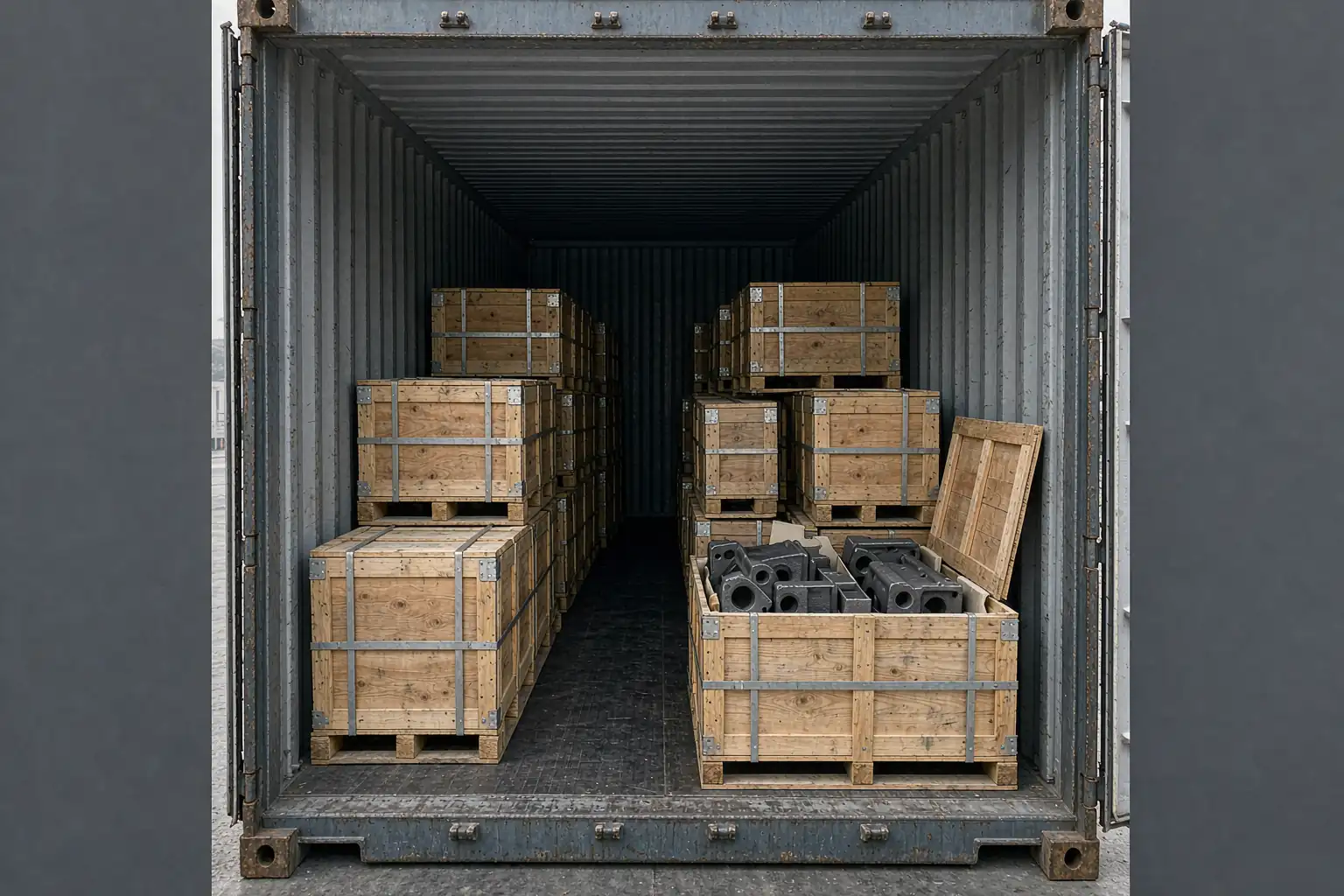
The shipment: 290 ductile iron pump housings at 62 kg each, produced on a green sand casting line and machined on two faces, 18,000 kg net, packed six crates to 19,060 kg gross, 18.4 m³ after crating, Shanghai to Los Angeles, 40-foot high cube, 2026 spot market. Whether a full container is justified at all is a separate calculation, set out in the casting MOQ arithmetic. Base production cost is held constant across all seven quotes, so every difference below is what the casting Incoterms themselves add: freight, insurance, clearance, duty or service margin — nothing else. The castings themselves are the same castings; see iron casting capabilities for the process behind them.
| Cost element | Amount (USD) | Paid by under FCA | Paid by under CIF | Paid by under DDP |
|---|---|---|---|---|
| Goods, ex-works equivalent | 30,960 | Seller | Seller | Seller |
| Inland trucking to port | 420 | Seller | Seller | Seller |
| Export declaration and documents | 185 | Seller | Seller | Seller |
| Origin terminal handling | 310 | Seller | Seller | Seller |
| Ocean freight, 40HQ | 2,850 | Buyer | Seller | Seller |
| Marine insurance | 124 | Buyer | Seller (ICC C) | Seller |
| Destination terminal handling | 495 | Buyer | Buyer | Seller |
| US customs broker | 165 | Buyer | Buyer | Seller |
| Duty, 2.9% of customs value | 1,023 | Buyer | Buyer | Seller |
| Merchandise processing fee, 0.3464% | 122 | Buyer | Buyer | Seller |
| Delivery to buyer plant | 680 | Buyer | Buyer | Seller |
Now the quotation each term produces, and what the buyer actually spends to get the castings onto the dock. The second column is the number a purchasing system records; the fourth is the number the finance team should be comparing.
| Term | Quoted price /kg | Quoted total | Buyer landed cost | Landed /kg | vs FCA |
|---|---|---|---|---|---|
| EXW Shanghai | 1.720 | 30,960 | 37,564 | 2.087 | +0.4% |
| FCA Shanghai | 1.775 | 31,950 | 37,408 | 2.078 | baseline |
| FOB Shanghai | 1.790 | 32,220 | 37,679 | 2.093 | +0.7% |
| CFR Los Angeles | 1.950 | 35,100 | 37,709 | 2.095 | +0.8% |
| CIF Los Angeles | 1.960 | 35,280 | 37,765 | 2.098 | +1.0% |
| DAP Los Angeles | 2.050 | 36,900 | 38,210 | 2.123 | +2.1% |
| DDP Los Angeles | 2.220 | 39,960 | 39,960 | 2.220 | +6.8% |
Three results are worth arguing about in a sourcing meeting. First, EXW is not the cheapest term, even though it carries the lowest unit price — the export agent fee the buyer has to buy back makes it 156 dollars more expensive than FCA on this shipment. Second, FOB costs 271 dollars more than FCA and buys nothing, because the container handover problem described above is priced in but not solved. Third, DDP is 2,552 dollars more than FCA, and 6.8 percent is a lot to pay for convenience on a shipment where the buyer already has a customs broker.
Where the DDP Premium Comes From
That 2,552 dollars is not profit, and it is the clearest illustration of what casting Incoterms actually price. Roughly 427 dollars is the cost of carrying 39,960 dollars of working capital for 60 days at 6.5 percent while the seller waits for the container to arrive and the buyer to pay. Another 1,058 dollars is a risk reserve against duty classification and exchange movement over the same two months — a reserve that exists because a 2.9 percent duty assumption becomes a 25 or 50 percent problem if the entry lands in a Section 232 category. Bond premium, broker handling and document work take perhaps 400 dollars. What remains is the seller’s margin for accepting compliance risk it may not be structured to hold.
For a buyer running four containers a year of the same part, the convenience costs about USD 10,208 annually. That is a defensible number if the buyer has no import function. It is indefensible if the buyer already files entries, which is why the first question in a casting Incoterms negotiation should be “who is the importer of record”, not “can you do DDP”.
Where Casting Incoterms Fail in Real Shipments
Every failure below has shown up on a real casting order, and each one traces back to a casting Incoterms choice made at quotation stage. None of them is exotic, and all of them are cheap to prevent before the vessel sails and expensive to argue about afterwards.
The CIF Certificate That Pays Nothing
A pallet of six machined housings took a forklift tine through the crate during discharge. Two flanges cracked, four bores were scored. Scrap value plus machining rework came to USD 1,730. The CIF certificate was in order, the premium had been paid, and the claim was declined: handling damage is not a Clause C peril. The 180 dollars built into the CIF price bought cover against fire and sinking, on a cargo whose realistic risk was a dropped crate.
Upgrading from Clause C to Clause A costs about 44 dollars more on this shipment — 224 dollars instead of 180 dollars built into the CIF price, at a 0.58 percent rate on 110 percent of CIF value. That 44 dollars would have covered the entire 1,730 dollar loss, a ratio of 39 to 1. The clause is worth more attention than the rate: ask for Institute Cargo Clauses (A), 110 percent of CIF value, warehouse to warehouse, and name the survey agent at destination.
The Handover Term That Does Not Fit a Container
FOB on a container booking creates a five-to-seven-day window in which neither party controls the cargo. Terminal operators handle thousands of container moves per vessel call; a stack collapse or a mis-stowed box is a normal operating event, not an act of God. Under FOB the seller is still the risk holder at that moment and the terminal’s liability is capped by its own tariff, typically a few dollars per kilogram at best. FCA, with delivery at a named container yard, moves the risk at the point where the seller genuinely stops controlling the goods. On the seven-term stack above, FCA is also the cheapest landed option — the correct term is usually also the cheaper one.
Demurrage Caused by Paperwork
Castings arrive with a mill test certificate, a packing list, a commercial invoice, a bill of lading and, for wood packaging, an ISPM-15 treatment mark. Any one of them missing at the broker’s desk stops the entry. Los Angeles detention on a 40-foot high cube runs about USD 185 per day; a seven-day document chase costs 1,295 dollars, more than the marine insurance on the whole shipment and 45 percent of the ocean freight. Under DAP the seller is still responsible for costs up to delivery, so a buyer-caused clearance delay becomes a fight about who pays demurrage — a fight that casting Incoterms can settle in one sentence. The fix is a clause, not a discussion: name the document set, name the number of working days for clearance, and assign detention beyond that date. Production slippage that pushes a vessel date also moves the clearance window, and the casting lead time breakdown shows where those weeks accumulate.
Weight, Volume and the 40HQ Ceiling
Ductile iron at 7.1 g/cm³ puts 18 tonnes into 2.54 m³ of solid metal. After crating the shipment occupies 18.4 m³ of a 76 m³ container: 24 percent of the volume and 72 percent of the 26,500 kg payload. A buyer who reads “76 m³ available” and adds another product line will hit the payload ceiling with the box still two-thirds empty, because the remaining 7,440 kg of capacity is only about 1 m³ of iron. Casting freight is priced on chargeable tonnage — for LCL, the greater of weight and volume — which on this cargo is 19.06 tonnes, not 18.4 cubic metres. Crating rules and ISPM-15 treatment are covered in the casting packaging guide.
| Failure mode | Symptom at destination | Clause that prevents it |
|---|---|---|
| CIF with Clause C cover | Handling damage claim declined; buyer absorbs loss | Name Institute Cargo Clauses (A), 110% of CIF, warehouse to warehouse |
| FOB on a container booking | Damage or loss during terminal dwell; liability disputed | Use FCA with a named container yard or forwarder facility |
| DDP without an importer of record | Duty billed to buyer although price included it | State who files the entry and who holds the bond; price DAP if unclear |
| No demurrage allocation | Detention invoice with no contractual home | Buyer clears within 5 working days; charges beyond that date to buyer |
| Quote without gross weight and volume | Under-booked capacity, reclassification at port | Require net, gross, crated volume and package count on every quotation |
Writing Casting Incoterms Into an RFQ and a PO
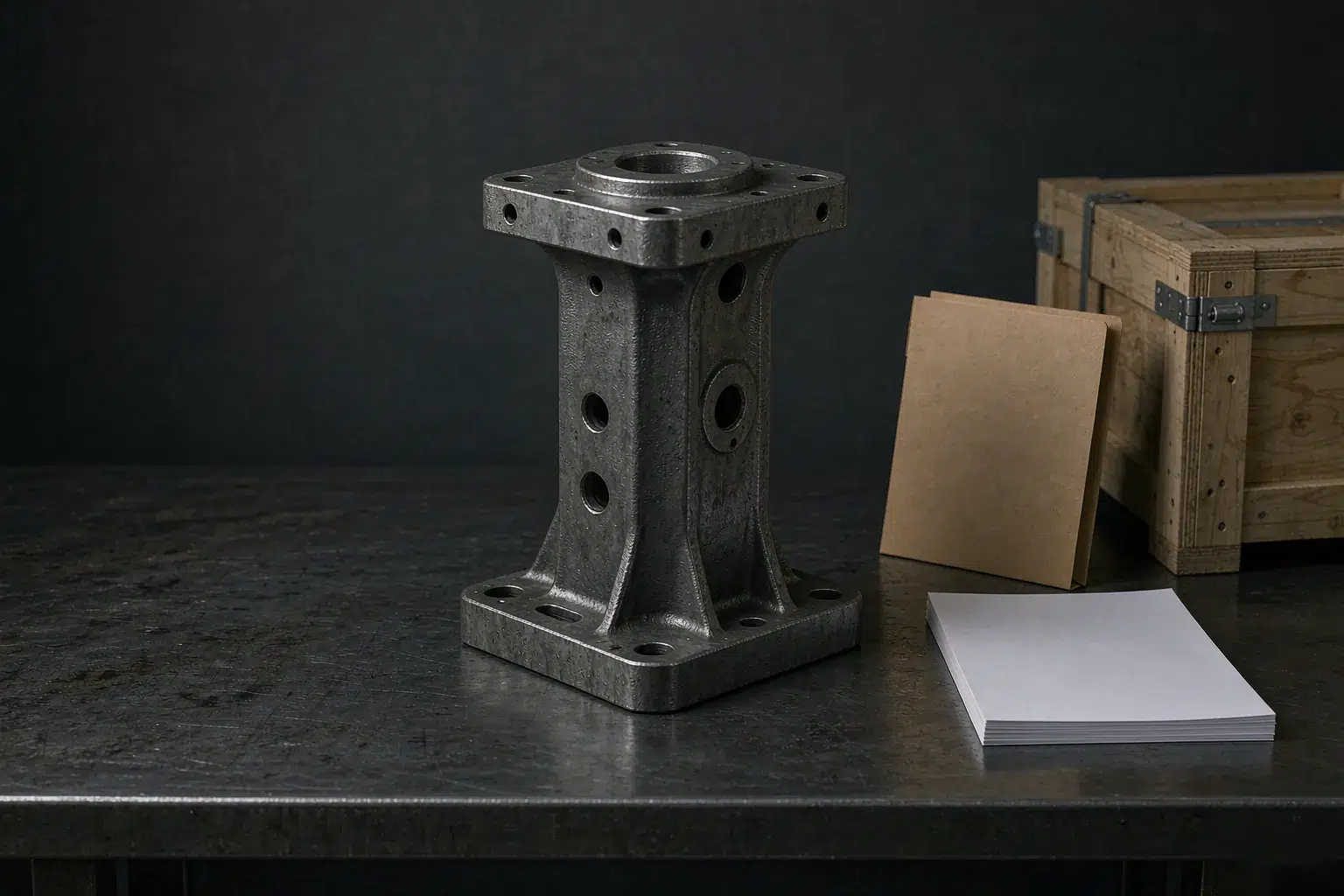
Casting Incoterms are only enforceable if the quotation states them precisely. “FOB China” is not a term; “FCA Shanghai container yard, Incoterms 2020” is. Five fields on the RFQ remove almost all of the ambiguity, and they cost nothing to add. Buyers who want the full inquiry structure can use the casting RFQ checklist; the Incoterms-specific part is below.
| Field | What to write | Why it matters |
|---|---|---|
| Term and named place | FCA Shanghai CY, Incoterms 2020 | Version and place both change the obligation set |
| Weight and package data | Net 18,000 kg, gross 19,060 kg, 6 crates, 18.4 m³ | Drives freight, booking and chargeable tonnage |
| Insurance | Buyer-arranged, ICC (A), 110% of CIF value | Clause C is the default and it is not enough |
| Customs data | HS 7325.99, origin China, MTC and ISPM-15 mark required | Entry cannot be filed without it |
| Charge allocation | Detention beyond 5 working days at buyer’s account | Removes the most common end-of-shipment dispute |
The term does not change with the process, only the freight line does. A pallet of investment castings in 20 kg cartons and a bin of die cast aluminum housings use the same seven terms, but the weight-to-volume ratio shifts the cost stack enough that the cheapest landed option can move from FCA to DAP between one product line and the next.
Three clauses cover the gaps that a term alone leaves open, and they are short enough to paste into a purchase order:
- Price basis. Prices are FCA Shanghai container yard, Incoterms 2020. Seller completes export clearance and delivers to the carrier nominated by buyer. Ocean freight, marine insurance and import clearance are for buyer’s account.
- Insurance. Buyer arranges marine cargo cover at Institute Cargo Clauses (A), 110 percent of CIF value, warehouse to warehouse, including handling and rust. Seller provides commercial invoice, packing list and mill test certificates at least 5 working days before vessel departure.
- Detention and storage. Buyer completes import clearance within 5 working days of vessel arrival. Detention, demurrage or storage charges incurred after that date are for buyer’s account; charges incurred before it are for seller’s account.
One negotiation lever is worth keeping in mind. A seller quoting CIF is charging a margin on the insurance line as well as on the goods; moving to CFR and buying cover directly usually lands within 50 dollars of the CIF price while upgrading the clause from C to A. On this shipment that trade cost 44 dollars and removed a 1,730 dollar exposure. Payment structure interacts with all of this — a 30/70 split against a bill of lading copy behaves very differently under FCA than under DDP, as the casting payment terms guide sets out — and the total cost of ownership view in casting TCO analysis is where the landed figures above belong.
FAQ
Is FOB or FCA better for casting shipments?
FCA, for any shipment that moves in a container — which covers the great majority of casting Incoterms questions that reach a purchasing desk. FOB requires the goods to be on board the vessel before risk passes, which leaves a five-to-seven-day terminal window where the seller pays for the move but controls nothing. FCA moves risk at the container yard, matches how containerised cargo is actually handled, and on the 18-tonne example above it also produced the lowest landed cost of the seven terms.
Does CIF insurance cover rust or breakage during unloading?
Not at the default cover level, and this is the most common casting Incoterms misunderstanding. CIF requires insurance complying with at least Institute Cargo Clauses (C), which is a named-perils policy covering fire, stranding, sinking and collision, not handling damage or rust. If the cargo risk is a dropped crate or a scored bore, the contract needs Clause A named explicitly, at 110 percent of CIF value, warehouse to warehouse.
Can a Chinese foundry sell DDP to a US buyer?
Only through a party that can legally act as importer of record — a US affiliate, a non-resident importer arrangement, or a licensed customs broker acting under a bond. A foundry without that structure cannot file the entry, so a quoted DDP often turns out to be DAP with a duty estimate in the unit price and the entry filed in the buyer’s name. Ask who holds the bond before accepting a DDP price, because the term you sign is not always the casting Incoterms term you are being sold.
Who pays import duty under DAP?
The buyer. DAP ends with the goods delivered to the named place ready for unloading; import clearance, duty and the merchandise processing fee remain with the buyer, who is also the importer of record. That is why DAP quotations look close to CIF prices until the duty line is added at entry.
Which Incoterms version should a casting PO reference?
Incoterms 2020, stated on the face of the purchase order. The 2020 revision renamed DAT to DPU and added a bill of lading option for FCA that lets the seller obtain an on-board document for letter of credit purposes. Undated references default to whatever version both parties can be assumed to know, which is exactly the ambiguity an arbitration does not need. The current rule text is published by the International Chamber of Commerce.
*Freight, terminal, brokerage and duty figures reflect 2026 Shanghai–Los Angeles spot rates and published US fee schedules; Incoterms rule text as published by the International Chamber of Commerce. Landed-cost model maintained from Supro MFG export records.
 English
 Français
 Deutsch
 Italiano
 日本語
 한국어
 Polski
 Português de Angola
 Русский
 Español de Argentina