
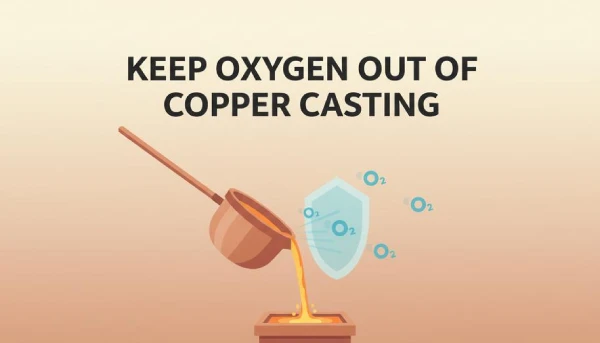
동 주조 시 산화 결함은 건전한 금속을 고철로 만들고, 생산 일정을 방해하며, 바이어와의 신뢰를 무너뜨립니다. 그러나 용탕이 너무 뜨겁고 분위기가 산소로 풍부할 때 산화는 급격히 발생합니다. 이러한 이유로 현대 주조소들은 엄격한 관리, 철저한 규율, 그리고 핵심 공정 지식을 통해 주조 공정에서의 산화 결함에 대처합니다.
로 온도, 합금 조성 또는 공기 노출의 미세한 변동조차도 연쇄 반응을 유발하여 결함을 초래할 수 있습니다 구리 주물 변색, 취화 또는 다공성 등. 근본 원인은 공정 제어의 미흡에 있습니다. 산화는 손상시킬 뿐만 아니라 표면 마감 강도뿐만 아니라 용해와 이송부터 붓기(주입)에 이르기까지 전체 공정에 스며들어 있습니다. 고온 노출, 산소 용해, 금형 설계와 같은 근본적인 원인을 해결해야만 안정적이고 제어 가능한 구리 주물 생산 달성된다.
이 기사는 전체적인 과정에 걸쳐 산화 방지 시스템을 구축하는 방법을 체계적으로 설명할 것입니다. 구리 주조 이 공정은 불활성 가스 보호, 진공 탈기, 플럭스 첨가의 세 가지 핵심 원칙에 중점을 두고, 용해로 조작, 사형 재생, 제중 정밀도, 실시간 모니터링 등의 실제 현장 적용을 통합하여 주조 공장에 실행 가능한 기술 지침을 제공하는 것을 목표로 합니다.

구리 주물은 왜 산화되는가?
구리 주조 공정에서는 산화가 지속적으로 발생하여 주물의 표면 조도, 강도, 기공률에 체계적인 영향을 미칩니다. 노의 온도, 합금 조성 또는 공기 노출의 미세한 변화조차도 연쇄 반응을 유발할 수 있습니다. 변색, 취성, 기공 등의 문제가 발생하는 경우, 그 근본 원인은 일반적으로 공정 제어의 미흡함에서 찾아볼 수 있습니다.
용해로에서의 고온 노출
구리 주물의 산화는 일반적으로 용해로 내부에서 시작됩니다. 언제 주물이 가열되었습니다 지나치게 높은 온도에 너무 오래 노출되면 표면이 깨끗하게 유지될 수 없습니다. 로(爐) 내부의 고온 환경이 합금의 한계를 초과하여, 표면 산화를 가속화하고 용융 금속 표면의 산화막을 두껍게 만듭니다. 고온과 장시간의 열 노출은 용융 금속과 로 내 분위기 간의 반응을 가속화합니다.
동시에 구리에 대한 불안정한 제어 주조 공정은 흔하다 버너의 공연비 변동 및 과도한 공기 유입을 포함한 산화 원인. 또한 재질 자체도 상당한 민감성을 나타내는데, 개방형 로에서 사용되는 인청동과 산소가 풍부한 로 분위기에 노출되는 실리콘 청동은 모두 품질 결함이 발생하기 쉽습니다.
용융 구리 합금에서의 산소 용해
구리 주조 및 기타 구리 주조 공정에서 산소는 숨겨진 요인이며, 용존 산소를 제어하는 것은 최종 주물의 품질에 매우 중요한.
용융 구리 합금에서의 산소 용해도는 온도가 상승함에 따라 증가하며, 액체 상태의 금속은 공기 중에서 산소를 적극적으로 흡수하여 아산화 구리를 형성합니다. 이러한 특성은 전체 주조 과정에 걸쳐 지속되며, 용융 구리의 높은 산소 친화성은 응고 과정에서 가스 포획을 유발하고, 이는 다시 산화 결함을 유발하다 그리고 공극률.
순구리에 비해 구리 합금은 액상 상태에서 산소 용해도가 더 높으며, 이는 가스 흡수 위험을 증가시키고 궁극적으로 인장 강도를 감소시킵니다. 완성된 구리 주물.
두께와 구배각의 영향
구리 주조에서 불량한 형상은 더 많은 주조 결함으로 이어질 수 있으며, 설계 선택 역시 위험에 영향을 미칠 수 있습니다. oxidation in the castings. Thin-walled designs cool more quickly, making them prone to strong turbulence during filling; meanwhile, inadequate 초안 각도 can disrupt the flow and cause surface entrapment of air.
Considering factors related to casting design and mold geometry, in die casting, high-speed filling causes oxidation peaks to rise, while in centrifugal casting, radial forces exacerbate air entrapment. Professional 구리 주조 서비스 must control airflow at the source—through mold geometry—to reduce the risk of oxidation defects.
Insufficient Inert Atmosphere Control
Insufficient Inert Atmosphere ControlThe key to preventing oxidation in copper casting lies in strict atmosphere control. Without an appropriate inert atmosphere, air leaks can easily occur during transfer, causing the molten metal to come into contact with oxygen during pouring.
Protection methods include argon shielding, nitrogen blanketing, and vacuum casting systems.
구리 casting foundries committed to high-quality production typically employ comprehensive protective gas systems. For this reason, the team collaborating with Supro MFG places particular emphasis on implementing controlled anti-oxidation methods during the casting process. Stability of the copper castings is ensured by strictly controlling furnace sealing, gas flow rates, and vacuum duration.
The occurrence of oxidation during copper casting is governed by the physical laws of the process. As long as air and heat are properly controlled, the castings will perform as expected.
신뢰할 수 있는 중국 금속 주조 공장을 찾고 계십니까?
3 Core Principles To Prevent Copper Casting Oxidation
In the copper casting process, even minimal exposure to oxygen can compromise surface finish and strength. In actual production settings, the quality of copper materials and castings depends on how well oxidation is controlled. To address this issue, Supro MFG has established three core principles that address atmospheric isolation, melt purification, and chemical modification, thereby creating a comprehensive oxidation protection system.
Principle 1 - Inert Gas Shielding via Argon Atmospheres
When molten copper comes into contact with air, oxidation occurs immediately. For foundries committed to producing high-quality bronze or brass castings, stable furnace atmosphere management is critical to ensuring the quality of copper castings.
Inert gas protection is the primary method for suppressing oxidation in copper castings. During the furnace atmosphere control phase, high-purity argon—the primary protective gas—is applied directly above the molten pool to create a stable protective atmosphere. During metal transfer, ensuring a continuous flow of argon along the ladle reduces turbulence and covers the exposed molten copper surface to limit oxygen absorption. During the pouring stage, controlling the height of the flow column and preventing spatter ensures continuous protection against oxidation. Implementing this series of measures throughout the copper casting process results in high-quality copper cast products.
Principle 2 - Vacuum Degassing for Dissolved Oxygen Removal
For high-precision copper castings, dissolved oxygen can remain trapped within the molten metal even if the surface appears clean. In such cases, Supro MFG employs a controlled vacuum degassing process to ensure tight and consistent internal quality.
Vacuum degassing effectively removes dissolved oxygen through the following process:
1) Place the molten copper in a vacuum chamber and rapidly reduce the pressure to initiate the degassing process and extract gases.
2) Directly remove oxygen from the molten copper and reduce hydrogen content, ultimately minimizing porosity defects in the castings.
3) The optimized copper alloy castings exhibit higher density, improved tensile strength, and consistent performance.
Principle 3 - Protective Fluxes and Alloying Additives
In actual copper and casting production, surface oxidation can be kept within acceptable limits through the use of sophisticated chemical methods. Supro MFG combines flux control with alloy formulation to ensure that copper castings remain clean throughout the entire process, from melting to pouring into the mold.
A protective flux is applied to the surface of the melt to form a stable flux layer. This protects the melt by blocking contact with air, thereby reducing the formation of inclusions. At the same time, adding deoxidizers such as phosphorus and introducing silicon-based alloy additives during the copper casting process not only directly removes dissolved oxygen from the molten copper alloy but also precisely controls surface oxidation reactions. To further enhance the quality of copper castings, fine-graining agents can be added before pouring to achieve a denser, more oxidation-resistant microstructure, effectively reducing oxide inclusions and resulting in a smoother casting surface.
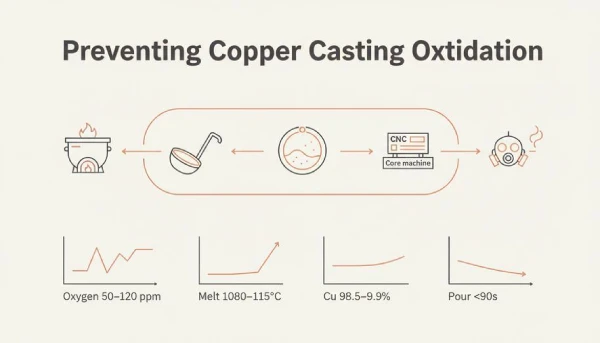
Foundry Setup: Preventing Copper Casting Oxidation
Maintaining the cleanliness of copper castings requires both scientific knowledge and the practical intuition gained from workshop experience. This series will provide a detailed explanation of furnace-side operating procedures, sand handling, core precision, and real-time molten metal inspection. All content is tailored to the daily operations of a foundry and the realities of extended pouring sessions, ensuring consistent copper casting quality throughout the entire production process.
Optimizing Melting Furnaces and Pouring Ladles
High-quality copper casting begins during the smelting preparation stage, not after pouring. To produce castings with high density and low oxidation levels, foundries must implement systematic controls at the furnace and ladle stages. Supro MFG combines the following solutions with process audits to ensure that melt quality is secured before pouring begins.
To achieve high-quality copper casting, the type of furnace selected should be compatible with the charge size of the copper alloy. Induction furnaces are widely used due to their rapid melting rates and reduced oxygen ingress. Additionally, the refractory lining should be inspected regularly for areas where copper has reacted with the lining to prevent the introduction of impurities.
Ladle operating procedures are equally critical in the copper casting process: preheating the ladle prevents gas absorption caused by thermal shock, selecting the appropriate crucible material limits impurity adsorption, and temperature control must be maintained within the recommended temperature range for the alloy to prevent overheating from exacerbating oxidation.
During the transfer phase, the surface of the molten pool is covered with an inert gas; the steady gas flow significantly reduces oxygen entrainment caused by turbulence, thereby producing uniform copper 배역.
Integrating Sand Reclamation Systems to Reduce Inclusions
The cleanliness of molding sand directly affects the quality of copper castings. Residual oxides in contaminated sand can re-enter the molten copper, leading to inclusion defects. An integrated sand regeneration system effectively addresses this issue: mechanical regeneration removes scale, while thermal regeneration burns off the binder. Combined with screening to control particle size and a sand cooler to stabilize the mold cavity temperature, this system enhances mold cavity integrity. A cleaner sand-binder mixture allows the molten copper to flow more smoothly during pouring.
Deploying CNC Machining Centers with Core Making Equipment
Core misalignment can cause metal spatter and exacerbate oxidation reactions in copper casting. To address this issue, Supro MFG employs the following integrated approach to consistently maintain uniform wall thickness and minimize turbulence during repeated casting production.
1) Standardizing the geometry of the core box;
2) Setting the core pusher pressure to ensure uniform filling;
3) Thoroughly drying the cores after cleaning, without cutting corners;
4) Automating core handling to minimize damage;
5) CNC machining precision at the sprue ensures a stable melt flow.
Using Spectrometers for Real-Time Atmosphere Monitoring
Modern gas analysis tools can monitor oxygen levels before defects become apparent, and the real-time data displayed allows for the timely salvage of non-conforming furnace batches.
“Real-time melt monitoring is becoming a baseline expectation for copper alloy quality,” noted the International Copper Association’s 2024 manufacturing outlook.
The monitoring system primarily consists of an oxygen sensor positioned above the melt pool that works in conjunction with emission spectroscopy to continuously monitor oxygen levels and shifts in alloy composition, while maintaining an inert atmosphere through an argon shield or nitrogen purge.
The control loop refers to the mechanism that allows for rapid parameter adjustments after abnormal data alarm signals are fed into the process control system. The following are the key control parameters:
매개변수 | Target Range | Alert Point | Action |
Oxygen (ppm) | 50–120 | >150 | Increase inert cover |
Melt Temp (°C) | 1080–1150 | >1180 | Reduce power |
Cu % | 98.5–99.9 | <98.3 | Alloy correction |
Pour Delay (s) | <90 | >120 | Reheat ladle |
Supro-Mfg에 문의하기
Oxidation control in copper casting must be implemented throughout the entire process, from melting and transfer to pouring. By identifying high-temperature exposure, oxygen dissolution, and design flaws at the source; implementing the three key principles of inert gas protection, vacuum degassing, and fluxing; and optimizing shop-floor practices such as furnace and ladle design, sand regeneration, core-making precision, and real-time monitoring, systematic measures can significantly improve the density and mechanical properties of copper cast parts while reducing scrap rates.
 English
 Français
 Deutsch
 Italiano
 日本語
 한국어
 Polski
 Português de Angola
 Русский
 Español de Argentina