
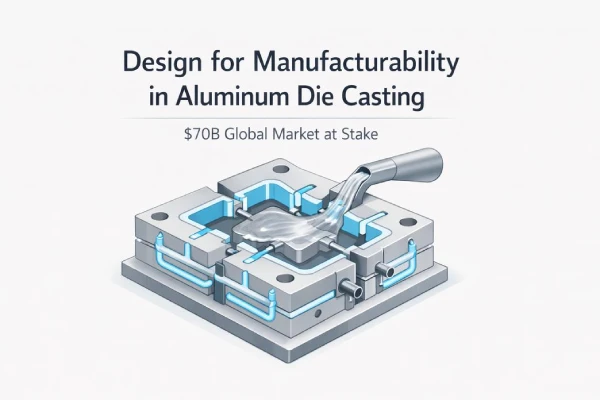
Aluminum die casting is more than just a shop-floor process; it determines whether a part will operate reliably for years or crack under pressure. In high-volume production, even minor design flaws can lead to scrap, delays, and budget overruns. Grand View Research estimates the global aluminum die casting market to be worth over $70 billion, which clearly demonstrates the high stakes in this industry. When profit margins are slim, Design for Manufacturability (DFM) directly determines the success or failure of production.
Through Design for Manufacturability, it is entirely possible to eliminate risks before metal injection: from identifying thin-walled areas through simulation, to optimizing runner geometry, and precisely controlling mold temperature—each step directly impacts the density and dimensional stability of die-cast aluminum.
This article will break down the design guidelines for aluminum die-cast parts step by step, covering topics ranging from uniform wall thickness design and smooth transition techniques to thin-wall risk simulation, as well as guidelines for the five major gate and runner configurations and the impact of mold temperature on quality. Whether you are responsible for product development or production management, mastering these DFM essentials will help your aluminum die-casting projects avoid pitfalls and produce more high-quality parts.
Aluminum Die Casting: Designing Uniform Wall Sections
Achieving high-quality 알루미늄 다이캐스팅 involves more than just the three basic processes of pouring metal, cooling, and demolding. In fact, wall thickness design is the key factor that determines the success or failure of a part. From the flow characteristics of aluminum alloys to the cooling rate of die-cast parts, uniform wall thickness ensures that parts remain straight, strong, and cost-effective. Let’s take a closer look at how intelligent aluminum die casting design can help your workshop avoid production challenges.
Why Uniform Wall Thickness Is Critical in Die Casting
In the aluminum 다이캐스팅 process, uniform wall thickness determines how molten aluminum fills and solidifies within the mold. When wall thickness is consistent, material distribution remains balanced, and stress levels are kept low.
Consistent wall thickness ensures that the cooling rates of the die-cast aluminum material are synchronized, preventing localized hot spots and allowing the metal to solidify stably. As a result, shrinkage is balanced, internal stresses are low, dimensional stability is achieved, and strength and fatigue life are naturally enhanced. Conversely, abrupt transitions from thick to thin walls, isolated bosses, or unbalanced ribs can compromise the integrity of aluminum die cast parts, leading to warping or even scrap.
In Supro MFG’s aluminum alloy die casting projects, engineers review wall thickness distribution diagrams at the earliest possible stage to coordinate cooling rates with gate layout. This approach ensures both the integrity of the aluminum die castings and the smooth progression of production, rather than reacting to issues after they arise.
Best Practices for Smooth Section Transitions
Abrupt changes in cross-section are the primary cause of turbulence and shrinkage cavities in aluminum die castings. Smooth section transitions allow molten aluminum to flow freely, preventing turbulence.
The following methods have proven effective in actual die-casting projects:
- Use larger fillets to avoid sharp corners.
- Use gradual tapers to transition wall thickness changes.
- Maintain appropriate draft angles to facilitate ejection.
When adjusting the geometry of aluminum die cast parts, the gate should be located in a thicker section to allow the molten aluminum to flow naturally toward the thin-walled areas. At the same time, using ribs instead of solid structures enhances rigidity without adding weight. These design choices stabilize flow, reduce stress, and minimize the risk of shrinkage while maintaining strength, thereby ensuring the dimensional accuracy of large 알루미늄 주물.
Care must be taken with challenging chamfers that can cause heat buildup or restrict flow channels. Combining proper geometry with early-stage flow analysis is essential to ensure balanced filling in aluminum die casting. Supro MFG often optimizes aluminum die castings by replacing thick gussets with a network of ribs. This approach maintains strength while reducing stress and producing a smoother casting surface.
Simulation Techniques to Spot Thin-Section Risks
Thin-walled sections of aluminum die cast parts may solidify before the mold cavity is fully filled. Simulation software can identify these risks in advance. Follow this workflow:
- Run a flow simulation. Track the mold filling rate and identify stagnant zones in thin-walled areas.
- Analyze the solidification process of aluminum die-casting materials by plotting temperature gradient distributions to check for the risk of premature solidification.
- Combine thermal analysis to evaluate the impact of cooling channels and optimize cycle time.
- Use data to fine-tune wall thickness and optimize gates and vents, ensuring that aluminum die-cast parts are both lightweight and structurally sound.
With proper thin-wall analysis, the 알루미늄 다이캐스팅 process becomes predictable rather than relying on trial and error. For complex aluminum alloy die casting projects, conducting simulations prior to mold manufacturing can significantly reduce risks and effectively control costs.
5 Guidelines for Gate and Runner Design to Improve Aluminum Die Casting Quality
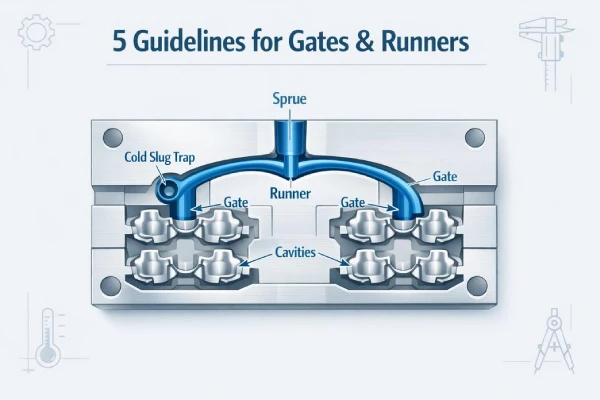
The success of high-quality aluminum die casting hinges on the design of the gates and runners. As the molten aluminum alloy is injected through the gate and flows through the runners to fill the mold cavity, the flow characteristics directly determine the quality of the casting: even with a high-quality alloy, improper runner design will inevitably lead to defects in the parts; only with a well-designed runner layout can the molten metal flow smoothly and fill the mold without obstruction. Runner control is, therefore, the critical factor in aluminum die casting projects.
Guideline 1: Selecting the Ideal Gate Location
The gate location determines the metal flow path and the quality of the casting. When planning the gate location for 알루미늄 다이캐스팅, the following factors should be considered:
An ideal gate should match the geometry of the aluminum die casting part, shortening the flow distance and minimizing sharp turns in the filling path, thereby reducing turbulence and the risk of weld lines.
By strategically positioning the gate to limit weld lines and designing proper venting to prevent gas pockets, the risk of defects can be effectively controlled.
Protect the core by preventing the molten metal from directly impacting fragile cores and guiding it to flow along the cavity walls.
At Supro MFG, engineers review the CAD flow paths before cutting the steel. This early inspection helps prevent avoidable defects from occurring later in the aluminum die casting project.
Guideline 2: Streamlining Runner Geometry to Reduce Turbulence
In aluminum die casting, a streamlined runner design ensures smooth metal flow. Maintaining a consistent cross-sectional area of the runner helps control the flow velocity of the aluminum die casting material. The use of tapered curves reduces turbulence. Balancing runner length helps control pressure drop and stabilize filling time. Smooth runners minimize oxide buildup and internal porosity. For aluminum die cast parts with stringent surface finish requirements, this also helps preserve surface quality.
According to the 2025 North America Die Casting Market Outlook by IBISWorld, manufacturers improving flow efficiency report measurable scrap reduction and stronger margin control. This insight confirms what experienced aluminum die casting manufacturers have long understood: strict control of metal flow pays off.
Guideline 3: Balancing Gate Size with Fill Time Requirements
In the aluminum die casting process, gate dimensions must be precisely balanced with part wall thickness and filling time. Gates that are too thin can cause the metal to solidify prematurely, while gates that are too thick are prone to flash. Properly matching gate dimensions to part wall thickness helps maintain a stable metal flow rate and, in conjunction with the cooling rate, promotes directional solidification. This also prevents excessive pressure from causing flash or excessive filling time from resulting in insufficient filling.
Supro MFG’s engineers fine-tune 알루미늄 다이캐스팅 gates through a combination of simulation and shop floor testing until both the data and the parts meet optimal specifications. Striking this balance is key to producing high-density aluminum die 부품 캐스팅.
Guideline 4: Integrating Cold Slug Traps for Cleaner Castings
A properly designed cold runner collector can improve the quality of aluminum die-cast parts. An integrated cold runner trap captures the initial metal, which has unstable temperature, and isolates impurities before they enter the mold cavity. This design enhances the runner system and gate design, resulting in cleaner aluminum castings with fewer defects.
During the aluminum die casting process, the initial metal flow often carries oxides and debris from the shot sleeve. A properly sized cold runner effectively prevents these impurities from reaching the critical surfaces of the aluminum die castings. Though it appears to be a small groove, it plays a crucial role.
Guideline 5: Harmonizing Runner Layout for Even Metal Flow
A balanced runner layout ensures uniform metal distribution among the cavities in a multi-cavity 알루미늄 다이캐스팅 금형. By balancing runner lengths, adjusting cross-sections to stabilize pressure, and combining this with precise gate positioning, it ensures synchronized material supply with the injection sleeve.
This ensures consistent part weight, reduces internal stress, and improves the repeatability of aluminum die casting production. For manufacturers producing aluminum die 부품 캐스팅 in batches, a balanced runner layout is the cornerstone of consistent quality. Supro MFG employs this balanced approach to ensure that each cavity is filled as if it were the only one in the mold.
신뢰할 수 있는 중국 금속 주조 공장을 찾고 계십니까?
- 우리는 제품 디자인을 최적화하고 비용을 절감하는 데 도움을 드릴 수 있습니다.
- 당사는 고품질의 대량 주조 부품 생산을 도와드릴 수 있습니다.
- 우리는 정시 배송을 완료하고 더 많은 판매 시장 기회를 확보할 수 있습니다.
- 수프로 MFG를 통해 혜택을 받으실 수 있습니다. 금속 주조 서비스.
How Does Mold Temperature Affect Quality?
Mold temperature is a critical factor in the success of aluminum die casting. If the temperature is too low, the molten aluminum will solidify prematurely; if it is too high, dimensional drift will occur. During the actual die casting process, heat flow controls surface finish, porosity, and dimensional stability. Only by accurately controlling mold temperature can we ensure that aluminum die cast parts have sharp edges, a dense structure, and consistent dimensions.
Preheating the Mold Improves Surface Finish
In the aluminum die casting process, mold preheating directly affects surface finish and overall casting quality. When cold steel comes into contact with molten aluminum, heat transfer increases dramatically. Rapid cooling disrupts metal flow, causing surface layering and cold shuts to appear quickly.
A stable mold opening process can bring about fundamental changes to aluminum castings:
1) Preheat the mold to a controlled reference temperature.
2) Balance heat transfer among the cavities.
3) Maintain metal flow during the die casting process.
For production teams engaged in large-scale aluminum die casting, the benefits are clear: controllable surface quality, effective reduction of thermal shock, and smooth filling of the mold cavities. Metal flow is stable, which reduces casting surface defects and results in cleaner edges. Professional 알루미늄 다이캐스팅 manufacturers like Supro MFG regard preheating as a non-negotiable requirement in the die casting process, particularly for thin-walled aluminum die castings.
Thermal Gradients Lead to Porosity Defects
Uneven temperature gradients can cause variations in the solidification rate within the cavity of an aluminum die casting. Areas with higher temperatures cool more slowly, while cooler areas solidify prematurely, leading to restricted metal flow and uneven filling. This chain reaction directly results in the formation of porosity, shrinkage cavities, and microporosity defects within the aluminum die casting parts, accompanied by residual stresses and surface bubbles.
The more pronounced the temperature gradient, the lower the density of the die cast aluminum material. Maintaining consistent mold temperatures is essential for ensuring the structural integrity of die-cast parts. Professional aluminum die-casting manufacturers optimize their processes through thermal analysis to prevent porosity defects and ensure that every batch of castings is reliable and durable.
Controlling Mold Temperature for Consistent Dimensions
Dimensional drift in aluminum castings is typically caused by poor mold temperature control. To ensure dimensional consistency in aluminum die cast parts, it is necessary to adjust the cooling channels, monitor die-casting parameters in real time, and compensate for thermal expansion during long periods of continuous production.
Key control steps include establishing thermal equilibrium through zone heating and directional cooling. Data corrections are made based on sensor feedback. A stable mold temperature ensures uniform shrinkage of the die cast aluminum material, resulting in predictable shrinkage rates, tighter tolerances, and greater part integrity. This is precisely why aluminum die casting maintains reliability across every shift.
Supro-Mfg에 문의하기
The key to successful 알루미늄 다이캐스팅 lies in meticulous attention to detail during the design phase: uniform wall thickness, smooth transitions, and well-designed gates and runners, combined with stable mold temperatures. These guidelines effectively minimize defects such as porosity and warpage, ensuring that aluminum die cast parts are dimensionally consistent and structurally sound. Supro MFG’s experience shows that optimizing the design early on is more cost-effective and yields higher-quality products than attempting to correct issues later in the process.
 English
 Français
 Deutsch
 Italiano
 日本語
日本語 한국어
한국어 Polski
 Português de Angola
 Русский
 Español de Argentina