
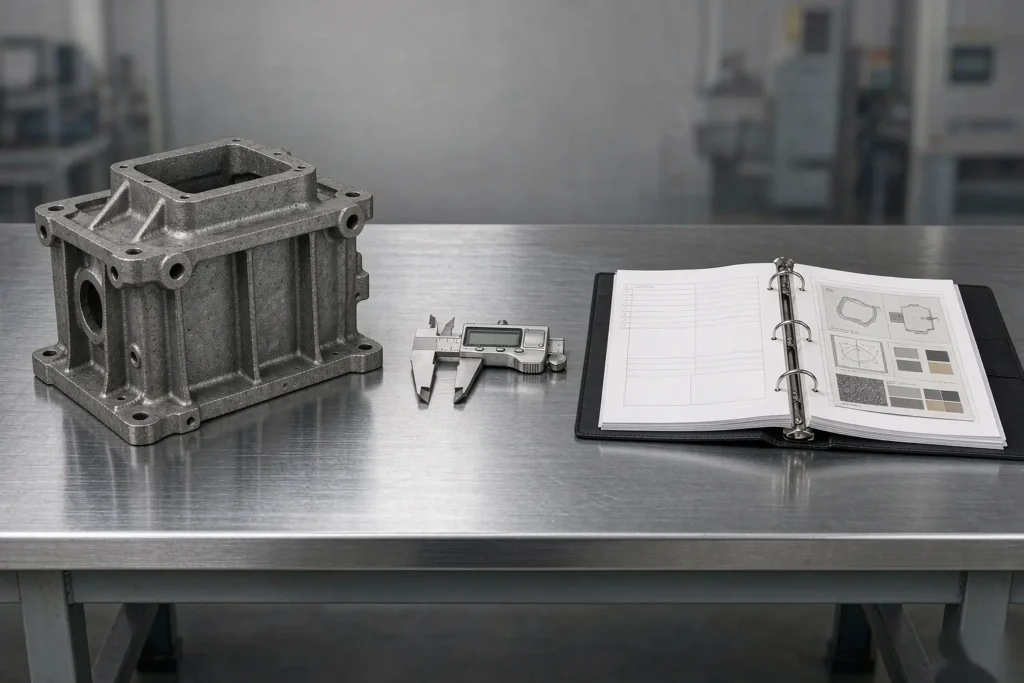
A casting quality agreement is the document that decides who pays when a part gets rejected — and most buyers sign one without reading it. Everything else in the sourcing file (the RFQ, the tooling quote, the price clause) only matters up to the moment something arrives wrong. After that, one paragraph of acceptance criteria and one sentence of liability cap decide whether you recover $144.50 or eat it.
This guide is written for buyers who machine, assemble or resell castings. It covers the 12 clauses a casting quality agreement needs, how to write acceptance criteria a foundry can actually measure against (ISO 8062-3, ASTM E446, MSS SP-55, EN 10204), what ISO 2859-1 sampling really protects you from, and how the claim window and liability cap move real money. Every number below is worked out, not quoted, so you can rebuild the same casting quality agreement arithmetic on your own part and volume. Standards references follow AFS et ASTM practice; the cost model comes from a 2,400-piece-per-year ductile iron housing programme.
What a Casting Quality Agreement Actually Decides
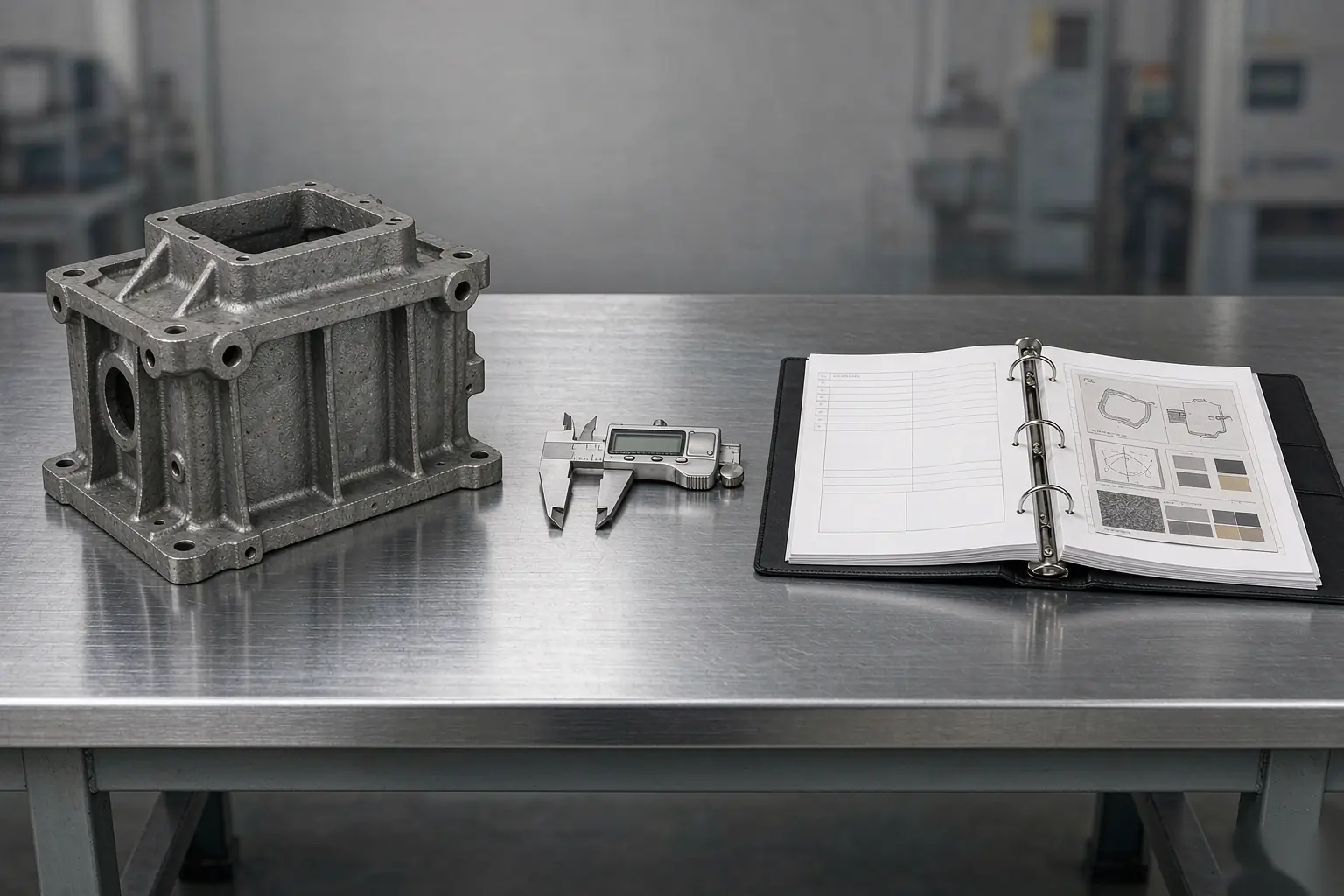
A casting quality agreement is not a quality manual and not a marketing certificate. It answers four questions that no drawing answers: what counts as a defect, how many parts get checked, who decides when a defect is the foundry’s, and how much the foundry pays when it is. Get those four right and disputes settle in days. Get them wrong and every claim becomes a negotiation you lose, because you are arguing about definitions instead of facts.
- “Passed inspection” is not an acceptance criterion. It describes an activity, not a limit. If your agreement says the foundry “inspects 100%”, you have no standard to reject against.
- Defects found after machining are the expensive ones. A casting that fails at the foundry gate costs its own price; the same casting that fails after you have machined it costs roughly three and a half times that. The agreement has to allocate that difference explicitly.
- Silence defaults to the seller. Where the agreement is silent on evidence, retention or time limits, the outcome defaults to whoever holds the parts — usually the foundry, once the goods are paid for.
| Clause | What it must say | The vague version that costs you money |
|---|---|---|
| 1. Scope & identification | Drawing number + revision, alloy and specification with year, heat-lot marking | “Per drawing” |
| 2. Dimensional acceptance | ISO 8062-3 DCTG grade, datum scheme, which features are measured | “Per print tolerances” |
| 3. Internal soundness | ASTM E446 / E186 / E280 category with severity level and the zones it applies to | “Sound castings” |
| 4. Surface acceptance | ASTM A802 or MSS SP-55 visual level, reference photos, Ra where machined | “Good surface finish” |
| 5. Material evidence | EN 10204 3.1 certificate tied to heat number: chemistry, tensile, hardness | “Material certificate provided” |
| 6. Heat treatment record | Furnace chart or batch record, hardness results by lot, not by “typical” | “Heat treated” |
| 7. Sampling plan | ISO 2859-1 level II, AQL per defect class, switching rules named | “Random inspection” |
| 8. First article gate | Full layout plus material and NDT reports before production release | “Samples approved” |
| 9. Defect classification | Critical / major / minor with definitions and disposition authority | “Nonconforming parts rejected” |
| 10. Claim window | Days from receipt or from machining, whichever is later | “Claims within 10 days of delivery” |
| 11. Remedy & liability cap | Replace, credit or rework, with the cap stated as a multiple of casting value | “Liability limited to invoice value” |
| 12. Traceability & retention | Heat-lot ID on every casting, three retained samples per lot, 12 months | “Parts traceable by batch” |
Writing Acceptance Criteria a Foundry Can Measure
In a casting quality agreement, every acceptance criterion should be a sentence a stranger could apply to the same part and reach the same verdict. That means naming the standard, the grade or severity level, and the zone it applies to. “Free of defects” fails that test; “no Category C porosity above severity level 2 in the pressure boundary, per ASTM E446” passes it.
Dimensional: name the DCTG grade and the datum
Castings are toleranced by ISO 8062-3 using Dimensional Casting Tolerance Grades (DCTG), not by the ±0.1 mm habits of machined parts — and the grade belongs in the casting quality agreement as a number, not as a note in the drawing title block. Writing “DCTG 10” on the drawing and in the agreement removes the argument, because DCTG values scale with the casting’s size range — see our casting tolerances reference for the grade tables. What buyers forget is the second half: the datum scheme. A layout report measured from a different datum than your machining fixture will pass at the foundry and fail on your machine. Put the datum order in the casting quality agreement, and check the first article against it — and read it alongside the cleanup stock you actually need, covered in our casting machining allowance guide. That gate is worth the two weeks it costs, as set out in our first article inspection guide. If you are still at sample stage, the metal prototype casting route shortens it further.
Internal soundness: severity levels, not adjectives
Radiographic acceptance works off reference plates: ASTM E446 for steel sections up to 2 in, E186 for 2–4.5 in, E280 above that, and E505 / E155 for aluminium and magnesium. Each defect category (A gas, B sand, C shrinkage, and so on) carries severity levels 1 to 5. Your agreement must state the category et the level et the zone — a severity 3 gas pore in a 40 mm non-pressure rib is a cosmetic note, while the same indication in a valve body’s pressure boundary is a reject. Link the criterion to a drawing zone — the same wording behaves differently in moulage au sable, fonderie à cire perdue et high-pressure die casting — and cross-reference the method in our casting inspection methods guide.
Surface: a visual standard beats a finish description
For steel castings, ASTM A802 gives a visual acceptance practice; for valve, flange and piping components, MSS SP-55 is the usual reference set. Both work the same way inside a casting quality agreement: agree a level, then agree a set of reference photographs or a physical limit sample signed by both parties. A limit sample costs one hour and ends every future argument about “rough”. Blasting, coating and repairable surface conditions are covered in more depth in our casting surface finishing guide, and the furnace-side evidence is set out in our casting heat treatment guide and heat treatment services page.
| Defect class | Standard to cite | Enforceable wording | What fails |
|---|---|---|---|
| Dimensions | ISO 8062-3 | DCTG grade + datum order + measured feature list | “Per print” |
| Internal voids (steel) | ASTM E446 / E186 / E280 | Category + severity level + drawing zone | “No porosity” |
| Internal voids (aluminium) | ASTM E505 / E155 | Grade + level per section thickness | “X-ray sound” |
| Surface condition | ASTM A802 / MSS SP-55 | Visual level + signed limit sample | “Clean surface” |
| Chemistry & mechanical | ASTM A536 / A216 / A148; EN 10204 3.1 | Grade + test coupon location + certificate type tied to heat number | “Cert included” |
| Pressure tightness | API 598 / customer test spec | Test medium, pressure, hold time, allowable leakage rate | “Leak tested” |
What AQL Sampling Really Protects You From
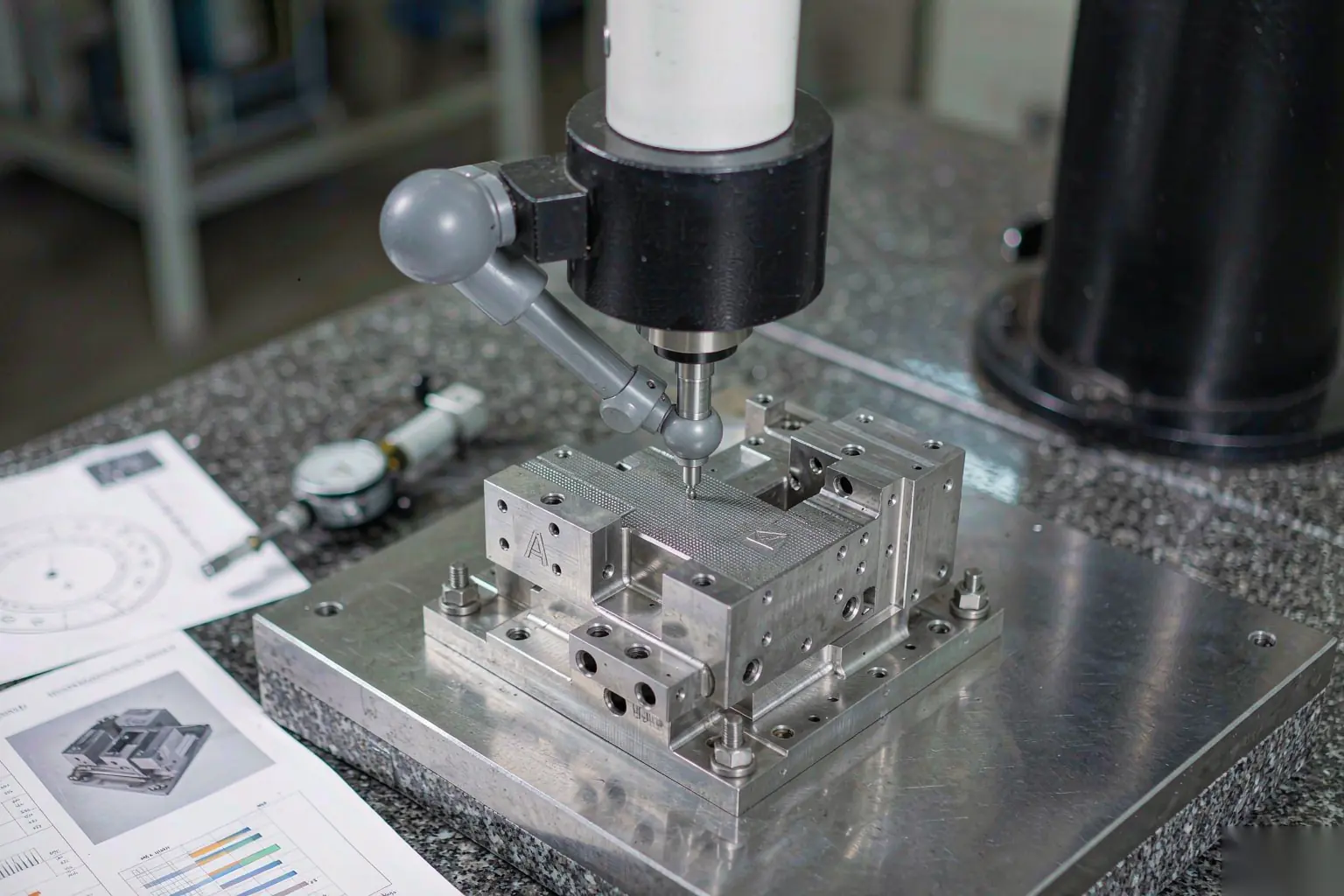
Most casting quality agreements say “AQL 2.5” and stop there. AQL is an acceptance quality limit, not a promise about the parts you receive — it is the defect rate the sampling plan will usually accept. The buyer’s real exposure sits on the other side of the operating characteristic curve, and it is larger than most people assume.
Take a 500-piece lot at general inspection level II: code letter H, sample 50, AQL 2.5 gives accept 3 / reject 4. If that lot actually contains 5% defective parts — double the AQL — the binomial probability of accepting it anyway is about 76%. At 8% defective it is still around 43%. Sampling is a filter, not a guarantee; that is exactly why a casting quality agreement needs a defect classification, a claim window and a liability cap behind it.
| Lot size | Code / n | AQL 1.0 Ac/Re | AQL 2.5 Ac/Re | P(accept) if lot is 5% defective, at AQL 2.5 |
|---|---|---|---|---|
| 151–280 | G / 32 | — | 2 / 3 | 79% |
| 281–500 | H / 50 | 1 / 2 | 3 / 4 | 76% |
| 501–1,200 | J / 80 | 2 / 3 | 5 / 6 | 79% |
| 1,201–3,200 | K / 125 | 3 / 4 | 7 / 8 | 71% |
Two clauses fix this. First, switching rules: ISO 2859-1 moves you from normal to tightened inspection after two of five consecutive lots are rejected, and back only after five consecutive acceptances. Tightened inspection for code H at AQL 2.5 drops to accept 2 / reject 3, cutting the chance of accepting a 5%-defective lot from 76% to about 54%. Second, defect-class separation: run critical characteristics (pressure boundary, load path) at AQL 1.0 or on a 100% test, and cosmetic characteristics at AQL 4.0. One AQL for everything means you over-inspect paint and under-inspect the bore.
The Money Clauses: Escalation, Caps and Claim Windows
Here is the working example: a ductile iron housing, 2,400 pieces per year, FOB price $42.00 per casting, inbound freight allocation $6.50, and $96.00 of machining value added per part before it reaches your assembly line. Foundry-caused latent defects — shrinkage, gas, hard spots, core shift that only shows up once you cut metal — run at 2.2%, or about 53 parts a year. That is the population the casting quality agreement has to allocate.
Where the loss lands
| Discovered at | Loss per part | Multiple vs gate | 53 defects / year |
|---|---|---|---|
| Foundry gate (scrap the casting) | $42.00 | 1.0× | $2,226 |
| Your machining (casting + $96 + $6.50) | $144.50 | 3.4× | $7,659 |
| Your assembly (plus $310 teardown and line stop) | $454.50 | 10.8× | $24,089 |
| Field (plus $780 service, $260 logistics, $900 goodwill) | $2,084.50 | 49.6× | $110,479 |
That 50:1 spread between gate and field is the whole argument for spending money on detection early. It does not, however, justify buying every test available. Adding 100% pressure decay testing at the foundry in this example costs about $3.20 per part, or $7,680 a year; each defect it catches before machining saves $144.50 − $42.00 = $102.50. Break-even needs about 75 catches, and if the test catches 60% of latent defects that means roughly 125 latent defects a year — a 5.2% latent rate. Below that, AQL sampling plus a real first article gate beats 100% testing on cost; above it, the test pays for itself. Run the arithmetic before you write the clause.
Liability cap: three structures, one winner
In a casting quality agreement the cap decides how much of that $144.50 comes back. Foundries price risk, so a wider cap is never free — it shows up in unit price. Working all three against the same 53 claims a year:
| Cap structure | Credit per claim | You absorb per year | Price premium | Total annual cost to you |
|---|---|---|---|---|
| A — casting invoice value only | $42.00 | $5,432.50 | $0 | $5,432.50 |
| B — 2× casting value cap | $84.00 | $3,206.50 | +0.5% → $504 | $3,710.50 |
| C — full documented value, 1.5% deductible | Up to $144.50 | $1,512.00 | +2.5% → $2,520 | $4,032.00 |
The middle option wins, and that is the point: the widest cap is not automatically the cheapest, because you buy it with unit price. Ask for 2× casting value including documented machining value added plus a small annual allowance. Ask for full-value liability only on characteristics where an escape is genuinely dangerous — pressure boundary, lifting lugs, load-path sections — not across the whole part.
The claim window is where agreements fail
“Claims must be made within 10 days of delivery” is the single most expensive sentence in supplier terms, and it is standard. In the example above, castings sit in your raw store for about five weeks before machining starts, so every one of those 53 latent defects surfaces after the window has closed. You absorb the full $7,659 a year and the clause is doing exactly what it was written to do. Rewrite it as “60 days from receipt, or 30 days from the start of machining, whichever is later”, and add that evidence consists of photographs, the retained sample and the heat-lot record — at which point the casting quality agreement finally does the job it was written for. Rework the clause and the same defects become claims.
Traceability: The Cheapest Clause in the Document
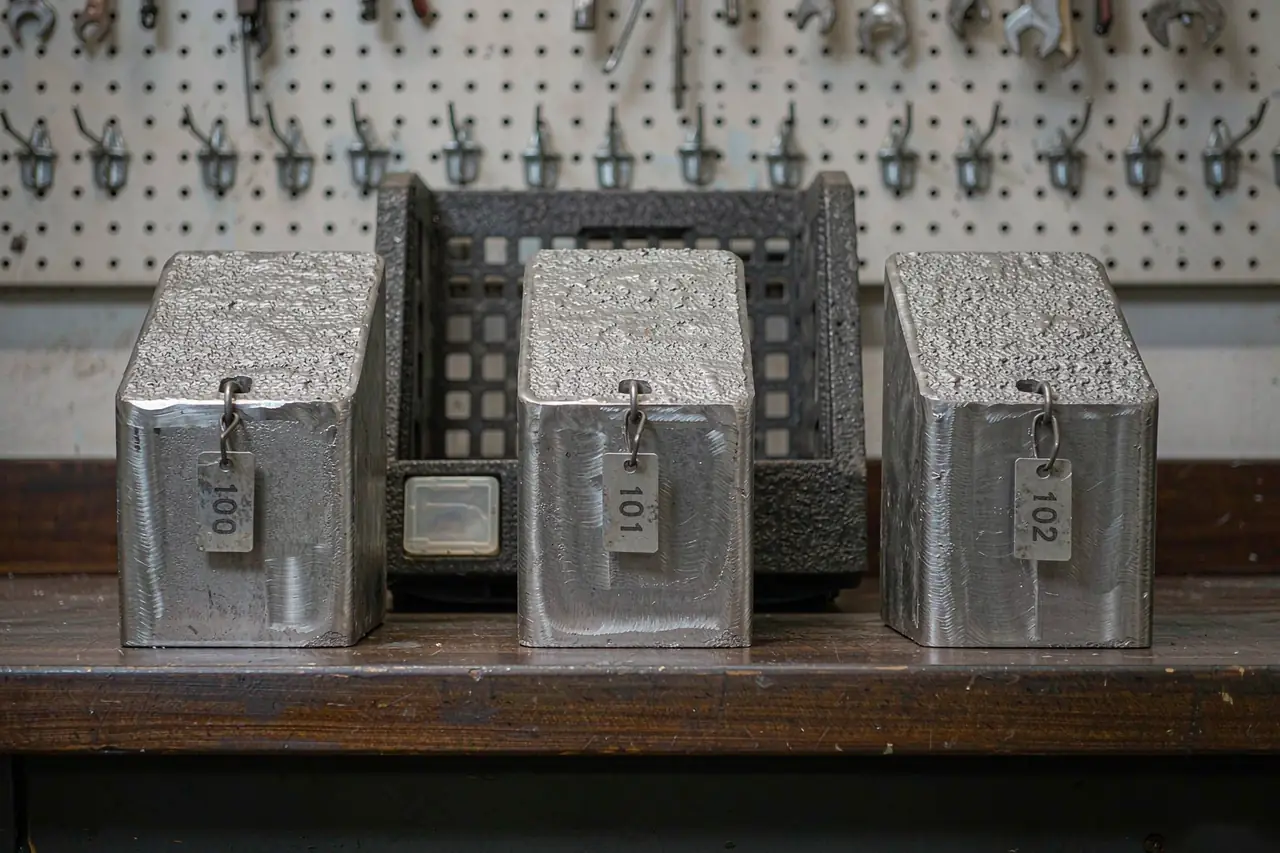
Heat-lot identification costs a few cents per casting and changes the size of a recall by an order of magnitude. Without it, a confirmed problem in one heat forces you to treat everything in the pipeline as suspect. In the example programme, three months of work-in-progress and finished stock is about 600 pieces; with heat-lot marking, only the 200-piece heat is in question. Sorting 600 pieces at six minutes each and $55 an hour costs $3,300 against $1,100 for the single lot, and the conservative disposition difference is $16,800 of casting value (600 × $42 vs 200 × $42). One event a year and the clause pays for itself many times over.
Pair it in the casting quality agreement with retention: three samples per lot, held for 12 months, unpainted and un-machined. When a claim arrives eleven months later, those coupons — not emails — settle it. The same logic applies to material evidence; a certificate without a heat number is a document, not a record. Our casting packaging guide covers the marking and packing side, and the lead time breakdown explains why a replacement lot takes the time it does.
Corrective Action: SCAR Timing and Who Pays for Containment
A casting quality agreement without response clocks produces a familiar pattern: the foundry acknowledges the problem, asks for photographs, and the conversation restarts every week. Fix the clocks, fix the deliverables, and state who carries containment cost before root cause is known.
| Step | Clock | Deliverable |
|---|---|---|
| Containment | 24 hours | Hold suspect lots by heat ID, sort or ship-safe plan in writing |
| Interim correction | 5 working days | What changes on the next pour, and how it is checked |
| Root cause | 10 working days | Documented cause against process parameters, not “operator error” |
| Corrective action & verification | 30 calendar days | Action closed and three consecutive lots verified clean |
| Closure | 60 calendar days | Updated control plan and FMEA, plus the cost allocation decision |
One clause removes most of the friction: containment cost is shared 50/50 until root cause is determined, then charged to the responsible party. Sorting 1,200 suspect pieces at six minutes each is 120 hours, about $6,600 at $55 an hour — enough to make both sides slow-walk the investigation if nobody knows who is paying. Making the default shared until proven keeps containment moving.
Six Red Flags in a Supplier’s Standard Terms
- “Liability limited to the invoice value of the goods.” Caps your recovery at $42 on a $144.50 loss. Counter with 2× casting value plus documented machining value.
- “Claims within 10 days of delivery.” Time-bars every latent defect. Counter with “60 days from receipt or 30 days from machining, whichever is later”.
- “Buyer shall not machine castings prior to inspection.” Physically unworkable at volume — internal defects are invisible until you cut. Counter with sampling plus a retained-sample evidence route.
- “Seller may repair defects at its discretion.” Removes your right to refuse weld repair on load-path or pressure-boundary areas. Counter with a written-waiver requirement plus ASTM A488 / ASME Section IX qualification.
- “Certificates available on request.” Request-based evidence disappears when you need it. Counter with EN 10204 3.1 shipped with every lot, tied to the heat number.
- “Conforming to industry standard practice.” No standard is named, so none can be enforced. Counter with the named standard, grade and severity level.
None of these are unreasonable asks when you are building a casting quality agreement. Foundries that already run to ASME-aligned procedures and keep heat records will accept most of them without a fight; the negotiation itself is a useful qualification signal, which is why it belongs in the RFQ stage rather than after the first shipment. If you need the process background behind the defect types you are writing criteria for, start with the Guide sur la fonderie des métaux and the defect-by-defect notes on porosity and shrinkage, défauts courants de moulage et vacuum impregnation, plus sand casting defect elimination, solidification simulation et riser design notes. What the certificate has to prove, in turn, depends on the alloy — see how to choose a casting alloy, cast steel grades et gray vs ductile iron, with the process notes on moulage d'aluminium et pièce moulée en acier inoxydable.
FAQ
Is a casting quality agreement the same as a purchase order?
No. The PO says what you are buying and when; the casting quality agreement says how a reject is judged and paid for. The practical route is to keep the agreement as a standing document and reference it by revision number on every PO, so you are not renegotiating per order. The items that belong in the PO itself are the drawing revision, the quantity and the delivery date — everything covered in our minimum order quantity guide.
What AQL should I use for castings?
Separate by risk, not by convenience. AQL 1.0 (or a 100% functional test) on pressure boundaries, load-path sections and safety features; AQL 2.5 on general machined dimensions; AQL 4.0 on cosmetic surface conditions. Always state ISO 2859-1, general inspection level II, and the switching rules, because AQL without switching rules never tightens after a bad lot.
Who owns tooling when a part is rejected repeatedly?
Ownership and liability are separate clauses in a casting quality agreement and should stay separate. You can own the tool while the foundry carries warranty responsibility for parts it made, which is the arrangement most buyers want; the ownership question itself is covered in our casting tooling cost guide, and the tooling itself on our casting molds making page. Add a clause letting you move the tool if corrective action fails twice on the same characteristic.
How do I prove a defect came from the foundry and not from machining?
Evidence, not argument: photograph the indication before further cutting, keep the part, and reference the heat-lot record. Machining-induced damage has a different signature from solidification defects — a shrinkage cavity follows the thermal centre, a chatter mark follows the tool path. Retained samples from the same lot are what close the case; the NDT routes that produce usable evidence are set out in our inspection methods guide.
Should I allow weld repair on rejected castings?
Allow it only where the casting quality agreement names the qualification: a written weld procedure, ASTM A488 or ASME Section IX qualification, post-repair NDT matching the original acceptance criterion, and stress relief where the section or alloy requires it. In the example programme, repair plus re-machining on a partially machined part runs about $54.90 against $99.60 to scrap — worth roughly $44.70 a part, but only with a signed waiver and re-inspection on the first pieces. Never allow unrepaired-record repairs on pressure boundaries; on those, pièce moulée en acier quality regimes generally require full documentation.
How long should the claim window be for machined castings?
Long enough to cover your own machining cycle. A workable default in a casting quality agreement is 60 days from receipt or 30 days from the start of machining, whichever is later, with latent internal defects covered for 12 months where the origin can be demonstrated. Anything measured only from delivery date will exclude most of the defects the clause was meant to catch.
Does a stricter agreement raise the unit price?
Yes — a stricter casting quality agreement is not free, and that is normal — a 2× casting value cap added about half a percent in the example, while full-value liability added roughly two and a half percent. The right question is not “how do I get the strictest terms” but “which characteristics deserve the stricter terms”. Load-path and pressure-boundary features warrant full-value liability; cosmetic ones do not. The cost side of that trade-off is laid out in our répartition des coûts de moulage.
*Standards referenced: ISO 8062-3, ISO 2859-1, ASTM E446 / E186 / E280 / E505 / E155 / A802 / A488 / A536 / A216 / A148, MSS SP-55, EN 10204, API 598. Cost model based on a 2,400-piece-per-year ductile iron housing programme.
 English
 Français
 Deutsch
 Italiano
 日本語
 한국어
 Polski
 Português de Angola
 Русский
 Español de Argentina