
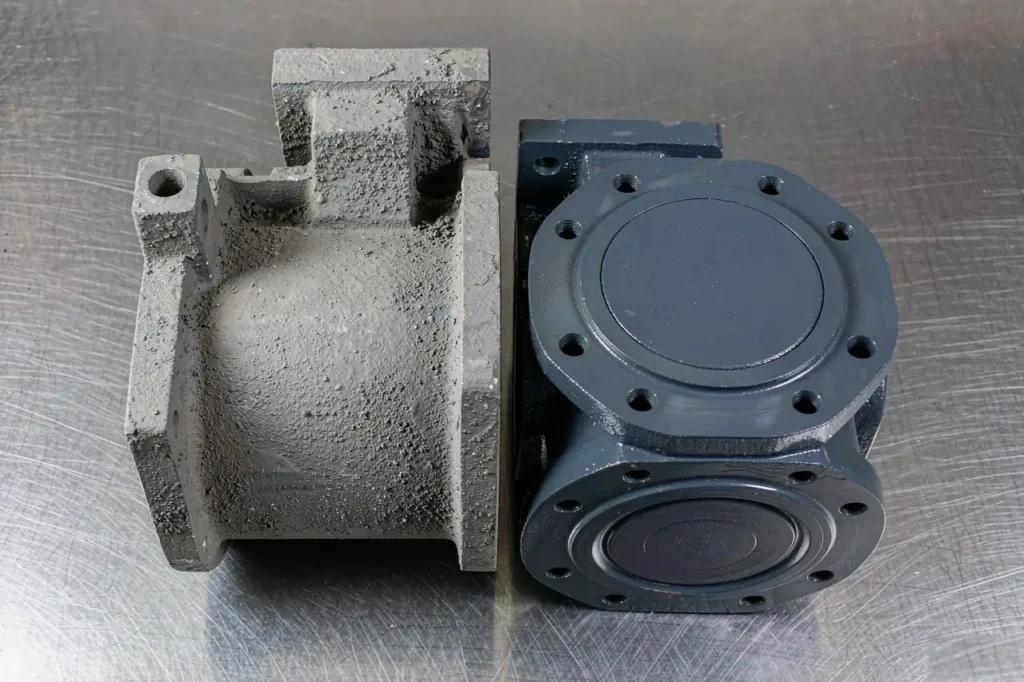
Casting secondary operations are where two quotes for the “same part” stop looking the same. One foundry quotes a casting; the other quotes a component that bolts straight into your assembly — and the second number is often double the first. The gap is not margin. It is nine distinct operations, each with its own labor, tooling and inspection cost.
This guide breaks casting secondary operations down the way a foundry costs them: operation by operation, with real numbers from a 12.4 kg ductile iron pump housing quoted at 1,800 pieces per year. You will see the full stack from a $41.60 as-cast part to an $83.52 ready-to-ship component, the salvage math behind impregnation, the single-source versus split-supply arithmetic, and the exact spec language that stops suppliers from quoting different scopes under the same words. Industry framing on post-cast work draws on AFS y NADCA publications; grade and test references follow ASTM standards.
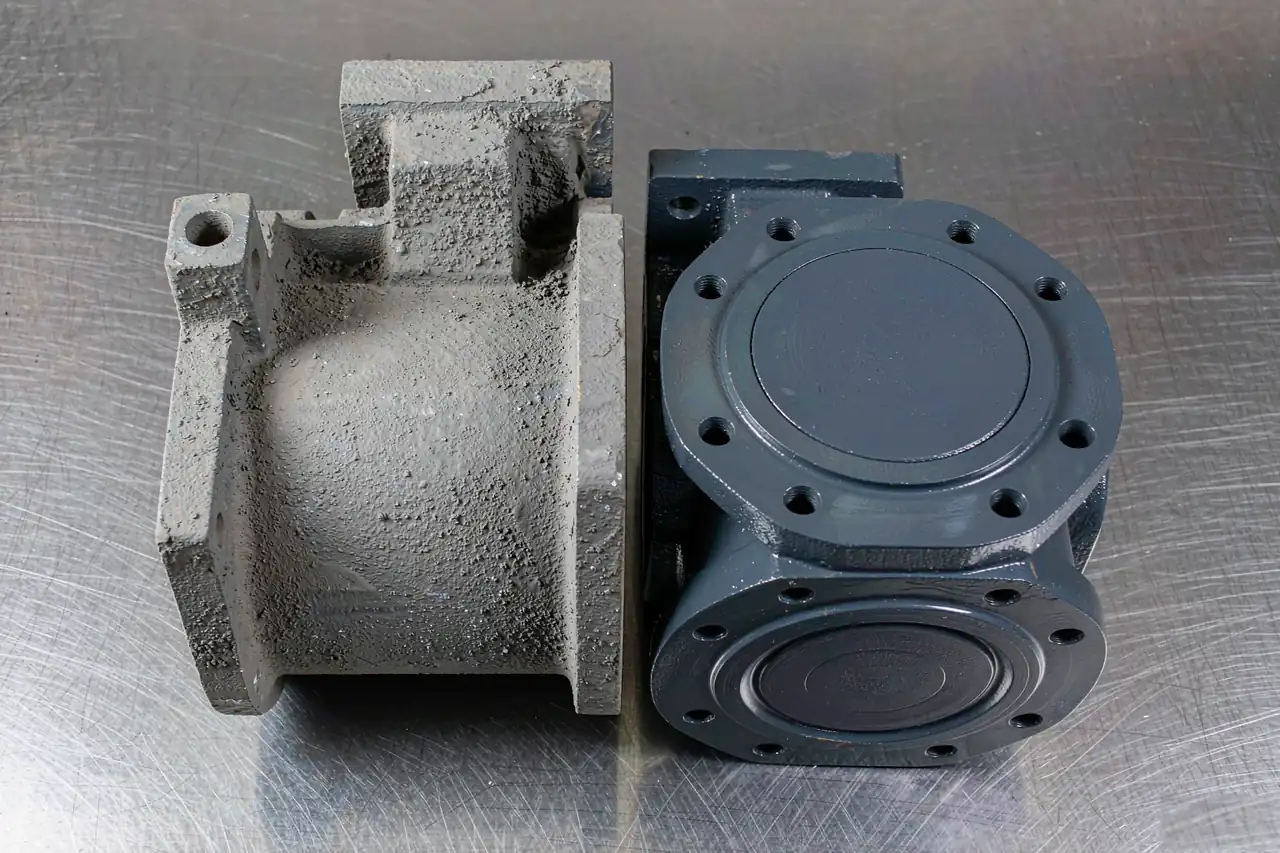
Casting Secondary Operations: The Nine Steps Between As-Cast and Ready-to-Install
A casting that leaves the mold is not a component. It still carries its gating system, sand residue, oxide scale, residual stress and as-cast surfaces that no seal will sit on. Casting secondary operations are everything that happens between shakeout and the shipping crate. Skipping them is not an option for most engineered parts — a rough casting cannot hold a gasket, accept a bearing or pass a leak test. What is an option is deciding which operations the foundry performs, which you perform, and which you delete by design. That decision needs the same cost discipline you already apply to the casting itself, because secondary work routinely adds 30–60% of the delivered piece price — on our reference part, 50.2%.
The table below is the standard stack for a machined, coated, pressure-tight iron casting. Process-specific pieces change it slightly — die castings add trim dies and flash control (see fundición a presión vs. fundición en arena), investment castings start with cleaner surfaces (see Fundición en arena vs. fundición a la cera perdida), and the casting route itself sets the baseline (start from the Guía de fundición de metales if the process choice is still open).
| Operation | What it does | Main cost driver | Reference part |
|---|---|---|---|
| Knock-out, decoring | Separates casting from mold sand, shakes out cores | Energy, shakeout labor | In the as-cast price |
| Shot blast cleaning | Removes sand, scale, burn-on; exposes surface defects | Media, wheel wear, handling | $2.85 |
| Gate & riser grinding | Removes ingates, riser pads, flash; breaks edges | Grinding minutes per part | $3.60 |
| Tratamiento térmico | Stress relief, hardness band, machinability | Furnace batch weight, cycle | $2.50 |
| Straightening / coining | Restores flatness after thermal distortion | Press setup, share of parts needing it | $0.45 |
| Impregnation | Seals micro-porosity so the part passes leak test | Leak-test failure rate | $0.12 average |
| Machining | Faces, bores, threads, datum features | Number of setups, cutting minutes | $22.65 |
| Coating | Corrosion protection, appearance | Coating type, surface area | $6.10 |
| Inspection & leak test | Acceptance evidence for the finished component | Sampling plan vs 100% test | $1.75 |
| Packaging | Export-grade protection to your dock | Crate share per part | $1.90 |
The Cost Stack: From $41.60 As-Cast to $83.52 Finished
Here is the reference part priced line by line — every element of casting secondary operations itemized the way a foundry’s router lists them. It is a 12.4 kg net ASTM A536 80-55-06 ductile iron pump housing, poured at 21.4 kg including gating and feed heads (58% mold yield), annual demand 1,800 pieces. The as-cast price — melt, molding, cores, shakeout — is $41.60. That number is already covered in the casting cost breakdown; what follows is everything stacked on top of it.
| Line item | Per piece | Cumulative | Basis |
|---|---|---|---|
| As-cast casting | $41.60 | $41.60 | 12.4 kg net, 21.4 kg poured, 58% yield |
| Cleaning & shot blast | $2.85 | $44.45 | Wheel blast, media and handling |
| Gate/riser grinding, deburring | $3.60 | $48.05 | 6 min at $36/h incl. wheel |
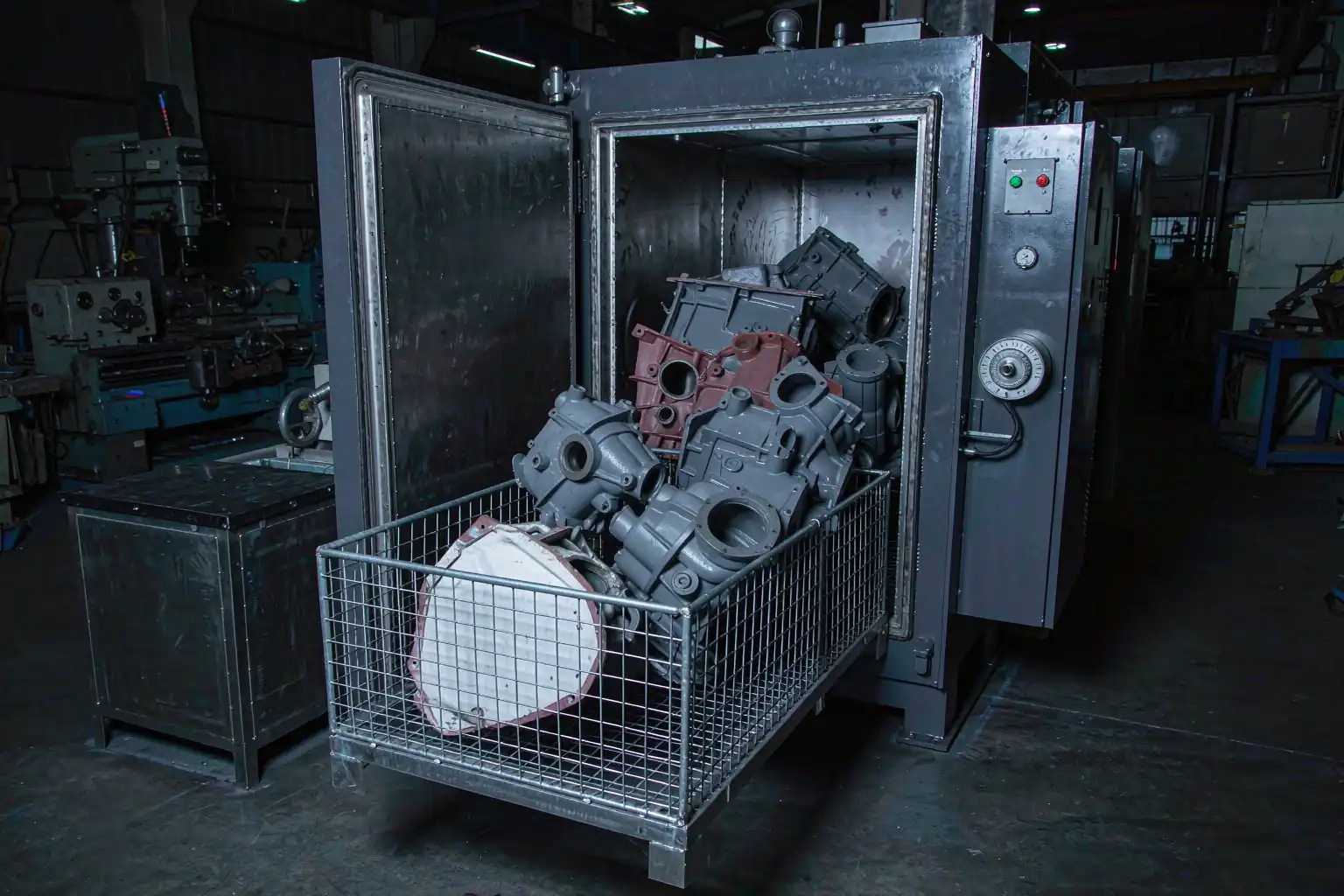
| Tratamiento térmico | $2.50 | $50.55 | Batch furnace, ~$0.20/kg |
| Straightening | $0.45 | $51.00 | ~5% of parts need press correction |
| Impregnation (failures only) | $0.12 | $51.12 | 4.2% leak failures × $2.90, averaged |
| Machining | $22.65 | $73.77 | 2 setups, 22 min at $54/h + fixture + tooling |
| Powder coating | $6.10 | $79.87 | 60–80 µm film, batch line |
| Final inspection + leak test | $1.75 | $81.62 | Air-decay test within takt + dimensional sampling |
| Export packaging | $1.90 | $83.52 | Crate share, VCI, dunnage |
Read the cumulative column twice. By the time the part reaches the leak test, it carries $73.20 of accumulated value — which is exactly why a defect found there costs 1.76× the as-cast price to remake, and why sequencing matters: cheap operations that prevent expensive scrap always run early. The finished price lands at $83.52, of which casting secondary operations are $41.92 — 50.2% of the delivered price. For heavily machined aluminum parts the share is routinely higher; for as-cast-only components sold by weight it approaches the 8–15% band quoted for basic finishing. Either way, a per-kilogram casting price tells you almost nothing about what you will actually pay.
Where the Money Goes, Operation by Operation
The sections below walk the casting secondary operations stack in cost order, because the sequence decides both what each step costs and what a defect discovered at that stage costs you.
Cleaning, Gate Removal and Grinding
Shot blasting is the cheapest line in the casting secondary operations stack and the one you should never delete. On iron castings it strips sand and scale, but its real job is exposing defects before value is added — sand burns, cold shuts and shrinkage are invisible under as-cast skin until the wheel opens the surface. Skipping blast to save $2.85 moves those findings downstream, where every discovery costs more (see defectos comunes en la fundición y métodos de inspección de piezas fundidas). Grinding, by contrast, is where foundries quietly lose or make margin: six minutes of angle-grinder time at a $36/h burdened rate is $3.60, and gating schemes with heavy riser pads can double that. If grinding cost matters to you, attack it at the design stage — a riser design y diseño de moldes that put feed metal where a band saw can reach beats an hour of manual blending.
Heat Treatment and Distortion Control
Among casting secondary operations, heat treatment is the smallest line with the largest side effect. For ductile iron housings the usual ask is stress relief plus a specified hardness band — batch-furnace work at roughly $0.20/kg, or $2.50 on our part. The cost is small; the side effect is not: the thermal cycle relaxes casting stresses and lets the part move, which is why straightening exists as a line item and why machining datums should be cut after, never before, heat treatment. Spec mechanics — temper names, hardness bands, test locations — are covered in tratamiento térmico de piezas fundidas, and Supro MFG runs this work under a dedicated heat treatment service. Aluminum heat treat is a different animal — T6 aging windows and solution times dominate price (see aluminum casting solutions).
Impregnation: The Salvage Math
Within the casting secondary operations stack, impregnation is the only line priced by failure rate rather than by part count. Micro-porosity is a fact of solidification, not a workmanship failure — gas and shrinkage voids in the 0.05–0.5 mm range can pass every visual and dimensional check and still weep at 6 bar. Vacuum impregnation — pulling a low-viscosity methacrylate sealant through the pore network under vacuum and pressure, then heat-curing it — seals the leak path without changing dimensions or machinability. The economics on our reference part: a 4.2% leak-test failure rate on 1,800 parts is 76 failures per year, each carrying $73.20 of already-added value. Treating the failures costs $2.90 per part — $220.40 per year, an average of $0.12 across the whole volume. A conservative 90% recovery saves 68 parts and $4,977.60 of remake cost: a 22.6:1 return. The break-even is brutal in impregnation’s favor — the process pays as long as the recovery rate exceeds 4%. Two buyer notes: first, disclose impregnation in your FAI package rather than hiding it — OEMs accept a declared sealing process and reject an undeclared one (see casting first article inspection); second, “seal-all” policies — impregnating 100% of parts before test — are the right call only when field failure cost is extreme, because they multiply the $2.90 across every part instead of the 4.2% that need it. The underlying porosity mechanics are covered in porosity and shrinkage control.
Machining: Setups, Not Cutting Time
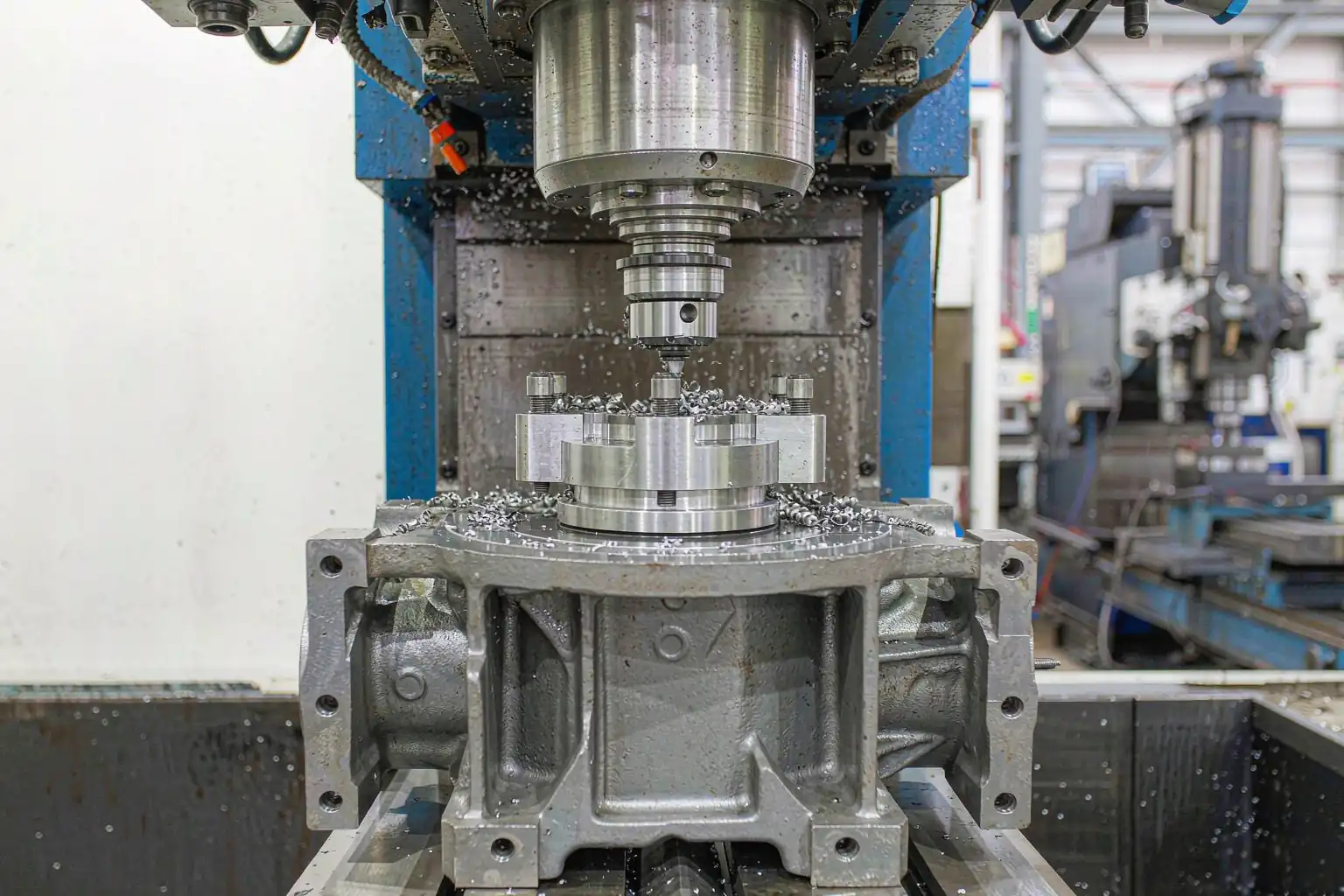
Machining is the single largest line in the casting secondary operations stack — $22.65 of the $41.92 — and the most commonly misjudged. On cast iron, metal removal is fast; what costs money is every time the part is unclamped, reoriented and re-fixtured, because each setup adds handling labor, a fixture and a tolerance stack between features. Our housing prices out at two setups and 22 minutes: $19.80 of machine time at $54/h, plus $1.00 of fixture amortized over the 1,800-piece run, plus $1.85 of inserts and consumables. Consolidating the same features onto one or two planes removes whole setups without touching a single tolerance — a design lever, not a purchasing lever. How much stock the casting must carry for all of this is its own discipline: the casting machining allowance guide prices the stock-per-surface tradeoff, the tolerancias de fundición reference keeps as-cast features inside ISO 8062-3, and the build-versus-buy question for the machining itself is covered in Mecanizado CNC vs fundición.
Coating and Surface Finishing
In the casting secondary operations stack, coating is priced by area and process, not by part weight: powder at $6.10 on a 0.35 m² housing is typical batch-line work, while e-coat for salt-spray durability or zinc-rich systems for marine service run higher. The specification that actually protects you is the test, not the adjective — “powder coat, 60–80 µm, 480 h neutral salt spray per ASTM B117” is enforceable; “good paint finish” is not. Coating also sits at the end of the stack for a reason: paint over unmachined as-cast skin hides the surfaces your fitters need to see, so specify which surfaces stay bare. The full menu — blasting, polishing, anodizing, plating — is compared in acabado de superficies de fundición, and Supro MFG quotes these as an integrated surface treatment service.
One Supplier or Two? The Split-Supply Math
Every buyer eventually asks whether casting secondary operations belong at the foundry or in their own machine shop. The honest answer is arithmetic. Below, the same finished housing is routed two ways: Option A buys a cleaned, heat-treated casting from the foundry and machines it at a job shop near assembly; Option B buys the finished component from one source.
| Cost element | Option A: split supply | Option B: single source |
|---|---|---|
| Casting, cleaned + heat treated | $50.55 | $50.55 (in-stack) |
| Extra freight leg to machine shop | $4.10 | — |
| Inter-operation packaging | $3.80 | — |
| Incoming inspection & handling | $6.50 | — |
| Machining | $38.90 (job-shop rate $85/h) | $22.65 (dedicated cell $54/h) |
| Impregnation + coating subcontract | $9.00 | $0.12 + $6.10 (in-stack) |
| Coordination: two POs, two FAIs, two quality gates | $5.60 | — |
| Total per part | $118.45 | $83.52 |
| Annual difference (1,800 pcs) | +$62,874 | baseline |
| Lead time and first-article count | +2 to +3 weeks, two FAIs | baseline, one FAI |
The $34.93 per-part gap decomposes into three things a split supply cannot avoid: $20.00 of pure handling overhead (extra freight leg, inter-operation packaging, incoming inspection, coordination), a machining rate difference of $16.25, and double first-article effort — each FAI costing real money and weeks (see what an FAI report must prove). On this arithmetic, split supply only wins in three situations: your machine capacity is genuinely idle and the true marginal cost of the 22-minute operation falls under $3.97 per part — about $10.80 per hour; the foundry’s own machining markup is pushed above job-shop rates by more than the $20.00 handling overhead; or control requirements — IP, export control, captive capacity — override the numbers. Single sourcing carries its own risk, a single point of failure, which you manage with a capacity and capability review before award, not after (see casting supplier audit). Whichever route you take, the sequencing rule from the cost stack still holds: operations that catch scrap early run before operations that add value.
How to Specify Casting Secondary Operations in Your RFQ
Most quote divergence is scope divergence. Two foundries read “clean, machined and painted” two different ways and neither is wrong — the words are unusable. A complete RFQ prices casting secondary operations as named steps with measurable acceptance criteria (the package-level checklist is in what foundries need for an accurate casting RFQ). The table below converts the vague phrases into spec language that survives a dispute.
| Vague phrase | What to write instead |
|---|---|
| “Cleaned” | “Shot blasted to bare metal; no residual sand, scale or burn-on; surfaces suitable for coating adhesion” |
| “Deburred” | “All gates, risers and flash removed flush; edges broken max 0.5 mm; no grinding marks on sealing surfaces” |
| “Heat treated” | “ASTM A536 80-55-06; hardness 187–241 HB at the designated test location, tested per casting lot” |
| “Leak-tight” | “100% air-decay leak test at 6 bar, 90 s stabilization, reject > 5 cm³/min; impregnation of failures permitted and disclosed” |
| “Machined” | “Datum scheme per drawing; machined surfaces with Ra ≤ 3.2 µm; Cpk ≥ 1.33 on flagged critical features at FAI” |
| “Painted” | “Powder coat 60–80 µm, color per chip, 480 h neutral salt spray per ASTM B117; listed surfaces masked bare” |
| “Well packed” | “VCI wrap, export wooden crate to destination, one part per compartment, max stated stacking height” (see casting packaging) |
Two more clauses close the loop. First, ask for the secondary operations priced as a separate line in the quote — a foundry that cannot itemize its finishing stack is guessing, and you will absorb the guess. Second, tie the stack to the schedule: every added operation step is also a queue, and each subcontract leg adds freight and wait (the schedule mechanics are in casting lead time). Supro MFG runs the full casting secondary operations stack — fundición en arena o fundición a la cera perdida, Mecanizado CNC, heat treatment, surface treatment and export packaging — under one router and one quality gate, so the cost stack you have just read is the stack you are quoted.
Preguntas frecuentes
What share of a finished casting’s price is secondary operations?
For a machined, coated, pressure-tight component, typically 30–60%. On the reference housing in this guide, casting secondary operations added $41.92 to a $41.60 as-cast part — 50.2% of the delivered price. Basic finishing alone (blast, grind, heat treat) sits in the 8–15% band; machining is the line that dominates.
Does impregnation mean my casting was defective?
No. Micro-porosity is inherent to solidification, and impregnation is a sanctioned, disclosed sealing process — functionally equivalent to a design allowance. What matters commercially is that it is declared in the FAI and priced honestly: at $2.90 per treated failure it salvages $73.20 of accumulated value, so the real question is not whether to allow it but who pays when it is needed.
Can I delete shot blasting to save cost?
On iron and steel castings, no — shot blasting is the cheapest insurance in the whole casting secondary operations stack, and $2.85 buys defect visibility. Skipping blast pushes sand inclusions, cold shuts and surface shrinkage to the machining stage, where each discovery costs a multiple of the as-cast price. On high-integrity die castings with clean as-cast skin the case is weaker, but the inspection that replaces it is rarely cheaper.
Should the foundry machine my castings?
Run the split-supply math first. A split route carries roughly $20.00 per part of unavoidable handling overhead plus a machine-rate difference; it only wins when your own capacity is effectively idle (marginal cost under about $10.80/hour on the reference part) or when control requirements override cost. Otherwise a single-source foundry with an integrated machining cell is cheaper and 2–3 weeks faster.
Why did two quotes for the same part differ by 35%?
Almost always scope. One supplier priced eight named secondary operations with test-backed acceptance criteria; the other priced a casting and will discover the rest after award. Force itemization of the secondary stack in every quote and the quotes converge.
*Data referenced from AFS / NADCA / ASTM industry publications and Supro MFG shop-floor records.
 English
 Français
 Deutsch
 Italiano
 日本語
 한국어
 Polski
 Português de Angola
 Русский
 Español de Argentina