
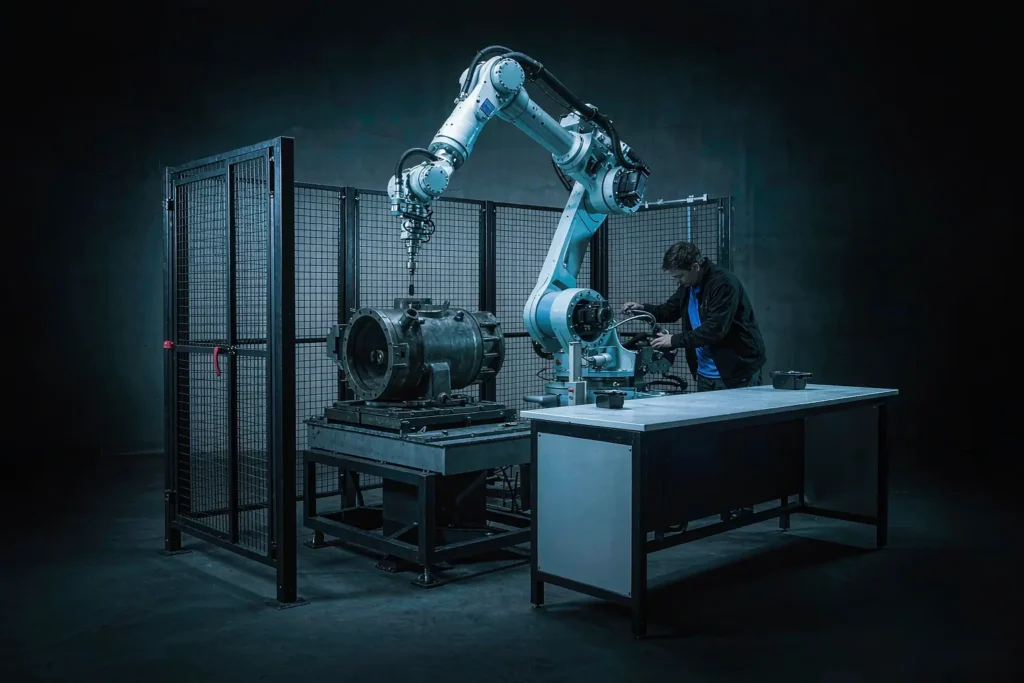
A fettling robot cell is sold as a labour-saving machine, but the number that actually decides its payback is utilization across part families, not cycle time alone. This guide walks through the layout, guarding distance, end effector, changeover method and cost model a buyer should demand before approving one — with arithmetic a purchasing team can audit.
Most buyers evaluate a casting quote at the furnace and ignore the cleaning room. That is where gate stubs are ground, riser remnants are cut and a worker spends minutes per part on a wheel. We have already shown how much of that time sits in casting degating; this article goes one level deeper into the cell that replaces it. For the wider decision frame, start with our metal casting guide.
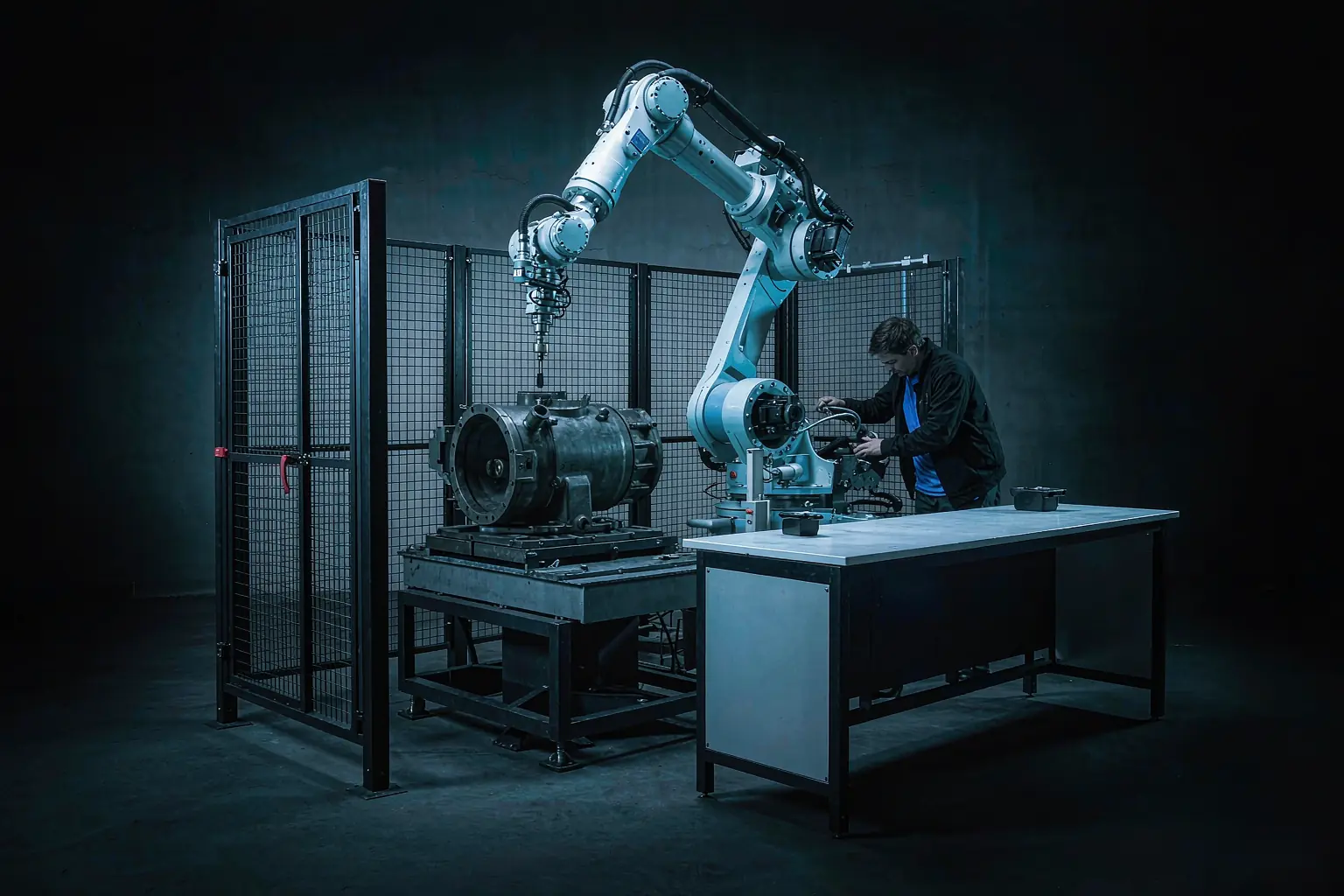
What a Fettling Robot Cell Actually Contains
A fettling robot cell is not a robot arm parked next to a conveyor. It is a bounded system: the robot, a force-controlled wheel or band-saw spindle, a part fixture that locates on cast datums, an unloading chute, a safety-rated controller, and a guarded perimeter with interlocked access. Remove any one element and the quoted cycle time is fiction.
The distinction matters because suppliers often quote the arm and the spindle as if those were the whole investment. In the cost model below, the arm and spindle are 78,000 USD of a 140,000 USD total. Guarding and the safety controller add 21,000 USD, installation and commissioning 17,000 USD, and two end effectors plus fixtures 24,000 USD. A buyer comparing “robot price” against manual labour is comparing one line item against an entire operating system.
The four subsystems that set capability
- Cutting head. A 74-second gate cut with an 8 mm wheel at 45 N contact force; a saw is chosen when the riser neck exceeds 22 mm.
- Fixturing. Three-point location on one machined face plus a core-print datum, repeatability ±0.15 mm.
- Perception. A simple through-beam sensor confirms part presence; vision is only justified when gate position varies more than 4 mm.
- Safety layer. Interlocked gate, safety PLC, and stop-time measurement recorded at commissioning — not assumed from the robot datasheet.
For Sandguss programs the cell replaces work that is highly variable by hand. Our earlier foundry automation breakdown explains where robots sit relative to molding and pouring; here we stay strictly inside the cleaning room.
Fettling Robot Cell Layout: Footprint Is a Safety Number
The first layout error is drawing the fence around the robot’s swept volume. The correct starting point is the hazard envelope — cutting wheel, flying fragments, and part reach — then adding the safety distance. For a 12 kg ductile iron pump housing, the hazard envelope measures roughly 4.6 × 5.8 m, or 26.7 m². Add a measured stop time and the fence moves outward.
Using the ISO 13855 approach, S = K × T + C. With a hand-approach speed K of 2,000 mm/s, a measured total stopping time T of 0.30 s and a penetration term C of 120 mm, S = 720 mm. With 100 mm of commissioning contingency, specify 820 mm from the hazard line. The guarded envelope becomes 6.24 × 7.44 m = 46.4 m² — 74% larger than the raw working area.
| Layout item | Manual station | Guarded cell |
|---|---|---|
| Floor area | 3.2 m² | 46.4 m² |
| Annual floor charge at 18 USD/m² | 58 USD | 835 USD |
| Access point | Open | Interlocked gate + light curtain at load side |
Floor cost is not the obstacle — under 1,000 USD a year. The obstacle is that a single fettling robot cell cannot be squeezed into the space one grinder occupies. Plants that try it end up with a fence line that violates the measured safety distance, then discover the safety PLC will not let the cycle start. Ask the supplier for the stop-time measurement sheet before the layout drawing.
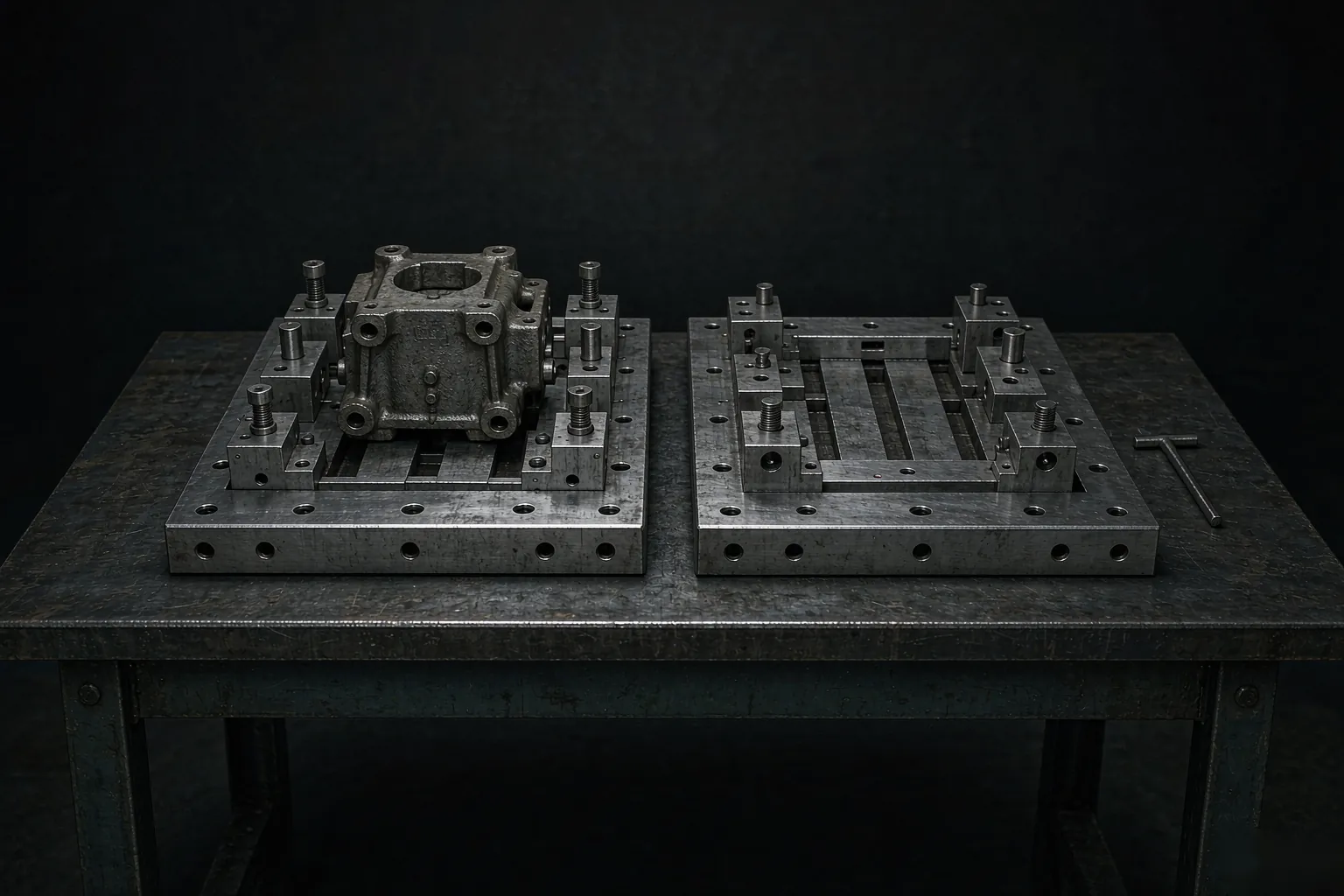
Flow matters as much as area. Parts should enter on the operator side and leave through a separate chute so nobody reaches across the cutting envelope. In a fettling robot cell serving three families, keep one fixture plate mounted and two staged outside the fence on pre-set stands; that single decision is what makes the 9-minute changeover repeatable. Material handling between shakeout and the cell should be buffered for at least 90 minutes, otherwise an irregular molding schedule stops the robot while it is still productive. Measure the queue, not just the cycle.
Guarding and Safety Validation: What to Put in the RFQ
A guarded fettling robot cell should arrive with documented validation, not a brochure claim. General machine-guarding expectations are public; see the NFPA resource library and the safety-practice material published by AWS for welding-integrated fixtures. The rank-and-file safety rule is simple: if an operator can reach the wheel before it stops, the cell is not compliant.
Four documents to demand
- Stop-time test record. Measured on the installed cell with the heaviest fixture fitted.
- Risk assessment. Signed for gate cutting, wheel burst and part ejection separately.
- Interlock schematic. Showing that a gate open stops Category-rated outputs, not just the arm programme.
- Changeover procedure. Defining how the fixture is unlocked without defeating the interlock.
This is also where product-liability exposure is created or avoided. Our note on casting product liability covers the documentation trail buyers should keep; the same logic applies to a cell that produces the parts. Suppliers who cannot produce a stop-time record are usually quoting a cell they have not commissioned.
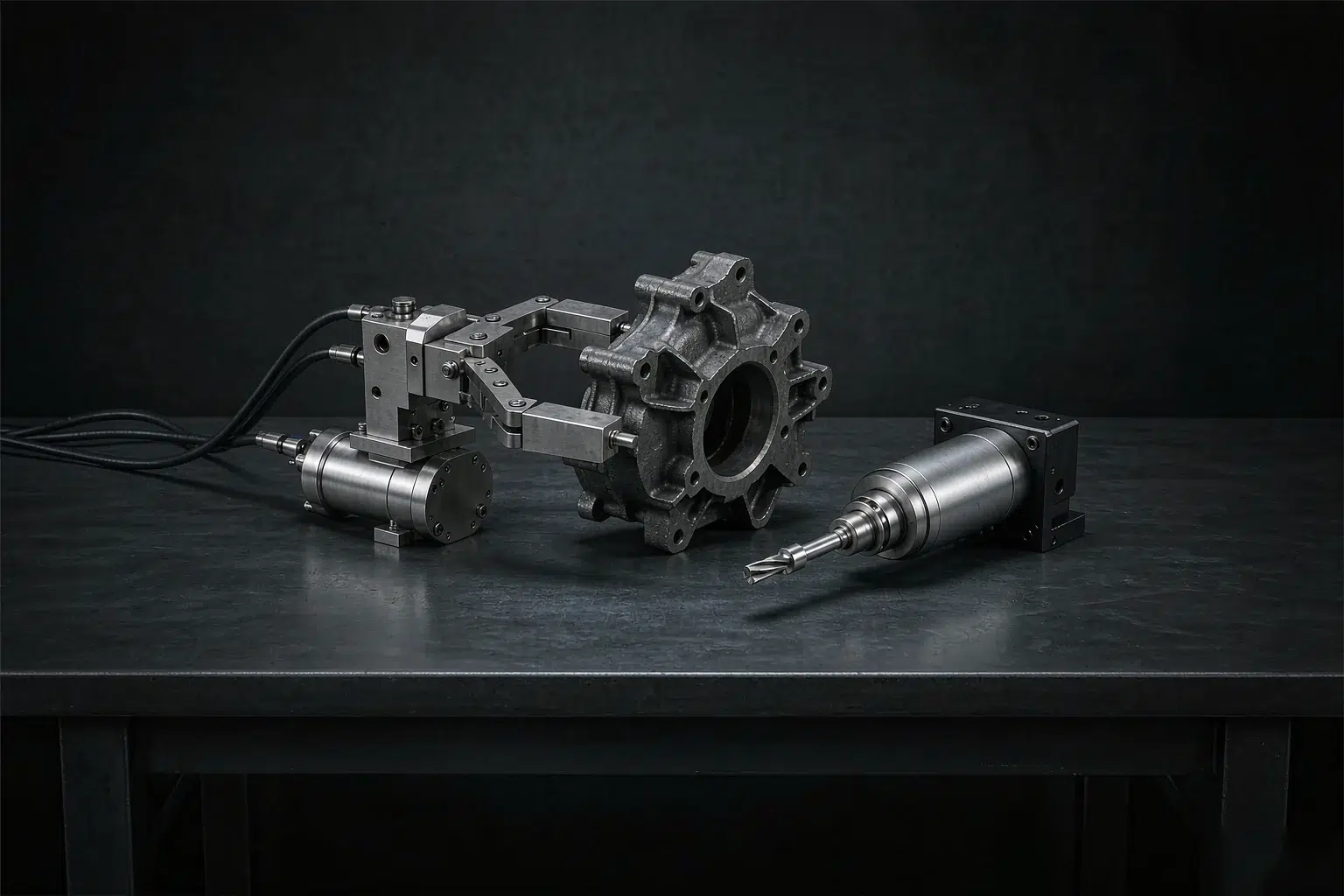
End Effector and Fixture Design in a Fettling Robot Cell
A fettling robot cell lives or dies on the fixture. The part arrives with as-cast variation: our pump housing has a gate pad that shifts up to 4 mm between molds. Locating on the machined sealing face plus one core print gives repeatability of ±0.15 mm, which is enough for a 74-second cut without vision.
Contact force is the second lever. A skilled grinder applies roughly 60–90 N when removing a gate stub; the robot holds 45 ± 5 N through a force-controlled spindle. Lower, more uniform force extends wheel life by about 32% in our trial — the wheel cost per part falls from 0.61 to 0.42 USD. That saving is small, but it is repeatable in a way that manual wheel consumption is not.
| Parameter | Manual | Robot cell |
|---|---|---|
| Contact force | 60–90 N, operator-dependent | 45 ± 5 N closed loop |
| Stub residual | 2.1 ± 1.3 mm | 1.2 ± 0.4 mm |
| Rework rate | 1.8% | 0.7% |
Fixture wear is easy to overlook. Track it like any other casting tooling asset: a locator that drifts 0.3 mm quietly moves the stub back into rework territory. We record locator gauge results weekly and replace pads at 12,000 cycles. Tooling built for Gießformen and fixturing should share the same revision-control discipline.
Fettling Robot Cell Cycle Time: Where the 2.83 Minutes Go
Suppliers like to quote spindle time. A real fettling robot cell cycle includes loading, clamping, cutting, grinding, deburring, unloading and air blow. Our measured breakdown for the 12 kg housing totals 170 seconds, or 2.83 minutes — versus 4.73 minutes per part by hand.
| Step | Seconds | Note |
|---|---|---|
| Load | 18 | Operator overlaps with previous part |
| Clamp | 6 | Pneumatic, safety-monitored |
| Gate cut | 74 | Two gates, 8 mm wheel |
| Grind and deburr | 47 | 35 + 12 s |
| Unload and blow | 25 | 15 + 10 s |
| Total | 170 s = 2.83 min | Not 74 s spindle time |
Because the operator loads the next part while the current one is cutting, direct labour falls to 1.10 min per part even though the robot cycle is longer than its spindle time. This overlap is the hidden source of the labour saving. It also explains why a casting shakeout schedule that delivers parts in uneven batches destroys the economics: no batch, no overlap.
Changeover: The Number That Decides Whether Mixed Parts Work
A dedicated fettling robot cell on one high-volume part is easy to justify. Real foundries run families. For our case, three changeovers per week across 50 working weeks give 150 changeover events a year. With loose fixtures, each one costs 38 minutes of setup and first-article checking. A quick-change plate with pre-set locators cuts that to 9 minutes.
The saving is 29 minutes × 150 = 72.5 hours a year, or 2,610 USD at 36 USD per hour. At 12,000 parts a year that is 0.2175 USD per part — about the same size as the wheel consumable saving. Ignore changeover and the cell looks 7% worse than it is; ignore it in a high-mix shop and the cell never reaches utilization.
Changeover time also sets the practical minimum order. If a family runs 400 parts and setup is 38 minutes, setup alone is 9.5% of the run. At 9 minutes it is 2.3%. This is why a cell that looks fine on a capacity reservation can still fail when the mix fragments, and why our minimum order quantity model includes setup as a line item rather than an afterthought.
Fettling Robot Cell Economics: The 12,000-Part Case
Here is the full arithmetic for a 12 kg ductile iron pump housing at 12,000 parts a year, 36 USD per hour labour and 42 USD fully loaded part value at the point of rework. Every figure below is per part unless stated.
| Line | Manual | Cell | Delta |
|---|---|---|---|
| Direct labour | 2.838 USD (4.73 min) | 0.660 USD (1.10 min) | +2.178 USD |
| Wheel and consumables | 0.610 USD | 0.420 USD | +0.190 USD |
| Rework and scrap | 1.8% × 42 = 0.756 USD | 0.7% × 42 = 0.294 USD | +0.462 USD |
| Changeover allocation | 38 min event | 9 min event | +0.2175 USD |
| Energy at 0.11 USD/kWh | 0.018 USD | 0.060 USD | −0.0415 USD |
| Net gain per part | — | — | 3.006 USD |
Annual gross gain = 12,000 × 3.006 = 36,072 USD. Fixed upkeep — robot service 4,800 USD, end effector wear 2,400 USD, guarding inspection 900 USD — is 8,100 USD a year. Net gain is 27,972 USD. Against 140,000 USD capex that is 60 months payback, not the 18 months a spindle-time-only model predicts.
Now invert the question. For a 24-month payback, annual net must reach 70,000 USD. At 3.006 USD net per part and 8,100 USD fixed cost, volume must be (70,000 + 8,100) / 3.006 ≈ 26,000 parts a year. At 28,000 parts the same cell returns 76,068 USD a year and pays back in 22.1 months. This is the number to negotiate against — not cycle time, and not the price of the arm. Buyers comparing supplier quotations should read our price per kilogram analysis alongside it, because automation cost is usually buried there.
Utilization: Why a Fettling Robot Cell Fails on One Part Number
Two shifts of 7.5 productive hours over 250 days give 3,750 available hours. At a realistic 0.72 OEE, 2,700 hours remain. Twelve thousand parts at 2.83 minutes consume 566 hours — 21% utilization. Twenty-eight thousand parts consume 1,321 hours, or 49%. Even in the good case the cell is idle half the time.
That is the counter-intuitive core of the decision: a fettling robot cell does not need a faster cycle, it needs more part numbers through the same fence. Sharing the cell across three families is worth more than a 10% spindle improvement. Before approving capex, ask which families will feed it and whether their fixtures fit the same quick-change plate. If the answer is “this part only”, the honest comparison is against a good manual grinder, not against robotics.
Energy efficiency guidance from the US DOE Industrial Efficiency and Decarbonization Office is useful here for measuring compressed-air and spindle loads, while traceable gauge calibration follows NIST metrology practice. For non-ferrous programs, the Aluminum Association publishes dross and cleaning guidance that changes what the cell must remove.
Downstream Value: What the Buyer Actually Gains
The stub residual difference — 2.1 ± 1.3 mm by hand versus 1.2 ± 0.4 mm from the cell — looks like a foundry detail. It is not. Three machined interfaces each need 0.9 mm less allowance, which removes about 1.4 minutes of CNC-Bearbeitung per part. At the same 36 USD hourly rate that is 0.84 USD of downstream value, almost 28% of the foundry’s own 3.006 USD gain.
A buyer who evaluates the cell only on foundry labour will undervalue it; a foundry that quotes the full benefit without showing the stub data will also lose trust. Our position is to publish both numbers and let the customer decide where the saving sits. The same reasoning applies to casting tolerances — a datum you do not measure is a datum you cannot hold. Surface condition after fettling also interacts with the casting surface finishing route chosen downstream.
For low-volume or prototype work the same operation is often better done with a metal prototype casting route and hand finishing. For high-volume Druckguss or iron casting programs, the cell becomes a capacity decision. For investment-casting parts with thin gates, a Feinguss supplier may need a different tool entirely — confirm before assuming the same cell transfers.
A 30-Day Pilot Before You Sign
Do not buy a fettling robot cell on a supplier video. Run a 30-day pilot with the supplier’s cell and your parts, and record five numbers: measured stop time, actual cycle time over 200 parts, stub residual distribution, changeover time on two families, and wheel consumption. Reject any cell whose quoted cycle cannot be reproduced on your dirtiest casting.
| RFQ field | What to ask for |
|---|---|
| Safety | Stop-time record and signed risk assessment |
| Throughput | 200-part cycle distribution, not best-case cycle |
| Quality | Stub residual mean and standard deviation |
| Flexibility | Changeover minutes and fixture family list |
| Kosten | Full installed price including guarding and commissioning |
Ask the supplier to state utilization assumptions in writing. A quote that uses 6,000 hours a year for a cleaning-room cell is not a quote; it is a hope. The correct question is how many part numbers will physically pass through the fence each week, and who owns the fixtures for each one.
Acceptance should be a statistical test, not a demonstration. Run 200 consecutive parts, record every cycle and every stub measurement, then compare the tenth-percentile cycle with the quoted number. A fettling robot cell that averages 2.83 minutes but has a 3.4-minute tail on 10% of parts changes the utilization calculation by 20%. Require the supplier to explain the tail — usually it is a gate pad out of position or a fixture chip that no sensor detected. Both are fixable, but only if they are measured before handover.
FAQ: Fettling Robot Cell Decisions
How many parts per year justify a fettling robot cell?
In our 12 kg ductile iron case, roughly 26,000 parts a year for a 24-month payback at a 140,000 USD installed cost. Below 15,000, a well-fixtured manual station usually wins. Volume alone is not enough — the cell needs several part families to keep utilization above 45%.
Does a fettling robot cell remove all cleaning-room labour?
No. It removes the wheel-holding time. An operator still loads, unloads, changes fixtures and handles exceptions — about 1.10 minutes of attended labour per part in our model. Cells advertised as lights-out usually assume part presentation that a mixed casting shop does not have.
How much floor space should be reserved?
About 46 m² for a 12 kg housing cell once the measured safety distance is added, compared with 3.2 m² for one manual grinder. Confirm the stop time first; changing it from 0.30 s to 0.45 s adds 300 mm to every side.
What is the most common specification mistake?
Quoting spindle time as cycle time. A 74-second cut becomes a 170-second cycle once loading, clamping, grinding, unloading and air blow are counted. The second most common mistake is ignoring changeover, which in a high-mix shop can outweigh the wheel consumable saving.
Should a buyer pay for the cell or the supplier own it?
For a single programme, supplier ownership is usually cheaper because the cell is shared across customers. For a multi-year, multi-family programme with stable volume, customer-funded tooling with a documented amortization schedule gives better control. Require the fixture ownership and changeover procedure in the contract either way.
*Model figures are Supro MFG shop-floor estimates for a 12 kg ductile iron pump housing; verify stop time, cycle distribution and stub statistics against your own part before committing capital.
 English
 Français
 Deutsch
 Italiano
 日本語
 한국어
 Polski
 Português de Angola
 Русский
 Español de Argentina