
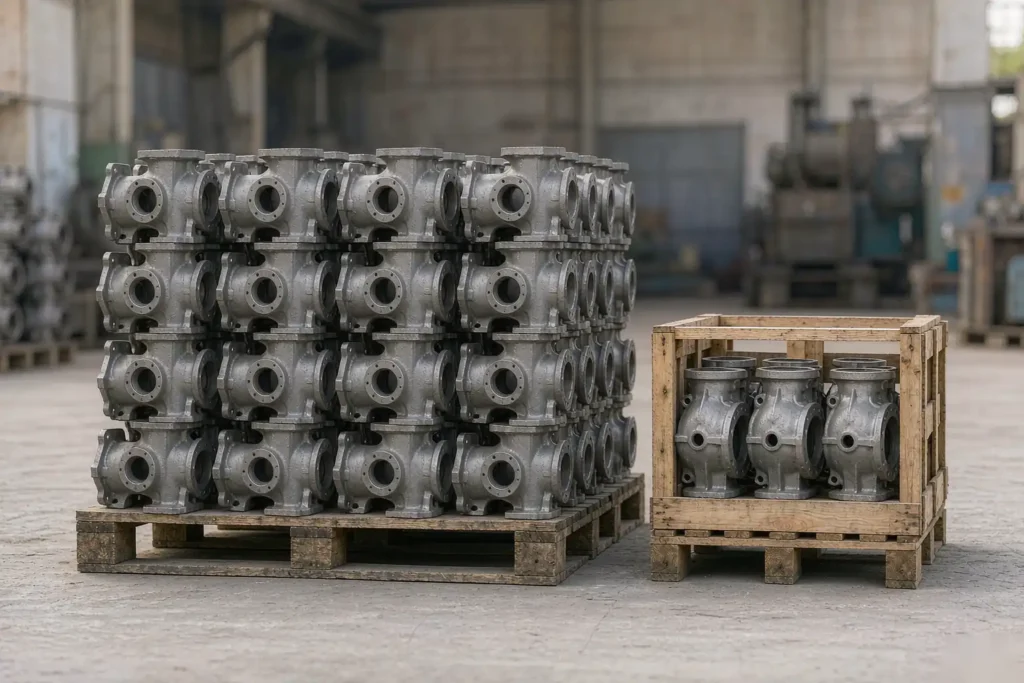
Most buyers meet the casting minimum order quantity for the first time inside a quote, as a single line that reads “MOQ 500 pcs”. It looks like a commercial rule the supplier invented. It is not. It is an arithmetic result: a furnace that must be tapped, a setup that has to be paid for, and a tooling cost that has to land somewhere. This guide shows how a casting minimum order quantity is really derived, process by process, and which six levers actually move it.
Everything below is production arithmetic you can check yourself — melt batch sizes, setup recovery, tooling amortization and inventory carrying cost — with industry practice cross-referenced against AFS und NADCA publications rather than rules of thumb. If you already know how a casting is made, start with our metal casting guide; if you are comparing routes for a low-volume part, jump to the process table — it shows where each casting minimum order quantity comes from.
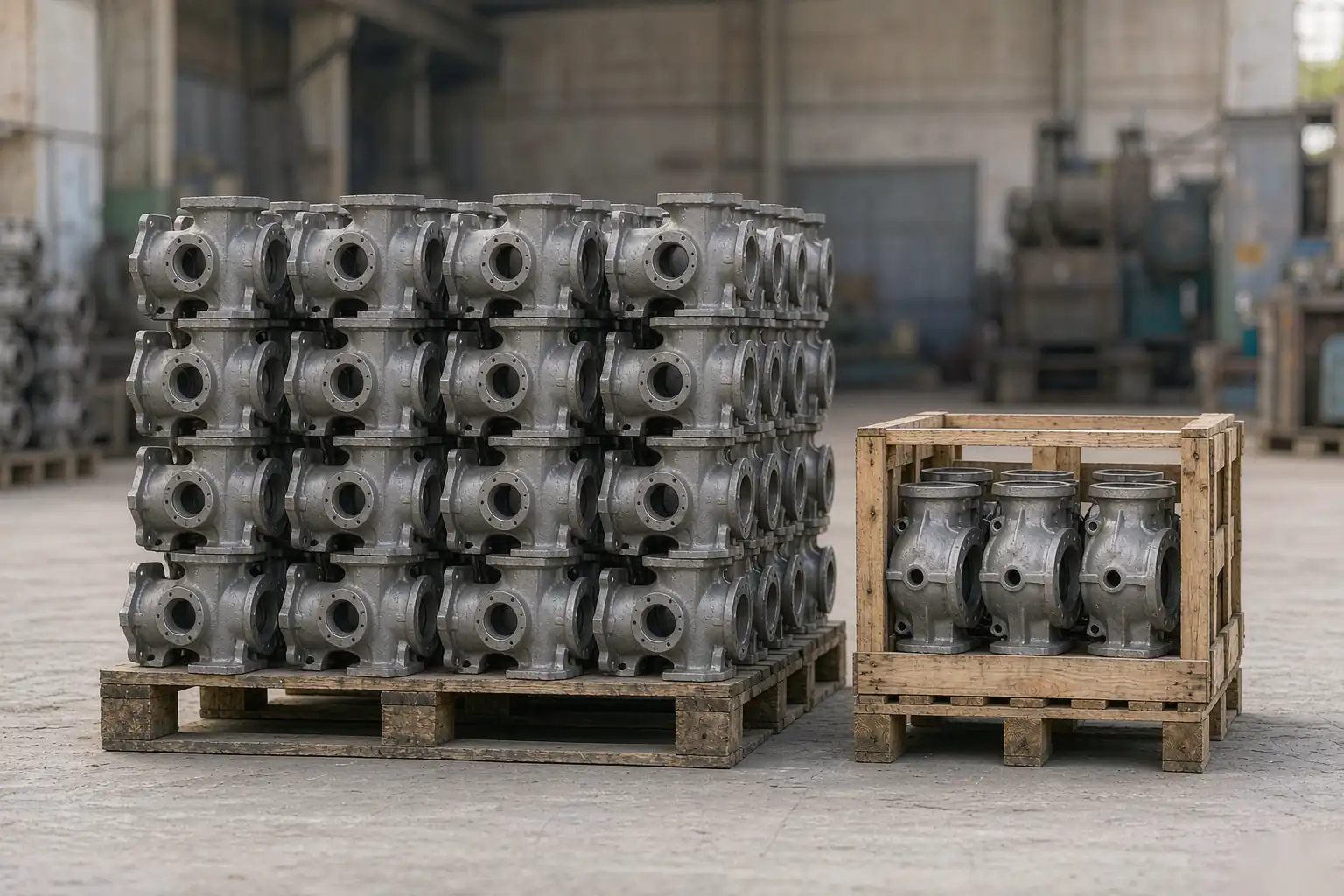
What a Casting Minimum Order Quantity Really Covers
A foundry does not set a number to be difficult. It sets the quantity below which the order loses money or blocks a machine for longer than the job is worth. Six drivers produce almost every MOQ you will see on a quote, and each one has a different fix.
| Driver | What it sets | Typical floor | What the buyer can change |
|---|---|---|---|
| Melt batch | Pieces per furnace tap | 30–80 pcs | Share the tap with other part numbers |
| Setup and changeover | Quantity that keeps setup under 8–12% of unit price | 300–1,000 pcs (die casting) | Fewer, larger releases per year |
| Tooling amortization | Tooling cost ÷ target cost per piece | Drives die casting hardest | Common mould base, longer tool life |
| Cavities or tree count | Pieces per shot or per wax tree | 12–36 pcs per tree | Run a part-filled tree or fewer cavities |
| First article and inspection | One-off $600–$1,200 per programme | Often hidden, rarely stated | One FAI per year, batch release after |
| Packing and freight | Full pallet or full container | One pallet minimum | Consolidated shipments, accept LCL surcharge |
Notice that only one of the six is about metal. A casting minimum order quantity is mostly a fixed-cost recovery problem, which is why the same part can carry an MOQ of 30 pieces from one process and 500 from another. That is also why the number is negotiable once you know which driver produced it.
How Foundries Derive a Casting Minimum Order Quantity
Below are three real derivations — sand casting, high-pressure die casting and investment casting — each worked from shop-floor numbers you can audit in a quote. The pattern is identical in all three: add up the cost that does not change with quantity, then ask how many pieces it takes to make that number small.
Sand casting — the melt batch is the floor
Take an 18 kg ductile iron pump housing. Poured weight per piece is 40 kg — 18 kg of casting plus 22 kg of runner, gate and riser, which is a normal yield of about 45%. A 3 t coreless induction furnace gives roughly 2,400 kg of usable iron per tap, so one tap produces 2,400 ÷ 40 = 60 pieces.
The fixed cost of making that tap happen does not scale down:
- Melt start-up, power and lining wear: $180
- Pattern set-up and moulding line changeover: $240
- Trial pour and two first pieces: $290
- Melt control, spectro check and paperwork: $150
That is $860 per batch. With a unit price of $64 and variable cost of $38.50 per piece, each piece contributes $25.50, so the batch must be at least 860 ÷ 25.50 = 34 pieces to break even on fixed cost alone. Below that the supplier has to add the shortfall to the price: at 20 pieces the shortfall is $350, or $17.50 per piece, pushing the price from $64 to $81.50 — a 27% premium for two-thirds less metal. In practice most foundries will quote the full 60-piece tap rather than sell 20 pieces at that price, because the remaining 800 kg of iron has nowhere to go. That is the whole origin of a sand casting minimum order quantity: it is a furnace size, not a policy. Over a year, 240 pieces bought as four taps costs 4 × $860 = $3,440 in fixed cost; the same 240 pieces bought as twelve 20-piece batches costs 12 × $860 = $10,320, or $6,880 more per year for identical castings.
Die casting — setup cost divided by shots
Now an aluminium housing on a 300 t machine with a two-cavity tool at a 45 s cycle. That is 80 shots per hour and 160 pieces per hour. The tool costs $48,000 and is good for about 100,000 shots, i.e. 200,000 pieces, so tooling adds $48,000 ÷ 200,000 = $0.24 per piece — small. The setup is not small:
- Tool install, preheat and die-lube setup: $310
- Trial shots and first-piece layout: $220
- Start-up scrap, biscuit and runner recycle: $90
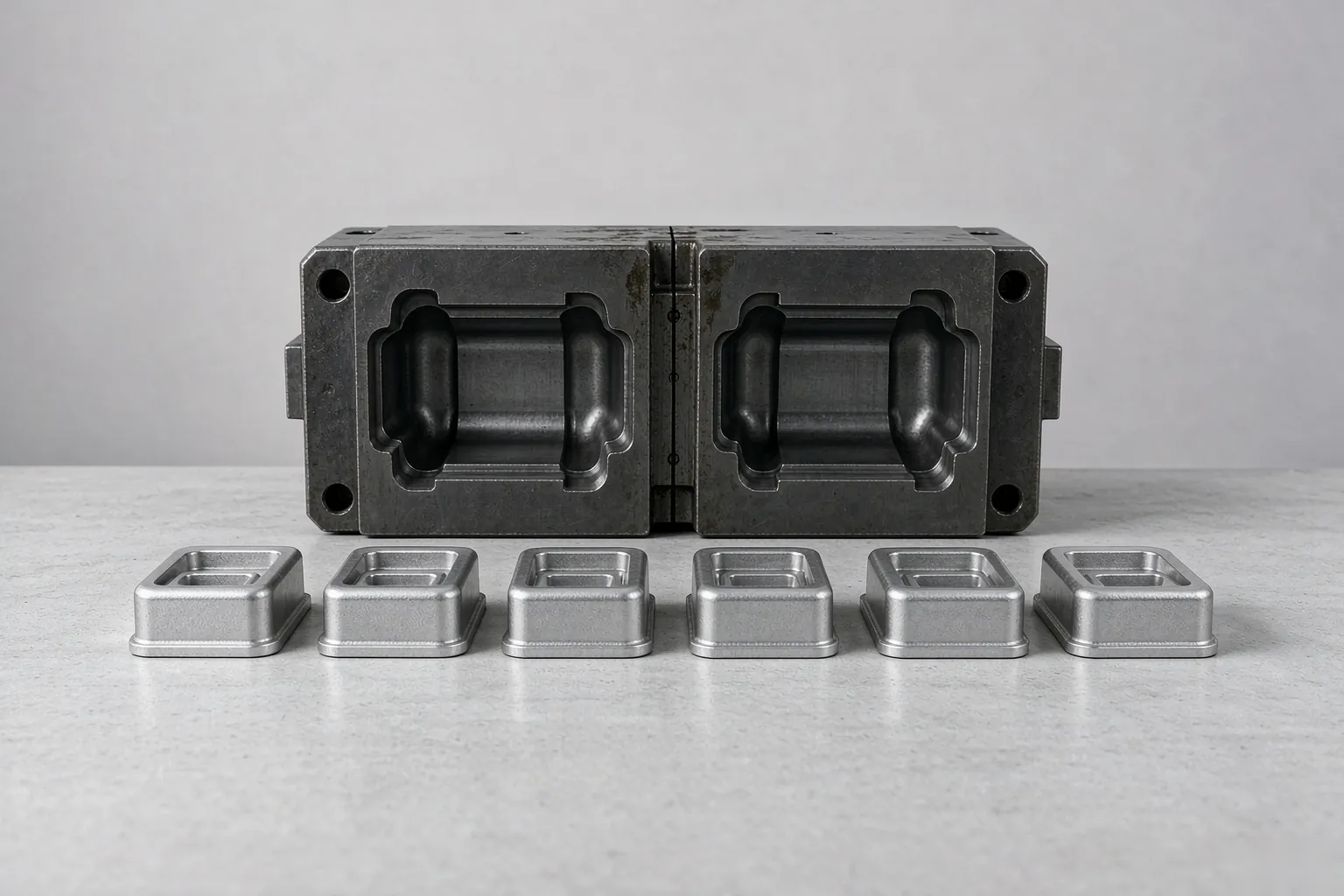
Total $620 per run. Most die casters will not let setup exceed roughly 10% of unit price, so with a $12 target unit price the cap is $1.20 per piece and the run must be at least 620 ÷ 1.20 = 517 pieces — which is why “MOQ 500” appears so often on die casting quotes. Work the two extremes: at 30 pieces the setup adds $20.67 per piece, so unit cost is $1.10 metal + $1.90 machine and labor + $20.67 setup + $0.24 tooling = $23.91. At 1,000 pieces setup drops to $0.62 and unit cost is $3.86 — a 6.2× swing from quantity alone — which is why a die casting minimum order quantity is quoted as a round number near the setup-recovery threshold, not as a melt size. If you want the tooling side of that arithmetic, see die cast tooling cost and lifecycle factors.
Investment casting — the tree sets the count
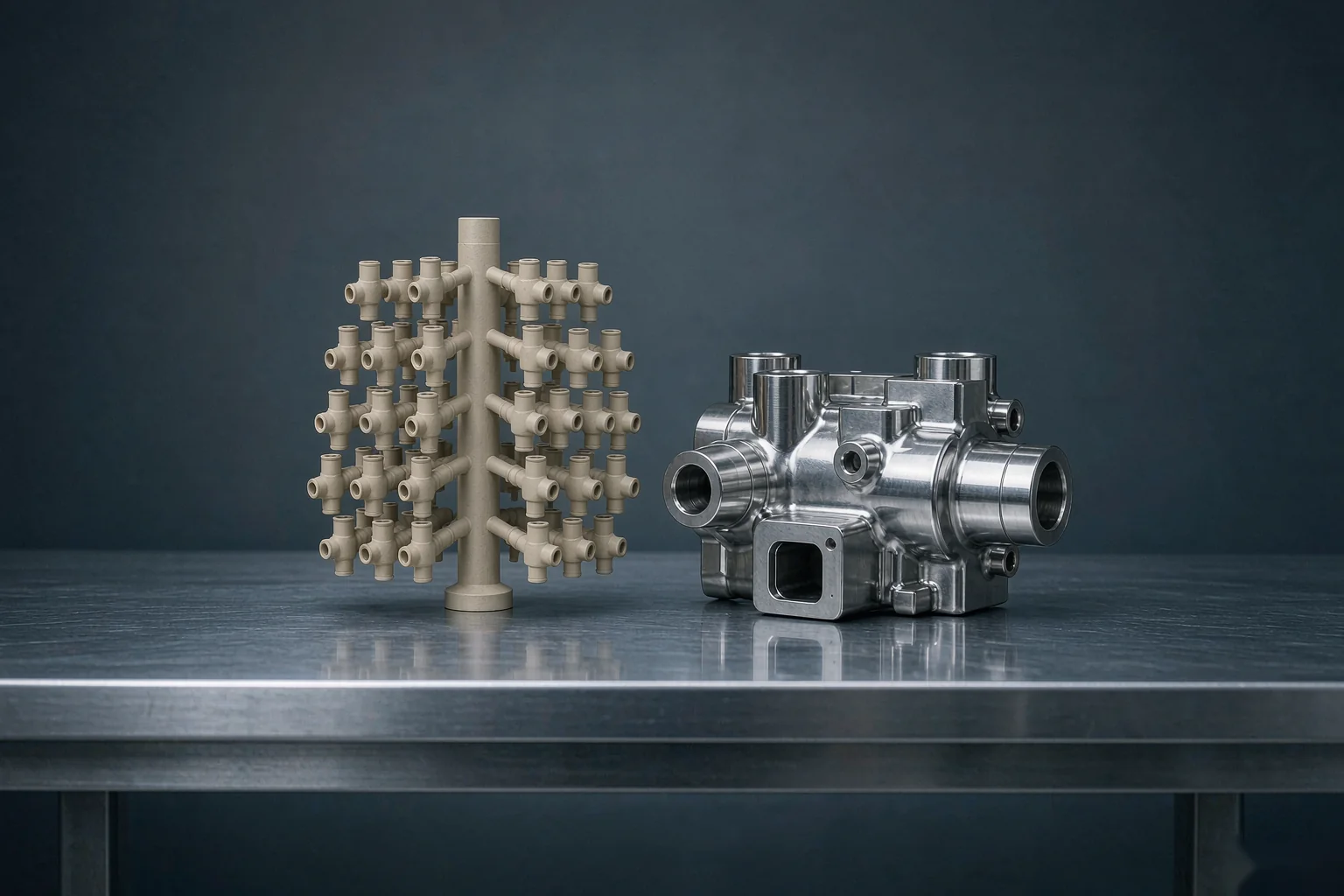
A 0.55 kg CF8M valve body is not run piece by piece; it is assembled onto a wax tree, and the casting minimum order quantity follows the tree rather than the customer. Say 24 pieces per tree. Shell building, dewax and firing costs about $145 per tree regardless of how many patterns hang on it. Poured metal is 24 × 0.55 = 13.2 kg of castings plus 6.8 kg of running system, i.e. 20 kg per tree at $6.40/kg of melted stainless = $128. Finishing — cut-off, grind, blast, passivate — runs $4.20 per piece, or $100.80 per tree. Total per tree $373.80, or $15.58 per piece at a full tree.
Ask for six pieces instead and you still pay for a full shell and a full running system: shell is $145 ÷ 6 = $24.17, metal is (3.3 kg + 6.8 kg) × $6.40 = $64.64 ÷ 6 = $10.77, finishing is $4.20 — $39.14 per piece, 2.5× the full-tree price. This is the cleanest illustration of the whole topic: the process has a natural packet size, and a casting minimum order quantity is simply that packet. The table below puts the three derivations side by side with the two processes most buyers also shortlist, so you can see which driver you are actually arguing with.
| Process | What sets the MOQ | Typical MOQ | Penalty at 1/3 of MOQ |
|---|---|---|---|
| Green sand | One furnace tap + line changeover | 30–100 pcs | +25–30% per piece |
| Resin / no-bake sand | Mixer batch and mould handling | 20–60 pcs | +20–30% per piece |
| Shell mould | Shell machine and pattern plate | 100–300 pcs | +30–40% per piece |
| Investment (lost wax) | Pieces per wax tree | 12–36 pcs (per tree) | Up to +150% per piece |
| High-pressure die casting | Setup recovery against unit price | 300–1,000 pcs | +400–600% per piece |
| Permanent mould / squeeze | Die preheat, cycle stability | 100–500 pcs | +40–80% per piece |
Unit Price Versus Carrying Cost: The Buyer-Side Math
Beating the casting minimum order quantity on paper is not the same as winning. Buying big to get the lower tier converts a price problem into an inventory problem, and inventory has a carrying cost. Take the pump housing at 480 pieces per year with a quoted ladder of $81.50 at 100 pieces, $72.40 at 300 and $64.00 at 600.
Option A, six releases of 100 pieces: purchase spend 6 × $8,150 = $48,900; average stock 50 pieces, and at a carrying rate of 22% per year (10% capital, 6% storage, 6% obsolescence and damage) that is 50 × $81.50 × 0.22 = $897. Option B, one buy of 480 pieces at $64 = $30,720; average stock 240 pieces, carrying 240 × $64 × 0.22 = $3,379.
| Line item | 6 × 100 pcs | 1 × 480 pcs | Delta |
|---|---|---|---|
| Purchase spend per year | $48,900 | $30,720 | −$18,180 |
| Inventory carrying cost | $897 | $3,379 | +$2,482 |
| Total cost of ownership | $49,797 | $34,099 | −$15,698 |
| Verdict | — | Buy big | Demand is stable |
Now flip the case. Annual demand is 120 pieces and the design is not frozen. Accepting a 600-piece MOQ locks up five years of stock: average stock is 300 pieces, so carrying cost is 300 × $64 × 0.22 = $4,224 per year, or $21,120 over five years. The price saving is (120 × $17.50) = $2,100 per year, or $10,500 over the same period. You spend $21,120 to save $10,500 — a net loss of $10,620. When demand is thin or the drawing may change, the right answer is to pay the premium, or to change process, not to buy the tier.
Six Levers That Lower a Casting Minimum Order Quantity
Once you know which driver produced the number, only a handful of moves genuinely help. Everything else is asking the supplier to absorb a real cost.
| Lever | What you actually do | Effect | Trade-off |
|---|---|---|---|
| Share the melt | Put three part numbers of the same alloy on one tap | $860 fixed cost → $287 per part number | Deliveries must be synchronized |
| Blanket order, scheduled releases | Price at annual volume, ship monthly | 600-pc price with one month of stock | Take-or-pay clause if volume slips |
| Common mould base | Buy inserts only, reuse a standard base | Tooling down 30–50% | Cavity layout flexibility is lost |
| Right-size the process | Sand or lost foam at 20–80 pcs instead of die casting at 500 | MOQ falls by an order of magnitude | Tolerance and surface class change |
| Prototype route first | 3D-printed sand moulds or bar stock until the design is frozen | No tooling exposure at 1–50 pcs | Unit cost high; must re-quote for series |
| Pay the premium openly | Agree a stated small-batch surcharge | Predictable price and delivery | +25–30% per piece at 1/3 MOQ |
Two of these are worth underlining. Sharing the melt is the cheapest lever in sand casting because the fixed cost genuinely disappears rather than moving. And right-sizing the process is the only lever that changes the MOQ itself instead of the price of ignoring it — a part quoted at 500 pieces by Druckguss may quote at 30 pieces from Sandguss or lost foam casting. Compare the routes in die casting vs sand casting before you argue about the number.
What to Write About MOQ in the RFQ
Most casting minimum order quantity friction is a specification problem, not a negotiation problem. Put these five lines in the enquiry and the number you get back will already reflect your real demand. A complete casting RFQ package gets priced in two to three working days; each missing line costs a week of round trips.
- State annual volume, not just this order. “480 pcs/year, releases of 40 pcs/month” is a different quote from “40 pcs”.
- Ask for three price points. Price at MOQ, at 2 × MOQ, and at the annual blanket volume.
- Ask what drives the casting minimum order quantity. Melt batch, setup recovery or tooling? The answer tells you which lever applies.
- Separate tooling from unit price. If tooling is billed once, unit price should not carry its amortization twice — see casting mould and pattern making.
- Confirm the unit of the MOQ. Per part number, per production batch, or per shipment? These are three different commitments.
Also say what happens after the first batch. If the programme needs a first article inspection once a year rather than once per release, that fixed cost stops being a reason for a large MOQ. The same applies to inspection class: a tight tolerance spec and a heavy machining allowance both raise setup scrap, which raises the quantity needed to absorb it.
When You Should Simply Pay the Premium
Four situations where fighting the casting minimum order quantity costs more than accepting it:
- The design is not frozen. A cheaper unit price on a part you will redraw is a write-off, not a saving.
- Annual demand is below the MOQ. As the 120-piece case shows, five years of carrying cost beats one year of price advantage.
- You are in qualification. Buy 20 pieces at a premium, run inspection and NDT, then commit to the volume price.
- It is a spare part. Intermittent demand plus a dated drawing is exactly the case for a prototype route or a CNC machined part, not a production batch — and certainly not for accepting a casting minimum order quantity you cannot consume.
Where the premium is unavoidable, reduce it somewhere else. Simulation before the first pour removes one sample loop — see casting simulation. Choosing an alloy that is already in the furnace removes the melt penalty — start with how to choose a casting alloy. And if you only need a handful of parts to validate an assembly, 3D printing versus casting, 3D printed prototypes und metal prototype casting will usually cost less than a production MOQ you cannot consume.
FAQ
What is a typical casting minimum order quantity?
It depends entirely on the process. Green sand and no-bake sand commonly sit at 20–100 pieces, shell mould at 100–300, permanent mould and squeeze at 100–500, and high-pressure die casting at 300–1,000. Feinguss is quoted in trees, typically 12–36 pieces per tree. Ask which driver set the number before you treat it as fixed.
Why is the MOQ so different between sand casting and die casting?
Because the fixed cost sits in a different place. Sand casting is limited by the furnace tap — 30 to 80 pieces per melt — and its setup is a few hundred dollars. Die casting has a $600-ish setup that includes tool install, preheat and trial shots, and its economics only work when that is spread over hundreds of pieces. See aluminium die casting for the process detail.
Can I lower the casting minimum order quantity without paying more?
Yes, in two cases: when your parts can share a melt or a setup with other orders, and when a blanket order lets the supplier price on annual volume while shipping smaller releases. Both remove real cost; neither is a discount. If neither applies, a lower MOQ is just a price increase with different wording.
Does tooling count toward the MOQ?
Indirectly, yes. Tooling is usually billed separately, but the supplier still needs enough pieces to justify occupying the tool and the machine. In die casting, tooling at $48,000 over 200,000 pieces is only $0.24 per piece — the MOQ is driven by setup recovery, not by amortization. Insist that tooling is quoted as its own line so you can see which is which.
Is the volume discount above the casting minimum order quantity linear?
No. The steepest part of the curve is between one third of MOQ and MOQ itself, because the fixed cost is being divided by a small number. Below MOQ the die casting example moves from $23.91 to $3.86 per piece — most of that happens in the first few hundred pieces. Beyond roughly 2 × MOQ the curve flattens and material price dominates.
How does MOQ affect lead time?
Smaller releases usually mean more setups, and more setups mean more queue time. Splitting 480 pieces into twelve 40-piece batches can add weeks to the schedule even when the casting itself takes hours — the full breakdown is in casting lead time. A blanket order with scheduled releases is often the best of both.
*Data referenced from AFS / NADCA industry publications and Supro MFG shop-floor records.
 English
 Français
 Deutsch
 Italiano
 日本語
日本語 한국어
한국어 Polski
 Português de Angola
 Русский
 Español de Argentina