
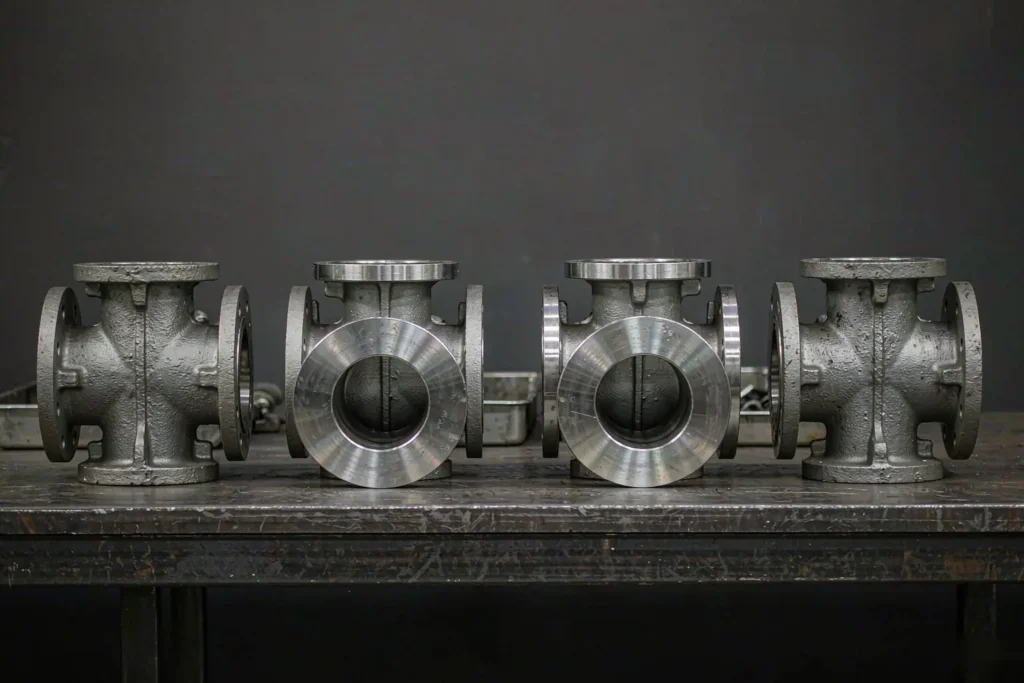
A casting scrap rate of 10.6% is not a quality statistic sitting in a spreadsheet. On a machined 21.5 kg valve body it is $3.72 of cost per good piece, 5.5% more furnace hours than the schedule assumes, and roughly one month in ten where the shipment arrives short. Most buyers never see the number until it appears as a late container.
This guide treats the casting scrap rate as a cost structure rather than a report card: which denominator to use, where the loss actually accrues across three process stages, how to turn the percentage into dollars per good part, and which five shop-floor levers move it without capital equipment. Alloy classifications referenced below follow ASTM A536 for ductile iron and NADCA process guidance; the arithmetic is standard yield accounting, not a benchmark borrowed from a brochure. For the process decisions sitting upstream of every yield loss, the guia de fundição de metais covers them in sequence.
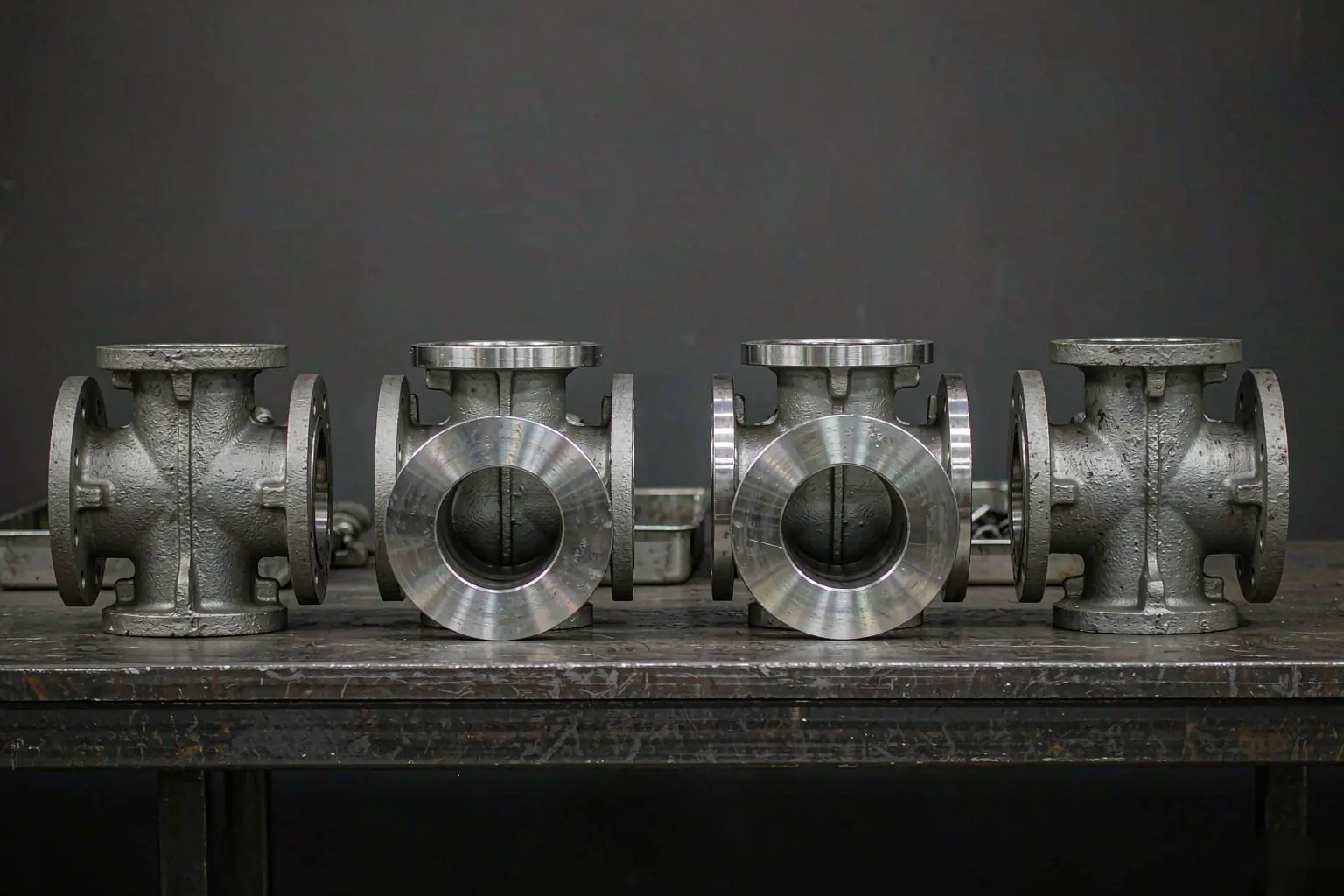
What a Casting Scrap Rate Really Measures
A casting scrap rate is the share of pieces that enter a process step and never reach the customer in saleable condition, counted over a defined period. Everything that makes the number useful or useless sits in two words: enter e saleable. Move either boundary and the same shop reports 4% or 14% in the same week without anyone lying.
- Pieces poured as the base. Count every cavity filled, including molds that produced only risers. This is the only denominator that charges the shop for metal it melted and never converted.
- Pieces after shakeout as the base. Castings that never filled, or that broke during knockout, quietly leave the sample. A foundry using this base typically reports two to four points lower than one using poured pieces.
- Shipped pieces as the base. Rework disappears into the good count. A part that went through weld repair, impregnation and a second machining pass shows up as 100% yield and 180% cost.
First Pass Yield Is the Number That Pays
First pass yield (FPY) counts only pieces that cleared every gate the first time. It is always the lower number and always the honest one. Take 1,000 castings where 60 are reworked and 40 are scrapped: final yield reads 96%, first pass yield reads 90%. The 60 reworked pieces still consumed a second setup, a second inspection and a welder, and those hours are in the price the buyer pays whether or not they appear in the yield figure.
When a supplier quotes a scrap rate, ask which one they mean. A 3% final loss with a 22% rework rate is a harder job to schedule than a flat 9% first pass scrap with no rework loop, because the rework path is invisible to capacity planning and builds its own queue.
How to Calculate a Casting Scrap Rate You Can Defend
The formula is trivial; the boundary conditions are not. Before comparing two suppliers, two months or two part numbers, fix four parameters in writing: the denominator, the counting point, whether rework returns to the numerator, and whether machining losses are included. The table shows what each common denominator hides.
| Denominator used | What it counts | What it hides |
|---|---|---|
| Pieces poured (molds x cavities) | Every cavity filled, risers included | Nothing at this stage; the most conservative base |
| Pieces after shakeout | Castings that survived knockout | Misfills, cold shuts, broken molds |
| Pieces charged to the job | Castings plus the rework loop | How many touches each piece needed |
| Pieces shipped | Only saleable output | Repair, re-inspection, schedule slip |
| Machined pieces only | Post-machining yield | Casting-stage loss, the largest share |
The Staged Calculation
Scrap does not cost the same at every stage. A casting scrapped at shakeout loses melt and mold cost only; the same casting scrapped after machining loses machining hours, tooling and inspection on top. The correct expression is a weighted sum, not a single percentage:
Scrap cost per good piece = sum over stages of (pieces entering x scrap fraction x cost accumulated to that stage) / good pieces
Run it on a 21.5 kg gray iron valve body at 10,000 pours a month, across three gates: pouring at 96.0%, cleaning and first inspection at 97.5%, first-pass machining at 95.5%. Multiply the three and the real first pass yield is 89.39%, a scrap rate of 10.61% – which is 106,100 PPM, roughly two hundred times the target an automotive buyer expects on a purchased part.
| Stage | Entered | Passed | Scrapped | Cost accumulated | Scrap cost |
|---|---|---|---|---|---|
| Melt and pour | 10,000 | 9,600 | 400 | $17.40 | $6,960 |
| Cleaning and inspection | 9,600 | 9,360 | 240 | $22.70 | $5,448 |
| Machining, first pass | 9,360 | 8,939 | 421 | $49.50 | $20,840 |
| Total | 10,000 | 8,939 | 1,061 | – | $33,257 |
Divide $33,257 by 8,939 good pieces and the scrap bill is $3.72 per good piece on a $51.60 variable cost, a 7.2% uplift. The component build-up behind that $51.60 is the same one used in any discriminação dos custos de fundição: metal, mold, finishing, machining, inspection, with scrap applied on top rather than inside each line. The naive shortcut – total cost divided by first pass yield – gives $57.73 and overstates the damage by $2.41, because it charges machining hours to pieces that were scrapped before they ever reached a machine. That shortcut is fine for a rough capacity estimate. It is wrong in a price negotiation.
One more number keeps the comparison honest: the confidence interval around the estimate. A 400-piece lot with 42 scrapped gives a point estimate of 10.5%, but the 95% interval runs from roughly 7.9% to 13.9% – wide enough that ranking two suppliers on a single lot is guesswork. When the question is “is this lot under the cap?” rather than “what is the average?”, ASTM E2334 formalises the upper confidence bound, and it is the honest way to write a lot-acceptance rule into a casting scrap rate clause.
The Cost Curve Hidden Inside a Casting Scrap Rate
Scrap percentage and scrap cost are not proportional. Because every scrapped piece carries the full cost of all upstream steps, the multiplier on cost per good part is 1 / (1 – scrap rate), and it steepens as the rate climbs. A shop moving from 4% to 8% loses more money per point than one moving from 2% to 5%, even though the second shop added three points and the first added four.
| Scrap rate | Cost multiplier per good piece | Extra cost on a $51.60 base |
|---|---|---|
| 2% | 1.020 | +$1.05 |
| 5% | 1.053 | +$2.71 |
| 8% | 1.087 | +$4.49 |
| 10.6% | 1.119 | +$6.12 |
| 15% | 1.176 | +$9.11 |
| 20% | 1.250 | +$12.90 |
The table uses the uniform-cost shortcut, so read it as a ranking tool rather than an invoice. The real bill depends on where the loss lands, which is what the staged calculation resolves. The commercial lesson holds either way: the last two points are the expensive ones, which is why the cheapest scrap reduction usually comes from the top two part numbers instead of a shop-wide campaign.
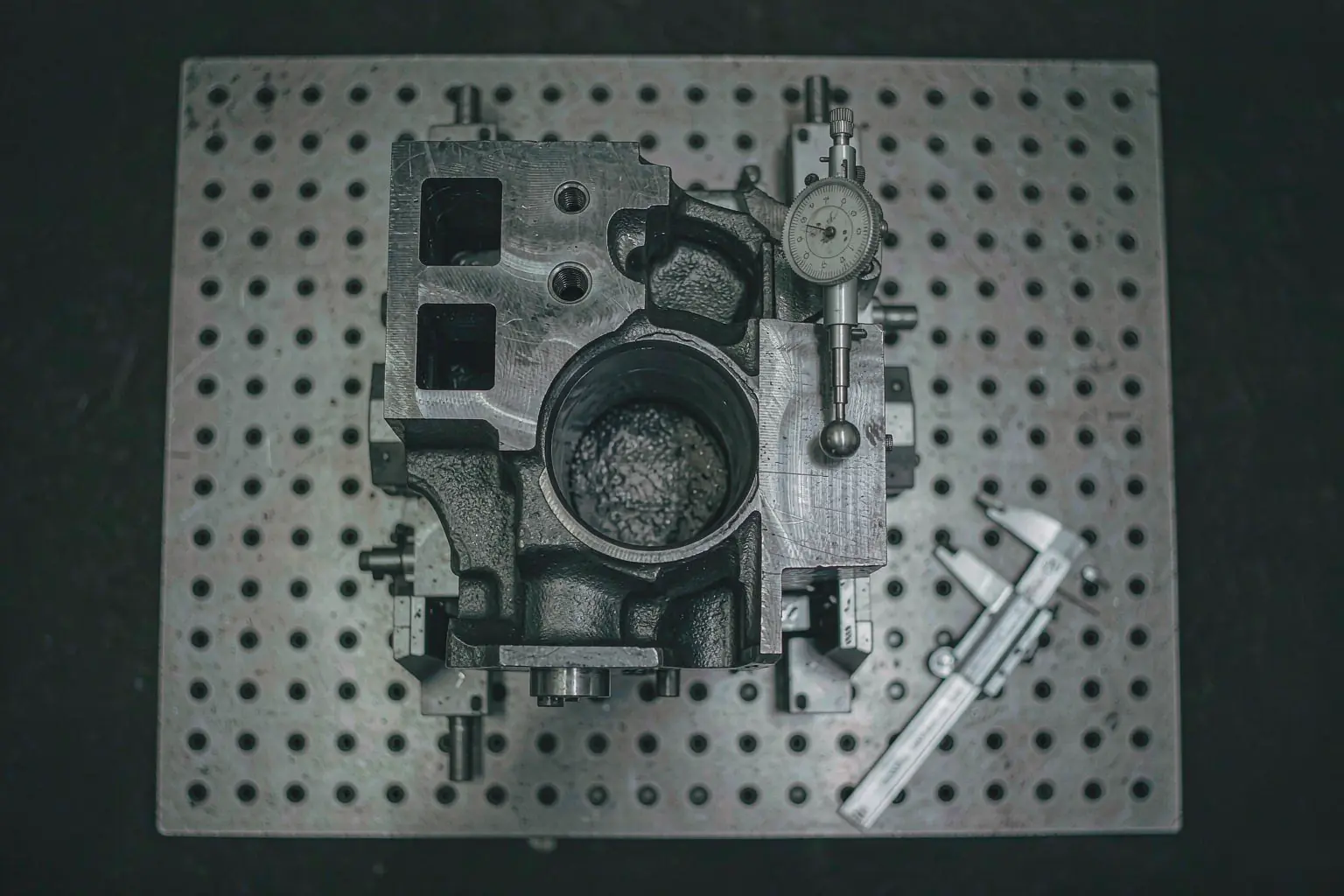
Where a Casting Scrap Rate Comes From: Six Signatures
A scrap rate without a Pareto is just a mood. The six sources below account for most of the loss in a sand foundry, and each leaves a signature that says which gate it belongs to. Shares are shop-floor experience across ductile and gray iron work, not a standard – sort your own data before budgeting against them. The defect names in the signature column map onto the pattern catalog in defeitos comuns de fundição, and the detection method decides which one you can actually see: métodos de inspeção de peças fundidas compares what each gate catches.
| Source | Typical share | Signature | Found at |
|---|---|---|---|
| Gating and riser design, shrinkage | 30-40% | Porosity at a hot spot, sink on a heavy section | X-ray, UT, sectioning |
| Sand system (blows, scabs, penetration) | 15-25% | Clustered on one mold position, worse after a sand change | Visual, after shot blast |
| Metal chemistry and pour temperature | 10-20% | Cold shuts, misruns, carbides, varying by heat | Spectrometer log, thermocouple |
| Core defects (shift, gas, breakage) | 8-15% | Internal void with a smooth wall, wall thickness off on one side | Sectioning, gauging |
| Pattern and tooling wear | 5-12% | Slow dimensional drift, flash growth over months | SPC on a locating feature |
| Machining-induced loss | 5-15% | Chatter, hard spots, allowance consumed on one face | CMM, tool life records |
The Half That Happens After the Casting Is Good
In most shops a fifth to a third of what gets reported as scrap is machining scrap wearing a casting label. A casting 0.4 mm out of position on a machined pad is a good casting with a bad process plan: fixing it with a pattern change costs five figures, fixing it with a fixture adjustment costs an afternoon. Split the scrap at the machining gate before you accept the number. The split tells you whether you are buying a foundry problem or a manufacturing-engineering problem, and those come with very different price tags. If the loss survives that test, the allowance was wrong rather than the casting – the arithmetic for that sits in casting machining allowance – and the fix belongs in the machining cell reviewed under CNC machining services, not on the pattern.
Cutting a Casting Scrap Rate Without Buying a New Line
The five levers below were sized against the 10.61% baseline casting scrap rate established above, on a shop running 10,000 pours a month. Expected reduction is the measured effect at that shop, not a vendor claim; the arithmetic total overstates the result because two levers attack the same porosity population, so plan for roughly 80% of it.
| Lever | Expected reduction | One-time cost | Retribuição |
|---|---|---|---|
| Pour temperature window held to +/-15 C with CE and inoculation control | 2.0 pp | $400 | Immediate |
| Sand system control: muller cycle, compactability 32-38%, moisture logging | 1.3 pp | $8,600 | 0.6 month |
| Gating and riser redesign on the top two part numbers | 1.4 pp | $12,800 | 0.9 month |
| SPC plus gauge R&R on three critical dimensions | 0.6 pp | $6,200 | 0.4 month |
| Machining fixture and allowance review | 0.7 pp | $4,900 | 0.3 month |
| Program total | 6.0 pp, plan 4.9 pp | $32,900 | 2.1 months |
Cutting the casting scrap rate by 4.9 points takes first pass yield from 89.39% to 94.30%: 9,430 good pieces from the same 10,000 pours, scrap cost down from $33,257 to $19,254, or $3.72 to $2.04 per good piece. At 9,430 pieces a month that is $15,833 a month – about $190,000 a year – against $32,900 of one-time spend. Few capital projects on a foundry floor pay back in nine weeks.
Why 100% Inspection Does Not Cut Scrap
Sorting every piece is the most common first response to a bad casting scrap rate, and the least effective. Inspecting 9,000 machined castings at 1.6 minutes each is 240 labour hours a month, about $6,720 at $28 an hour, and nothing changes upstream: the same 1,061 pieces are still poured and still lost. Worse, a visual gate on internal porosity detects well under half of what passes through it, so the exercise converts an internal scrap cost into an external one. Inspection buys information; process control buys pieces back.
The right use of 100% inspection is short and diagnostic: run it for one or two lots to find where escapes originate, then move the resource upstream and hold sampling at the level your incoming inspection plan specifies.
A 30-Day Start on Two Part Numbers
Programs die when they start shop-wide. Pick the two part numbers contributing the most scrap dollars – not the highest percentage, the highest dollars – and run four weeks of disciplined work on them. Four weeks is usually enough to prove whether a casting scrap rate is a tooling problem or a process-window problem, and the answer decides where the next $12,000 goes.
- Week 1: tag and weigh every scrapped piece, by cavity position, for five consecutive shifts. Position clustering is the fastest signal you will get.
- Week 2: pull the pour log for the heats behind those pieces – temperature at the furnace, temperature at the mold, CE and inoculation method. One lever, measured.
- Week 3: section two scrapped parts and one good part. The comparison locates the porosity population and tells you whether gating or a core is responsible.
- Week 4: change one variable at a time, 300 pieces per cell, and re-measure. Two variables at once and you learn nothing.
Where the answer lands in the workshop depends on the process. Gating and riser changes belong with the pattern and the casting mold making team; solidification checks are cheaper than pattern cuts and are covered in casting simulation; iron work with a sand-system problem is process-specific enough that the sand casting process and the iron casting line should be tuned together; and a high-volume aluminium part with a 10% scrap rate is usually a tooling-cooling question that belongs in fundição sob pressão rather than sand work at all.
What to Put in the PO When a Casting Scrap Rate Matters
Scrap rate is a supplier-internal metric until it affects delivery, and then it becomes a contract term. Six fields make it enforceable without turning a purchase order into an audit protocol:
- Definition and denominator. “Scrap rate means pieces scrapped divided by pieces poured, measured at each of the three gates named in the inspection plan and reported monthly.” Without the denominator the clause is unenforceable.
- Target and cap. A 6% target with a 9% cap is workable; a single number is not. The cap triggers a written corrective action, the target drives improvement.
- Notification trigger. Any lot above the cap gets written notice within 48 hours with the affected heat numbers. This is the clause that prevents a short shipment discovered at the port.
- Rework disclosure. Reworked pieces must be declared and counted in first pass yield, not final yield. Undeclared rework is the commonest way a quality report stays green while the process drifts.
- Capacity commitment. State the good-piece quantity, not the pour quantity, so the supplier carries the yield risk they control.
- Cost sharing on repeat causes. If the same root cause appears in three consecutive lots, tooling or process correction sits with the supplier; the buyer pays only for design changes they requested.
Two buyer-side numbers make the case internally. Variability first: a supplier averaging 8% scrap with a 3.2 point standard deviation lands above 12% in roughly one month in ten, and covering that at a 95% service level costs about $5,395 a year in carrying cost on a 9,000-piece monthly order, against $1,854 for a supplier holding 1.1 points of deviation – $3,540 a year that never appears on a quotation. Capacity second: shipping 9,000 good pieces needs 10,069 pours at 10.61% scrap versus 9,544 at 5.70%, so 5.5% of the furnace, molding and machining hours you already pay for is producing scrap.
Those figures are also the right way to open the conversation. Asking for a casting scrap rate by stage rather than as a single percentage signals that you know where the number comes from, and it usually gets a more useful answer than a request for a certificate. Pair it with the acceptance criteria in your quality agreement and the escalation path in your defect claim procedure, and the metric stops being a monthly argument.
Perguntas frequentes
What is a good casting scrap rate?
It depends on the process and the alloy, so treat any single figure with suspicion. Across sand casting shops, 3-8% first pass scrap is a well-run process and 8-15% is common; above 15% usually points to a design or sand system problem rather than operator error. Die casting runs lower on dimensional scrap and higher on porosity scrap, and investment casting sits between the two. Compare a supplier against their own history and against a part of similar geometry, not against a headline number.
Is a 0% scrap rate realistic?
No, and a supplier claiming one has either moved the denominator or is not counting rework. New tooling, first articles and alloy changes all carry higher early loss; a mature part on stable tooling can hold 2-3% in die casting and 4-6% in sand casting. What matters commercially is the trend and the variability, not the absolute figure.
How is a casting scrap rate different from first pass yield?
They are complements. First pass yield counts pieces that cleared every gate the first time; scrap rate counts the rest. The gap between first pass and final yield is rework, and that gap is where cost hides – a shop reporting 96% final yield and 90% first pass yield is carrying a 6% rework loop that never appears in the headline number.
Does a supplier scrap rate change the price I pay?
It is already in the price, itemised or not. Scrap raises cost per good piece by 1/(1 – scrap rate): at 10.6% that is roughly a 12% uplift on variable cost before margin. The reason to ask is not to argue the number down but to understand delivery risk – high and variable scrap shows up as short shipments and re-quoted lead times long before it shows up as a price increase.
How do I ask for the number without sounding accusatory?
Ask by stage and by part number rather than as a company average: “for this part, what is your first pass yield at pour, at cleaning and at machining?” That framing makes the answer about the process instead of about blame, and it produces data you can act on. A supplier who cannot answer by stage has probably never split the number, which is useful to know.
*Yield and cost figures are worked examples from Supro MFG shop-floor records; alloy classifications follow ASTM A536 and NADCA process guidance.
 English
 Français
 Deutsch
 Italiano
 日本語
 한국어
 Polski
 Português de Angola
 Русский
 Español de Argentina