
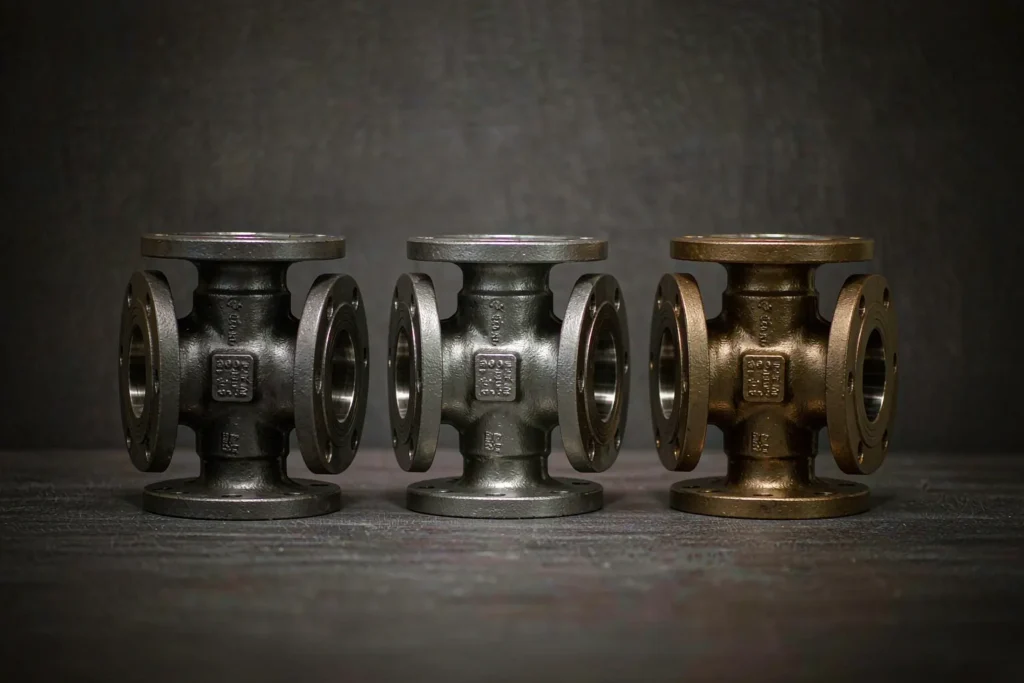
Casting material substitution looks like a one-line change on a purchase order and behaves like a full engineering project. A buyer swaps “A216 WCB” for a cheaper or more available grade, the part still fits the drawing, and six weeks later the first heat arrives with the wrong impact test temperature, a carbon equivalent that forces post-weld heat treatment, and a certification package the customer’s notified body will not accept.
This guide treats casting material substitution as what it actually is: a four-level decision, each level with its own approver, its own paperwork and its own arithmetic. Every number below comes from shop-floor records on 100–400 kg castings and is checked against published ASTM oraz ASM International material data. If you are still choosing the original alloy rather than replacing one, start with how to choose a casting alloy and come back here when the alloy is fixed and the pressure is on price or lead time.
What Casting Material Substitution Really Means
Suppliers and buyers use the same phrase for four very different transactions. Mixing them up is where most substitution projects fail, because the approval effort and the risk profile differ by an order of magnitude.
A drop-in substitution happens inside one specification. ASTM A216 already permits a carbon range; moving from C 0.25 to C 0.22 within the same grade is not a substitution at all, it is normal heat-to-heat variation. A property-equivalent substitution changes the designation but promises the same minimum mechanical values — typically a cross-standard swap such as WCB to EN 1.0619, or CF8M to its EN and JIS cousins. A spec-permitted alternative is written into the purchase order in advance: the drawing says “A216 WCB or A352 LCB at the buyer’s option”, which is a substitution you have already approved. A redesign substitution changes section size, wall thickness or the casting process itself, and that is a drawing revision, not a material note. Whichever level you are working at, the discipline is identical: a casting material substitution is approved against evidence, never against a price list.
| Level | What actually changes | Who signs | Realistic lead time |
|---|---|---|---|
| Level 1 – Within grade | Chemistry inside the existing range | Foundry metallurgist | 0 days |
| Level 2 – Cross-standard equivalent | Designation, test bar source, certification route | Buyer engineering + quality | 3–6 weeks |
| Level 3 – Property substitution | Strength, toughness or corrosion class changes | Design authority + end customer | 8–16 weeks |
| Level 4 – Redesign | Wall thickness, risering, pattern, machining stock | Full drawing revision, new PPAP | 4–7 months |
Most quotation-stage “can you use a cheaper material” questions sit at Level 2, but the answer usually travels through the RFQ process as if it were Level 1. That mismatch is the single most common source of rework in the first article stage.
The Four Silent Differences That Break a Material Swap
Two grades can share a tensile number and still fail each other’s acceptance test. These four details sit below the headline properties and decide whether a casting material substitution survives the first incoming inspection.
Chemistry Windows Are Ranges, Not Points
A grade such as A216 WCB permits carbon up to 0.30%. Sit at the top of that window and you are legally compliant and practically un-weldable without preheat. Sit at the bottom and you lose hardenability. When a casting material substitution crosses standards, the windows shift by 0.03–0.08% carbon and by 0.2–0.5% manganese, which is enough to move carbon equivalent by 0.05 and flip a welding procedure from “preheat optional” to “preheat mandatory”. The cast steel grades reference lists the window for each common designation.
Where the Test Bar Comes From
A separately cast keel block, an integrally cast coupon and a trepanned core sample from the part itself give three different answers on the same heat. ASTM A216 and EN 10213 do not specify the test location identically. If the customer’s drawing says “properties to ASTM A216” and your substitute heat was qualified on EN-style separately cast bars, the numbers on the certificate are real but not automatically acceptable, and the casting material substitution stalls at certificate review rather than at the tensile test. For heavy sections the gap widens: a 100 mm wall of a normalized carbon steel casting can read 20–40 MPa below the separately cast keel block value used to qualify the grade.
Impact Temperature and Heat-Treat Condition
This is where a cheap swap becomes expensive. A352 LCB and A216 WCB are close metallurgical neighbours, but LCB carries a Charpy requirement at −46 °C that forces a normalizing treatment and a per-heat impact test set. A casting material substitution into a low-temperature grade therefore does not just change the price per kilogram; it adds a furnace cycle and a destructive test to every heat. The heat treatment guide covers which conditions each grade expects.
Traceability and the Certification Route
A mill certificate, an EN 10204 3.1 inspection certificate and a 3.2 certificate signed by an independent inspector are three different products. A supplied substitution that arrives with a 2.2 test report when the quality agreement calls for 3.1 is a documentation nonconformance even if every mechanical value passes. This is worth writing into the quality agreement before the first substituted heat is poured, not after.
Casting Material Substitution Across Standards: ASTM, EN, JIS, GB
Cross-referencing standards is where sourcing teams spend the most time and get the least certainty. The table below lists the pairs that are genuinely used in commercial quotations. Treat each row as “closest commercial equivalent”, never as legal equivalence — the standards bodies do not publish an official mapping, and any notified body will want your own comparison matrix with property-by-property justification. No casting material substitution should be quoted from this table alone.
| Family | ASTM | EN | JIS | GB |
|---|---|---|---|---|
| Carbon steel | A216 WCB | 1.0619 / GP240GH | SCPH2 | ZG230-450 |
| Austenitic stainless | A351 CF8 | 1.4308 / GX5CrNi19-10 | SCS13 | ZG08Cr18Ni9 |
| Mo-bearing stainless | A351 CF8M | 1.4408 / GX5CrNiMo19-11-2 | SCS14 | ZG08Cr18Ni12Mo2 |
| Żeliwo sferoidalne | A536 65-45-12 | GJS-450-10 | FCD450 | QT450-10 |
| Żeliwo szare | A48 Class 35B | GJL-250 | FC250 | HT250 |
| Cast aluminium | B26 356-T6 | EN AC-42100 | AC4CH | ZL101A |
Two rows in that table deserve a warning. Gray iron to ductile iron is not a substitution at all — one has measurable elongation and the other has effectively none, which is why the gray iron versus ductile iron comparison exists. And 356-T6 to AC-42100 looks clean on paper but the two standards control iron and magnesium content differently, so hardness and elongation scatter differs even when both hit the tensile number. The aluminium alloy comparison and the stainless grades guide go deeper where the risk is highest.
The practical tool is a carbon equivalent check, because it predicts weldability and preheat before anyone cuts metal. Using the standard formula CE = C + Mn/6 + (Cr + Mo + V)/5 + (Ni + Cu)/15, a typical WCB heat at C 0.22, Mn 0.80, Cr 0.15, Mo 0.05, V 0.02, Ni 0.10, Cu 0.15 gives CE = 0.414 — just over the 0.40 line, so 100–150 °C preheat and no post-weld heat treatment. A high-strength low-alloy substitute at C 0.32, Mn 1.20, Cr 0.60, Mo 0.25 lands at CE = 0.719. That is a 0.305 jump, and it moves the part into 200–250 °C preheat plus a 620 °C post-weld heat treatment cycle. Same drawing, same wall, completely different shop routing.
Running the Numbers on Casting Material Substitution
Three cases, all real part shapes, all costed the same way: net saving per piece = gross saving minus new processing cost, then breakeven units = qualification cost divided by net saving per piece. If the breakeven sits above your annual volume, the substitution is a hobby, not a project.
Case A: Upgrading a Valve Body and Shrinking It
A 200 kg WCB gate valve body, 1,200 pieces a year. The casting material substitution allows 16% less section, so the casting drops to 168 kg at the same design pressure. Gross saving per piece: 32 kg × $3.85/kg = $123.20 material, plus $4.10 melting and freight, plus $6.50 of machining time on the smaller envelope, for $133.80. New cost per piece: a 9-hour post-weld heat treatment at $48/hour is $432 per furnace load of 8 pieces, so $54.00, plus 3 hours of preheat and slow-cool labour at $32/hour, so $12.00 — $66.00. Net saving $67.80 per piece.
Qualification cost comes to $5,200: $1,450 process qualification over three heats, $620 first article and dimensional layout, $1,870 of customer engineering review at 22 hours, $480 of certificate and document revision, $540 of chemistry and mechanical testing on three heats, $240 of impact testing. Breakeven is 5,200 / 67.80 = 76.7 pieces. At 1,200 pieces a year this pays back inside the first month of production and returns roughly $238,880 over three years. This one is a clear yes.
Case B: CF8 to CF8M in a Chlorinated Loop
A pump impeller, 600 pieces a year, running in a cooling loop with residual chlorine. Upgrading from CF8 to CF8M adds molybdenum and nickel: the premium lands at $21.60 per piece, or $12,960 a year extra. What it buys is pitting resistance, and here the history matters more than the datasheet. Casting material substitution in a corrosion service is an insurance decision, not a price decision.
Maintenance records show 48 impeller failures a year at 8% of installed units, each costing $485 in part, labour and lost production. A molybdenum-bearing grade plausibly cuts that to 4 failures a year, avoiding 44 × $485 = $21,340. Net gain $8,380 a year against $9,400 of qualification cost — payback in 1.12 years. Approve it, but write the failure-rate assumption into the approval: if the real baseline is 20 failures a year rather than 48, the project loses $3,260 annually and should have been rejected.
Case C: The Downgrade That Should Be Refused
A 12 kg mounting bracket, 5,000 pieces a year, specified in ductile iron 65-45-12 at $2.10/kg. Gray iron at $1.45/kg saves $7.80 per piece — $39,000 a year. On purchase price alone this casting material substitution wins, with a trivial $3,100 qualification bill and a 397-piece breakeven. On arithmetic alone it is the best of the three cases.
It is also the one to refuse. The bracket carries clamp load across four bolt holes and sees shock from a reciprocating pump. Gray iron’s tensile strength is fine at 250 MPa and the working stress is only 42 MPa, but the material has essentially no elongation, and its bending fatigue limit sits near 100 MPa with far more scatter than ductile iron. A bolted joint that relaxes or a shock load that a ductile bracket would absorb becomes a crack initiation site. The honest answer is: keep the ductile grade, or redesign the bracket as a compressive-load part at Level 4 and re-qualify. A 31% purchase price cut on a part that fails in the field is not a saving.
| Case | Net per piece | Qualification cost | Breakeven | Verdict |
|---|---|---|---|---|
| A – WCB to low-alloy | $67.80 | $5,200 | 77 pcs | Approve |
| B – CF8 to CF8M | $8,380/yr net | $9,400 | 1.12 yrs | Approve with baseline data |
| C – Ductile to gray | $7.80 | $3,100 | 397 pcs | Refuse on fatigue |
Qualifying a Casting Material Substitution Without Stopping Production
Run a casting material substitution as five gates, and keep the original material running until gate four closes. Every gate produces a document; a gate without a document did not happen.
- Gate 1 – property matrix. Put the two grades side by side on chemistry range, tensile, yield, elongation, impact at the specified temperature, hardness and any corrosion index the service needs. Flag every parameter where the substitute is worse, even slightly.
- Gate 2 – process impact. Carbon equivalent, preheat, post-weld heat treatment, riser and feeder changes, casting yield, and whether the substitute needs a different pouring temperature. This is where the $66 per piece in Case A appeared.
- Gate 3 – destructive and non-destructive evidence. Chemistry plus mechanicals on three consecutive heats, plus whatever NDT the drawing requires. The inspection methods guide maps which technique proves which property.
- Gate 4 – first article approval. Full dimensional layout plus the material evidence in one package. Without this the substitute never reaches the line, whatever the price says. The first article inspection article lists the document set that satisfies most notified bodies.
- Gate 5 – running change control. Mark the drawing revision, update the bill of material, retire the old certificate template, and set a review date at 90 days of production data.
Two shortcuts are worth taking. First, ask the foundry for a supplier audit file on the substitute heat rather than a fresh audit — if the same shop pours both grades on the same line, the process risk is already known. Second, prototype the substitute in the final process, not in a machining route: a odlewanie prototypowe in sand or investment will expose shrinkage behaviour that a machined sample never will. If the geometry also changes at Level 4, 3D printed patterns get you a real casting in days instead of waiting for tooling.
Ten Clauses to Put in the PO for Casting Material Substitution
The clauses below are the ones that have actually prevented disputes. They turn a verbal casting material substitution into an auditable one, and they belong in the purchase order, not in a side email, because the person handling the claim in eighteen months will read the PO and nothing else.
- The exact designation and edition year of the governing standard, for both the original and the substitute.
- A statement that the substitute is approved only for the listed part numbers, not as a general licence to swap material.
- Chemistry range narrowed to the middle of the standard window if weldability matters, with the carbon equivalent ceiling stated as a number.
- The test bar source: separately cast keel block, integrally cast coupon, or trepanned from the part.
- Impact test temperature and acceptance energy, plus how many bars per heat and per lot.
- Heat treatment condition and the furnace record retention period.
- Certification type per heat, and whether a third-party witness is required.
- Notification obligation: no further substitution, including within-grade changes that move carbon equivalent by more than 0.03, without written approval.
- Price protection: the substitute’s price is fixed for the qualification period, so the saving cannot evaporate after approval.
- Exit terms: who owns the qualification data and the pattern if the substitute is later withdrawn.
Pair those with the total cost view rather than the unit price. A substitution that saves $7.80 a piece but adds one field failure a year is a loss, and the total cost of ownership model is the tool that shows it. Where the substitute also changes the casting process — say from odlewanie w formach piaskowych to odlewanie precyzyjne for a tighter section — the cost breakdown shows which line item actually moves, and the pattern and mould making scope tells you whether the tooling survives the change.
Najczęściej zadawane pytania
Is casting material substitution allowed without customer approval?
Only at Level 1, inside the chemistry range of the grade already on the drawing. Anything that changes the designation, the test method or the certification route needs written approval. Most quality agreements make an unapproved casting material substitution a reportable nonconformance, and many notified bodies treat it as a product recall trigger rather than a paperwork issue.
How long does a casting material substitution take to qualify?
Three to six weeks for a cross-standard equivalent where the properties already match, because you are qualifying documents more than metallurgy. Eight to sixteen weeks where a property band changes, since you need three heats of evidence plus customer engineering review. Add tooling lead time if the substitute forces a section change.
Does a cheaper casting material substitution always lower total cost?
No. It lowers purchase price, which is one line of five. Melting and treatment cost, machining cost, scrap rate, field failure cost and inventory carrying cost all move when the material moves. In Case C above the purchase price fell 31% while the expected field failure cost rose by more than the entire annual saving.
Can a foundry quote an equivalent grade instead of the specified one?
It can and often should, but it has to be flagged as an alternate in the quotation with the property matrix attached. A quote that silently returns the specified grade name while pouring a different one is the failure mode that ruins the relationship. Ask for the heat chemistry ranges with the quote, and check that they sit inside the specified window.
Which substitution is safest for a first project?
A Level 2 swap within the same material family, with the same heat treatment and the same test bar source. WCB to EN 1.0619, or A536 65-45-12 to GJS-450-10, stay inside one metallurgical family and one welding procedure. Cross-family substitutions — iron to steel, steel to stainless — change density, machinability and corrosion behaviour at once and should be treated as redesign.
*Cost figures are Supro MFG shop-floor records on 100–400 kg production castings; grade designations follow ASTM, EN, JIS and GB standard editions and are cross-referenced for commercial comparison only.
 English
 Français
 Deutsch
 Italiano
 日本語
 한국어
 Polski
 Português de Angola
 Русский
 Español de Argentina