
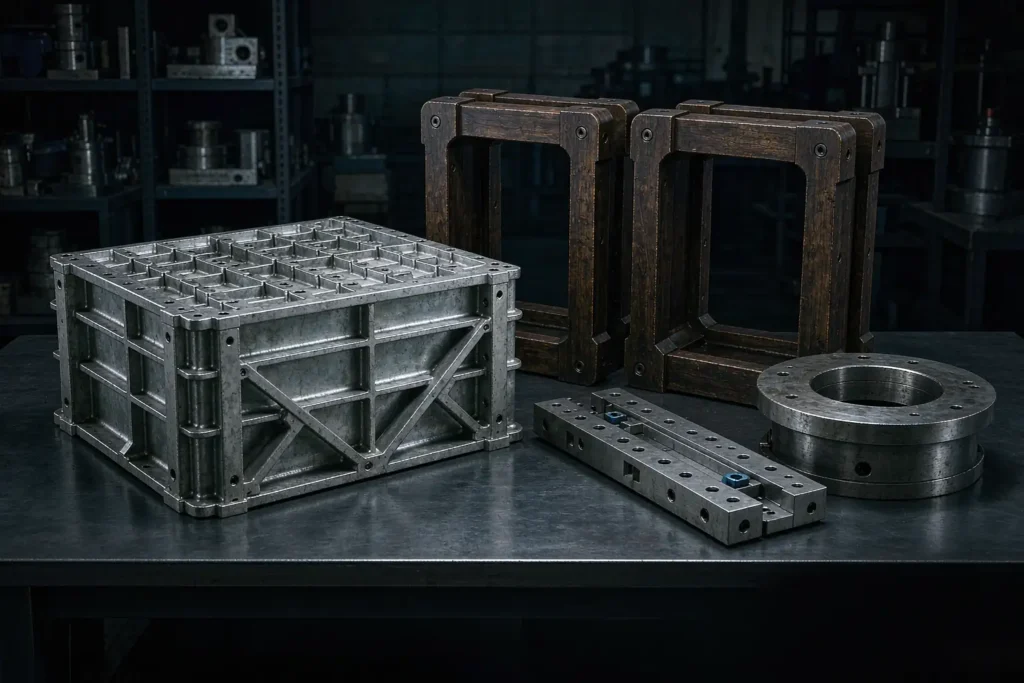
Casting tooling asset management starts with an uncomfortable fact: paying the tooling invoice does not prove that you own a complete, usable, transferable tool. The pattern may sit in one building, the core box in another, the machining fixture may carry no part number, and the latest CAD revision may exist only on a former engineer’s laptop. A buyer finds out whether the system works only when a tool must be audited, repaired, transferred, or used after two quiet years.
This guide turns casting tooling asset management into a controlled asset register, not a folder of purchase orders. It defines the asset hierarchy, the minimum tool-passport fields, physical identification, revision control, condition records, storage cost, and a transfer pack. The method follows the lifecycle logic behind NIST’s digital thread for manufacturing: product definition, manufacturing data, quality results, authorization, and traceability need to stay connected. For die-casting-specific technical resources, the North American Die Casting Association is a useful authority. The calculations below use a real-size tooling family for an 18 kg ductile iron pump housing.
Casting Tooling Asset Management Starts With the Complete Tool Family
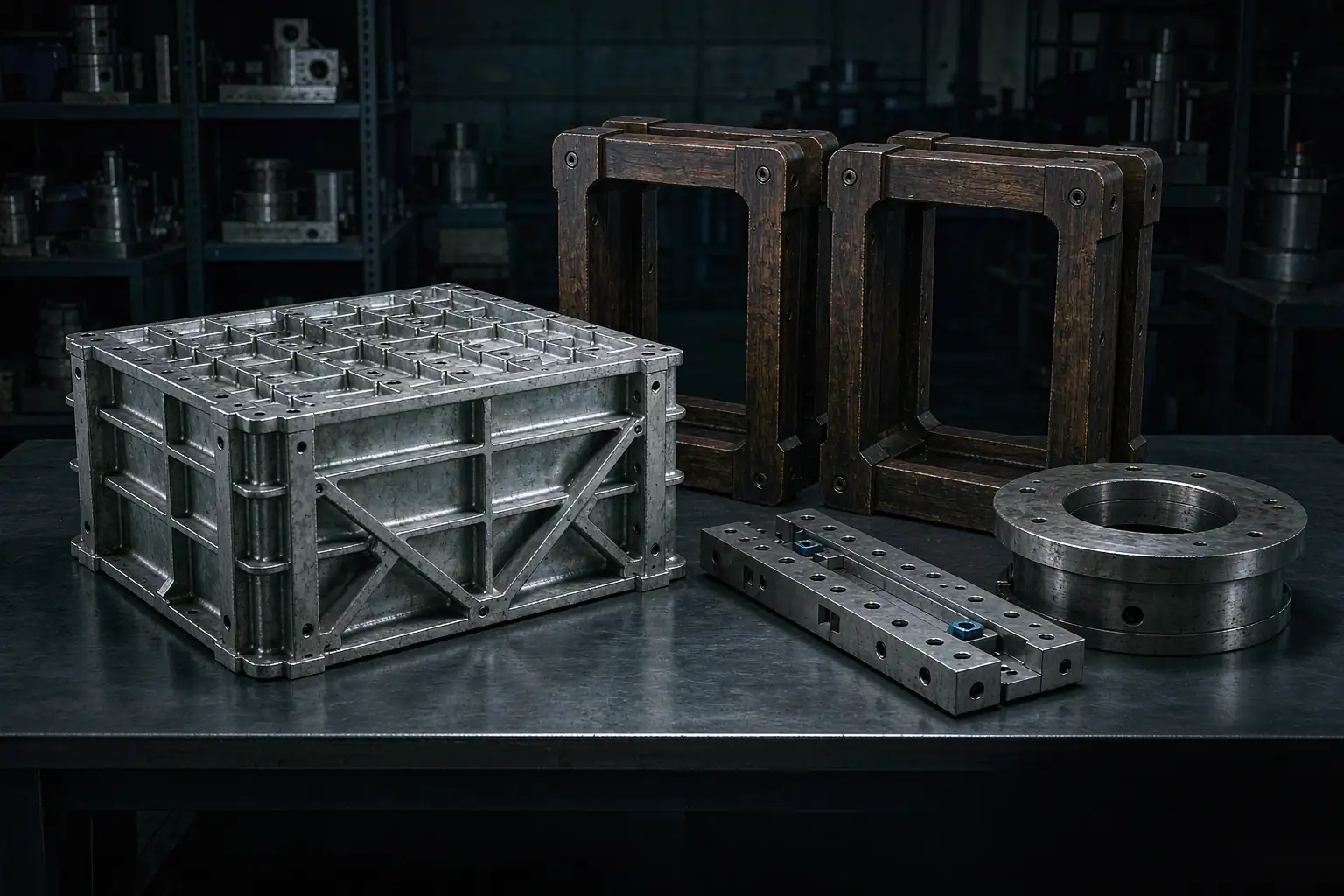
A tooling invoice often names one object: “pump housing pattern,” “wax die,” or “die-casting mold.” Production uses a family. If one child asset is missing, the nominally complete tool may be unable to make an acceptable part. That is why casting tooling asset management begins by breaking a part number into independently identifiable assets.
| Casting route | Parent asset | Child assets that are often missed | Transfer blocker |
|---|---|---|---|
| Sandguss | Pattern plate | Core boxes, loose pieces, gating boards, checking templates | Pattern arrives without the core package |
| Feinguss | Wax injection die | Slides, inserts, ceramic-core dies, trim fixtures, master samples | No approved wax dimensions or injection window |
| High-pressure die casting | Cover and ejector die halves | Slides, cores, spare inserts, trim die, shot sleeve interface, cooling diagram | Unknown machine interface or cooling connections |
| Machined casting | Casting tool family | CNC fixtures, soft jaws, leak-test fixture, CMM fixture, go/no-go gauges | New source can cast the blank but cannot release finished parts |
The practical naming rule is one parent record per finished part number and one child record per physical item that can be moved, maintained, revised, damaged, or lost independently. A casting mold and pattern design may start as one engineering project, but the asset register should separate every pattern plate, core box, insert, fixture, and gauge. The tooling build supplier should deliver this hierarchy before tool acceptance.
Ownership, Custody, Use and Maintenance Are Four Different Rights
The buyer can own a tool while the foundry possesses it, maintains it, and holds limited permission to use it. Those four ideas are often collapsed into the sentence “customer-owned tooling.” That sentence is too weak. Casting tooling asset management separates the rights because each one creates a different failure mode.
| Control | Question the contract must answer | Evidence |
|---|---|---|
| Ownership | When does title pass: deposit, final payment, or acceptance? | Purchase order, paid invoice, acceptance record |
| Custody | Which legal entity and physical address hold each asset? | Location-coded asset register, dated photographs |
| Use | May the tool make parts for affiliates, subcontractors, or other customers? | Restricted-use clause and production records |
| Maintenance | Who pays routine PM, wear inserts, accident repair, and major refurbishment? | Approved PM plan, work orders, condition photos |
| Release | How many business days after written demand must the tool be packed and released? | Transfer clause, packing list, release sign-off |
The invoice establishes cost, not always title or release rights. The best place to close the gap is the tooling section of the purchase order plus the supplier casting quality agreement. Link the wording to the commercial logic in the casting tooling cost guide: tooling price, ownership, expected life, refurbishment responsibility, and release must be reviewed as one package.
The Casting Tooling Asset Management Passport
A spreadsheet can run casting tooling asset management if its fields are disciplined. Expensive software does not repair missing source data. The minimum useful passport contains identity, ownership, technical definition, condition, production history, location, financial value, and transfer readiness.
Twelve fields that make a tool auditable
- Unique asset ID. One permanent code on the physical tool and in the digital record.
- Parent part number and child relationship. The register must show which core box, insert, fixture, and gauge belong together.
- Tool type and process. Sand pattern, core box, wax die, HPDC die, trim tool, machining fixture, checking fixture, or gauge.
- Owner and custodian. The legal owner can differ from the company holding the asset.
- Exact physical location. Site, building, rack, shelf, and any subcontract location.
- Drawing and CAD revision. Current released revision plus the hash, date, and approver of the controlling file.
- Machine and interface data. Platen size, bolt pattern, shot-end interface, utilities, cooling circuit, fixture datum scheme, or molding-line compatibility.
- Build and acceptance data. Builder, completion date, trial report, approved sample, and first article inspection status.
- Cumulative use. Shots, molds, wax cycles, casting batches, or fixture loading cycles.
- Condition and last inspection. A–D condition grade, defect photographs, dimensional checks, and open repairs.
- Financial record. Original cost, refurbishment spend, insured value, and ownership payment status.
- Transfer status. Pack-ready, documents complete, adaptation required, or non-transferable with a stated reason.
Do not use filenames as revision control. A folder containing “final,” “final2,” and “latest-approved” is not a digital thread. The passport should point to one released file set and record who approved it. NIST’s manufacturing digital-thread work highlights the need for globally unique identifiers, trustworthy product data, authorization, and lifecycle traceability. Casting tooling asset management applies the same principle at a practical supplier level.
Identification and Revision Control Prevent the Expensive Wrong-Tool Run
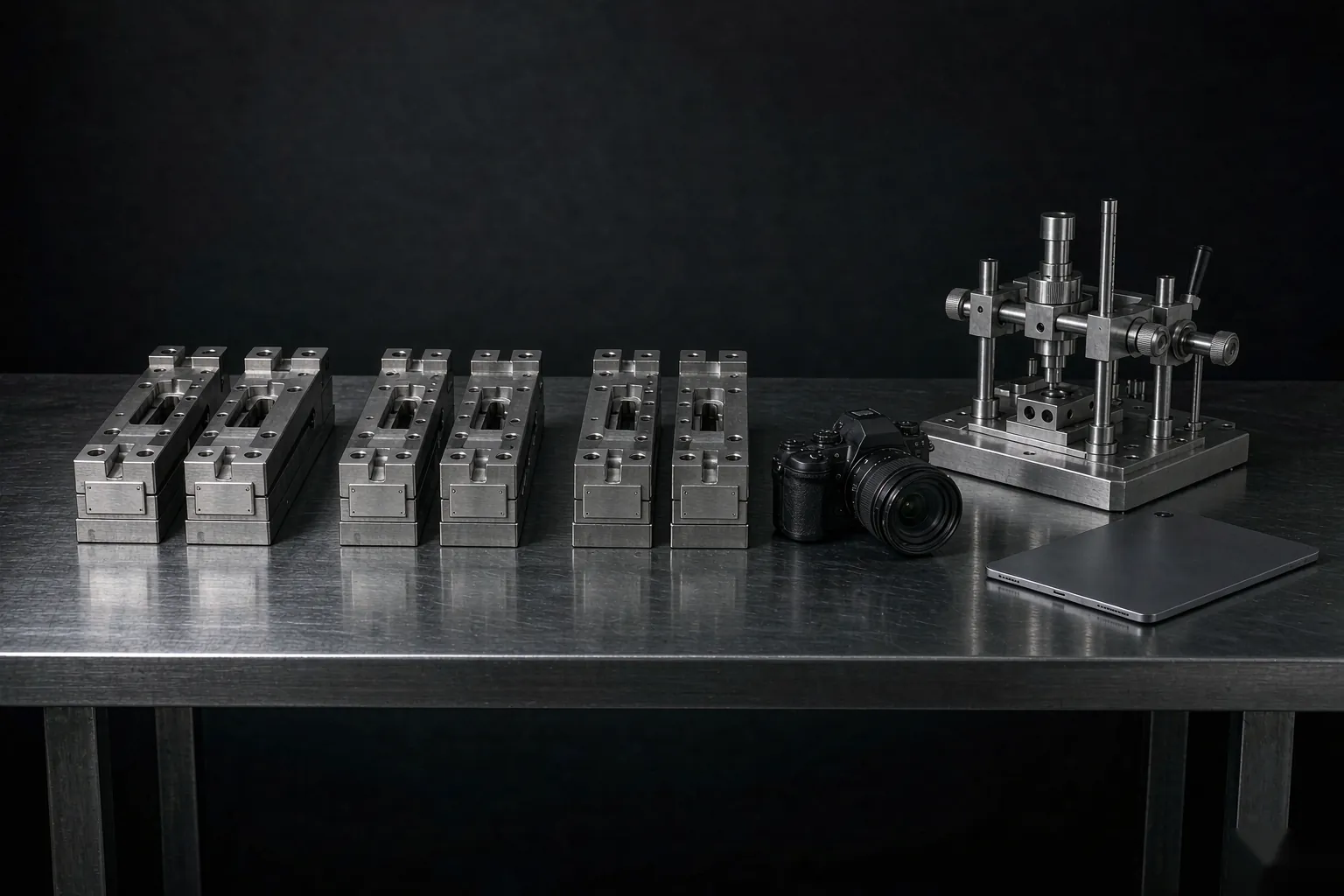
The physical mark should survive the environment. Use an engraved stainless plate, laser mark, or stamped plate on metal tooling; use a sealed metal plate or durable recessed tag on wood and resin patterns. A loose paper label is not permanent identification. The code should be readable without disassembling the tool and should never be placed on a molding, sealing, or working surface.
Revision control needs two locks. The first is digital: the asset record states the released part revision and tool revision. The second is physical: every modified insert, loose piece, core print, gauge, and fixture carries the current tool-revision mark. If the part drawing changes but the tool does not, the record should say “reviewed—no tool change” rather than silently leaving the old revision.
A 300-piece revision mistake costs $19,296
Assume a foundry runs revision B after revision C changed one mounting boss. Three hundred 18 kg finished housings reach final inspection at an accumulated cost of $84 each. Sixty can be recovered with $18 of rework; 240 must be scrapped, but each returns 18 kg × $0.45/kg = $8.10 of scrap credit.
| Loss item | Calculation | Kosten |
|---|---|---|
| 240 scrapped finished parts | 240 × $84.00 | $20,160 |
| Scrap-metal credit | 240 × 18 kg × $0.45/kg | −$1,944 |
| Rework on 60 recoverable parts | 60 × $18.00 | $1,080 |
| Total direct loss | $20,160 − $1,944 + $1,080 | $19,296 |
That number excludes missed delivery, air freight, line downtime, and the emergency CNC-Bearbeitung slot. A revision check that takes one buyer and one supplier ten minutes before release costs less than $20. The control is not administrative overhead; it closes a five-order-of-magnitude risk gap.
Condition, Cycle Counts and Casting Tooling Asset Management
A photograph proves that a tool exists. It does not prove that the tool is ready. Casting tooling asset management needs a condition grade tied to measured evidence. Keep it simple: A = production ready; B = usable with planned work; C = hold pending repair; D = obsolete, damaged beyond economic repair, or awaiting authorized disposal.
Cycle count gives the grade a time axis. Suppose a die has completed 76,000 shots and the approved major-inspection threshold is 90,000. At 4,000 shots per month, 14,000 shots equal 3.5 months. A demand surge to 7,000 per month compresses that window to two months. The production forecast therefore changes the maintenance date even though the die’s physical condition did not change today. The detailed PM method belongs in a separate casting tooling maintenance plan; the asset passport should summarize its latest result and next due point.
- Patterns and core boxes: check wear at parting surfaces, loose-piece fit, core-print dimensions, distortion, and mounting holes.
- Wax dies: record flash, slide clearance, cooling stability, insert condition, and approved wax dimensions.
- Die-casting dies: record heat checking, washout, soldering, ejector condition, slide clearance, cooling-circuit flow, and shots since refurbishment.
- Fixtures and gauges: record datum wear, clamp repeatability, bushing condition, leak-test sealing surfaces, and calibration status.
For a transfer or restart, dimensional evidence matters more than a cosmetic photograph. Tie the tool record to the approved sample, the latest capability result, and any critical dimensions identified in the casting tolerance stack. That connection tells a new foundry what the tool was capable of before it moved.
Storage Cost Is Small; Uncontrolled Storage Is Not Free
Dormant tooling still consumes money and loses condition. Wood absorbs moisture and moves. Resin patterns creep under poor support. Steel rusts under condensation. Cooling channels hold contaminated water. Precision gauges drift or expire. Casting tooling asset management should therefore put an annual number beside storage instead of treating it as free.
| Annual storage item for a $24,300 tool family | Basis | Annual cost |
|---|---|---|
| Controlled floor and rack space | 2.2 m² × $11/m²/month × 12 | $290 |
| VCI, desiccant, oil and re-preservation | $140 every six months | $280 |
| Quarterly visual and condition check | 1.5 h × $42/h × 4 | $252 |
| Insurance allocation | 0.75% × $24,300 | $182 |
| Total controlled storage | $290 + $280 + $252 + $182 | $1,004/year |
A $1,004 annual charge can be challenged and optimized because its basis is visible. “Free storage” cannot. Free storage commonly means outdoor racks, mixed ownership, no periodic preservation, and a surprise repair when the tool is needed. Put retention and disposal dates in the register: active, dormant with forecast demand, end-of-service pending owner instruction, and approved destruction. Never let a supplier scrap customer tooling merely because a part has been inactive.
Casting Tooling Asset Management Must Make Transfer Possible
Owning a tool that cannot run anywhere else is a weak form of ownership. Transferability does not mean every mold can move without adaptation. It means the buyer knows what must move, what data must accompany it, what condition it is in, and what adaptation the receiving foundry must quote.
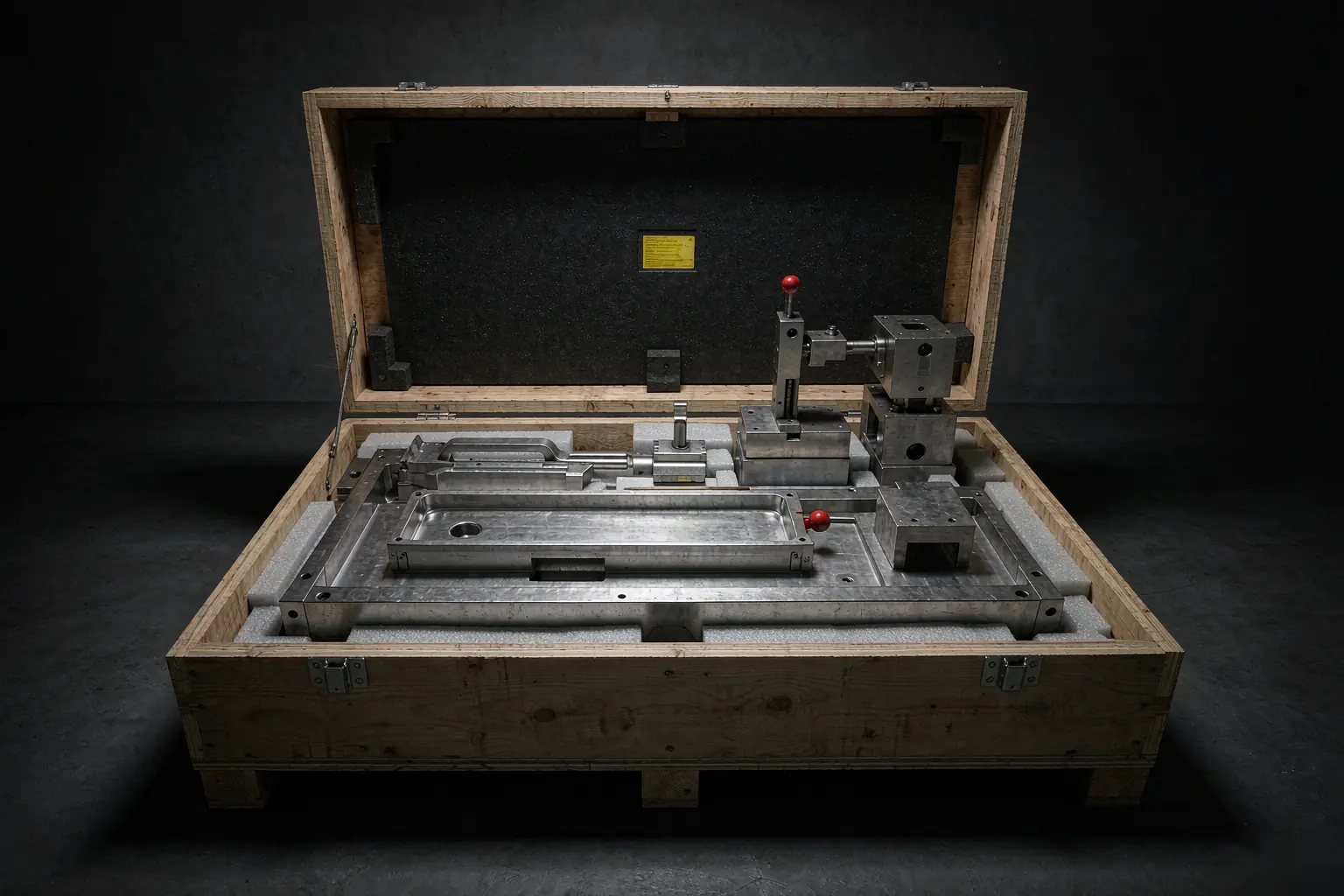
The transfer pack should include: parent and child asset list; photographs from all sides; weight and lifting points; released 2D and 3D files; material and hardness of critical inserts; cooling and utility diagram; machine or molding-line interface; revision history; open repair list; cycle count; last capability study; approved sample; spare-parts list; preservation and packing instructions; and the written release approval. A casting dual-sourcing plan is only credible when this pack exists.
Transfer instead of rebuild: $20,630 saved
For the pump-housing family, assume a new pattern and core-box set costs $14,800, the CNC fixture $6,900, the checking fixture $2,600, new FAI $1,250, and production trial $1,800. Rebuilding everything costs $27,350 before lost time. A controlled transfer costs less.
| Route | Cost stack | Total | Typical route time |
|---|---|---|---|
| Rebuild from incomplete records | $14,800 pattern/core + $6,900 fixture + $2,600 gauge + $1,250 FAI + $1,800 trial | $27,350 | 12–16 weeks |
| Transfer controlled assets | $450 inspection + $280 preservation + $620 crate + $1,100 freight + $2,400 adaptation + $1,250 FAI + $620 trial | $6,720 | 4–6 weeks |
| Value of usable records and custody | $27,350 − $6,720 | $20,630 saved | 6–10 weeks recovered |
The receiving source still needs validation. Moving a tool does not transfer process capability. For a sand-casting program, molding-line stiffness, sand system, flask size, and core process can change results. For Feinguss, wax machine, injection window, shell system, and tree layout matter. For Druckguss, machine interface, shot capacity, vacuum, thermal balance, and cooling circuits must match. The passport exposes those adaptation items before the truck arrives.
The Financial Case for Casting Tooling Asset Management
A small program should beat its own expected cost. Build the initial register with 12 buyer hours at $65/hour, 18 supplier hours at $42/hour, and $180 for durable IDs and photographs. Initial cost is $780 + $756 + $180 = $1,716. Add a quarterly audit at 1.5 supplier hours × $42 × four quarters = $252 per year. Three-year program cost is therefore $1,716 + 3 × $252 = $2,472.
The controlled-transfer saving above is $20,630. Break-even event probability over three years is $2,472 ÷ $20,630 = 12.0%. If there is more than a 12% chance that the program will face one foundry exit, ownership dispute, lost child asset, obsolete revision, or emergency transfer in three years, the register pays for itself before valuing recovered lead time. That is one chance in eight—not an exotic risk across a portfolio of dozens of tools.
The model also prevents over-management. A $1,500 wood pattern for a stable local supplier does not need the same audit depth as a $180,000 multi-slide die supporting a single-source automotive line. Rank tools by replacement value, replacement lead time, annual demand, single-source exposure, and technical portability. Apply full casting tooling asset management to the high-exposure group; keep a basic ID-and-location register for the low-exposure tail.
Write Casting Tooling Asset Management Into the RFQ and Contract
Do not wait until the tool exists. Put the deliverables in the foundry audit, RFQ, and purchase order. Ask bidders to price any recurring storage, preservation, major PM, and transfer packaging separately. A complete metal casting sourcing decision needs those lifecycle numbers, not just the piece price.
| Clause | Measurable wording to include |
|---|---|
| Title | State exactly when ownership passes and that paid customer tooling is not subject to reuse or disposal without written approval. |
| Identification | Permanently mark every parent and child asset with customer ID, part number, and tool revision. |
| Register | Provide the twelve passport fields at acceptance and update location, revision, condition, and cycle count quarterly. |
| Use restriction | No production for another customer, affiliate, or subcontractor without written authorization. |
| Change control | No tool modification, welding, insert replacement, or datum change without an approved change record. |
| Maintenance | Define routine PM included in piece price, buyer-approved major refurbishment, and evidence required after work. |
| Storage | Define indoor storage, preservation interval, environmental controls, inspection frequency, and declared annual charge. |
| Audit | Allow register review and a physical sample audit on reasonable notice. |
| Release | Release identified tools and the complete transfer pack within a stated number of business days after written demand. |
| End of life | No destruction without owner approval; provide destruction evidence or return shipment records. |
Ask for a sample asset record during supplier selection. A foundry that claims mature casting tooling asset management should be able to show one anonymized passport, one PM record, one tool photograph with permanent ID, and one release procedure. If the answer is “we know where everything is,” treat that as unverified. For new or replacement assets, use prototype casting and FAI to prove that the physical tool, released data, and accepted part all match before volume production.
A 30-Day Implementation Plan
Do not begin by buying software. Begin with the highest-exposure tools and close one complete loop.
- Days 1–5: rank exposure. List active part numbers and score replacement cost, replacement lead time, annual revenue, single-source dependence, and customer shutdown consequence. Select the top ten tool families.
- Days 6–12: build the hierarchy. Ask each foundry to identify every parent and child asset, including fixtures, gauges, spare inserts, and subcontract-held items.
- Days 13–18: mark and photograph. Install permanent IDs, record exact locations, and capture condition photographs with a date and scale.
- Days 19–24: connect technical records. Attach released drawings, CAD, interface data, trial report, FAI, latest condition report, cycle count, and open repairs.
- Days 25–30: test transfer readiness. Pick one tool family and run a tabletop transfer: can another foundry quote adaptation, packing, transport, and validation without asking for missing basics?
The last step is the real audit. If the receiving foundry cannot price the move, the passport is incomplete. Fix the missing fields, then repeat. Once the top ten are stable, expand by risk tier rather than trying to catalogue every low-value template at once.
FAQ About Casting Tooling Asset Management
Who owns casting tooling after the buyer pays for it?
Ownership depends on the purchase order and applicable law; payment alone should not be your only evidence. State when title passes, identify every covered asset, prohibit unauthorized use or disposal, and define release obligations. Obtain legal review for jurisdiction-specific wording.
Can casting tooling asset management run in Excel?
Yes. For tens or low hundreds of tool families, a controlled spreadsheet with unique IDs, linked evidence, revision permissions, and a change log is enough. Move to dedicated software when multiple sites, thousands of assets, automated cycle data, or workflow approvals make spreadsheet control fragile.
How often should customer-owned tools be audited?
Use risk. High-value, single-source, high-cycle, or dormant-but-critical tools deserve quarterly record review and at least annual physical verification. Low-value active tools can be checked annually. Any relocation, major repair, revision, ownership change, or demand restart triggers an immediate update.
Does a transferable tool guarantee the same casting at a new foundry?
No. The new source has different molding equipment, sand or shell systems, furnace practice, thermal balance, process windows, and inspection systems. The transferred tool reduces rebuild cost and time, but new trials, FAI, and capability approval are still required.
What is the first record to request from a foundry?
Request the complete parent-child asset list with permanent IDs, exact locations, current revisions, condition photographs, cycle counts, and ownership status. That single request quickly shows whether the supplier manages a tool family or remembers only the largest object.
*Cost figures are worked sourcing examples for decision modeling. Contract language should be reviewed for the governing jurisdiction. Technical references include NIST manufacturing digital-thread resources, NADCA industry resources, and Supro MFG shop-floor records.
 English
 Français
 Deutsch
 Italiano
 日本語
 한국어
 Polski
 Português de Angola
 Русский
 Español de Argentina