
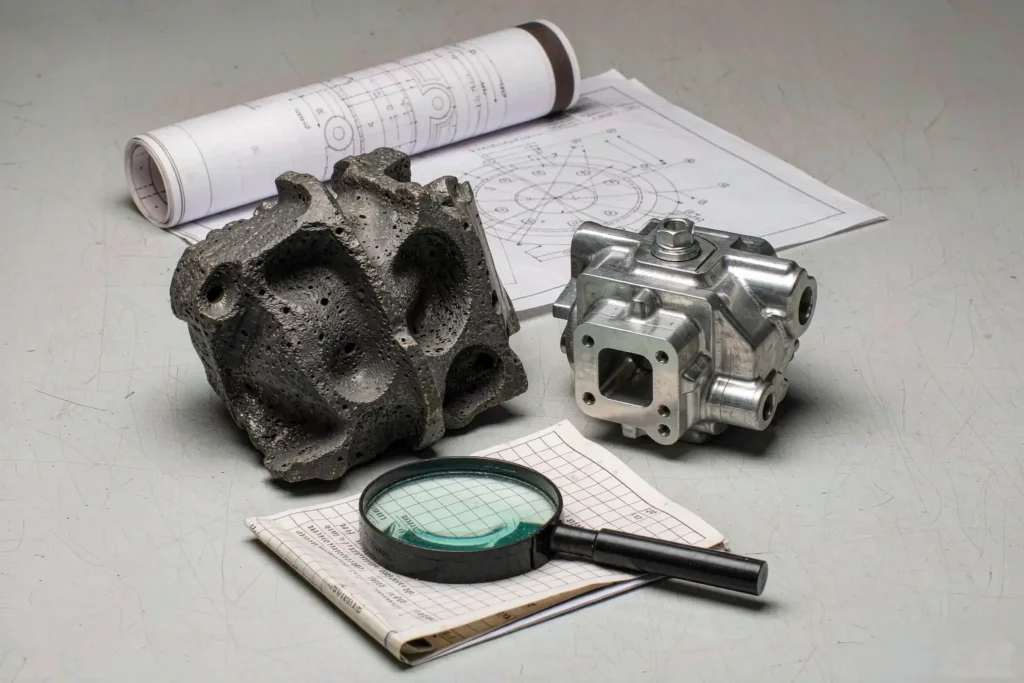
A casting RFQ decides two things: how accurate the price is, and how many weeks you lose before anyone can build the tooling. In our own 2025 quote log, packages missing drawings or inspection criteria produced bids that moved 18–32% between first quote and first invoice; complete packages stayed inside 5%.
This guide turns a casting RFQ into a checklist you can paste into an email: twelve fields, the standards behind them, and the real cost of each field you leave blank. Numbers come from quotes we actually priced, plus the references a purchasing team can quote back when a bid looks wrong: ISO 8062-3 for dimensional tolerances, ASTM A536 / A216 for material specification, ASTM E446 for radiographic acceptance and ISO 2859-1 for sampling. Industry bodies such as the American Foundry Society (AFS) publish the process-side background; if you want it in one page first, read our metal casting guide, then come back here with your drawing open.
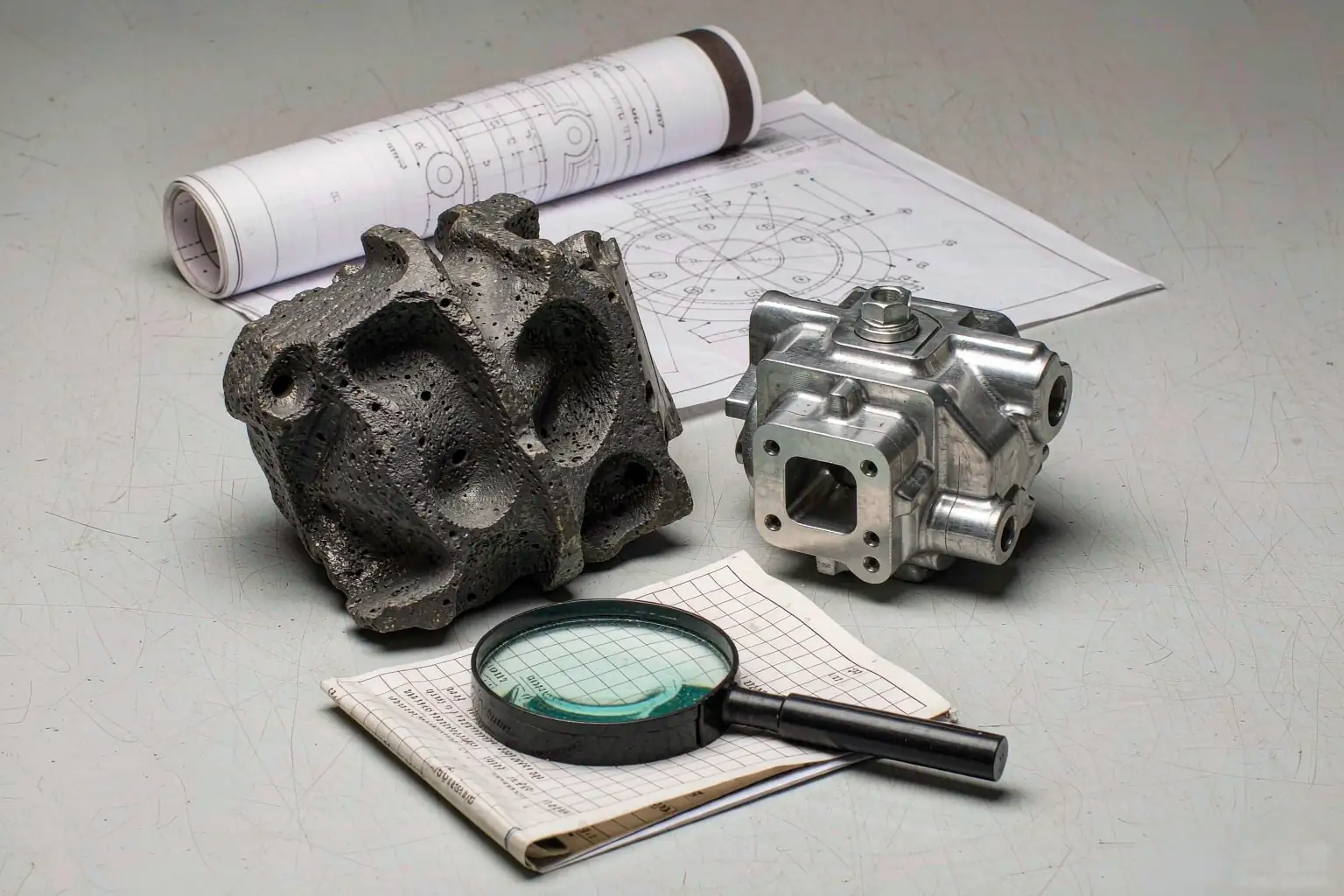
Why a Weak Casting RFQ Costs More Than Time
Three things happen when a casting RFQ leaves a foundry guessing. First, the estimator prices the worst case rather than your case: maximum machining stock, tightest default tolerance, highest scrap allowance. Second, each unanswered question becomes an email round trip — our log shows a median of 3.4 clarification emails per incomplete RFQ. Third, when the answer finally arrives (say: sections up to 90 mm need radiographic quality), the tooling is already built for the cheaper assumption.
The delay arithmetic is blunt. A complete casting RFQ gets a priced bid in 2–3 working days. An incomplete one averages 8 days, because each clarification cycle costs about 1.5 days of calendar time across time zones. On a first order that already runs 11–24 weeks end to end (see our breakdown of casting lead time), a week of email ping-pong lands directly on your launch date.
The 12 Items Every Casting RFQ Must Carry
Nothing below is exotic; these are simply the twelve fields that change a price or a tooling design. A casting RFQ that carries all twelve produces bids you can line up side by side. A thin one — four fields and a PDF export — gets four different sets of assumptions, and none of the numbers that come back are comparable.
| RFQ item | Why it moves the number | Typical penalty if missing |
|---|---|---|
| 3D model + 2D drawing with GD&T | Defines datums, machines faces, critical dimensions | Estimators add 2–4% material for unknown stock |
| Alloy + full specification (ASTM / EN / GB + UNS) | Sets melt cost, scrap risk, heat treatment | Quote defaults to the cheapest compliant grade |
| Required mechanical properties + test bar type | Drives chemistry window, heat treatment, coupon cost | Dispute at first article; re-test $180–$420 per heat |
| Heat treatment condition | Anneal / normalize / quench and temper / T6 | $2.80–$9.40 per part appears later as a change order |
| Annual volume, batch size, call-off pattern | Sets tooling class and amortisation basis | Tooling charged as single-batch: +$15–$30 per part |
| Machining scope (rough / finish / none) | Determines machine hours, fixtures, inspection | Two bids differ 40%+ and neither is comparable |
| Dimensional standard (ISO 8062-3 DCTG / GG) | Tolerance class prices tooling and finishing | Foundry applies its own default class |
| NDT method + acceptance level | PT / MT / UT / RT economics are very different | 100% RT assumption adds $20–$70 per part |
| Sampling plan (ISO 2859-1 AQL) for visual | Labour hours in final inspection | Either 100% sort (costly) or disputes at receipt |
| Surface finish / coating | Blasting grade, primer, plating, Ra target | Freight damage or rework at destination |
| Packaging + export marking (ISPM-15) | Crate cost, container utilisation, customs holds | Fumigated crate retrofit $1.60–$4.20 per part |
| Incoterms + destination port | Freight and duty sit inside or outside the unit price | Two bids differ by 6–11% purely on delivery terms |
Drawings: Send Geometry and Intent, Not Just a STEP File
A 3D model tells a foundry what the part looks like. The drawing tells it what actually matters. A well-built casting RFQ ships both: STEP AP242 (or Parasolid) for the geometry, plus a dimensioned 2D PDF with datum structure, machined faces marked, and wall thickness callouts. If your model already carries PMI, say so explicitly — otherwise the estimator ignores it and assumes everything is general tolerance.
A note worth deleting from every drawing: “standard casting tolerances apply”. There is no single standard; the default depends on the foundry’s process. Specify the class instead, using ISO 8062-3: DCTG for linear dimensions and GCTG for geometric. Our reference table in casting tolerances shows what each class means once it reaches your machine shop.
What the tolerance line is actually worth
Take a 9 kg grey iron housing with a machined Ø120 bore. Quoted to a loose default class, the foundry leaves 5 mm per side for clean-up. Specify ISO 8062-3 DCTG 10 (±1.8 mm on that band) and the casting machining allowance drops to 3 mm. Same drawing, two packages:
- Cast weight: 41.6 kg vs 38.9 kg — 2.7 kg less metal at $2.30/kg plus $0.55/kg handling = $7.70 per part.
- Machining time: roughing the bore went from 26 min to 17 min at a $72/h machine hour rate = $10.80 per part.
- Latent cost: if you discover the clearance problem after the pattern is cut, the fix is a pattern modification ($1,800) plus three weeks.
That is $18.50 per part on paper, before you count a single tooling change. On a 600-part annual programme it is $11,100 for one line of text in the RFQ.
Material Spec: the ASTM Number Is Not Enough
“Ductile iron” is not a specification. “ASTM A536 65-45-12, Brinell 170–220 HB, ferritic matrix, test bar type: separately cast keel block, condition: as-cast” is. Each qualifier changes either the melt practice or the inspection load, so each one changes the price — and each one belongs in the casting RFQ rather than in a follow-up email.
Two qualifiers buyers forget most often. First, test coupon type and location — properties measured on a separately cast keel block can read 10–15% higher than properties in a 60 mm thick section of the actual casting, so if your design stress is in that thick section, say which coupon governs. Second, the heat treatment condition. A normalized-and-tempered cast steel grade and an annealed one have different machinability, which your CAM estimate will feel even if the foundry’s price does not change much.
If you are still choosing between families rather than grades, the comparisons we keep updated include gray iron vs ductile iron, cast iron vs cast steel, aluminum casting alloys und bronze casting. Sending an RFQ that names a family and asks the foundry to propose the grade is legitimate — but then the quote you get is only comparable if every supplier proposes the same one.
Volume and Batch Pattern Decide Unit Price
Nothing moves a quoted unit price faster than quantity, and not because of a volume discount. Tooling is amortised, and the amortisation base is invisible unless you state it. Typical case from our own quoting desk: an aluminium gravity-die tool set at $8,600.
| Declared annual volume | Tooling per part | Same drawing, quoted |
|---|---|---|
| 400 pcs / year (all tool cost in one batch) | $21.50 | $58.40 per delivered part |
| 1,200 pcs / year | $7.17 | $44.07 per delivered part |
| 3,200 pcs / year | $2.69 | $39.59 per delivered part |
Identical geometry, identical alloy, three prices spread over $18.81. The lesson is not “ask for a discount”; it is that a casting RFQ without an annual quantity forces the estimator to assume the smallest batch. If you genuinely do not know, state the worst case plus the forecast: “250 pcs first order, forecast 1,200 pcs/year, please quote both tooling ownership and amortised options.”
Batch size has a second, less visible effect: furnace economics. A 100-part release off a 500 kg induction furnace carries almost the same setup cost as 400 parts, so per-part energy and labour can swing by double digits. Batch also decides the tooling life question — permanent mould tools, for example, are quoted against expected cycles, which we unpack in permanent mold casting.
Machining Scope: Quote Like Against Like
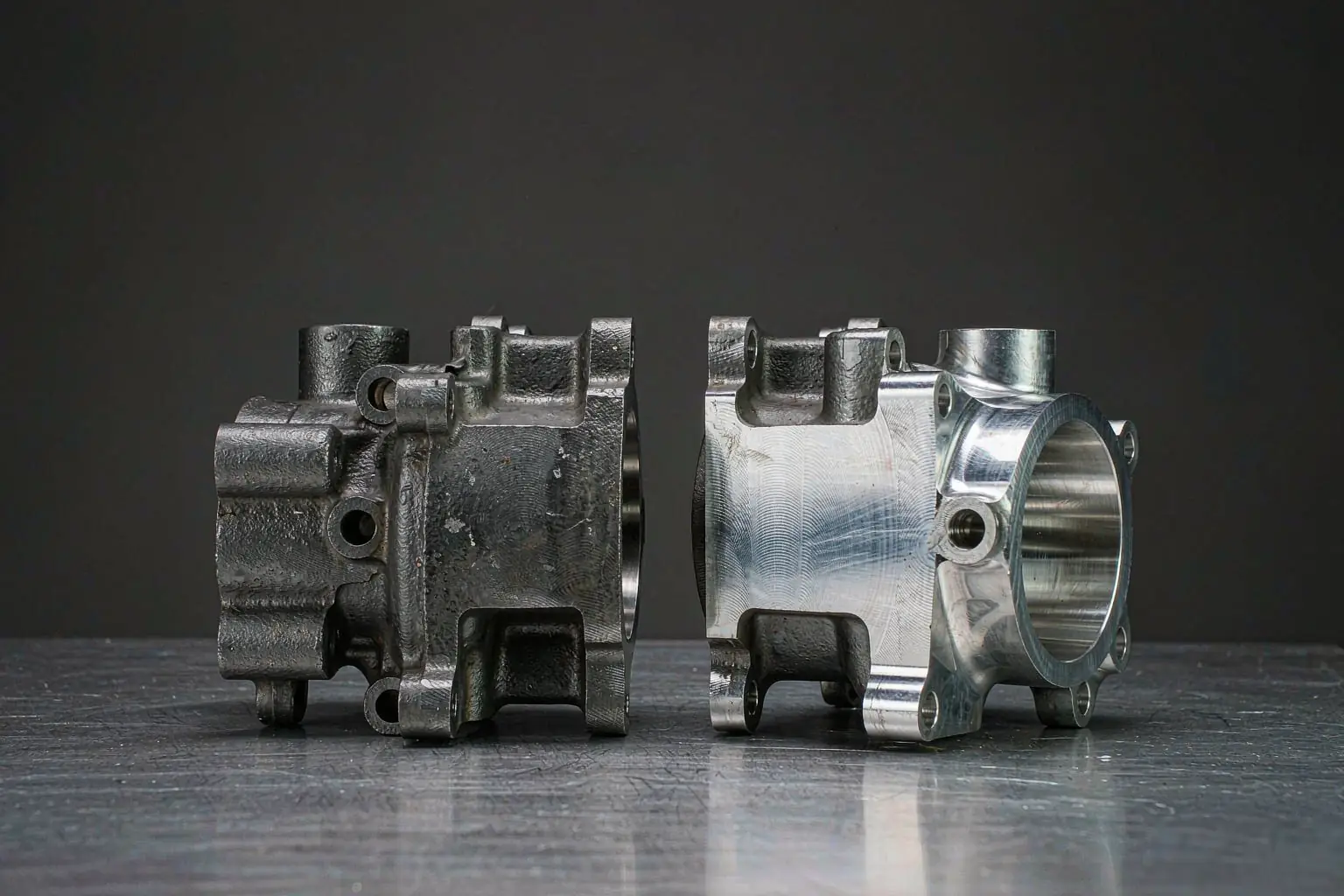
The most common reason two casting quotes look 40% apart has nothing to do with efficiency: one bid is for a rough casting, the other for a machined part. Before you send an RFQ, decide which side of the line you are buying, and use the same line for every supplier.
| Scope | Included in the price | Typical quote for the example housing |
|---|---|---|
| Casting only, shot blasted | Pattern, melt, pour, fettling, blast, visual | $39.05 |
| Casting + finish machining | Above, plus CNC hours, fixtures, in-process checks | $105.88 |
| Casting + machining + 100% RT | Above, plus radiography on every part | $129.40 |
All three numbers are correct for their own scope. If your casting RFQ does not say which one you want, you will collect three “cheapest” bids from three different definitions and pick the wrong one twice. When machining is in scope, also state the datum scheme and the surfaces that must be clean — a drawing that leaves that to interpretation is where most first-article surprises come from, and outsourcing the operation to the same supplier through our CNC machining services removes one hand-off from the schedule. The sequencing question (machine first, cast later, or cast then machine) has its own trade-off table in CNC machining vs casting.
Acceptance Criteria: If You Do Not State It, You Bought the Default
Inspection is where a quiet RFQ gets expensive. Say nothing and one supplier prices 100% visual, another prices full radiography. On a 9 kg steel part, three RT shots at roughly $22 each is $66 per casting that you may not need at all; if your design only requires sound material in one loaded boss, ASTM E446 acceptance at Category B severity 2 on that area costs a fraction of that.
Put three things in writing — all three belong in the casting RFQ, not in a purchase order amendment. First, the method — PT per ASTM E165, MT per ASTM E709, UT or RT per ASTM E94 with ASTM E446 reference radiographs for steel castings. Second, the acceptance level: for each defect category, the maximum severity your engineering team accepts. Third, the sampling plan for visual attributes: under ISO 2859-1 general inspection level II, a 500-piece lot gives sample size 50, and at AQL 1.5 that means accept on 2 and reject on 3. Whichever plan you choose, write it in the RFQ, because inspectors cannot guess it at receipt. The method economics are laid out in casting inspection methods, and the defect vocabulary you need to name the acceptance level is in common casting defects.
Stating the criteria also fixes the failure-mode discussion before it happens. A casting that will see cyclic load needs acceptance language around shrinkage in fillet radii, not around cosmetic surface marks; both cost money to police, only one protects the part.
A Worked Casting RFQ Example
Below is a shortened version of a real request that produced a quote in two days, with no clarification emails. Every line below is something the buyer wrote in the casting RFQ itself. Part: ductile iron pump housing, casting weight 9.4 kg, machined weight 6.2 kg, annual volume 1,200 pcs in 100-piece releases.
- Material: ASTM A536 65-45-12, Brinell 170–220, as-cast, test bar: attached coupon at the flange.
- Drawings: STEP AP242 + dimensioned PDF, datum A = machined mounting face, datum B = bore axis.
- Tolerances: ISO 8062-3 DCTG 11, machining allowance 3 mm on machined faces.
- Machining: finish machine bore, mounting face, four bolt pads; Ra 3.2 max on sealing face.
- Inspection: MT 100% on fillet radii per ASTM E709, dimensional report FAI 5 pcs, visual per ISO 2859-1 level II, AQL 1.5.
- Commercials: tooling quoted separately, DAP Hamburg, ISPM-15 crate, 40-pcs per crate.
The returned price broke down cleanly: metal $18.33, melting and pouring conversion $14.20, normalising $3.10, blast and fettling $4.40, CNC $51.00 (0.75 h at $68/h), inspection $6.50, packaging amortised $2.35, tooling amortised over 1,200 pcs $6.00 — $105.88 per finished part. Because every line was traceable, the follow-up negotiation took one call instead of three weeks. The same part sent without machining scope would have drawn two bids roughly $39 and $106, and the buyer would have had no basis to compare them.
Two details do most of the work here. Attaching the coupon at the flange means properties are measured where the load is, which is what casting alloy selection decisions should be based on. And declaring the crate count makes freight a per-part number you can audit, instead of a lump sum hidden in the unit price. The rest of the cost structure — what drives it and where it can move — is documented in our casting cost breakdown.
How Long Should a Casting Quote Take?
Once a casting RFQ is complete, the estimating route itself is short. Anything longer than five working days usually means someone is waiting on information, not doing analysis.
| Estimating step | Working days | What stops the clock |
|---|---|---|
| Drawing and feasibility review | 0.5 | No 2D drawing, unclear machined faces |
| Tooling concept and process route | 1–2 | Unknown volume, no preferred process |
| Cost model (material, conversion, machining) | 1 | Missing alloy or heat treatment condition |
| Internal review and release | 0.5 | Unspecified Incoterms / payment terms |
| Total, complete RFQ | 3–4 | Incomplete RFQ adds 1.5 days per clarification cycle |
If you need the number faster, the fastest lever is not asking for a rush — it is sending a package with nothing left to ask about. Where the schedule is genuinely tight, a casting simulation request in parallel with the casting RFQ removes the most common first-sample failure, and a printed prototype before tooling settles fit-up questions in days rather than weeks — our metal prototype casting service runs that step before any tooling is committed.
The Casting RFQ Checklist You Can Copy
Paste this twelve-line casting RFQ checklist into your email or sourcing portal. Each line maps to one of the twelve items above, and every one of them changes either price or risk.
- Attachments: 3D model (STEP or Parasolid) + dimensioned 2D drawing with GD&T and datums.
- Material: full specification + grade + required mechanical properties + hardness range.
- Test coupon: type, location, quantity per heat.
- Heat treatment: none / stress relief / anneal / normalize / quench and temper / T6, with target hardness.
- Quantities: sample quantity, first-order quantity, forecast annual volume, release pattern.
- Machining: none / rough / finish, surfaces list, Ra targets, datum scheme.
- Dimensional standard: ISO 8062-3 DCTG + GCTG, and machining allowance if applicable.
- Inspection: NDT methods, acceptance standard and severity level, sampling plan and AQL.
- Documents required with shipment: dimensional report, material test report, NDT report, PPAP/FAI level.
- Surface finish and coating: blast grade, primer, plating, or masking requirements.
- Packaging: crate type, parts per crate, ISPM-15 heat-treated timber, labelling.
- Commercial: Incoterms 2020 rule, destination port, target lead time, quote validity period.
Two field notes from our side of the desk. First, if you are unsure about the process, say so and ask for options — asking a Sandguss supplier to also price Feinguss or Druckguss in the same casting RFQ is normal, and the comparison table in die casting vs investment casting will tell you which axis actually matters. Second, patterns and tooling deserve their own line item rather than being buried in unit price; our mold making team quotes them separately for exactly that reason, and the tooling-design implications are covered in mold and pattern design. Whichever alloy you settle on, the same casting RFQ can be run against our steel casting or Aluminiumguss programme without redrawing anything.
FAQ
What is the minimum I can send for a casting RFQ?
A 3D model, an alloy grade, a quantity and a country of delivery will get you a budgetary number, usually accurate to ±25%. To get a firm quote you need the drawing with tolerances, the heat treatment condition, machining scope and inspection criteria. Think of the short version as a budget check and the full version as a purchase order waiting to happen.
Can I get a casting quote from a 3D model only?
Yes, but expect questions back. Without a drawing the estimator does not know which dimensions are critical, where the machined faces sit, or what surface finish you expect. Most suppliers will either add stock and inspection allowances to cover the unknowns or send three clarifying emails first.
Why did two foundries quote 40% apart on the same casting RFQ?
In our experience the cause is scope in roughly eight out of ten cases: one bid is a rough casting, the other includes machining, inspection or freight. Put every supplier on the same twelve-item list, then re-read both quotes against their inclusions table before you conclude anyone is overpriced.
Do I need to specify tolerances, or will the foundry handle it?
Specify them. Every foundry has a process default, and those defaults differ. Naming ISO 8062-3 classes in the RFQ costs nothing and removes a very expensive source of disagreement — tolerance class also drives machining allowance, tooling design and part weight, so it belongs in the first email, not the third.
What quantity should I quote if demand is uncertain?
Give three numbers: sample quantity, first production release, and best forecast for the next twelve months, plus the release pattern. Ask for tooling quoted separately and unit price at two volume levels. That way the quote stays valid whether you order 200 or 2,000, and nobody renegotiates from scratch after the first batch.
Which documents should I require with the shipment?
At minimum: material test report with heat number traceability, dimensional inspection report, and any NDT reports required by the specification. For pressure-containing parts, add hydrostatic test records. Requesting them in the RFQ is free; adding them after production means reopening records nobody kept, and inspection rates then apply retroactively.
*Referenced standards: ISO 8062-3, ISO 2859-1, ASTM A536, ASTM E94, ASTM E446, ASTM E709, Incoterms 2020. Cost figures from Supro MFG quoted projects, 2025–2026.
 English
 Français
 Deutsch
 Italiano
 日本語
日本語 한국어
한국어 Polski
 Português de Angola
 Русский
 Español de Argentina