
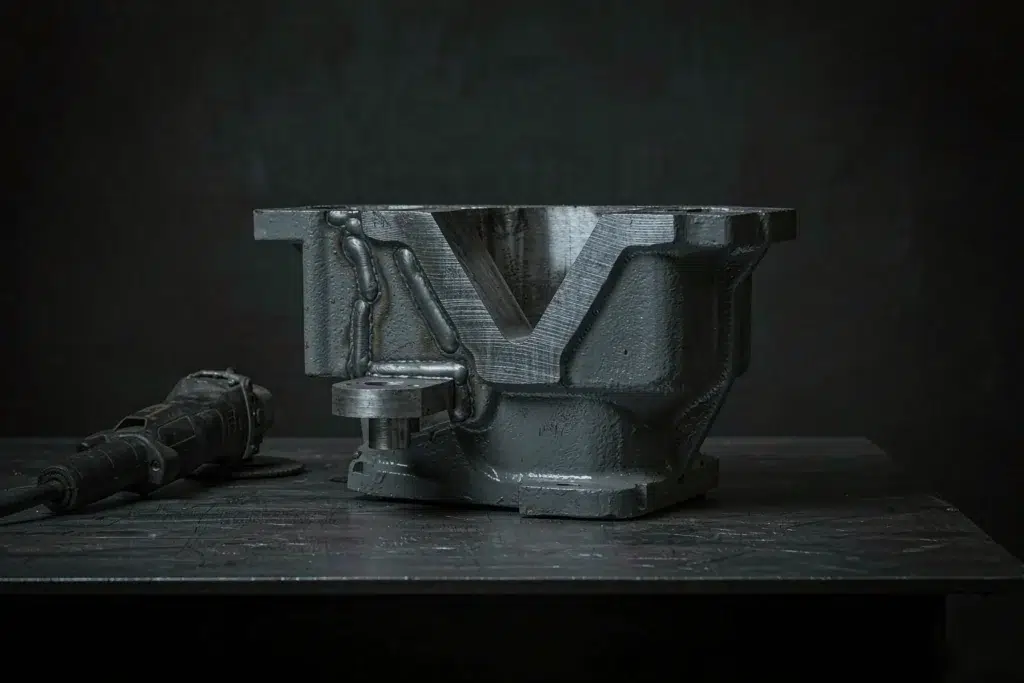
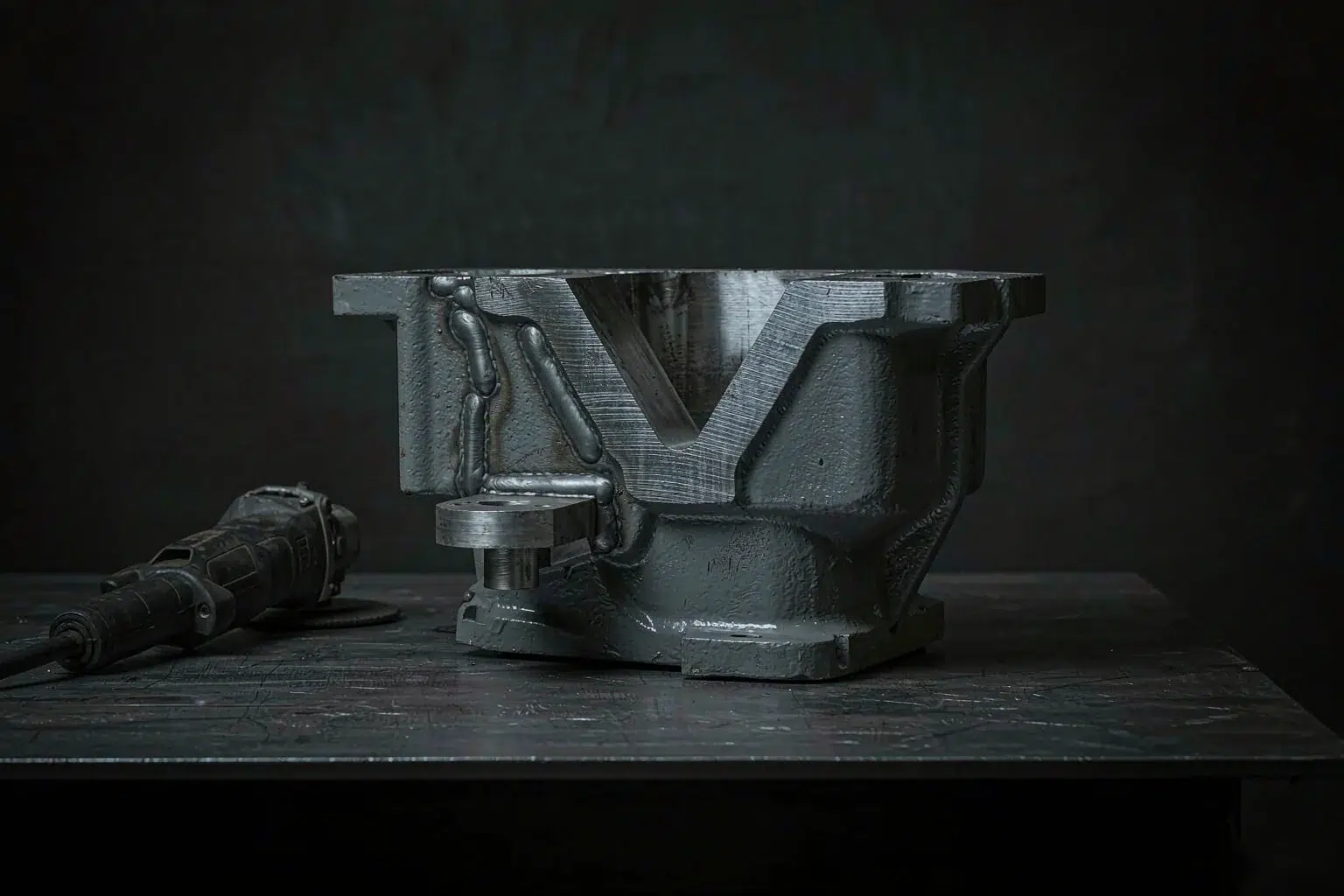
Repair it or scrap it. Every casting buyer eventually faces that choice after a shrinkage cluster shows up on a radiograph, an inclusion appears on the machined face, or a valve body weeps at the pressure test. Casting weld repair is legitimate under almost every major specification — but it is legitimate only inside a narrow frame: a qualified welding procedure, the right filler metal, controlled preheat and post-weld heat treatment, and records that survive audit. Miss any one of those and you may end up with a part that looks repaired rather than one that is.
This guide draws on published material from the American Foundry Society (AFS), the Steel Founders’ Society of America (SFSA) and ASTM welding practice, and puts casting weld repair into three sets of verifiable numbers: preheat temperatures derived from two carbon-equivalent calculations (0.42 and 0.66), the three documents that must reach your inbox before an arc is struck, and cost models for three real parts. One of those models shows repair costing $55.00 more than a brand-new casting — welding it would be the wrong call.
What Counts as Repair — and What Already Breaks Your Specification
Before discussing casting weld repair, it helps to sort the dispositions. There are four outcomes for a casting defect, and only the second is a repair in the metallurgical sense. Which one applies mostly follows from the defect type, covered in our guide to defeitos comuns de fundição.
- Blending by grinding. The indication sits inside the machining allowance or within the visual acceptance limits written into MSS SP-55. Grind the pit out, blend it smooth, done — no welding, no heat treatment, no qualification. This is the cheapest disposition and the one most often overlooked.
- Weld repair. This is what casting weld repair means in strict terms: excavate to sound metal, deposit filler metal under a qualified procedure, then re-examine and heat treat as required. This is the subject of the rest of the article.
- Prohibited “seal-ups”. For carbon steel castings supplied to ASTM A216, the standard states plainly that castings shall not be peened, plugged, or impregnated to stop leaks. Vacuum impregnation is a perfectly good process for non-pressure and non-ferrous parts — offering it as a fix for a leaking steel pressure part makes the whole batch non-conforming.
- Scrap and re-make. When the defect sits in a critical load path, or when the same area has already been repaired twice, re-making is the only defensible answer.
The practical takeaway for the purchase order: casting weld repair starts here, because impregnation is a legitimate process step, but it is not a repair disposition for a steel pressure part bought to ASTM. When a supplier proposes “we’ll just impregnate it”, the correct answer is no — either a through-wall weld repair under a qualified procedure, or a re-make.
When Casting Weld Repair Is Legitimate
Casting weld repair decisions turn on only two variables: location e material. Location decides whether design authority is required; material decides whether the joint can ever equal the parent section.
| Location / duty | Normal ruling | Extra requirement |
|---|---|---|
| Cosmetic or non-load-bearing face (machine-base wall, end cover) | Allowed | Blend flush to the same surface standard as the rest of the casting |
| Defect inside the machining allowance | Grind, do not weld | Judged against the specified machining allowance |
| Low-stress wall section (excavation under ~20% of wall thickness) | Allowed | Qualified WPS plus MT/PT of the finished repair |
| High-cycle fatigue area (crank bracket, cantilever, gearbox arm) | Not without written design approval | Fatigue life is not restored by weld metal |
| Pressure boundary (valve body, pump casing wall) | Allowed under strict conditions | 100% RT/UT of the repair zone, PWHT, owner approval, no plugging or impregnation |
| Sealing face (flange serrations, mechanical seal seat) | Normally re-make | Weld-metal hardness differs from parent metal; the seal leaks again in service |
The material axis is simpler. Cast steel grades such as WCB, WC6 and CF8M are weldable and routinely repaired; ferro fundido is a material you have to do arithmetic on; pressure-retaining parts such as valve castings sit under the strictest version of those rules; bronze and copper alloys plus most sand-cast aluminium grades are rarely worth casting weld repair, and high-pressure die castings with 2–3 mm walls almost never are — there is no sound parent section to weld back into. A workshop that produces steel castings almost always has a qualified welding bay attached. A workshop that only pours iron castings often has no WPS at all — worth confirming before you place the order, not after the defect appears.
Qualification: Three Documents Behind Every Repair
ASTM A488 and the ASME IX shortcut
Casting weld repair on steel castings is governed, for procedure and personnel qualification, by ASTM A488/A488M-24, “Steel Castings, Welding, Qualifications of Procedures and Personnel”. One clause saves a lot of argument: a procedure and welder qualified under ASME Boiler and Pressure Vessel Code Section IX is automatically qualified under ASTM A488. So when a supplier of stainless steel castings or investment cast stainless parts hands you ASME IX paperwork, accept it — it is a higher bar, not a different one.
A complete package is three documents. The WPS (welding procedure specification) states the process, filler class and preheat / interpass / post-heat parameters. The PQR (procedure qualification record) is the laboratory evidence behind it — tensile, bend, Charpy impact and radiographic results. The welder performance qualification limits that person to specific processes, positions and material categories. Remove any one of the three and the repair has no metallurgical basis.
If no suitable PQR exists, qualifying one on the fly is expensive: a package with tension, bend, impact and RT testing typically runs $2,400–$6,500 and three to five weeks. That cost either lands in your order or in the supplier’s decision to decline it — which is exactly why supplier audits should include a WPS/PQR register, and why your quality agreement should state that no unqualified procedure may be used on a casting weld repair.
Preheat, Filler and PWHT: The Numbers Behind a Sound Repair
For cast steel, casting weld repair is controlled by one number: preheat temperature, set by the IIW carbon-equivalent relation CE = C + Mn/6 + (Cr+Mo+V)/5 + (Ni+Cu)/15, combined with section thickness. Two worked examples:
- ASTM A216 WCB (C 0.25% / Mn 1.00%): CE = 0.25 + 0.167 = 0.42 → preheat 95–150 °C, interpass ceiling 260 °C.
- ASTM A217 WC6, 1¼Cr-½Mo (C 0.20% / Mn 0.65%): CE = 0.20 + 0.108 + 0.350 = 0.66 → preheat 150–200 °C, interpass ceiling 300 °C, PWHT 650–700 °C.
| Material family | Preheat | Max interpass | Post-weld heat treatment |
|---|---|---|---|
| Carbon steel casting, WCB | 95–150 °C | 260 °C | 595–675 °C, 1 h per 25 mm, 1 h minimum |
| Low-alloy WC6 / WC9 | 150–200 °C | 300 °C | 650–700 °C, 1 h per 25 mm |
| Austenitic stainless CF8M | None beyond drying | 150 °C | If required, solution anneal at 1 040 °C; low-temperature stress relief risks sensitisation |
| Ductile iron A536 | Hot weld 200–350 °C, or cold nickel technique | By procedure | No unified PWHT cycle; tratamento térmico does not restore ductility |
| Gray iron A48 | 300–350 °C hot weld, or low-heat nickel beads | Low heat input | Reduces HAZ hardness, does not restore plasticity |
Two shop details decide more repairs than anything in the table. First, low hydrogen: electrodes such as E7018 need baking around 345–400 °C for one to two hours and then holding at 120–150 °C in a rod oven. Damp flux is the single most common cause of a repair that looks sound, passes the dye check, and cracks a day later. Second, hydrogen bake-out: if a thick carbon steel section cannot reach the PWHT furnace immediately, holding it at 300–350 °C for two to four hours removes a large share of that risk.
Cast Iron Runs on Different Arithmetic
SFSA takes a blunt position: gray and ductile iron are not weldable. AWS meanwhile publishes both a guide to welding iron castings and a dedicated filler-metal specification. The two views are not contradictory — they use a different definition of acceptable.
The numbers settle it. In a published study on ductile iron welded with a 98% nickel filler, the best joint averaged 380 MPa against 450 MPa parent metal — 84.7% — while the heat-affected zone reached 355–365 HV against 187–238 HV in the base material. Post-weld heat treatment brings that hardness down, but it does not restore ductility or toughness. That is the honest basis for comparing weld repair against replacement on gray and ductile iron, not whether the bead will hold.
So casting weld repair on iron really means three routes:
- Nickel filler welding. Good for static machine bases, non-pressure faces of pump housings and small defects caught before machining. Nickel weld metal also machines cleanly, unlike a steel bead on iron.
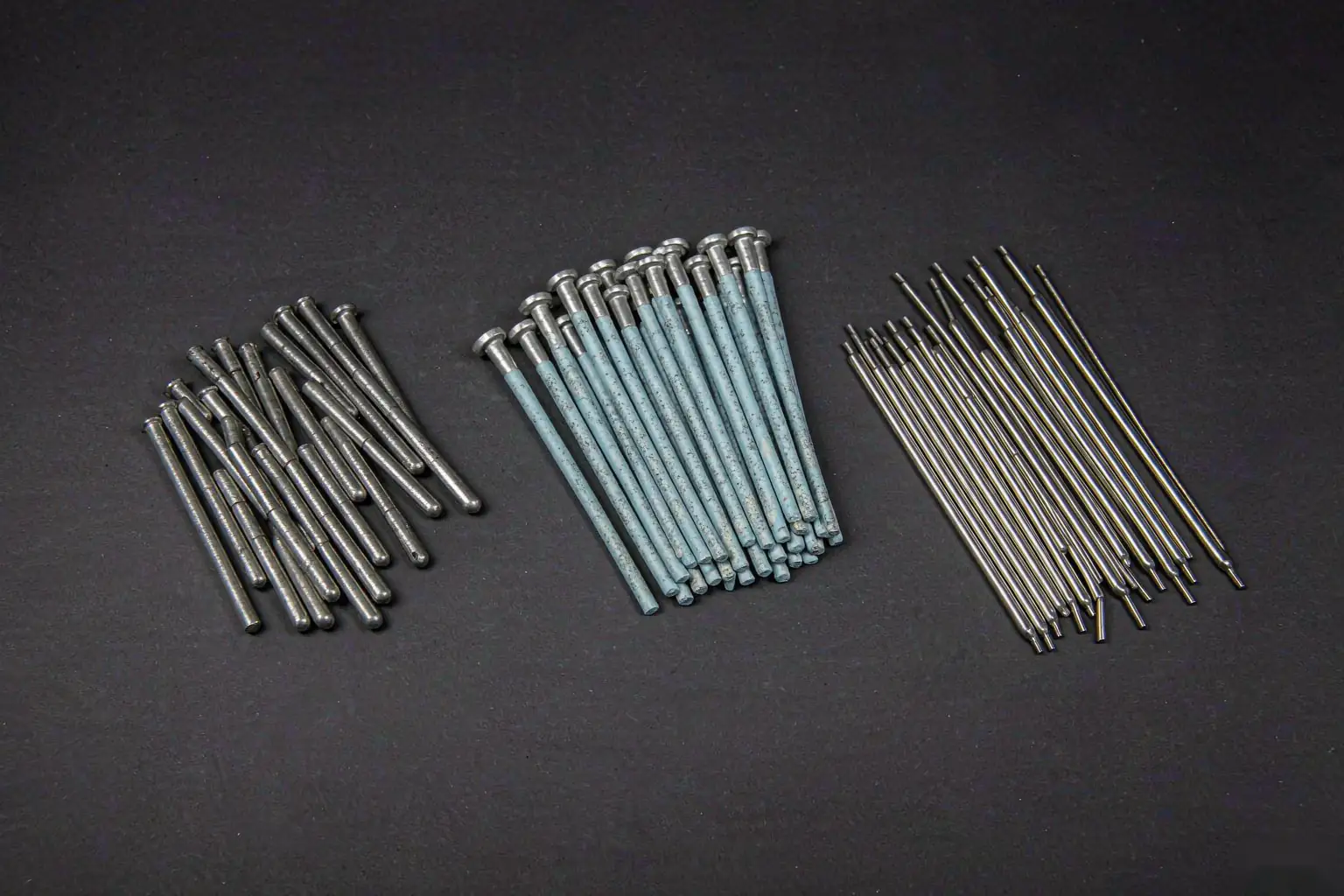
- Metal stitching. A cold process with no arc: interlocking keys are set across the crack and a line of overlapping pins is drawn along it, locking and sealing the fracture. No HAZ means it is the right answer for in-service frames, beds and engine housings — but it restores enough strength and tightness to keep equipment running, not the continuous section the drawing assumes.
- Re-make. For any load-critical or pressure-retaining iron section.
The Eight-Step Casting Weld Repair Workflow
A defensible casting weld repair is eight gates, each producing evidence. It is the same discipline as first article inspection: an unverified gate is a gate that did not happen.
| # | Step | Evidence on file |
|---|---|---|
| 1 | NDT locates the defect: nature, size, depth | MT / PT / UT / RT report plus a marked location — see inspection method selection |
| 2 | Engineering check: will removing the defect take more than 20% of the local wall? | Recorded judgement; beyond the limit requires design approval |
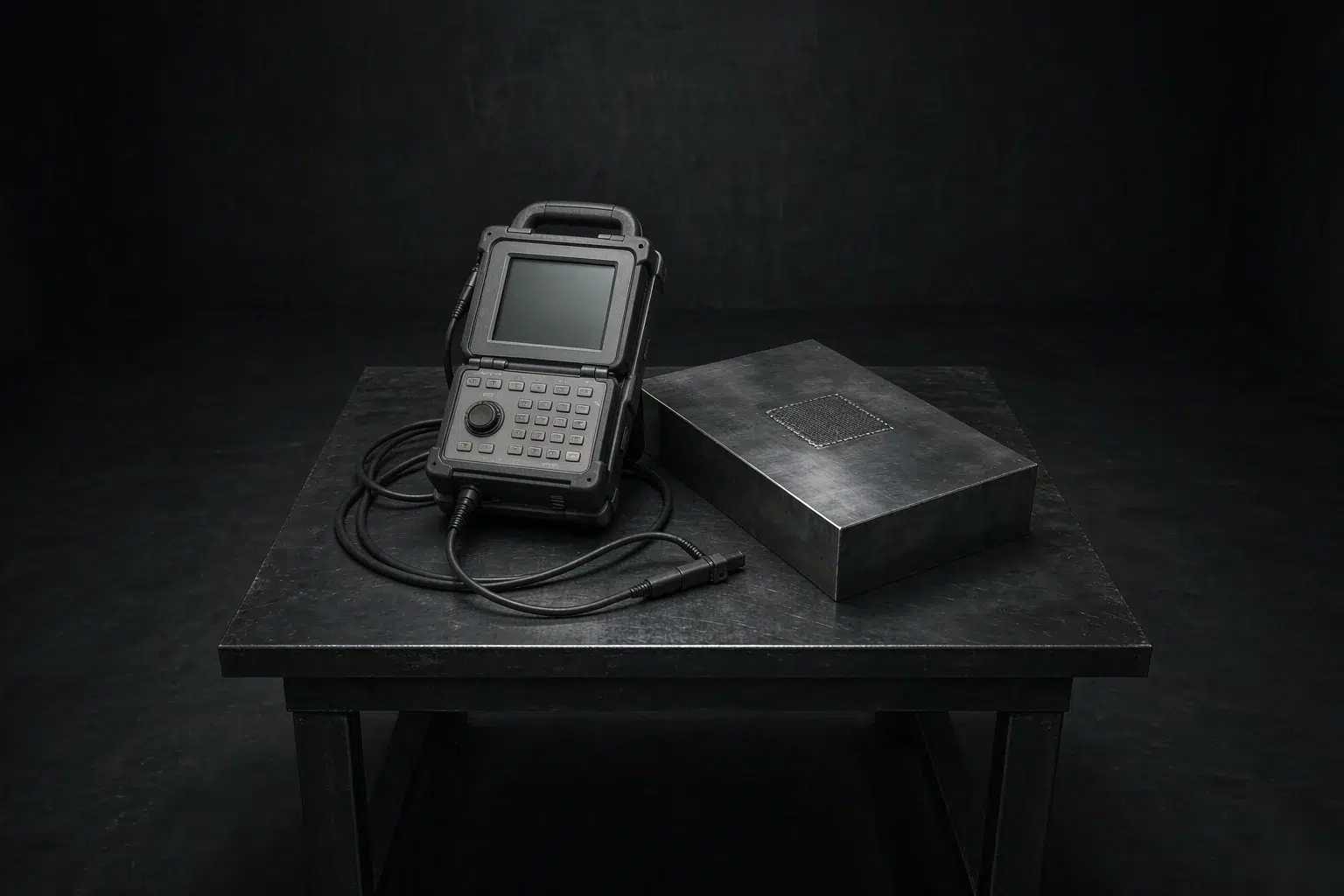
| 3 | Excavate by arc-air gouging or grinding into sound metal | MT or PT on the finished cavity to prove complete removal |
| 4 | Prepare the cavity: rounded profile, no sharp notches | Visual check |
| 5 | Weld under preheat, controlled interpass, qualified WPS and welder | Preheat record, interpass log, WPS number, welder identity |
| 6 | Hydrogen bake-out or full PWHT | Furnace time-temperature chart |
| 7 | Grind flush and restore dimensional tolerances | Visual and dimensional check |
| 8 | Re-examine the repair zone plus 25 mm of surrounding material at 100% | NDT report and hardness survey |
The two steps most quietly skipped are the MT/PT after step 3 — many shops substitute “looks clean” — and the furnace chart at step 6, where a verbal “it was heat treated” means it was not. Write both into your quality agreement as missing-report-equals-reject rather than as a request. One more practical note: when the repaired part goes back to Maquinação CNC, a hard HAZ on carbon steel eats tools fast, while nickel weld metal on iron machines almost like the parent material.
Repair or Re-make: Three Cost Models
Turn the casting weld repair decision into expected cost and the argument stops being about opinion. Expected cost = repair spend + failure probability × consequence. All three cases below use one shop’s hourly rates, so the structure can be copied straight into your own comparison sheet.
Case A: 62 kg ductile iron bracket, defect found before machining
| Item | Cost |
|---|---|
| MT locate plus post-repair MT (0.9 h @ $68.00) | $61.20 |
| Arc-air gouge and grind (1.6 h @ $72.00) | $115.20 |
| Welding with preheat and controlled cool-down (2.4 h @ $78.00) | $187.20 |
| Nickel-iron filler, 0.9 kg @ $46.00/kg | $41.40 |
| Re-machine the boss (0.8 h @ $85.00) | $68.00 |
| Repair total | $473.00 |
| Re-make one new casting (42-day lead time) | $418.00 |
The verdict is counter-intuitive: this casting weld repair costs $473.00 against $418.00 for a brand-new casting — $55.00 more, about 13.2%. At that point the deciding variable is not money but time: two days versus 42. If this bracket is blocking an assembly line worth $9,500 a day, the wait costs $380,000 and the premium is noise. If the part just sits in a schedule with slack, scrap it. Do not put expensive repairs on cheap castings.
Case B: 186 kg WCB valve body leaking at final pressure test
| Item | Cost |
|---|---|
| RT/MT locate and mark | $165.00 |
| Excavation: gouge plus grind (3.2 h @ $82.00) | $262.40 |
| Welding under a qualified WPS (4.5 h @ $86.00) | $387.00 |
| Low-hydrogen electrodes, 2.6 kg @ $9.50/kg | $24.70 |
| Local PWHT, resistance pads plus recording | $285.00 |
| Post-repair RT plus MT | $245.00 |
| Re-machine the seat (1.2 h @ $95.00) | $114.00 |
| Repair total | $1,483.10 |
| Risk term: 2% chance of field failure, consequence $3,190.00 | $63.80 |
| Expected cost | $1,546.90 |
| Re-make: new casting $1,340.00 plus full re-machining $620.00 | $1,960.00 |
Here the casting weld repair answer flips. Expected cost of $1,546.90 against $1,960.00 means repair saves $413.10 and roughly nine weeks. The reason is that machining value is already sunk into the part — for a high-value, already-machined steel casting, repair almost always wins. The condition matters: that $1,483.10 includes real PWHT and 100% RT. A $400 “weld repair” quote almost certainly has both lines deleted.
Case C: 320 kg gray iron machine base with a 380 mm crack
| Disposition | Cost | What you get |
|---|---|---|
| Nickel arc repair | $880.00 | About 84.7% of parent strength, HAZ hardness 355–365 HV, ductility not restored |
| Metal stitching (380 mm crack) | $775.00 | No HAZ; restores alignment and pressure tightness, not a continuous section |
| Re-make plus re-machine | $2,530.00 | Fully conforming, at seven weeks |
For non-critical large parts such as frames and machine beds, metal stitching is usually the best answer: cheaper than arc repair and no heat-affected zone at all. If the crack runs through a load-bearing rib carrying cyclic load, fall back on the first rule — you cannot substitute an 85% joint for 100% parent material, and the numbers behind that position are visible in every cast iron property table. Re-make it.
Writing the Repair Clause Into Your PO: Six Items, Six Red Flags
Two checks on the supplier side predict how any disagreement will end: does the sand casting foundry hold a qualified WPS in its own name, and does the pattern and tooling set still exist so a re-make is even possible inside the quoted lead time? A repair quote from a shop that can do neither usually reflects that, not generosity.
Most casting weld repair disagreements come from orders that never said what may be repaired, or what evidence comes with it. Put these six items in at RFQ stage — negotiating them once costs an afternoon, and they remove a year of argument.
| # | Write it into the PO / quality agreement | Why |
|---|---|---|
| 1 | No repair without prior written approval, including a marked weld map | A repair with no map cannot be verified later |
| 2 | WPS/PQR number, welder identity and validity dates | Traceability; an expired qualification is none |
| 3 | Filler metal class plus heat/lot traceability | Mixing nickel rods with steel jobs is the classic cast iron failure |
| 4 | Preheat, interpass and PWHT temperatures with the furnace chart | Numbers you cannot invent after the fact |
| 5 | NDT coverage: repair zone plus 25 mm of surrounding material at 100% | Testing only the weld and ignoring the HAZ inspects half the risk |
| 6 | Maximum two repair cycles in one area; a third requires engineering review | Repeated thermal cycles keep degrading HAZ properties |
Red flags. Any one of these should pause acceptance:
- A weld map that shows only post-repair photos, never the original defect location
- No WPS/PQR number, only “our welder has twenty years of experience”
- No recorded preheat or interpass temperatures
- PWHT described in one sentence with no furnace chart attached
- Impregnation offered as a leak-stopping method on an ASTM pressure steel casting
- Three or more repair cycles in the same area with no design authority signature
Put the same list into the quality agreement and sample two real repair records during the next supplier audit. That is worth more than any sentence beginning “we take quality very seriously”.
Perguntas frequentes
Does casting weld repair reduce fatigue life?
It does. A repair joint mixes cast and weld microstructures and its fatigue strength is below parent metal. Wherever fatigue is specified — pump casings, lifting components, rail parts — the repair must sit outside high stress areas and carry written design acceptance. Sometimes switching to a forged part costs less than repeatedly repairing iron castings.
Is weld repair allowed on pressure-containing steel castings?
Yes, with conditions: a qualified procedure, PT/MT verification that the defect is fully removed, PWHT matched to the grade, and 100% RT/UT of the repair zone. What is prohibited is peening, plugging or impregnating to stop leaks (ASTM A216 wording). The same logic applies to stainless steel casting grades.
How deep can a defect go before repair becomes unsafe?
Two working limits cover most shops: excavation deeper than 20% of the local wall thickness, or removing more than 30% of the section area, triggers an engineering review rather than a welder’s judgement. Put it in the order, otherwise the default behaviour is to gouge until nothing shows.
Why is my supplier’s repair quote far below your cases?
Because items were removed. The totals above include WPS coverage, PWHT, 100% NDT and full records; a $200 “weld-up” usually buys one welder, a handful of rods and a handwritten note. Ask for a line-item repair quote — 20–30% above these numbers is normal, double is worth questioning.
Which defects should never be repaired?
Three types: defects on sealing faces and in high-cycle load paths; dispersed porosity spread across the whole section — the reason solidification simulation pays for itself; and recurring defects in an area already repaired twice. The full taxonomy is laid out in the guia de fundição de metais.
*Data referenced from AFS / SFSA / ASTM A488 & A216 / AWS publications and Supro MFG shop-floor cost records.
 English
 Français
 Deutsch
 Italiano
 日本語
 한국어
 Polski
 Português de Angola
 Русский
 Español de Argentina