

When you need a metal part produced at volume, the single decision that drives your unit cost, lead time, and final tolerances is the casting process. For most B2B buyers the real contest comes down to sand casting vs investment casting — two mature processes that look similar from the outside but behave very differently on the shop floor.
Pick the wrong one and you either overpay for tooling you never needed, or you fight dimensional scrap on every shipment. This guide gives procurement managers, quality engineers, and OEM specifiers a practical way to choose in the sand casting vs fonderie à cire perdue debate, backed by real numbers, NADCA industry data, and AFS foundry practice rather than marketing claims.
The Buyer’s Real Dilemma
Most teams do not actually struggle with “which process is better” in the abstract. They struggle with three concrete trade-offs that decide the total cost of ownership:
- Cost vs precision. Sand casting is cheap to set up but looser in tolerance; investment casting is tight but carries higher per-part cost.
- Volume vs geometry. High, simple parts favor sand; low-volume, complex shapes favor investment.
- Surface vs delivery. Sand gives a rougher “as-cast” skin and shorter tooling lead time; investment gives a near-net finish at the cost of wax patterns and longer cycle planning.
Once these are explicit, the choice usually makes itself. The rest of this guide walks through each factor with the numbers our foundry actually uses on the shop floor.
What Is Sand Casting
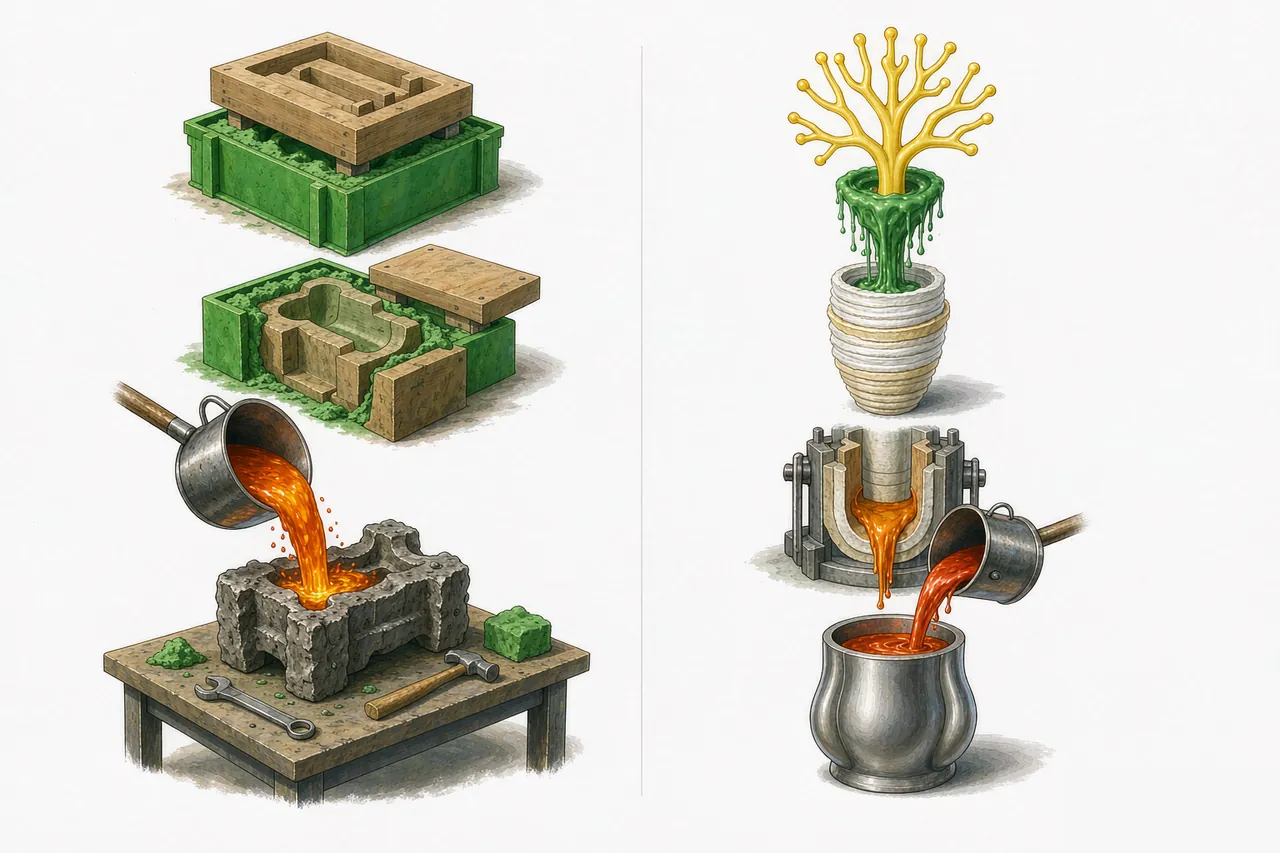
Sand casting uses a one-time disposable mold made of bonded sand. A pattern (wood, resin, or aluminum) is pressed into a sand mix to create the cavity, the sand is stripped, cores are set, the mold is closed and metal is poured. Once the casting cools, the mold is shaken out and the sand is recycled or discarded.
Where sand casting earns its place
- Large structural parts — pump housings, valve bodies, gearbox cases, automotive suspension knuckles.
- Ferrous alloys where pattern tooling dominates the cost — gray iron, ductile iron, carbon steel, most stainless grades.
- Low-to-medium volume where the alloy section is thick enough to tolerate rough surface finish.
What sand casting costs you
Typical as-cast surface roughness is 200–500 µin Ra, with dimensional tolerance on the order of ±0.030 inch (±0.8 mm) on small features before machining allowance. AFS publishes typical pattern allowances and shrinkage rates by alloy, and most foundries target a 1.5–2.5 mm finish allowance on faces that will be machined later.
What Is Investment Casting
Investment casting builds the mold from a wax pattern: inject wax into an aluminum die, dip the cluster in ceramic slurry, stucco with refractory grain, dry, repeat until the shell is thick enough, dewax in an autoclave, then pour molten metal into the fired shell. The shell is broken away after cooling.
Where investment casting earns its place
- Complex geometry with undercuts, thin walls, or fine internal passages — impellers, manifolds, firearm components, orthopedic implants.
- Tight as-cast tolerances — ±0.005 to ±0.015 inch (±0.13 to ±0.38 mm) on small features, per NADCA product geometry standards.
- Reactive alloys (high-chrome stainless, tool steels, cobalt- and nickel-base superalloys) that need a clean, low-contamination melt flow.
What investment casting costs you
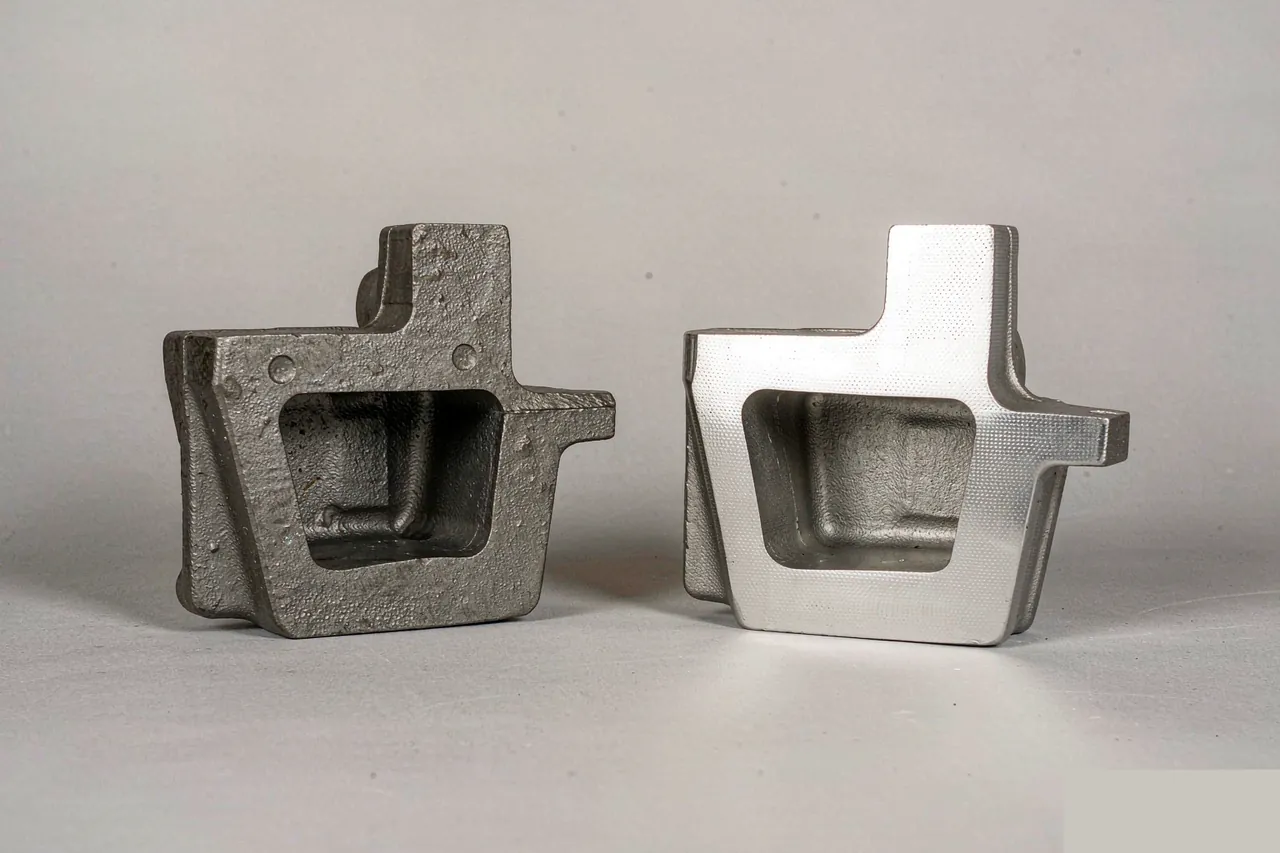
The wax tool itself is the capital expense — typically $4,000–$25,000 for a single pattern die — plus a 6–10 week lead time for wax tooling before the first pour. Per-part cost is then driven by pattern clusters, shell dipping cycles, and dewax yield. As-cast finish is dramatically better: 75–125 µin Ra on dressed surfaces, often near-net without secondary blasting.
Key Differences (Side-by-Side)
| Factor | Moulage au sable | Moulage de précision |
|---|---|---|
| Typical tolerance | ±0.030 in (±0.8 mm) | ±0.005 to ±0.015 in (±0.13–0.38 mm) |
| Surface finish (as-cast) | 200–500 µin Ra | 75–125 µin Ra |
| Max part weight (practical) | Up to ~20 tons (single piece) | Up to ~100 lb (45 kg) per cluster |
| Pattern/tooling cost | $500–$5,000 (wood or resin pattern) | $4,000–$25,000 (wax die) |
| Lead time, first pour | 2–4 weeks | 6–10 weeks |
| Best for alloys | Iron, carbon steel, most stainless | Stainless, tool steel, superalloys, aluminum (tight tol) |
| Material utilization | Runner + riser overhead 30–60% | Cluster-driven, often 70–90% |
| Internal complexity | Limited (cores only) | High (undercuts, thin walls, passages) |
Cost Comparison (Real Numbers, Not Marketing)
For a 5 lb (2.3 kg) ductile iron housing at 500 pieces per month, the cost spread looks roughly like this on our shop floor:
| Cost driver | Sand casting | Investment casting |
|---|---|---|
| One-time tooling | $1,500 resin pattern | $12,000 wax die |
| Per-part (material + foundry) | $8.50 | $18.20 |
| Machining savings (less finish stock) | — | -$1.40 |
| Scrap rate (real, last 6 mo.) | 4.2% | 2.1% |
| Break-even volume (vs. all-in) | Best above ~600 pc/mo | Best below ~300 pc/mo |
Numbers vary widely with alloy, geometry, and region; the takeaway is the shape of the comparison. Sand wins on absolute part cost and lead time; investment wins on geometry and tolerance. Many programs run both: a sand casting for the rough body, investment casting for the tight-tolerance flange or insert.
Surface Finish and Machining Allowance
Surface finish translates directly into machining cost. Cast iron at 300 µin Ra needs a facing pass to clean the skin before any precision dimension can be held. Investment cast stainless at 100 µin Ra can often be used as-finished on cosmetic or non-critical surfaces, saving a CNC operation on every part.
How much finish stock to leave
- Sand cast iron/steel: 2.0–3.0 mm per machined face.
- Sand cast aluminum: 1.5–2.5 mm per machined face.
- Investment cast (any alloy): 0.5–1.0 mm per machined face, often less on critical features.
Lead Time and Tooling Reality
Sand casting pattern lead time is usually the deciding factor for urgent programs: a resin pattern can be machined and ready to pour in 2–4 weeks, and an emergency wood pattern in under a week with tooling cost measured in hundreds, not thousands. Investment casting wax die lead time is 6–10 weeks for a new tool, so the program has to absorb that into the development plan.
However, once the wax die exists, investment casting cycle time is comparable to sand for many alloys because the shell-dip/dry/dewax steps can run in parallel on a multi-day cadence. The bottleneck moves from tooling build to process control (shell thickness, dewax yield, section modulus).
Sand Casting vs Investment Casting: Which Should You Choose
If you are still unsure after looking at the numbers, this decision tree covers the 80% case:
- Choose sand casting if: part weight > 5 kg, alloy is iron or carbon steel, volume > 500/mo, and tolerances ≤ ±0.5 mm are acceptable.
- Choose investment casting if: geometry has undercuts or thin walls, tolerance < ±0.2 mm is required, alloy is stainless/superalloy/aluminum, and volume is low-to-medium.
- Choose both if: the assembly has a rough body + a tight-tolerance feature. Many real products do this.
Final Thoughts
The “sand casting vs investment casting” question is not really a contest between two competing processes. It is a matching exercise between part geometry, alloy, volume, and tolerance. Most B2B programs that get into trouble picked a process because a brochure said it was “precision” or “economical,” then hit cost or scrap numbers they did not expect. The right move is to specify your three real constraints (tolerance, weight, volume), get a quote from a foundry that runs both, and let the numbers — not the marketing — make the call.
Is sand casting always cheaper than investment casting per part?
For most alloys above 1 lb (0.5 kg) per piece at volumes above ~300 pc/mo, yes — sand casting per-part cost runs roughly 40–60% of investment casting on the same alloy. The gap narrows on small stainless parts, where investment casting cluster efficiency offsets pattern cost.
Can investment casting replace sand casting 1:1 on the same drawing?
Usually yes on geometry and tolerance, but rarely on cost. Investment casting tooling is a step more expensive; if the part does not need the tighter tolerance or surface finish, the extra tooling spend will not pay back. Always re-quote — never assume 1:1 substitution.
How do I verify a foundry actually runs both processes?
Ask for a tour and audit their pattern shop (wood/resin) and their wax room + shell line. A foundry that only runs sand will often try to “make investment work” by adding machining; a foundry that only runs investment will downplay volume limitations. A real dual-process shop will tell you where each one falls short.
What alloys are off-limits for investment casting?
Very high-melting-point alloys (above ~1600 °C / 2900 °F melt) and very large castings (above ~100 lb / 45 kg) become impractical in investment casting because of shell thermal shock and metal inventory per cluster. Sand casting handles both routinely.
References: NADCA Product Design Standards for Die Casting (comparable tolerance practice); AFS Foundry Sand Handbook; internal foundry data, last 6 months. Specifications are typical and vary with alloy, geometry, and region — confirm with your foundry before committing.
 English
 Français
 Deutsch
 Italiano
 日本語
日本語 한국어
한국어 Polski
 Português de Angola
 Русский
 Español de Argentina