

In high-volume manufacturing, die casting vs sand casting is rarely an arbitrary choice—it is an engineering decision that directly affects tooling cost, surface finish, dimensional tolerance, and ultimately your per-unit price. Get it right and your production ramp-up pays back in months; get it wrong and you are absorbing scrap costs and retooling delays through the entire product lifecycle.
This guide cuts through the jargon. We benchmark die casting vs sand casting across eight shop-floor criteria—tooling, material range, tolerances, surface finish, production volume, cycle time, typical defects, and per-unit cost—so you can match the process to your part, not the other way around. Industry data draws on NADCA und AFS standards throughout.
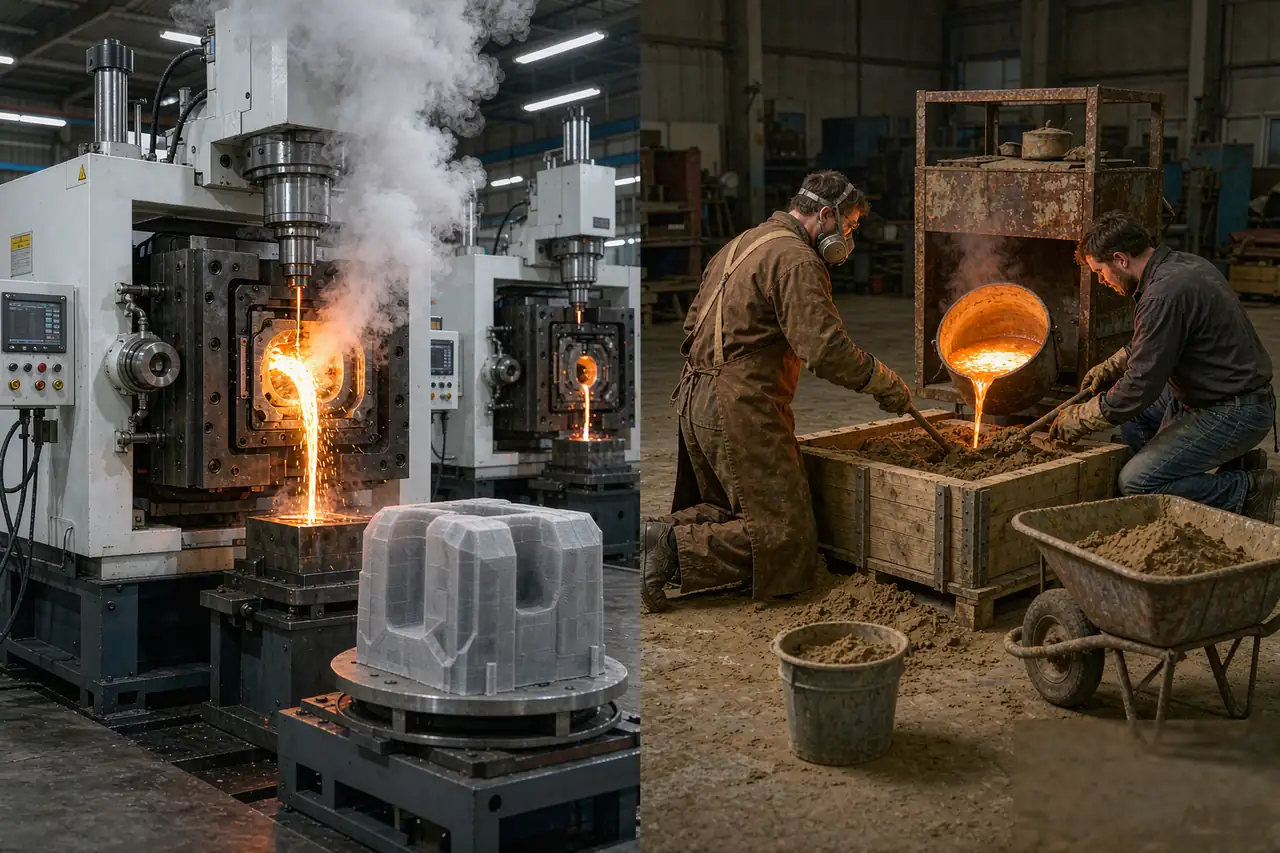
How Die Casting and Sand Casting Work
Druckguss forces molten metal into a precision-machined steel die under high pressure—typically 40–140 MPa. Once solidified, the die opens and the part ejects. The die (or “mold”) is reusable across hundreds of thousands of cycles, which is why die casting dominates high-volume production of automotive, hardware, and consumer-goods components.
Sandguss forms the mold cavity by packing sand around a pattern (the part shape), then removes the pattern and pours metal in. Each pour requires a new sand mold. The sand is reclaimed and recycled, but the mold itself is single-use—hence the term “expendable mold” process. AFS estimates sand casting accounts for roughly 60–70 % of all metal castings by tonnage globally, driven by its near-universal material compatibility and low entry cost.
Die Casting vs Sand Casting: Eight Key Criteria Compared
| Criterion | Druckguss | Sandguss |
|---|---|---|
| Tooling cost | $25,000–$250,000+ | $1,000–$20,000 |
| Typical production volume | 10,000–1,000,000+ parts | 1–5,000 parts |
| Dimensional tolerance (as-cast) | ±0.03–0.08 mm per 25 mm (NADCA) | ±0.5–2.0 mm per 25 mm |
| Surface finish (Ra) | 0.8–3.2 μm (often ready to use) | 3.2–12.5 μm (as-cast) |
| Cycle time per part | 2–120 seconds | 300–900 seconds |
| Wall thickness capability | 0.8–12 mm typical | 3–150 mm+ |
| Materialien | Al, Zn, Mg, Cu alloys (low melting point) | Cast iron, steel, Al, Cu, Ti, Superalloys |
| Per-unit cost at high volume | $0.05–$5.00 (amortized tooling) | $2.00–$50.00 (mold-per-part) |

When Die Casting Wins
For die casting vs sand casting decisions, die casting delivers clear advantages in three scenarios:
High-Volume, Tight-Tolerance Parts
If your annual demand exceeds 20,000 pieces and your design requires dimensional precision better than ±0.1 mm, die casting is almost always the correct answer. The steel die reproduces the cavity geometry to within microns and wears minimally over 100,000+ shots. NADCA tolerances for die-cast aluminum typically run ±0.03 mm per 25 mm wall—unachievable with sand without expensive machining.
Thin-Wall, Net-Shape Components
Die casting forces metal into dies at high velocity, filling sections as thin as 0.8 mm without cold shuts or misruns. Automotive housings, telecom connectors, and power-tool bodies—where every gram of material and every micron of flatness matters—default to die casting. Post-casting machining is minimal or eliminated, which directly lowers the total part cost.
Consistent High-Volume Output
With cycle times of 2–30 seconds per shot (multi-cavity dies), a modern cold-chamber die casting cell routinely produces 5,000–15,000 pieces per shift. For a deeper look at die casting process selection, see our aluminum die casting guide which covers alloy grades, gate design, and shot-end quality control.
When Sand Casting Wins
For die casting vs sand casting decisions, sand casting dominates whenever die casting’s constraints become deal-breakers:
Large, Complex, or Low-Volume Parts
Pump casings over 1 meter, ship propellers, and valve bodies weighing hundreds of kilograms simply cannot fit into a die casting press—and the tooling cost to build a steel die for a 5,000 kg part would be astronomical. Sand casting scales from 1 piece prototyping to thousands without retooling; pattern cost for a large industrial casting runs $2,000–$15,000 versus $50,000–$200,000 for a comparable die.
High-Temperature or Specialty Alloys
Steels melting above 1,500 °C, manganese steel, and nickel-based superalloys destroy steel dies on contact. Sand casting handles virtually any ferrous or non-ferrous alloy. For iron-based castings, the gray iron vs ductile iron guide walks through alloy selection criteria that apply equally to sand-mold processes.
Rapid Prototyping and Engineering Changes
When a design is still evolving (common in new-product development or reverse-engineered parts), the sand mold can be modified in hours by simply recutting the pattern or adding a core. Changing a die means CNC-machining new cavity inserts—days of lead time and thousands of dollars per revision. Sand casting gives engineering teams the flexibility to iterate without burning tooling budget.
Common Defects in Die Casting vs Sand Casting
Both processes produce high-quality parts when process controls are in place—but the failure modes differ, and knowing them sharpens your supplier qualification checklist.
- Die casting: Cold shuts (from low metal temperature or slow injection), porosity (from trapped gas or oil contamination on die surface), and flash (from worn die parting faces). NADCA quality standards specify maximum porosity levels by radiographic examination for structural parts. NADCA PS-201 is the standard reference.
- Sand casting: Sand expansion defects (pencil-core flashing), misrun or cold shut (from low pouring temperature or slow fill), and penetration defects (from metal eroding the sand mold wall). AFS publishes defect atlases and root-cause checklists that most quality-conscious foundries use internally.
Unser common casting defects guide covers prevention strategies for both processes in detail, including the heat-treatment adjustments that eliminate residual-stress-related distortion.
Making the Final Call: A Practical Decision Framework
Answer these five questions in sequence—the first “yes” typically locks in the process:
- Annual volume > 10,000 pieces? → Lean toward die casting (tooling amortization works in your favour).
- Tight tolerance (< ±0.1 mm) required without secondary machining? → Die casting wins.
- Part weight > 50 kg or dimensions > 500 mm? → Sand casting wins.
- High-temperature alloy (steel, iron, titanium, superalloy)? → Sand casting wins—die casting materials are limited to zinc, aluminum, magnesium, and copper.
- Design not yet frozen, expect multiple engineering revisions? → Sand casting reduces retooling exposure.
When the answers split evenly—say, 10,000-piece volume but a 30 kg ductile-iron housing—the per-unit cost model becomes decisive. Run a break-even analysis on tooling amortization vs. per-part cost differential. For a deeper walk-through of what actually drives casting pricing, see our casting cost breakdown.
FAQ
Can a part be made by both die casting and sand casting?
Yes—if the alloy and geometry permit both. An aluminum bracket at 5,000 pieces might economically justify either process. In such cases, die casting typically wins on surface finish and tolerance; sand casting wins on tooling lead time and prototype flexibility. The decision should be validated with a supplier quoting both methods.
What post-casting operations does each process typically require?
Die-cast parts often need only degating (cutting off the gates and runners) and may be ready for assembly. Sand-cast parts frequently require shot blasting to remove sand residue, and often need machining for sealing or mating surfaces. Our surface finishing guide covers blasting, polishing, and coating options for both processes.
How do I choose a die casting or sand casting supplier?
Check three things: (1) current NADCA or AFS certification of key personnel, (2) PPAP or first-article inspection reports with dimensional CMM data, and (3) sample lead time and tooling amortization terms. A supplier unwilling to share process capability studies (Cpk, porosity reports) before production is a red flag regardless of price. For a broader overview of Metallguss capabilities, see the metal casting guide.
*Industry data from NADCA Product Standards (PS-201), AFS Casting Design Handbook, and Supro MFG shop-floor production records.
 English
 Français
 Deutsch
 Italiano
 日本語
日本語 한국어
한국어 Polski
 Português de Angola
 Русский
 Español de Argentina