
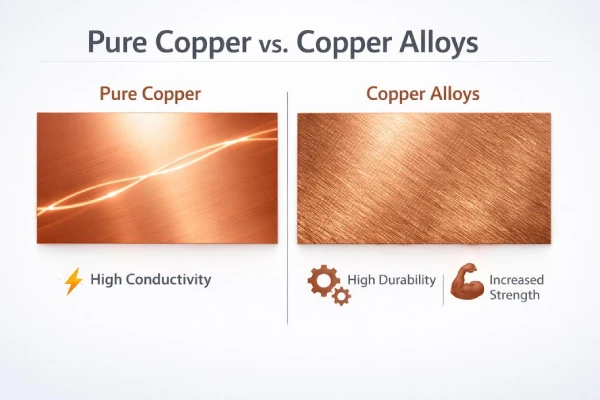
Lití mědi nabízí širokou škálu možností – od čisté mědi až po vysoce výkonné slitiny – pro elektrické, tepelně manažerské a konstrukční aplikace. Celý proces lití vyžaduje pečlivou rovnováhu mezi čistotou materiálu, chováním při tuhnutí a procesními parametry. Čistá měď se vybírá pro svou výjimečnou elektrickou a tepelnou vodivost, zatímco slitiny mědi obsahují prvky jako berylium, telur a fosfor k dosažení vyšší pevnosti nebo odolnosti proti opotřebení.
Výběr mědi odlévání přímo ovlivňuje výkon a náklady na životní cyklus konečných produktů. Čistá měď nabízí pět přirozených výhod v oblasti odvádění tepla, elektrické vodivosti, odolnosti proti korozi a recyklovatelnosti; avšak v případech, kdy aplikace vyžadují vysoce pevné kontakty, snadno obrobitelné přesné díly nebo odolnost pružin proti únavě materiálu, se beryllium-měď, telur-měď a fosforový bronz stávají optimálními řešení pro odlévání Projekty.
Tento průvodce poskytuje podrobnou analýzu základních definic, klíčového zařízení, hlavních procesů a pěti hlavních výhod lití mědi, stejně jako slitiny výběr elektrických komponentů, která nabízí technickou referenci pro rozhodování o výběru materiálu.
Co je odlévání mědi? Klíčové základy
Měď se zahřívá, dokud roztaje, poté se nalije do formy, kde chladne a vytváří pevný, trvanlivý tvar. Od surovin až po přesné dílce tento proces v moderních slévárnách odlévání mědi plynule kombinuje praktické dovednosti s pokročilou metalurgií.
Definování lití mědi: Od roztaveného kovu k pevnému tvaru
Lití mědi je ve své podstatě proces, který úzce propojuje přenos tepla, proudění a tuhnutí. Na rozdíl od konvenčního lití vyžaduje proces lití mědi přesnou rovnováhu mezi tepelnou vodivostí, vzdáleností proudění a rychlostí chlazení – chování čisté mědi a slitin mědi při tuhnutí se v této fázi výrazně liší, což přímo ovlivňuje konečné mechanické vlastnosti.
Při lití mědi závisí volba základní mědi nebo slitiny na požadavcích na tepelnou vodivost nebo pevnost. Materiál se pak umístí do pece a roztaví se za kontrolovaných podmínek. Pečlivé sledování teploty taveniny a chemického složení zajišťuje, že odlitky z mědi splňují metalurgické specifikace.
V scénářích velkoobjemové výroby s vysokou přesností měděná raznice proces lití využívá vysokou tepelnou vodivost kovu dutina formy k rychlému odvádění tepla, což podporuje zjemnění zrna a omezuje vady v podobě pórovitosti. Od roztaveného do pevného stavu určují teplotní gradienty strukturu zrna, návrh formy určuje rozměrovou přesnost a řízené parametry tuhnutí účinně snižují riziko vzniku porosity a segregace v odlitcích z mědi.
V době, kdy odlitky z čisté mědi opouštějí slévárnu, již získaly požadovanou elektrickou vodivost, tepelnou vodivost a odolnost proti korozi – to je vlastní proces, při němž měď přechází z kapalného stavu do pevného.
Základní slévárenské zařízení: Od tavičních pecí po formovací stroje
Pro každou profesionální slévárnu odlévání mědi se klíčové schopnosti opírají o kompletní řetězec zařízení – od tavicí pece až po formovací stroj. Spolehlivé zařízení pro lití mědi se odráží především v tavicím systému: tavicí pec ohřívá suroviny z čisté mědi nebo slitiny mědi do plně tekutého stavu, kelímek chrání roztavený kov před kontaminací a nalévací lžíce zajišťuje bezpečné nalévání.
Během fáze formování lisovací stroj zhutňuje písek nebo používá kovovou formu k vytvoření přesné dutiny, přičemž jádro definující komplex geometry. This comprehensive copper casting process directly affects the density and dimensional accuracy of the copper castings.
The dokončovací systém určuje konečnou kvalitu měděného odlitku. Proces třesení účinně odstraňuje částečky písku a odděluje vyjmutí z formy. Proces broušení odstraňuje vtok a otřepy, čímž eliminuje body koncentrace napětí. Povrchová úprava, ať už leštěním nebo povlakováním, zvyšuje životnost a odolnost mědi proti korozi. odlitkové díly.
Podle výhledu Mezinárodní studijní skupiny pro měď (ICSG) pro rok 2024 zůstává poptávka po rafinované mědi silně spjata s růstem v oblasti elektrotechniky a průmyslu, což upevňuje stabilní investice do slévárenství celosvětová kapacita.
Supro MFG integruje tyto systémy do své vysoce účinné mědi castingová produkce linku, čímž zajišťuje přísnou kontrolu kvality a udržuje nízkou míru zmetkovitosti.
Základní procesy: Pískové lití, lití na vytavitelný model a další
Každá měď proces odlévání udržuje rovnováhu mezi náklady, přesnost a kvalita povrchu. Společnost Supro MFG vybírá vhodný odlitek z měděné slitiny metoda založená na specifických požadavcích, která zajišťuje, že zákazníci obdrží díly s vysokou mírou lícování a stálým výkonem. Různé procesy lití jsou vhodné pro různé výrobní úkoly, jak je podrobně uvedeno níže:
- Měď lití do písku využívá jednorázové pískové formy, což nabízí širokou použitelnost a nízké náklady. Je vhodný zejména pro velké díly a malosériovou výrobu, přestože povrchová úprava a rozměrová přesnost jsou omezené.
- Měď přesné lití využívá keramických forem k dosažení rozměrové přesnosti stupně CT4–CT6 a kvality povrchu Ra 1,6–6,3 μm, s minimální tloušťkou stěny 0,5 mm. Je vhodný pro vysoce hodnotné, složité odlitky v odvětví letectví a přesného strojírenství.
- Lití mědi do formyTento proces zahrnuje vysokotlaké a rychlé plnění dutiny kovové formy, čímž se dosahuje rozměrové přesnosti stupňů CT4–CT6. Nabízí vysokou efektivitu výroby a je vhodný pro hromadnou výrobu malých, tenkostěnných měděných odlitků.
- Odstředivé lití mědi využívá odstředivou sílu generovanou vysokorychlostní rotací k naplnění dutiny formy roztavenou mědí. Tento proces vytváří hutnou mikrostrukturu bez vad v důsledku smrštění, což z něj činí preferovanou metodu pro válcové díly, jako jsou měděná pouzdra a ložiskové pánve.
- Copper continuous casting employs water-cooled molds to achieve continuous pouring and solidification, making it suitable for the efficient production of long products such as copper rods and billets.
Lití mědi: Srovnání pevnosti čistého kovu a slitin
Pokud jde o odlitky z mědi, pevnost je vždy prvořadým zájmem. Čistá měď nabízí klasický, nedotčený vzhled, zatímco slitiny mědi poskytují větší houževnatost. Při výběru měděných odlitků je pro inženýry klíčem k správnému rozhodnutí pochopení kompromisu mezi vysokou elektrickou vodivostí čisté mědi a vysokou pevností slitin mědi.
Pure Copper
In copper casting applications, high-purity metals stand out due to their emphasis on electrical conductivity rather than sheer strength. However, in the casting of copper for electrical enclosures or bus ducts, the factors given priority differ.
Pure copper has lower mechanical strength than other alloy grades, but it exhibits excellent ductility under stress and high plasticity during the copper casting forming process. It also possesses exceptional electrical conductivity (typically exceeding 100% IACS), and its high thermal conductivity aids in heat dissipation.
Molten pure copper exhibits excellent casting fluidity in controlled molds, and due to its high purity, alloy segregation is minimal. It is suitable for manufacturing copper castings that require flexibility, such as power connectors.
The International Copper Study Group noted in its 2025 outlook that global demand for high-conductivity copper castings continues rising, driven by electrification and grid upgrades.
For a professional Chinese copper casting foundry like Supro MFG, pure copper casting remains the preferred solution when electrical conductivity is non-negotiable.
The following are the properties and typical applications of pure copper C110:
Property | Pure Copper (C110) | Unit | Typical Application |
Tensile Strength | 210–250 | MPa | Electrical bus bars |
Hardness | 40–60 | HB | Terminals |
Electrical Conductivity | 100–101 | % IACS | Power systems |
Thermal Conductivity | 385–400 | W/m·K | Heat sinks |
Copper Alloys
Copper alloys, on the other hand, are quite different; their properties change rapidly when alloying elements are added. By leveraging a proven copper casting process, the following can be achieved:
- Increased strength in structural components
- Higher hardness under load
- Enhanced wear resistance in moving parts
In bronze and brass casting, slight adjustments to the composition directly affect mechanical properties. Bronze casting typically enhances corrosion resistance, while brass casting improves machinability. Beryllium-based alloys can achieve extremely high strength after tepelné zpracování.
Měď alloy casting typically follows these steps:
1) Select an alloy formulation based on load requirements.
2) Control the chemical composition of the melt to achieve balanced mechanical properties.
3) Perform heat treatment to unlock enhanced strength.
4) Perform finishing operations to meet strict tolerance requirements.
In summary, copper alloy castings are tougher and harder, making them suitable for products that must withstand pressure.
Supro MFG is dedicated to supporting copper and copper alloy casting projects with extremely high durability requirements—such as gears, valve bodies, and pump components. When engineers need to prioritize toughness over mere electrical conductivity, alloyed copper castings are the preferred choice.
Hledáte spolehlivou čínskou kovodlévarnu?
- Můžeme vám pomoci optimalizovat design produktů a ušetřit náklady.
- Můžeme vám pomoci s velkými objemy v vysoké kvalitě odlitkové díly.
- Dokážeme dodat včas a získat další příležitosti na prodejním trhu.
- Získáte výhodu díky Supro MFG kovolitectví služba.
5 Advantages Of Pure Copper Casting
When performance is critical, pure copper casting stands out. From thermal management to electrical conductivity, this casting process is both simple and efficient. Furthermore, its comprehensive performance in terms of corrosion resistance, machinability, and recyclability makes pure copper the material of choice for demanding applications.
Superior Thermal Conductivity for Heat-Sensitive Parts
In terms of thermal management, the high thermal conductivity of pure copper makes it a reliable choice for industrial cooling and power systems, particularly those operating under harsh conditions. Because of the thermal conductivity of pure copper castings, dynamic cooling systems can respond quickly and maintain stable thermal management performance during repeated thermal cycles. As a result, copper castings with complex geometries can provide exceptional heat dissipation performance.
Thanks to copper’s excellent thermal conductivity, copper castings feature a uniform grain structure, which helps reduce the risk of equipment overheating and extends service life. For example, in heat sinks, this eliminates localized hot spots. During the production of mold inserts, it helps balance temperatures. It also ensures that power modules remain within safe operating limits.
Compared to aluminum alloys, copper odlitkové díly conduct heat more efficiently, which means that smaller structures can withstand the same load. This is a significant advantage for both compact electronic devices and heavy-duty tools.
Unmatched Electrical Performance in Conductive Components
Electrical engineering requires low resistance and stable current flow. For this reason, pure copper castings demonstrate unique advantages in high-load electrical applications and conductive components. The high electrical conductivity of copper cast parts ensures that they maintain stable electrical performance under load. The benefits of efficient power transmission help reduce energy loss in power distribution units. For busbars and switchgear, copper castings reduce both resistance losses and heat buildup. This balance is hard to beat.
The following is a performance comparison based on industry standard values:
Material Type | Electrical Conductivity (% IACS) | Thermal Conductivity (W/m·K) | Typical Application | Relative Resistance |
Pure Copper Casting | 100% | 390–401 | Busbars, connectors | Very Low |
Aluminum Alloy | 61% | 205–237 | Lightweight conductors | Medium |
Brass Casting | 28% | 120 | Fittings, terminals | Vysoko |
Bronze Casting | 15% | 60 | Bearings, bushings | Very High |
High Corrosion Resistance Without Alloying Elements
An often-overlooked advantage of non-alloyed copper is its inherent corrosion resistance. During the pure copper casting process, an oxide layer forms on the surface of the casting, effectively preventing further degradation of the material. Copper castings exhibit strong chemical stability in air and remain reliable even with moderate exposure to the environment.
In water supply systems and outdoor installations, copper castings maintain excellent performance without the need for coatings. This simplifies maintenance and reduces long-term costs. For infrastructure projects utilizing copper castings, the reduced use of additives also means fewer material variables to manage.
Ease of Machining and Post-Casting Finishing
Pure copper offers excellent machinability and produces smooth cast surfaces. It is a favored material among manufacturers for its ease of machining. The copper casting process involves the following steps:
1) Precision turning or milling.
2) Deburring and polishing.
3) Final post-processing is performed to optimize surface quality.
During the manufacturing process, copper casting enhances surface quality, ensures dimensional stability, and is compatible with CNC systems, thereby meeting customized manufacturing requirements. This flexibility ensures that casting projects can meet strict tolerance requirements, whether for power connectors or custom enclosures. Teams that partner with experienced copper casting service providers like Supro MFG frequently note that the machining process is highly predictable, which allows production to proceed smoothly and helps avoid unexpected issues.
Recyclability and Environmental Benefits
Sustainability is more important than ever, and copper casting aligns perfectly with this trend. Pure copper is 100% recyclable, with minimal loss of properties upon remelting, supporting full recyclability while maintaining performance.
Furthermore, scrap from copper cast parts can be directly reintroduced into the casting process. Quality remains uncompromised, and standards are upheld. This circular model not only makes copper casting practical but also a wise choice for forward-thinking companies.
Copper Casting: Selection of Casting Alloys for Electrical Components
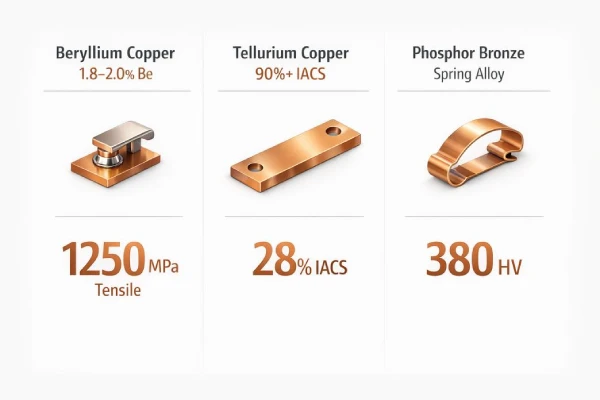
Electrical performance begins at the smelting stage. A prudent selection of copper raw materials determines the conductivity, strength, and service life of critical electrical components. In copper casting, three alloy options offer the advantages of ultra-high strength, a balance of conductivity and machinability, and fatigue resistance, respectively. Engineers can select the appropriate alloy based on specific electrical and mechanical load requirements.
Beryllium Copper Casting for High-Strength Contacts
When high loads and strict tolerance requirements coexist, beryllium-containing copper castings are an excellent choice. Copper alloys containing 1.8–2.0% beryllium achieve tensile strengths exceeding 1,200 MPa after heat treatment, effectively increasing the hardness of the castings and enhancing wear resistance in sliding contacts.
This alloy formulation ensures high strength while maintaining the machinability of electrical contact geometries. A conductivity of 20–30% IACS provides a balance between electrical and mechanical properties. Typical applications include heavy-duty relay contacts, aerospace connectors, and industrial switchgear.
At Supro MFG, our copper casting and post-casting aging processes are fully optimized, ensuring that the cast copper components consistently meet specifications without any issues.
The following is a comparison of the properties of cast copper alloys before and after heat treatment:
Property | As-Cast | Heat Treated | Unit | Application Impact |
Tensile Strength | 600 | 1250 | MPa | Long-term load |
Conductivity | 18 | 28 | % IACS | Signal flow |
Hardness | 180 | 380 | HV | Contact wear |
Elongation | 8 | 3 | % | Form stability |
Density | 8.3 | 8.3 | g/cm³ | Weight control |
Tellurium Copper: Balancing Conductivity and Machinability
In the field of copper casting, tellurium-copper achieves a unique balance between electrical conductivity and machinability. By adding trace amounts of tellurium, castings maintain an IACS conductivity of over 90% while producing smooth chip cross-sections and significantly reducing tool wear. This advantage extends throughout the entire copper casting process, ensuring reliable and smooth machined surfaces for precision electronic components.
In copper casting projects requiring precision threads or fine features, the use of tellurium-containing copper alloys can reduce secondary machining time. It minimizes vibration, resulting in smoother tapping. Supro MFG typically recommends this process for busbar and terminal manufacturing where both a polished finish and high performance are required.
Phosphor Bronze Solutions for Spring Contacts
In the field of copper casting, phosphor bronze has become the material of choice for spring contact applications due to its unique shape memory properties. The addition of tin and trace amounts of phosphorus to the copper matrix refines the grain structure and enhances corrosion resistance. Through an optimized copper casting process, the castings maintain stable spring force even after millions of cycles, while also offering excellent electrical conductivity and resistance to oxidation.
For designers who need to balance cost and durability, phosphor bronze castings ensure that components are both compact and robust. From battery clips to terminal springs, the cast copper alloys manufactured by Supro MFG ensure smooth current flow while effectively reducing the rate of post-sales repairs.
Contact Supro-Mfg
Copper casting offers a clear selection path between pure copper and copper alloys: Pure copper excels in high electrical and thermal conductivity, corrosion resistance, machinability, and recyclability, making it suitable for thermosensitive and electrical applications; beryllium copper, tellurium copper, and phosphor bronze, on the other hand, meet the requirements for high-strength contacts, precision machining, and spring fatigue resistance, respectively. Leveraging a well-established copper casting process, engineers can strike a precise balance between performance and cost, ensuring the reliable service life of copper castings.
 English
 Čeština
 Français
 Deutsch
 Italiano
 日本語
日本語 한국어
한국어 فارسی
فارسی Polski
 Português de Angola
 Русский
 Slovenčina
 Español de Argentina
 Українська