
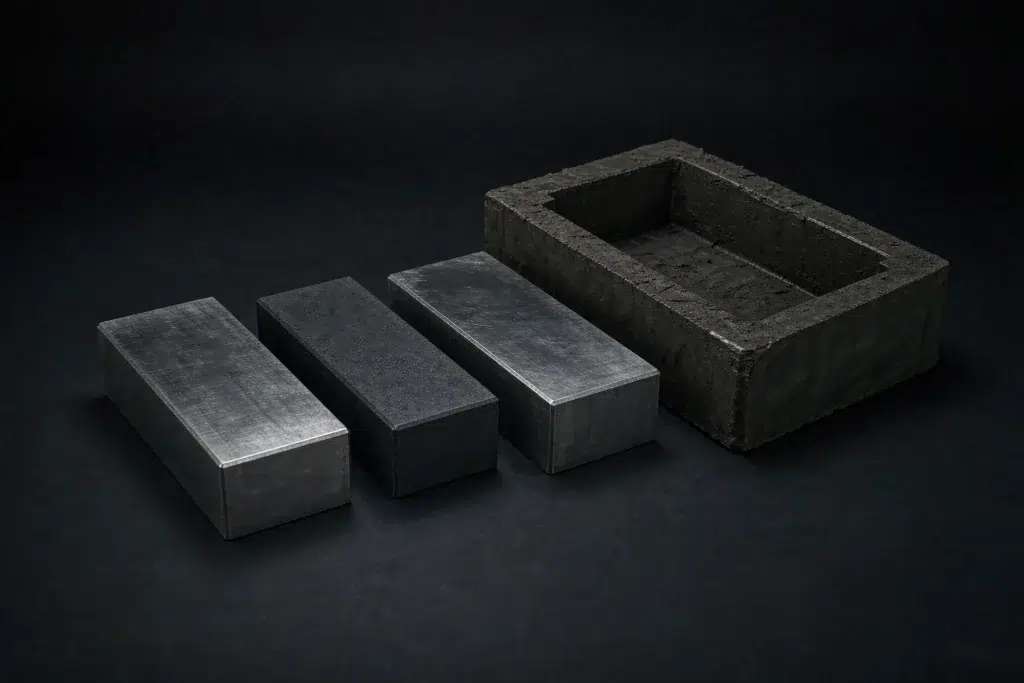
Casting chills are the most under-used metallurgical lever in a sand foundry: a 15 mm steel block pressed against a hot spot can shorten local freezing time by about a third without adding one gram of feed metal. Place the same block on the wrong face, or leave a 0.3 mm air gap under it, and it does almost nothing — or prints a hard white-iron band the machine shop must grind away.
This guide covers what external and internal casting chills do at the solidification front, how to size them from section modulus and interface conductance, how the answer changes between aluminum, iron and steel, and how to price the choice against a larger riser. Heat-flow measurements follow NIST metrology practice; acceptance uses ASTM E446 reference radiographs and, for ductile iron, the ASTM A536 grade system. Start with the broader guia de fundição de metais if you need the process backdrop.
What Casting Chills Actually Do at the Solidification Front
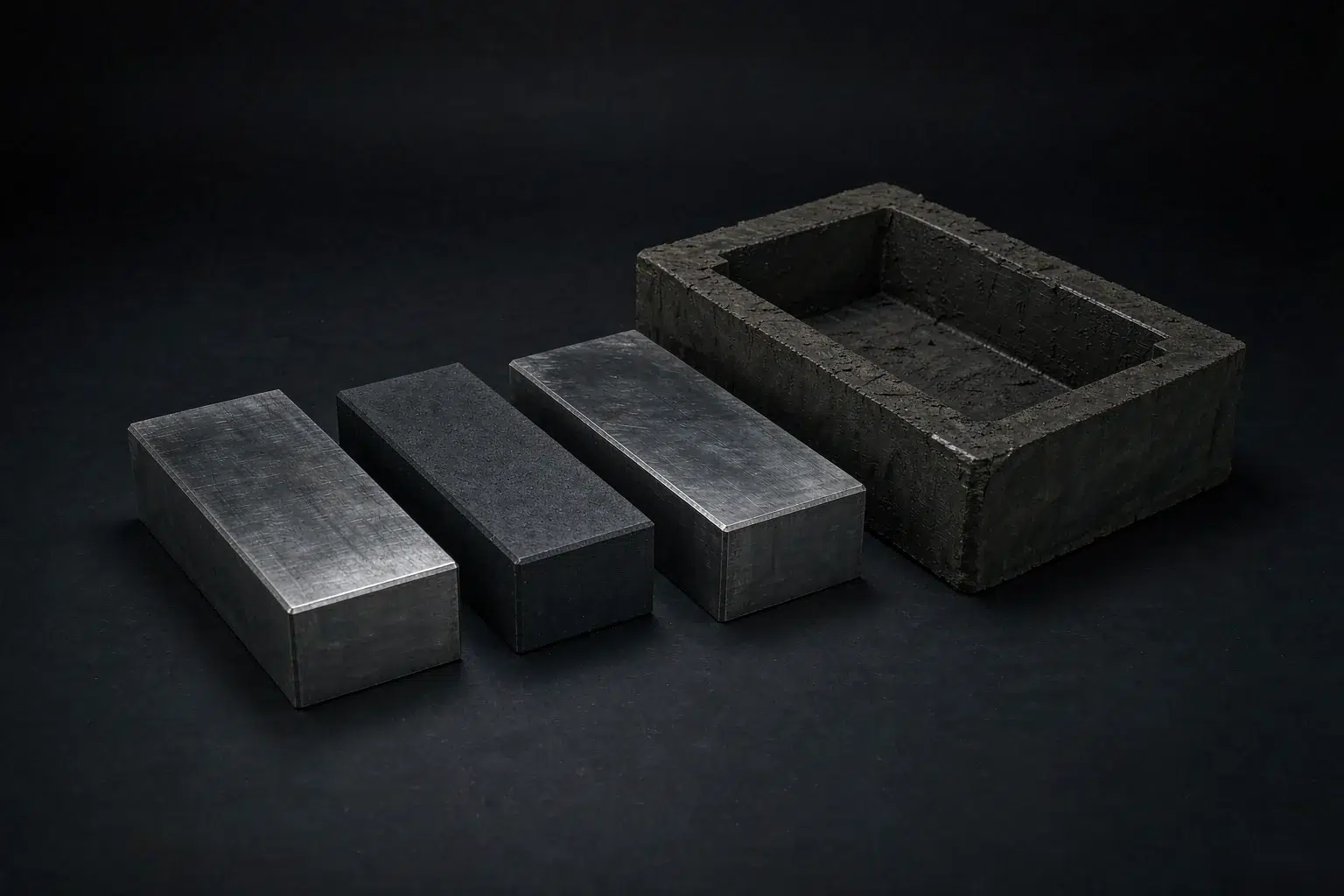
Casting chills do not feed shrinkage. They change the local cooling rate so that the last liquid to freeze is the riser, not the casting. Chvorinov’s rule makes the mechanism visible: solidification time is proportional to the square of the casting modulus M = V/A. A chilled face counts as extra cooling area A, which lowers M and shortens local freezing time.
Take a Ø80 × 60 mm boss on a 20 mm ductile-iron plate. The boss volume is 301,593 mm³. With its side wall and one free top face, the cooling area is 20,106 mm² and M = 15.0 mm. Press a steel chill onto that top face and the effective area becomes 25,133 mm², M drops to 12.0 mm, and local freezing time falls to (12.0/15.0)² = 0.64 of the original — a 36% reduction. That is enough to open a feed path that was closing too early, while the riser itself keeps its original size.
This is why casting riser design and chills are complementary tools. A bigger riser adds metal and time; casting chills add gradient. Foundries that reach for the riser first usually pay twice: extra melt loss, longer removal time, and still a hot spot if the feed path freezes shut. In fundição em areia we routinely trial a chill before increasing riser volume, because the block can be moved between pours and the learning is reversible.
Two failure modes follow directly from the same physics. If the chill is too small or loses contact, M barely moves and nothing improves. If it is too aggressive on a gray-iron face, the surface cools through the eutectoid too fast and forms carbide — a hard skin that destroys tool life. The entire craft of casting chills is controlling that balance, not simply adding cold steel to a mold.
External vs Internal Casting Chills: Four Families
Buyers usually hear “chill” and picture a steel block in the sand. That is only one option. The table below separates the four families by where the heat sink sits and what it costs to qualify.
| Family | Where it sits | Typical use | Watch-out |
|---|---|---|---|
| External steel or gray-iron block | Embedded flush in the mold wall | Bosses, flanges, heavy sections in sand molds | Air gap and carbide band on iron |
| Graphite chill | Mold wall or permanent mold insert | Aluminum housings, die and gravity dies | Fragile edges; needs gentle handling |
| Copper or water-cooled chill | Permanent mold / die insert | High-cycle permanent mold casting and die work | Condensation, thermal fatigue, capex |
| Internal chill | Placed inside the cavity, fused into the casting | Isolated steel hot spots no riser can reach | Inclusion and fusion risk; avoid on critical faces |
Internal chills deserve special caution. They become part of the casting, so chemistry, cleanliness and full fusion matter. We treat them as a last resort after section redesign and fundição à cera perdida or serviços de fundição sob pressão route review. External casting chills, by contrast, are reusable tooling: they never enter the metal and can be swapped in a trial without a procedure change.
The geometry rule is simple: the chill face should cover the hot spot plus a 10–15 mm land on every side. A chill smaller than the hot spot cools the centre but leaves an annular band that still freezes late — a classic cause of local microshrinkage near the chill edge.
Sizing Casting Chills: Modulus, Thickness and Contact
Start with the modulus, not a rule of thumb
Chill thickness is usually specified as a multiple of the local section thickness t. Below about 0.75t the sink saturates before the casting freezes; above roughly 1.5t the extra metal buys almost no extra gradient because the mold/casting interface is the bottleneck.
| Local section t (mm) | External chill thickness (mm) | Typical plate footprint | Comment |
|---|---|---|---|
| 10–20 | 15–20 | t + 15 mm land | Watch cold shuts on thin aluminum |
| 20–40 | 25–35 | Hot spot + 15 mm land | Default range for iron housings |
| 40–60 | 40–55 | Hot spot + 20 mm land | Pair with a neck/riser review |
| > 60 | 60–80, or split chills | Two opposed faces | Model before cutting steel |
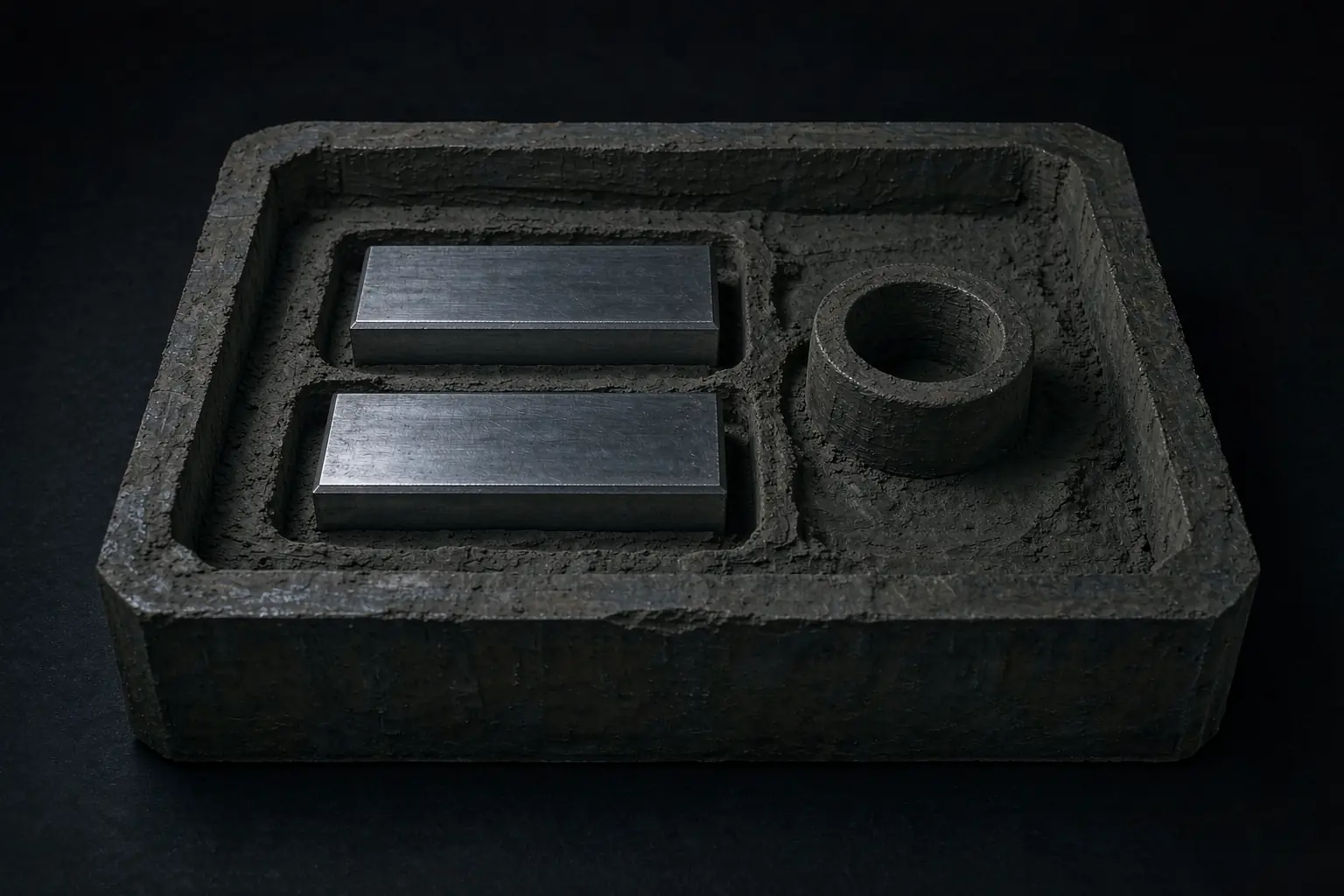
A 25 mm chill on a 40 mm boss costs far less than a 60 mm block and often performs the same, because contact conductance — not chill mass — sets the heat flux. For mold-built chills we also check the neighboring core making package: a core print that shifts 2 mm can lift the chill off the face and erase the whole effect.
Contact resistance is the hidden variable
Heat flux across the interface is roughly q = h·ΔT. With good metal-to-mold contact, h of 2–5 kW/m²·K gives a flux near 1.8 MW/m² at a 600 K driving difference. Introduce a 0.2–0.3 mm sand film or an air gap and h can fall toward 0.5 kW/m²·K — about 0.3 MW/m², a six-fold drop. This is the main reason casting chills that look correct on the drawing fail in the trial.
Practical controls: seat the chill in a machined pocket, use a 1–2 mm refractory backup (paper or wash) only where sticking is a problem, and verify contact with feeler gauge before closing the mold. The casting mold coating article explains why coating thickness is a process variable, not a cosmetic detail. Dimensional consequences belong in the guia de tolerâncias de fundição — a chilled face can move the local profile by 0.2–0.5 mm through differential contraction.
Coating and placement discipline
A 0.15–0.30 mm refractory wash prevents welding of metal to the chill and extends block life, but each extra 0.1 mm reduces heat extraction. We record coating thickness on the setup sheet together with chill ID, pocket location and number of pours. Chills are then rotated out after a fixed cycle count rather than when they visibly fail. The same tracking discipline used for casting molds making tooling pays back directly here.
Alloy Windows for Casting Chills: Aluminum, Iron and Steel
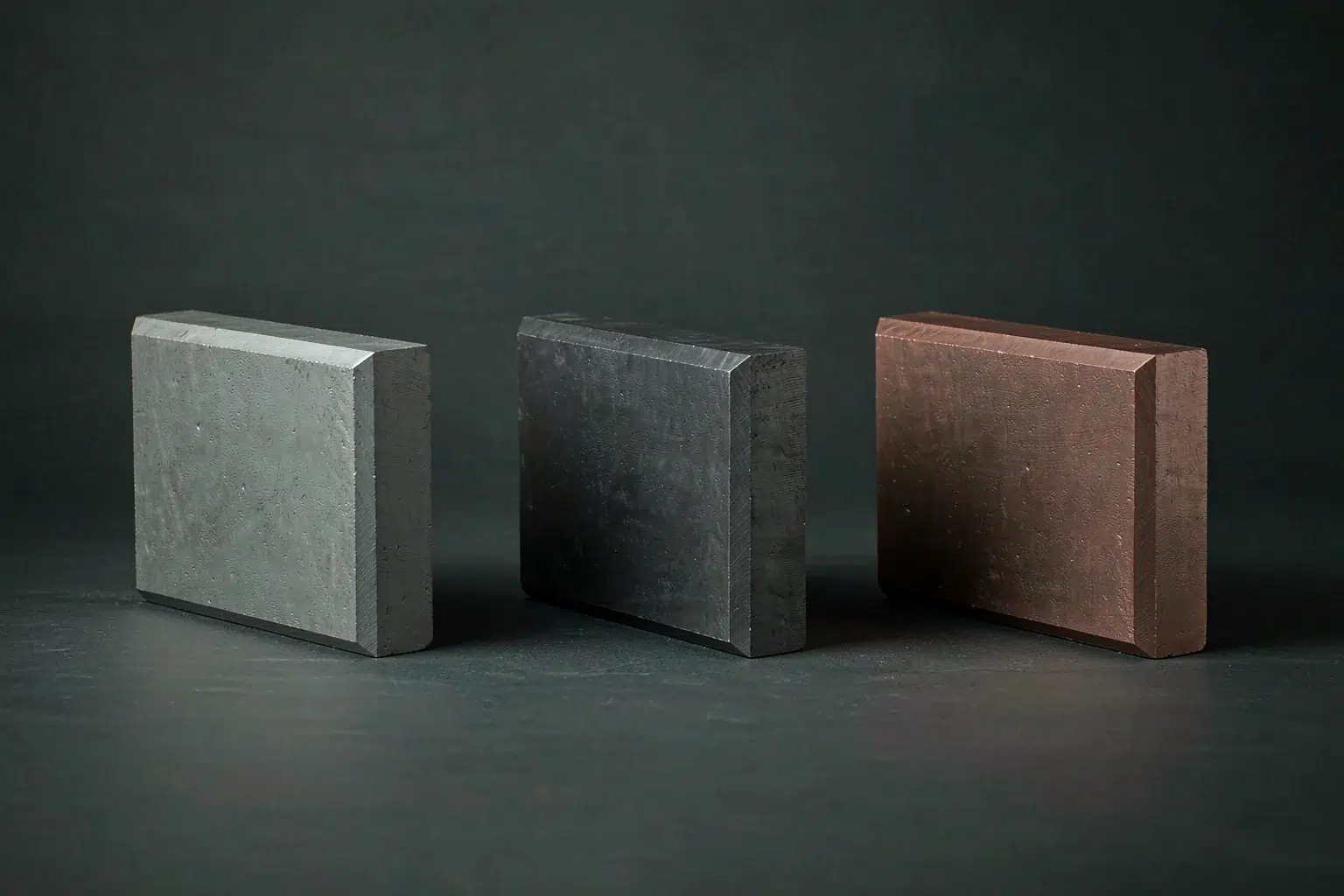
The same chill block produces different results in different alloys. Freezing range, graphite expansion and pouring temperature decide whether a chill removes shrinkage or creates a new defect.
| Alloy family | Typical pour window | Preferred chill | Main risk | Controlo |
|---|---|---|---|---|
| A356 / Al-Si | 705–730 °C | Graphite or steel, coated | Cold shut, chill marks | Keep casting pouring temperature at the top of the window |
| Ductile iron | 1350–1420 °C | Gray-iron or steel block | Carbide / white iron at chill face | Limit chill area; verify hardness; follow ASTM A536 |
| Gray iron | 1360–1450 °C | Steel block, deliberate chilling | Machining-hard skin | Utilização tratamento térmico de peças fundidas or anneal if required |
| Carbon / low-alloy steel | 1500–1560 °C | External block; internal only if unavoidable | Fusion defects, inclusion | Radiography per ASTM E446; see casting defect claim |
Aluminum deserves a note on die work. In high-pressure dies, chill action is built into the cooling channels rather than loose blocks; deeper conformal channels can replace a graphite insert. Our aluminum die casting guide covers that trade-off, and the foundry audit checklist shows how to audit whether cooling circuits are actually clean. Aluminum Association data on cast alloys is a useful external reference for freezing behavior: The Aluminum Association.
Iron is the classic white-iron case. A deliberately chilled wheel tread can carry a 3–10 mm carbide-rich layer with high wear resistance, while the core stays tough gray iron. The same mechanism is a defect on a machined flange face. Specify which surfaces may be chilled, then protect the rest with coating or mold design — and leave casting machining allowance for any hard skin that cannot be avoided.
Steel has high volumetric shrinkage, roughly 3.5–4.0%, so casting chills rarely work alone. They shorten local freezing time and extend the effective feeding distance, but the riser must still contain enough hot metal. Our defeitos comuns de fundição guide shows the radiographic signature of a feed path that closed early.
Casting Chills vs a Larger Riser: A Shop-Floor Cost Model
Consider 12,000 ductile-iron pump housings per year, 12 kg net each. The baseline uses one Ø90 × 80 mm riser: 3.61 kg of ductile iron at 7,100 kg/m³. Grinding the contact pad takes 9 minutes at a fully burdened 36 USD/hour. Shrinkage scrap sits at 4.8%, and each scrap casting costs 78 USD in metal and lost processing.
Instead of enlarging that riser, trial two 2.4 kg gray-iron external chills on the isolated boss. The riser can shrink to Ø70 × 65 mm, or 1.78 kg. Local freezing shortens, scrap drops to 2.6%, and grinding falls to 5 minutes because the pad is smaller. The numbers below are per year unless stated.
| Line | Baseline | With casting chills | Annual effect |
|---|---|---|---|
| Poured riser metal | 3.61 kg/part | 1.78 kg/part | 24,254 USD saved at 1.10 USD/kg |
| Riser_pad grinding | 9 min/part | 5 min/part | 28,800 USD saved |
| Shrinkage scrap | 4.8% | 2.6% | 20,592 USD saved |
| Chill placement | — | 1.5 min/part | 10,800 USD cost |
| Coating and replacement | — | 0.12 USD/part + 1.5 sets | 1,463 USD cost |
| Upfront chill + fixture | — | 2 blocks + 4,200 USD fixture | 4,215 USD capex |
Total annual saving is 73,646 USD against 12,263 USD of operating cost: 61,383 USD net, with payback in 0.8 months on the 4,215 USD capex. The counter-intuitive part is where the cost sits: chill placement labour is 88% of program operating cost, while the iron blocks themselves cost 15.36 USD per set and last about 8,000 pours. Any improvement that removes the manual step — a fixture, a pocket with a stop, a quick-change carrier — beats buying exotic chill material.
Do not ignore downstream consequences. A chilled face changes hardness and therefore grinding media choice, which is covered in casting surface finishing and the secondary operations cost stack. If the surface is machined, quote the CNC machining services route before freezing the chill layout; for iron housings, our iron casting solutions team can run the trial with both options. Energy per tonne is not the deciding factor here — see the DOE Industrial Efficiency and Decarbonization Office for context on melt energy.
Validating Casting Chills in 30 Days
Days 1–10: Map the thermal problem
Start with section modulus and a thermal map, not with steel blocks. Sectioning a known scrap casting and comparing it with casting simulation output tells you whether the last-to-freeze zone is a true isolated hot spot or a gating problem. If it is gating, chills will mask the symptom; fix the gating first. Cross-check melt condition against casting melt treatment, because gas and inclusion levels change how a chilled zone appears on radiography.
Days 11–30: Freeze the process
- Trial matrix. Two chill thicknesses × two coating thicknesses × contact verified / not verified. Keep pouring temperature constant.
- Measurement. Thermocouples at the hot spot and 20 mm away; record local freezing time and compare with the modulus prediction.
- Destructive check. Section and polish the chilled face; check carbide depth, microshrinkage and fusion on every trial part.
- Handoff. Record chill ID, pocket, coating, cycle count and hardness on the setup sheet, then release three consecutive lots.
Only after that should you lock the layout. Chills that work once but are not repeatable across shifts are worse than no chills: the scrap pattern moves from a known hot spot to random locations. Casting shakeout timing also changes when local freezing is faster, so recheck the removal window before changing the production sequence. For first articles, our serviços de fundição de protótipos metálicos route can produce the trial set without committing production tooling.
RFQ Checklist: Specify Casting Chills Before You Ask for a Quote
A foundry cannot price casting chills from a part weight alone. Include the following eight fields in the RFQ; they turn a vague “please add chills” request into a quote that can be held to a number.
| Field | What to state | Why it changes the quote |
|---|---|---|
| Hot spot | Part zone / drawing coordinate | Sets chill footprint and pocket location |
| Section thickness | Local t and adjacent wall | Sets thickness and coverage |
| Alloy and grade | e.g. ASTM A536 65-45-12 | Defines carbide and hardness risk |
| Chill type | External steel, graphite, internal | Changes tooling and qualification effort |
| Interface | Coating type and thickness | Drives extraction rate and consumables |
| Acceptance | Radiography class, hardness band | Defines proof, not just appearance |
| Machined faces | Which faces may be chilled | Avoids grinding and tool-life surprises |
| Annual volume | Pieces/year and expected chill life | Amortises blocks and fixtures |
Use this together with the wall-section rules in orientações relativas à espessura das paredes na fundição em areia and the commercial framing in the guia de fundição de metais. If your part needs a prototype first, 3D printing prototype can shorten the geometry iteration before steel is cut.
FAQ: Casting Chills, Answered Plainly
Do casting chills replace risers?
Usually no. They replace some riser volume by steepening the temperature gradient, but they add no feed metal. On gray iron and thin-wall aluminum, chills may remove the need for a riser entirely; on steel, plan on both until simulation and sectioning prove otherwise.
How thick should an external chill be?
Start near the local section thickness t: 0.75–1.5t for most sand work. Beyond about 1.5t the interface, not the chill mass, limits heat flow. For a 40 mm boss, a 25–35 mm block with a 15 mm land is a sensible first trial.
Will casting chills make the surface too hard to machine?
They can, especially on gray and ductile iron. Specify the allowed chill zone, keep coating in the 0.15–0.30 mm band, and add hardness checks to the first article. If a hard skin is unavoidable, include it in the machining allowance and tool-life estimate.
Are internal chills safe for critical parts?
Only with a qualified process. Internal chills must be clean, composition-compatible and fully fused; otherwise they act as inclusions. External casting chills are preferred because they never enter the casting and are easier to audit.
Do die castings use chills?
Yes, but as cooling channels or conformally cooled inserts rather than loose blocks. The physics is identical: remove heat from the last-to-freeze zone. See the aluminum die casting guide for die-side cooling practice.
*Data referenced from ASTM, NIST, The Aluminum Association, US DOE and Supro MFG shop-floor records.
 English
 Français
 Deutsch
 Italiano
 日本語
 한국어
 Polski
 Português de Angola
 Русский
 Español de Argentina