
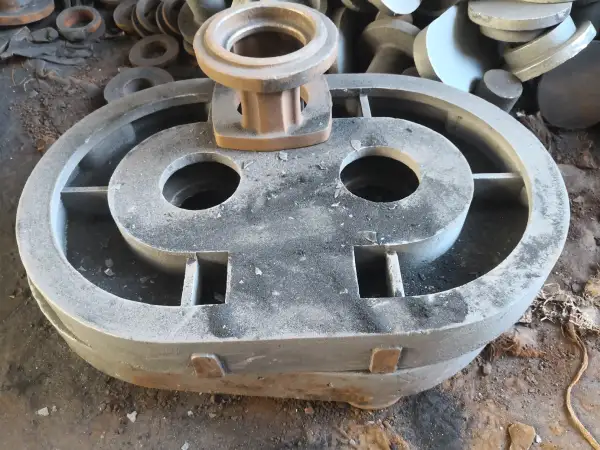
With the ongoing trend toward automotive weight reduction and increasingly stringent structural safety requirements, sand casting is being used more widely in safety-critical components such as aluminum alloy chassis parts and steering knuckles. However, casting porosity and aluminum sand casting shrinkage are the two primary defects that affect component fatigue life and crash safety, and their control spans the entire process from melting to solidification. This paper will systematically explain how to effectively eliminate porosity through hydrogen solubility management, rotational degassing, and density index testing; how to address shrinkage issues in thick, large cross-sections using sequential solidification, riser feeding, and localized chill design; It will also introduce the process advantages of resin sand casting in reducing gas generation from cores and optimizing venting channels, as well as the critical role of sand casting cores in forming complex internal cavities, thereby providing technical insights for the stable production of highly reliable aluminum castings. The following sections will analyze these topics one by one, combining specific process parameters with key on-site control points.
Mitigating defects in automotive aluminum sand casting projects
Implementing defect mitigation strategies during the early design stages of sand casting is critical to ensuring the structural integrity of safety-critical automotive components. When casting high-stress components such as control arms or steering knuckles, internal metallurgical stability is more important than basic surface appearance. Therefore, it is essential to carefully evaluate how molten metal flows into the mold to prevent subsurface defects from weakening the strength of critical cross-sections. By implementing rigorous molten metal treatment and utilizing advanced resin sand casting technology, structural deviations can be consistently eliminated, ensuring that green castings can safely withstand millions of load cycles without catastrophic structural failure.
Critical safety standards for automotive aluminum castings
Compliance with automotive industry regulations during the sand casting production process ensures that finished structural components pass the original equipment manufacturers’ (OEMs) rigorous safety verification. Tier-1 supplier engineering specifications require that load-bearing components show no macroscopic defects during digital radiographic testing. By analyzing these density standards, it is possible to ensure that the metal can withstand sudden stress cracking during vehicle operation. Foundries can prevent dangerous wall thinning and dimensional deviations by maintaining uniform mold compaction and using stable sand casting cores. Consequently, this rigorous process control enables the production of highly safe aluminum components that reliably meet global crash test safety requirements.
Impact of micro-voids on component fatigue life
If left uncontrolled, porosity in aluminum sand castings can become a severe stress concentration point, directly affecting the long-term fatigue life of suspension components. Under cyclic road loads, microporosity hidden within the metal matrix gradually expands over time into severe structural cracks. Metallurgists have analyzed the cross-sections of these failed components to trace how microscopic gas bubbles accelerate microstructural tearing. By adjusting molding parameters to eliminate aluminum sand casting porosity in high-stress areas, the fatigue threshold of the components has been significantly improved. This structural improvement ensures that the vehicle chassis can withstand continuous operational stresses without experiencing sudden mechanical failure.
Root causes of gas entrainment during sand mold filling
Turbulence in the resin sand casting process is the primary cause of gas entrapment inside thin-walled castings. When molten aluminum enters the mold cavity too rapidly, it creates shear forces against the sand walls, forming bubbles in the molten metal flow. This high-speed filling can lead to severe bubbling, particularly when the mold’s venting system is insufficient to expel the displaced air. By analyzing these flow dynamics, the runner geometry can be optimized to force the gas out through active vents before solidification. As a result, the metal can fill the mold smoothly and evenly, thereby preventing defects caused by gas pockets.
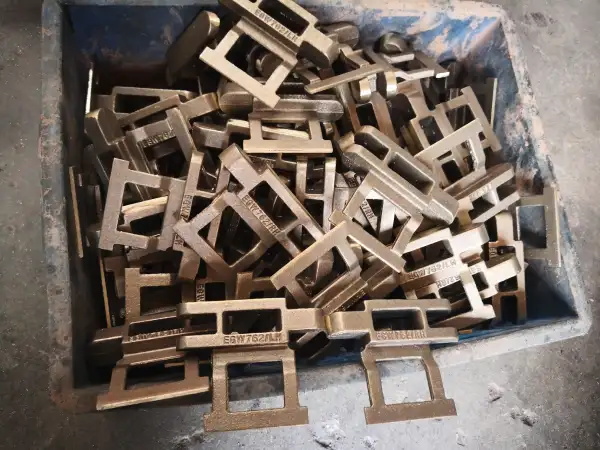
Eradicating aluminum sand casting porosity through gas control
To prevent aluminum sand casting porosity, it is essential to have a thorough understanding of the chemical behavior of gases in molten aluminum alloys. Under high-temperature melting conditions, hydrogen rapidly dissolves in molten aluminum; however, as the alloy cools within the sand mold, its solubility drops sharply, leading to the formation of gas bubbles in the solidifying matrix. Therefore, strict atmospheric control and chemical treatment protocols must be implemented directly within the melting furnace to ensure that the formation of this gas is suppressed before pouring begins. Combining thorough chemical degassing with low-moisture resin sand casting materials ensures that the molten metal remains pure, thereby effectively preventing subsurface pinholes and porosity from compromising the strength of automotive components.
Managing hydrogen solubility in molten aluminum alloys
Using pure raw materials can prevent aluminum sand casting porosity caused by environmental moisture and fuel combustion gases. When the temperature of molten aluminum exceeds 700°C, atomic hydrogen easily diffuses into the liquid metal and remains trapped there until the solidification process begins. Metallurgical experts closely monitor this liquid-gas equilibrium because even slight seasonal fluctuations in humidity can significantly alter the total volume of dissolved gases. By applying a precise layer of flux during furnace operation, a physical barrier can be formed to prevent hydrogen absorption during the sand casting melting phase, thereby minimizing the initial gas content prior to refining.
Best degassing practices for reliable sand casting runs
To achieve reliable sand casting, a rotary nitrogen or argon degassing system must be integrated directly into the holding furnace. As the graphite rotor rotates at 300 revolutions per minute, it disperses microscopic bubbles of inert gas, which capture dissolved hydrogen by exploiting differences in partial pressure. This mechanical purging action forces the trapped gas upward, allowing it to safely escape from the surface of the molten alloy. Implementing this rigorous filtration protocol ensures that volatile gases are completely removed from the molten alloy flowing into the resin sand mold, resulting in a highly dense and predictable internal structure.
Evaluating density indexes before the pouring stage
Verifying melt quality through density index testing effectively ensures that no porosity will occur in aluminum sand castings during post-pour inspection. Technicians cool and solidify a small sample of the molten metal under a partial vacuum of 80 mbar, then measure its weight in both air and water to calculate an accurate density index. By comparing this vacuum sample with a standard sample solidified at atmospheric pressure, the residual gas content in the melt can be precisely determined. If the density index is less than 1%, it indicates that the melt is pure, confirming that it can be safely poured into complex sand casting core assemblies.
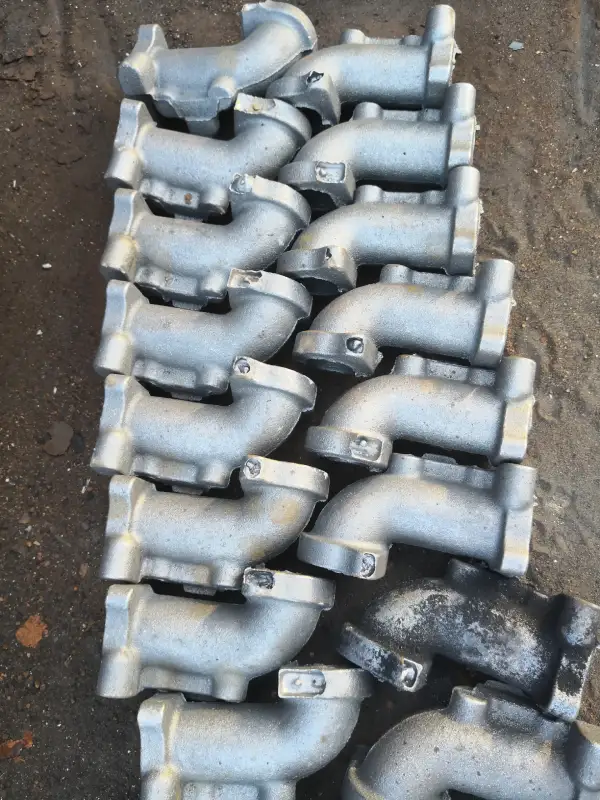
Utilizing resin sand casting to suppress core gas evolution
The use of advanced resin sand casting technology provides foundries with a method to effectively control gas release from molds during the pouring of high-temperature molten aluminum. Traditional green sand molds often release large amounts of moisture and organic vapors, which can easily diffuse into the cooling metal, leading to dangerous porosity. By switching to a chemically bonded sand system, it is possible to more strictly control the mold’s overall gas release and thermal stability. This material optimization significantly reduces the volume of gases generated during thermal decomposition and ensures that the sand casting process can produce complex automotive components with excellent subsurface cleanliness and free of gas-related defects.
Advantages of resin bound molds for intricate channels
Choosing a professional resin sand casting mold solution ensures exceptional dimensional stability when casting complex automotive water jackets and oil passages. Traditional sand mixtures are prone to erosion when subjected to the impact of high-velocity molten aluminum, which can lead to dimensional drift or the formation of sand inclusions. Resin-coated sand particles bond tightly after curing, forming mold walls with high tensile strength that can easily withstand physical erosion during the pouring process. Consequently, this strong bonding capability enables the sand casting process to produce ultra-thin, smooth internal passages that maintain precise dimensional accuracy even under severe thermal stress, without deformation.
Optimizing sand casting core binders for minimal emissions
Developing a low-emission sand casting core binder requires a careful balance between the organic resin content and the required mechanical strength. By mixing precisely proportioned low-volatilizable furan or cold-box resin at a ratio of less than 1.2% of the total sand weight, potential gas emissions can be minimized. Baking the cured cores in an industrial oven at 200°C effectively removes residual moisture and volatile chemicals prior to assembly. This rigorous preparation step prevents chemical vapors from being introduced into the molten alloy, thereby effectively eliminating porosity in the deep cavities of aluminum sand castings.
Designing active venting systems within heavy sand molds
Integrating a strategic sand casting core venting network into heavy-duty sand molds is critical for safely venting expansion gases from the mold. Before the compacted sand block sets, nylon vent tubes or wax threads are inserted directly into its center. When molten aluminum at high temperatures fills the mold, these wax channels melt away, leaving vent paths to the outside that direct gases away from the rising molten metal surface. This rapid pressure-relief mechanism prevents trapped air from breaking through the metal boundary, thereby ensuring that the resin sand casting process ultimately produces dense, uniformly dense castings.
Ищете надежный металлургический завод в Китае?
- We can help you optimize product design and save costs.
- Мы можем помочь вам с высоким качеством и большими объемами литые детали.
- Мы можем осуществить поставку вовремя и получить больше возможностей на рынке сбыта.
- Вы получите выгоду от Supro MFG литье металлов сервис.
Preventing aluminum sand casting shrinkage in heavy sections
When manufacturing large automotive structural components with varying wall thicknesses, controlling aluminum sand casting shrinkage is a fundamental challenge in engineering design. Aluminum alloys have a wide solidification range, which means the transition from liquid to solid occurs slowly, often resulting in microporosity or spongy volume defects in areas where cooling is slow. To counteract this natural shrinkage, casting engineers design precise gating systems that continuously feed molten metal into isolated thick-walled areas during the cooling process. By combining advanced solidification analysis tools with rigid resin sand литейные формы, it is possible to ensure that volumetric defects are completely kept away from the component’s critical load-bearing areas.
Implementing sequential solidification with strategic risers
To control aluminum sand casting shrinkage, a distinct temperature gradient must be established to promote sequential solidification of the molten aluminum from thin-walled areas toward thick-walled areas. Engineers position heat-insulating or exothermic risers directly above the thickest flanges of the powertrain housing, allowing them to act as reservoirs for molten metal. As the alloy contracts within the main cavity, these specially designed reservoirs transport molten metal to the lower portion of the mold to fill the newly formed voids. This strategic placement ensures that the casting process ultimately produces no internal voids and seals critical stress zones before the gates solidify and block the flow.
Utilizing localized chills to control alloy contraction
Placing metal cooling blocks directly into the resin sand casting mold helps accelerate the cooling rate of thick-walled areas that are difficult for the gate to reach. Molded iron or copper blocks are embedded into the sand surface so that they rapidly absorb heat upon contact with the molten metal. This localized cooling forces the thickest metal areas to solidify at the same rate as the surrounding thin-walled sections, thereby counteracting the tendency for localized shrinkage in the casting. Consequently, this balanced cooling distribution prevents localized tearing and controls structural deformation, ensuring that the finished casting maintains an ultra-high-density, uniform metal matrix.
Post-casting treatments for validating microstructural density
Verifying the density of complex sand-cast core components requires a combination of non-destructive radiographic testing and precision microscopic examination. By cutting specific test specimens from high-stress areas of the casting, it is possible to verify whether hidden microporosity remains after the molding process is complete. While the elimination of macroscopic porosity represents a significant advancement, optimizing internal grain boundaries is also necessary to achieve the longest fatigue life when the engine is subjected to heavy cyclic stresses. To unlock optimal mechanical properties following defect-free casting, learn about our approach to [Революция в термообработке песчаного литья для создания превосходных автомобильных конструкций].
Contact Supro MFG
This paper systematically analyzes the causes of casting porosity and shrinkage in safety-critical automotive aluminum castings produced via sand casting, along with strategies for controlling them. Porosity can be effectively suppressed by managing hydrogen solubility, optimizing degassing, and verifying the density index; shrinkage defects in thick, large-section castings can be significantly reduced through sequential solidification and the design of risers and chill blocks. At the same time, the use of low-emission resin sand casting, combined with active degassing and optimized sand casting core, can further ensure the internal quality of the castings.
With its extensive experience, Supro MFG can precisely eliminate critical defects to ensure that castings meet the most stringent Tier 1 automotive testing requirements. Looking for highly reliable casting solutions? Contact Supro MFG metallurgy and engineering experts today for a professional technical evaluation.
 English
 Čeština
 Français
 Deutsch
 Italiano
 日本語
日本語 한국어
한국어 فارسی
فارسی Polski
 Português de Angola
 Русский
 Slovenčina
 Español de Argentina
 Українська