
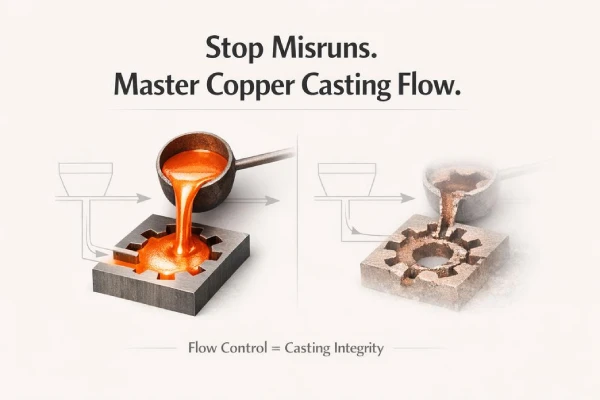
ریختهگری مس فرایندی بسیار چالشبرانگیز است که فلز مذاب را در دماهای بالا و در یک بازه زمانی محدود درگیر میکند؛ حتی کوچکترین انحراف در عملیات میتواند به نقصهای جدی منجر شود. وقتی خطاها یا تخلخل فرآیند تولید را مختل میکنند، پیامدها فراتر از اتلاف مواد اولیه رفته و شامل تأخیر در تحویل، اختلافات زنجیره تأمین و افزایش هزینهها میشوند. آنچه بیش از هر چیز خریداران را نگران میکند، عدم قطعیت نظری نیست، بلکه قطعات ریختهگریشده مسی هستند که قالب را پر نمیکنند، آببندی نمیشوند یا قابل تحویل نیستند.
“اکثر نقایص به کنترل جریان برمیگردند. یک مهندس ارشد فرآیند در شرکت Supro MFG در یک نشست توجیهی برای مشتریان در سال ۲۰۲۵ میگوید: ”و هندسه سیستم راهگاهی - نه خود آلیاژ». با بهینهسازی کانالهای جریان و تسلط بر طراحی قالب،, ریختهگری مس تولید میتواند از فرآیندی مملو از خطرهای تصادفی به یک فرآیند مهندسی قابل پیشبینی تبدیل شود.
این مقاله بهطور نظاممند پنج مورد اصلی را بررسی میکند. علل خطاهای ریختهگری مس. این فرایند که همه چیز را از طراحی قالب و انتخاب آلیاژ تا بهینهسازی دروازه و عملیات پس از ریختهگری در بر میگیرد، یک فرایند عملی را پیشنهاد میکند. راهکارهای کنترلی برای کمک به کارگاههای ریختهگری در بهبود فرآیند ریختهگری یکپارچگی و بازده تولید.
۵ علت اصلی نقصهای ریختهگری مس
در ریختهگری مس، حتی خطاهای جزئی—از آمادهسازی قالب ماسهای گرفته تا انتخاب آلیاژ—میتواند به سرعت به ضایعات قطعات مسی ریختهگریشده منجر شود. یک سیستم راهگاه نامتعادل، سیالیت ضعیف آلیاژ، سرعت نامناسب ریزش، یا گاززدایی ناکافی همگی میتوانند به نقصهای داخلی مانند پرشدگی ناقص و حفرهدار شدن منجر شوند. گنجاندن طراحی قالب، کنترل دما و تطبیق مواد در یک دستورالعمل یکپارچه برای فرآیند ریختهگری مس میتواند یکپارچگی ریختهگری را بهبود بخشد.
طراحی نامناسب قالب ریختهگری ماسهای
در ریختهگری آلیاژ مس، ماسه ناکافی طراحی قالب is the primary cause of misruns and internal defects. An unbalanced gating system and narrow runners restrict the flow of molten copper, while sharp bends induce turbulence and trap oxides. If the riser is too small, it cannot compensate for shrinkage during solidification, leading to internal porosity in the mold cavity. Furthermore, in the copper casting process, surface misalignment and insufficient support can cause core displacement, resulting in dimensional distortion.
علاوه بر این، مس مذابهای آلیاژی سیالیت کمتری نسبت به آلومینیوم دارند. Therefore, when the layout of a copper casting pouring system works against gravity rather than with it, gate defects and inclusions quickly become apparent. Automotive valve bodies and pump housings often fail inspection for this very reason. At Supro MFG, mold fluid simulation is an essential part of our مس [məs] خدمات ریختهگری، چرا که طراحی مناسب راهگاه و تغذیههای با اندازه مناسب به جریان روان و منظم فلز مذاب کمک میکنند.
دمای ریختهگری پایین در برنج و برنز
دمای ریختهگری پایین علت اصلی اشکالات پر شدن در ریختهگریهای برنج و برنز است. وقتی دمای اضافی فلز مذاب ناکافی باشد، سیالیت آن کاهش مییابد که به نوبه خود بر کیفیت ریختهگری مس با دیواره نازک تأثیر میگذارد قطعات. پیامدهای رایج شامل معیوب بودن گیتها میشود جایی که فلز به محل مورد نظر نمیرسد، بستههای سرد قابل مشاهده، و زبری سطح ناشی از جام شدن زودرس.
در عملیات روزمره ریختهگری مس، بهویژه هنگام تولید کانکتورهای الکتریکی یا قطعات مبدل حرارتی، کنترل دقیق ورودی حرارت برای برنج و برنز ضروری است. اگر دما بیش از حد پایین باشد، فلز در حین جریانیافتن منجمد میشود؛ اگر بیش از حد بالا باشد، ساختار دانهای آسیب میبیند. حتی اندکی افت دما در حین ریختن میتواند منجر به پرنشدن کامل قالب شود. راه حل در نظارت لحظهای بر مس مذاب و رویههای ریختهگری استاندارد نهفته است.
انتخاب نامناسب آلیاژ: مس خالص در برابر برنز فسفرور
در ریختهگری مس، انتخاب نامناسب آلیاژ میتواند خطر اشکالات ریختهگری را افزایش دهد. اگرچه مس خالص رسانایی الکتریکی بالا و مقاومت عالی در برابر خوردگی دارد، اما قابلیت ریختهگری ضعیف و استحکام و مقاومت سایشی پایینی دارد که میتواند بهراحتی منجر به مشکلات داخلی شود. عیوب در ریختهگری. از سوی دیگر، برنز فسفر خواص مکانیکی و مقاومت در برابر سایش را بهبود میبخشد و انعطافپذیری بیشتری نسبت به بسیاری از مواد دیگر ارائه میدهد. آلیاژهای ریختهگری, ، اما رسانایی الکتریکی آن کمتر از مس خالص است.
In copper castings for marine hardware or industrial bushings, phosphor bronze typically performs better than pure copper. It retains its shape even when subjected to friction and loads. At the same time, cast copper used for electrical terminals may prioritize electrical conductivity over strength.
Choosing the wrong casting alloy can affect not only performance but also the filling behavior of the mold. Certain copper alloys offer better fluidity and more predictable shrinkage behavior. Supro MFG helps customers match material properties to actual operating conditions during the copper casting process, rather than relying solely on specifications in product catalogs.
Insufficient Pour Rate in Investment Casting
In ریختهگری دقیق, an insufficient pouring rate can compromise the integrity of the copper casting process, leading to misruns. After the mold has been preheated and the molten metal begins to flow into the ceramic shell, if the pouring rate is too slow, the molten copper will cool prematurely, causing the mold filling to be interrupted and resulting in cold shuts or misruns.
Although slow pouring is safe, in copper casting, because molten copper and copper alloys cool rapidly, hesitation during pouring can increase turbulence and cause localized solidification in thin-walled areas. At the same time, pouring too quickly can also cause turbulence and lead to the formation of oxides. The optimal pouring speed depends on the casting’s geometry, wall thickness, and gate design. For precision bathroom fixtures and complex decorative cast copper parts, controlling the pouring speed is just as important as the alloy composition.
Lack of Venting and Gas Entrapment
In copper casting, insufficient degassing is the primary cause of porosity defects. Low permeability of the sand, blocked vent holes in the cores, or excessive binder content can all lead to gas accumulation in the mold, resulting in internal porosity or surface blowholes. During the pouring process, air and decomposition gases must escape from the mold cavity. If they cannot escape, gas pores will form, creating round voids that weaken tensile strength. For copper alloy castings subjected to pressure, this poses a serious risk.
Radiographic testing often reveals porosity defects in copper castings that are invisible to the naked eye. Once porosity extends into load-bearing areas, repair options are extremely limited. Effective venting designs, sand systems with good permeability, and unobstructed vent channels in the cores are practical solutions. Copper casting foundries like Supro MFG, which specialize in producing high-quality castings, consider gas control to be a critical component of mold engineering.
It is the subtle details of the process that determine the final quality of copper castings. Only when mold design, alloy selection, temperature, pouring speed, and venting measures are perfectly coordinated can cast copper parts achieve a smooth, dense surface and perform reliably in practical applications.
Why do defects often occur in metal parts during copper casting?
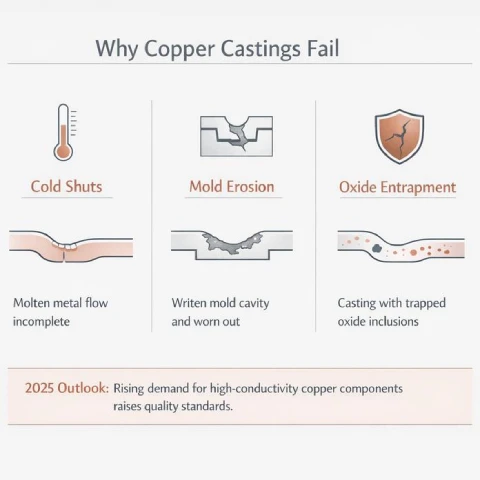
Misruns occurring during the copper casting process can lead to quality losses. Even with repeated adjustments to the molds and strict control of the molten metal, a significant amount of scrap may still result. From poor flow of the copper alloy to surface defects on the castings, even minor deviations in the production process can trigger a series of technical challenges. This article will provide a detailed analysis of the causes of defects in copper cast parts and discuss how stricter control of the casting process can ensure smooth production.
Cold Shuts from Poor Thermal Conductivity
In copper casting, high thermal conductivity causes the molten metal to cool rapidly. When the solidification rate exceeds the flow rate of the metal, cold shuts occur. Specifically, when the mold temperature is too low or the ضخامت دیوار is designed too thin, the molten alloy rapidly loses heat. This causes a semi-solid skin to form on the leading edges of the two metal streams before they meet inside the mold cavity, resulting in a fragile bond line that fails to achieve complete fusion. Furthermore, low pouring temperatures and the inherently poor flowability of copper alloy castings further increase the risk of cold shuts.
Optimizing the ریختهگری مس process requires controlled preheating of the molds, strict monitoring of pouring temperatures, and the completion of flow simulation analyses prior to mass production. Professional copper casting foundries, such as Supro MFG, ensure that every casting is free of cold shuts and improves its integrity through systematic casting services.
Mold Erosion in High-Volume Production
High-volume copper casting places extremely high demands on molds; however, rapid cycle times, high-temperature bronze molten metal, and prolonged continuous production can cause severe mold wear. Mold erosion is caused by the turbulent injection of molten metal. Repeated impacts accelerate mold wear, and after multiple casting cycles, surface degradation occurs at the gates and sharp corners. A rough mold cavity directly leads to sand adhesion on castings and dimensional deviations.
In sand casting, poor-quality mold materials wear out more quickly. In metal molds, poor heat dissipation shortens mold life. Supro MFG ensures the stable operation of copper casting production lines by optimizing gate design and balancing flow rates, thereby preventing dimensional accuracy issues caused by high-volume casting.
Oxide Film Entrapment in Permanent Mold Casting
In the permanent mold process for copper casting, oxide film inclusions can significantly reduce the ductility of copper alloy parts. When molten copper comes into contact with air, a thin oxide film forms; turbulent pouring folds this film inward, causing entrapped gas, which then forms internal inclusions and visible surface defects.
The International Copper Study Group noted in its 2025 market outlook that rising demand for high-conductivity copper components in energy and marine sectors is increasing quality expectations for casting processes.
Better melt quality, smoother flow, and a controlled pouring rate ensure a smooth surface finish for copper قطعات ریختهگری فلزی. In short, handling molten copper with care is always more reliable than any quick fix.
به دنبال یک ریختهگری فلز قابل اعتماد در چین هستید؟
- ما میتوانیم به شما در بهینهسازی طراحی محصول و کاهش هزینهها کمک کنیم.
- ما میتوانیم با کیفیت بالا و حجم زیاد به شما کمک کنیم اجزای گچگرفتگی.
- ما میتوانیم به موقع تحویل دهیم و فرصتهای بازار فروش بیشتری به دست آوریم.
- You will benefit from Supro MFG ریختهگری فلزات service.
Overcome Poor Filling Through Optimal Riser Placement in Copper Casting
Poor filling in copper casting can severely affect strength, surface finish, and delivery times. In copper casting projects, proper gate placement and pouring design ensure that the molten copper flows to the intended locations. With the right strategy in place, the defect rate of castings can be rapidly reduced.
Choosing Riser Types for Beryllium Copper
When using beryllium copper alloys for copper casting, the selection of the sprue must be based on solidification behavior to ensure casting integrity.
The rationale for sprue selection is as follows:
- Open sprues facilitate visual monitoring of molten metal flow and are suitable for sand-molded copper casting processes.
- Blind sprues reduce the risk of oxidation and are more suitable for closed-mold materials.
In terms of geometry, cylindrical risers provide stable metal flow efficiency, while conical designs help guide directional solidification.
Performance testing should focus on tensile strength retention, X-ray porosity, and grain flow consistency.
At Supro MFG, engineers select the appropriate riser type based on the shrinkage rate of the مس [məs] alloy casting to ensure a short pouring path and uniform thermal gradients.
Calculating Riser Volume in Continuous Casting
During the continuous casting of copper ingots, ensuring that the copper casting remains free of porosity during long production runs requires following a verifiable adjustment process. The first step is to calculate the riser volume, based on the solidification modulus and actual casting parameters. Key variables include the cross-sectional thickness of the casting, the target feeding efficiency, the measured temperature gradient, and the flow state of the molten metal.
Second, the adjustment process for optimizing the copper casting process is as follows:
Step A: Calculate the casting modulus.
Step B: Multiply by a safety factor of 1.2–1.4 to compensate for shrinkage.
Step C: Verify through thermal simulation.
The following is a reference table for copper casting riser dimensions:
Section Thickness (mm) | Solidification Modulus (cm) | Recommended Riser Volume (cm³) |
20 | 0.45 | 180 |
40 | 0.80 | 520 |
60 | 1.10 | 1100 |
Integrating CAD/CAM Services for Optimal Risers
Digital tools provide precise solutions for sprue optimization in copper casting. CAD software is used to design sprue layouts and control neck dimensions. Casting simulation tracks the flow analysis of the copper casting process and predicts hot spot locations. CAM integration adjusts machining allowances to improve manufacturing efficiency.
“Simulation-driven casting design can reduce defect rates by over 30% while shortening development cycles,” notes a 2025 SmarTech Analysis report on digital manufacturing trends.
By leveraging virtual prototyping and design automation technologies, Supro MFG reduced the number of test castings and ensured that the copper casting project proceeded according to schedule.
Post-Casting Machining Considerations for Riser Removal
After copper casting is complete, cleaning and removing the sprue helps ensure surface quality and dimensional accuracy. Sprue removal must follow a rigorous process. First, the sprue is cut using a controlled machining process, with carbide cutting tools selected based on the properties of the copper alloy. This is followed by grinding and deburring to eliminate defects at the joint.
Key inspections include flatness tolerance checks, heat-affected zone inspections, and final dimensional scanning. However, it is important to avoid hasty removal of the sprue, maintain consistent cooling, and adjust tool speed according to the alloy’s hardness. Rigorous post-casting operations result in lower scrap rates, more precise fit, and smoother assembly in every copper casting production run.
Contact Supro-Mfg
Defects in copper casting, such as short shots and porosity, are primarily caused by improper mold design, inappropriate alloy selection, inaccurate temperature control, and insufficient venting. By optimizing gate layout, implementing CAD/CAM simulations, and strictly controlling pouring speed and post-casting processing, the integrity of castings can be systematically improved. A professional copper casting foundry should establish comprehensive process specifications to ensure that high casting yield becomes the norm rather than the exception.
 English
 Čeština
 Français
 Deutsch
 Italiano
 日本語
日本語 한국어
한국어 فارسی
فارسی Polski
 Português de Angola
 Русский
 Slovenčina
 Español de Argentina
 Українська